Stacking of resistance loci to give full resistance to higher - - PowerPoint PPT Presentation
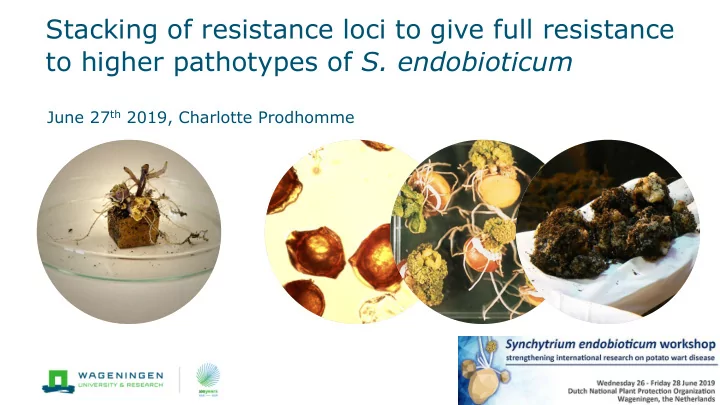
Stacking of resistance loci to give full resistance to higher pathotypes of S. endobioticum June 27 th 2019, Charlotte Prodhomme Inventory of resistances known so far 1999: 1 st mapping of Sen1 (Hehl et al ., 1999) Adapted from Obidiegwu et al .,
Inventory of resistances known so far
2 Adapted from Obidiegwu et al., 2015
1999: 1st mapping of Sen1 (Hehl et al., 1999) 2011: Mapping of several QTLs (Ballvora et al., 2011) 2013: Mapping of several QTLs (Groth et al., 2013) 2006: Mapping of Sen1-4 (Brugmans et al., 2006) 2015: Mapping of several QTLs (Obidiegwu et al., 2015) 2018: Mapping of Sen2 (Plich et al., 2018)
Sen2
2018: Mapping of Sen3 (Bartkiewicz et al., 2018 ;
Prodhomme et al., 2019) Sen3
> Qualitative and quantitative resistance loci identified > Broad / specific spectrum of resistance How to use these resistance loci in breeding? What is the pathotype R spectrum for Q management?
Population segregating for pathotypes 2, 6 and 18 resistance
3
Resistant parent Kuba P1, 2, 6, 18 Susceptible parent Ludmilla P1
n = 328
20 40 60 80 100 120 140 160 [1 - 1.5[ [1.5 - 2[ [2 - 2.5[ [2.5 - 3[ [3 - 3.5[ [3.5 - 4[ [4 - 4.5[ [4.5 - 5] P2 P6 P18
R S
Glynne-Lemmerzahl
Bimodal distribution of resistance to pathotypes 2, 6 and 18 > P18 resistance skewed toward susceptibility
Segregating ratio χ2 χ2 test significance P2 (G1) 1:1 0.30 ns P6 (O1) 1:1 1.48 ns P18 (T1) 1:1 30.49 ***
Prodhomme et al., 2019 (Plant Methods)
Principal Component Analysis of phenotypes
4
Individuals fully resistant to P2, P6 and P18 n = 67 Individuals fully susceptible to P2, P6 and P18 n = 170 Individuals fully resistant to P2 and P6, weaker resistance to P18 n = 93 50% 50%
Hypothesis about the R loci segregating
5
1/ There is one gene (or several tightly linked
genes) giving full resistance to P2 and P6
and partial resistance to P18 1:1 segregation ratio 2/ One or several other loci are required by the first gene to bring full resistance to P18 50% 50%
Strategy to identify the R loci segregating
6
Major gene + P18 R loci Major gene Major gene P18 R loci? Whole Genome Sequencing of the three bulks + 2 parents P2P6-R- bulk P2P6P18
- R-bulk
S-bulk
Comparative Subread Sets Analysis = CoSSA
7
Whole Genome Sequencing
ACGTGATGACGTGACGTACCGG… ACGTG CGTGA GTGAT TGATG GATGA ATGAC K-mer analysis in each sample = quick and easy comparisons Reads Subreads = k-mers
Prodhomme et al., 2019 (Plant Methods)
S-bulk R-bulk R-P2P6- bulk
Whole Genome Sequencing
CoSSA method to identify sequence variants linked to the major gene segregating
8
P2P6P18-R-bulk S-bulk
k-mers k-mers k-mers k-mers k-mers k-mers k-mers k-mers k-mers k-mers k-mers k-mers
Major gene + P18 R loci Major gene P18 R loci? Major gene (+ P18 R loci?)
Inheritance of resistance specific variants
9
Ludmilla Kuba
Mapping of the subreads to the potato reference genome
Subread mapping reveals a single locus for P2, P6, P18 resistance
10
a) R-genes in the reference genome (Jupe et al., 2013)
b) R-bulk specific k-mers from Kuba c) R-bulk specific k-mers from Ludmilla d) R-bulk specific k-mers from both parents
Prodhomme et al., 2019 (Plant Methods)
11
Design of KASP markers to validate Sen3
Prodhomme et al., 2019 (Plant Methods)
Jupe et al., 2013
12
Effect of chr11_1519485 on P18 resistance
R S
P2 P6 P18
CoSSA method to identify sequence variants linked to the P18 R loci segregating
13
P2P6P18-R-bulk R-P2P6-Bulk R-P2P6-Bulk
R-P2P6-bulk Major gene + P18 R loci Major gene Major gene + P18 R loci
Inheritance of resistance specific variants
14
Ludmilla Kuba
Mapping of the subreads to the potato reference genome
Subread mapping reveals several loci for P18 resistance
15
a b c d
a) R-genes in the reference genome (Jupe et al., 2013)
b) R-bulk specific k-mers from Kuba c) R-bulk specific k-mers from Ludmilla d) R-bulk specific k-mers from both parents
Validation experiment with KASP markers
16
Interaction Sen3 * chr8 p-value = 0.00974**
Pathotype 2 Pathotype 6 Pathotype 18
Chr02_30 ns ns ns Chr02_32 ns ns ns Chr05_8 ns ns ns Chr06_25 ns ns ns Chr07_10 ns ns ns Chr07_41 ns ns ns Chr08_44 ns ns 0.03401 Chr08_45 ns ns 0.04718 Chr11_1259552 < 2.2e-16 < 2.2e-16 < 2.2e-16 Chr11_1519485 < 2.2e-16 < 2.2e-16 < 2.2e-16 Chr11_1666090 < 2.2e-16 < 2.2e-16 < 2.2e-16
Sen3
Effect of the chr8 locus on P18 resistance
17
Ludmilla Kuba
R S
Pathotype 18 resistance
3 CNL clusters:
- Clusters 59, 60 and 61
- Rpi-blb1, Rpi-pta1,
Rpi-sto1
Jupe et al., 2013
chr8 No QTL Sen3 + chr8 Sen3
One isolate = several genotypes
18
van de Vossenberg et al., 2018
› Mitochondrial genome sequencing revealed an intra- isolate variation. › Higher diversity observed for isolates from P8, P18, P38. > Intra-isolate diversity can explain the strong or weak effect of the R loci mapped
Use of only one R gene (Sen3)
19
Sen3 SenChr8 AvrSen3 AvrSen Chr8
Incomplete resistance Pathotype 18 population New pathotype population
20
Use of only one R gene (Sen3)
Sen3 SenChr8 AvrSen3 AvrSen Chr8
New pathotype population Susceptibility
Stack of R genes (Sen3 + chr8)
21
Sen3 SenChr8 AvrSen3 AvrSen Chr8
Complete resistance Pathotype 18 population
- Diversity of S. endobiodicum populations causal to partial
resistance:
- Complex populations can only be contained by broad
spectrum R genes or R gene stacks
- More research should be performed on identifying R loci to less
frequent S. endo genotypes:
- How to identify such loci? How to design diagnostic
markers for a use in MAS?
Take home messages
22
Phenotype the segregating population with the “trained” pathotype
23
Use the pathotype 18 population that was multiplied on Sen3 genotypes enrichment
- f the S. endobioticum genotypes
recognised by the chromosome 8 QTL Re-phenotype the K x L population with the “trained” P18 Stronger effect of chr8 QTL / weaker effect
- f Sen3 on P18 resistance unambiguous
phenotypes mapping and fine-mapping
Acknowledgements
24
Wageningen University and Research Plant Breeding Jack Vossen Herman van Eck Richard Visser Danny Esselink Gert van Arkel Linda Kodde Theo Borm Dirk-Jan Huigen Marjan Bergervoet Biointeractions Theo vd Lee Bart vd Vossenberg Consortium Partners TKI T&U
This project is financially supported by the Dutch Topsector Horticulture & Starting Materials. Within the Topsector, private industry, knowledge institutes and the government are working together on innovations for sustainable production of safe and healthy food and the development of a healthy green environment.