Sta tabil ility ity of reli lic meth thane hydrate tes at clim - - PowerPoint PPT Presentation

sta tabil ility ity of reli lic meth thane hydrate tes at
SMART_READER_LITE
LIVE PREVIEW

Sta tabil ility ity of reli lic meth thane hydrate tes at clim - - PowerPoint PPT Presentation

Sta tabil ility ity of reli lic meth thane hydrate tes at clim climatic tic changes in in th the Holocene Arzhanov M.M., Malakhova V.V., Mokhov I.I., Parfenova M.R. Main in r research ch dir irect ctio ions: s: In recent


slide-1
SLIDE 1

Sta tabil ility ity of reli lic meth thane hydrate tes at clim climatic tic changes in in th the Holocene

Arzhanov M.M., Malakhova V.V., Mokhov I.I., Parfenova M.R.

Main in r research ch dir irect ctio ions: s:

  • Modeling of the thermal regime of the soil;
  • Analysis of the dynamics of permafrost under

climate changes in the Holocene;

  • Analysys of the gas hydrates stability.

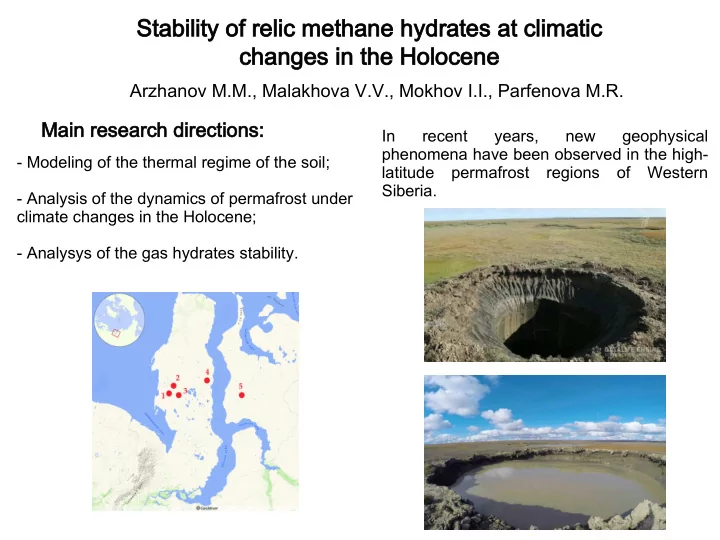
In recent years, new geophysical phenomena have been observed in the high- latitude permafrost regions of Western Siberia.

slide-2
SLIDE 2
  • Model of thermal processes in the soil [Malakhova and Eliseev, 2017]
  • External atmospheric forcing based on

Global climate model CLIMBER-2 [Ganopolski et al., 2010]

  • Heotermal flux 0.06 W m-2 [Davies, 2013]

Current regional warming may exceed the magnitude of the Holocene optimum warming.

Numerical e l experiments ts

year

Air temperature in Yamal region Air temperature anomalies in Yamal region [Ganopolski et al., 2010]

slide-3
SLIDE 3

Modeli ling o

  • f th

f the th thermal r regim ime o

  • f th

f the s soil

Soil temperature, oC

depth, m x103 years depth, m T,

  • C

The results obtained indicate that at present time, stable and relict methanhydrates might have persisted at negative temperatures below -7 °С for the last 10 thousand years, including the optimum Holocene preiod, and still might exist in the frozen soil

  • f Yamal at depths of up to 150 m, which is above the modern boundary of the

stability zone. The disruption of their stability might be a consequence of ongoing climate change.