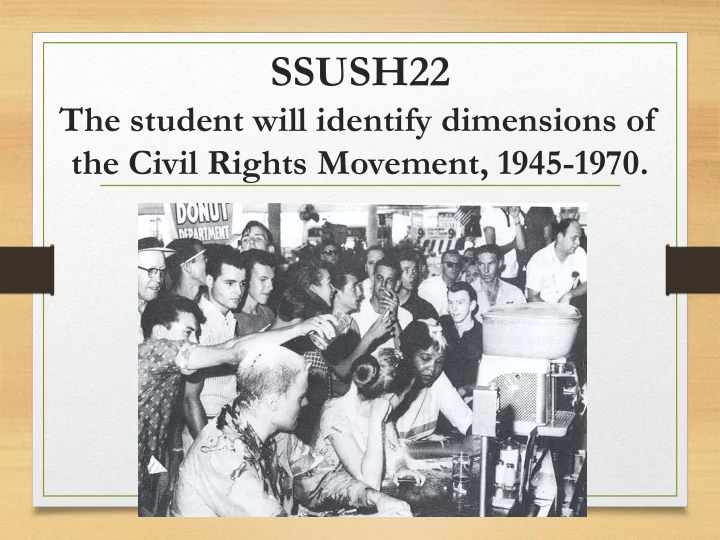
SSUSH22 The student will identify dimensions of the Civil Rights - - PowerPoint PPT Presentation

ssush22
SMART_READER_LITE
LIVE PREVIEW

SSUSH22 The student will identify dimensions of the Civil Rights - - PowerPoint PPT Presentation

SSUSH22 The student will identify dimensions of the Civil Rights Movement, 1945-1970. a. Explain the importance of President Trumans order to integrate the U.S. military and the federal government. Pres. Truman put his career on the line


slide-1
SLIDE 1

SSUSH22

The student will identify dimensions of the Civil Rights Movement, 1945-1970.

slide-2
SLIDE 2
  • a. Explain the importance of President Truman’s
  • rder to integrate the U.S. military and the federal

government.

  • Pres. Truman put his career on the line for civil

rights.

  • Congress would not pass any of his civil rights

measures.

  • Acting on his own, in 1948, he issued an executive
  • rder to desegregate the armed forces.
  • He also ordered an end to discrimination in hiring

government employees.

slide-3
SLIDE 3
  • b. Identify Jackie Robinson and the

integration of baseball.

  • "Jackie" Robinson was the first African-American Major League

Baseball player of the modern era.

  • Robinson became the first African American in the 20th century to play

baseball in the major leagues -- breaking the "color line“, a segregation practice dating to the nineteenth century.

  • Jackie Robinson was an extremely

talented multi-sport athlete and a courageous man who played an active role in civil rights.

slide-4
SLIDE 4
  • c. Explain Brown v. Board of Education and

efforts to resist the decision.

  • In this case, the Supreme Court ruled that separate schools

for whites and blacks were unequal – and thus unconstitutional.

  • Some Southern communities refused to accept the Brown
  • decision. In 1955, the Supreme Court handed town a second

Brown ruling. It ordered schools to desegregate more quickly.

slide-5
SLIDE 5
  • The school desegregation issue

reached a crisis in 1957 in Little Rock, Arkansas.

  • The state’s governor refused to let 9 black students attend

Little Rock Central High School.

  • President Eisenhower sent in federal troops to allow the

students to enter the school.

slide-6
SLIDE 6
  • d. Describe the significance of Martin

Luther King, Jr.’s Letter from a Birmingham Jail and his I Have a Dream Speech.

“Letter from Birmingham Jail” by Martin Luther King, Jr.

  • MLK, Jr. (1929-68) was a Baptist minister and became the

first president of the Southern Christian Leadership Conference (SCLC), which was one of the principal

  • rganizations of the civil rights movements in the US.
  • He advocated nonviolent resistance to patterns of racial

injustice and was awarded the Nobel prize for peace in 1964.

slide-7
SLIDE 7
  • During a series of illegal

(because a parade permit was denied his group) demonstrations in 1963 protesting the segregation of many public facilities in Birmingham, King was arrested and sent to jail.

  • He wrote a letter from his jail cell

to local clergymen who had criticized him for creating disorder in the city.

  • School children were asked to

participate in the demonstration.

  • Organizers felt this may

deter officials from opening fire hoses and releasing dogs on demonstrators.

slide-8
SLIDE 8
  • His “Letter from Birmingham City Jail,” argued that individuals

had the moral right and responsibility to disobey unjust laws.

  • The letter was widely read at the time and added to Kings

standing as a moral leader.

  • National reaction to the Birmingham violence built support for

the struggle for black civil rights.

  • Presents the question, however, of who/what determines

“unjust” laws? And, when is it, if ever, permissible to disobey a law, whether perceived “unjust” or not?

slide-9
SLIDE 9

“I Have A Dream”

  • On August 28, 1963, more than 250,000 people, a fifth of

them white, gathered near the Lincoln Memorial in Washington to rally for "jobs and freedom."

  • Dr. Martin Luther King Jr. had originally prepared a short

speech.

  • He was about to sit down when gospel singer Mahalia Jackson

called out, "Tell them about your dream, Martin! Tell them about the dream!“

  • In his speech, King asked for peace and racial harmony.
slide-10
SLIDE 10
  • e. Describe the causes and consequences of the Civil

Rights Act of 1964 and the Voting Rights Act of 1965.

  • President Kennedy (D) was

assassinated in November of 1963, and many worried that the push for a civil rights bill would die with him

  • Vice-President Lyndon Johnson

(D), from Texas (a Southern state) was sworn in as President

Why would civil right leaders be concerned that a Southern Democratic President wouldn’t help their cause?

slide-11
SLIDE 11

Causes and Consequences of the Civil Rights Act of 1964

  • The growing civil rights movement impressed

President Kennedy so much that he became convinced that the nation needed a new civil rights law.

  • Kennedy called on Congress to pass a sweeping civil

rights bill.

  • This bill outlawed discrimination based on race,

religion, national origin, and gender.

  • It also gave govt. more power to push for school

segregation.

  • The Act was signed into law by President Johnson.
slide-12
SLIDE 12

Causes and Consequences of the Voting Rights Act of 1965

  • In 1965, Civil rights workers attempted a voting project

in Selma, Alabama.

  • They were met with violent resistance.
  • As a result, MLK, Jr. led a massive march through
  • Alabama. Pres. Johnson responded by asking Congress

to pass a new voting rights act.

  • Congress passed the Voting Rights Act of 1965.
  • The law eliminated state laws that had prevented African

Americans from voting, like literacy test & poll taxes