
SLIDE 1
SSUSH15: H15: The e stu tudent ent wil ill l analy alyze ze th the e
- r
- rigins
gins and d impa pact ct of
- f U.S
SSUSH15: H15: The e stu tudent ent wil ill l analy alyze ze - - PowerPoint PPT Presentation
SSUSH15: H15: The e stu tudent ent wil ill l analy alyze ze th the e origins or gins and d impa pact ct of of U.S .S. . involvement volvement in Wo World ld Wa War I. a. Describe the movement from U.S. neutrality to
“We must be impartial in thought as well as in action.”
underwater or machine guns on deck to sink ships.
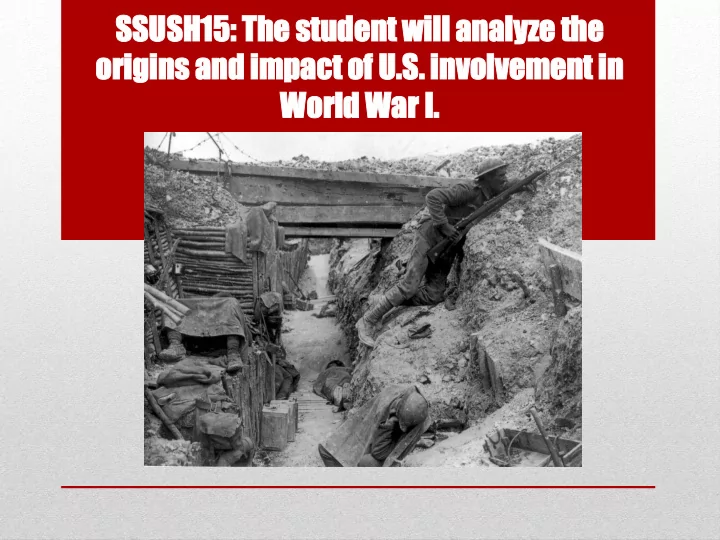
Trench Warfare
Trench Warfare
Trench Warfare
Trench Warfare
An infection of the feet caused by cold, wet and unsanitary conditions. In the trenches men stood for hours on end in waterlogged trenches without being able to remove wet socks or boots. The feet would gradually go numb and the skin would turn red or blue.
When America entered World War I in 1917, Congress passed a law called the Espionage Act. The law said that during wartime obstructing the draft and trying to make soldiers disloyal or disobedient were crimes. Almost 2,000 people were accused of violating this law and were put on trial. Charles Schenck was against the war. He mailed thousands of pamphlets to men who had been drafted into the armed forces. These pamphlets said that the government had no right to send American citizens to other countries to kill people. The government accused Schenck of violating the Espionage Act. It said that Schenck's pamphlets were intended to weaken the loyalty of soldiers and to obstruct military recruiting. Schenck answered by saying that the Espionage Act was unconstitutional. Justice Holmes admitted that "in many places and in ordinary times" Schenck would have had a right to say everything that he said in his pamphlets. However, he said that how far a person's freedom of speech extends depends on the circumstances. "The most stringent protection of free speech," he said, "would not protect a man in falsely shouting fire in a theatre and causing a panic." Justice Holmes compared that circumstance to living in a nation at war. "When a nation is at war," he said, "many things that might be said in time of peace are such a hindrance to its effort that their utterance will not be endured so long as men fight and that no Court could regard them as protected by any constitutional right."
Which country is missing from the meeting? Why is this important?
Wilson presented his plan for peace, called the Fourteen Points to Congress.
member countries.
Germany
Germany for “starting” the war.
they did not have)
Most of Wilson’s Fourteen Points were dismissed by the other leaders, with the exception of the Fourteen Point.
Prohibition, and the Nineteenth Amendment, establishing woman suffrage.
Supporters of prohibition thought that it would reduce unemployment, domestic violence, and poverty. Which groups of people do you think supported prohibition?
Why do you think the 18 Amendment was so difficult to enforce?