SSL Pricing and Efficacy Trend Analysis for Utility Program Planning - - PowerPoint PPT Presentation

ssl pricing and efficacy trend analysis for utility
SMART_READER_LITE
LIVE PREVIEW

SSL Pricing and Efficacy Trend Analysis for Utility Program Planning - - PowerPoint PPT Presentation

SSL Pricing and Efficacy Trend Analysis for Utility Program Planning Jason Tuenge Northwest Power and Conservation Council Pacific Northwest National Laboratory Conservation Resources Advisory Committee meeting November 21, 2013 1 Background


slide-1
SLIDE 1

1

SSL Pricing and Efficacy Trend Analysis for Utility Program Planning

Jason Tuenge

Pacific Northwest National Laboratory Conservation Resources Advisory Committee meeting November 21, 2013
Northwest Power and Conservation Council

slide-2
SLIDE 2

2

Background

  • April 2012 TINSSL Utility Planning Roundtable
  • Roadmap needed to forecast when important SSL product applications

will become cost‐effective, looking 2‐3 years out

  • Price and performance projections
  • Provide time for planning
  • Enable prioritization by application or product category
  • Inform delivery and education approaches
  • Allow estimation of energy savings potential and appropriate incentive

levels to overcome price barriers

  • DOE viewed as a credible source of such data for regulatory review
slide-3
SLIDE 3

3

Background

  • October 2013 report
  • Informed by additional input from Advisory Task Force
  • Appropriate type/timing/magnitude of energy efficiency activities will

vary from organization to organization

  • Price is a primary barrier
  • Focused on category‐specific projections of pricing and efficacy
  • Cost‐effectiveness beyond scope
  • Historical data from
  • CALiPER
  • LED Lighting Facts (LF)
  • ENERGY STAR (ES)
  • DesignLights Consortium (DLC)
  • To serve as a starting point…
slide-4
SLIDE 4

4

SSL energy savings potential

LED market penetration and savings potential in key categories Category Savings potential in 2012 (TWh) Penetration in 2012 (%) Installed base in 2012 (million units) Troffers et al. 110.4 < 0.1 0.7 A lamps 79.1 < 1 19.9 High‐bay luminaires 46.5 < 1 0.3 Decorative lamps 28.7 < 1 4.7 Downlights 26.8 < 1 5.5 Parking lot luminaires 20.4 1 0.2 Parking garage luminaires 15.3 1 0.4 Streetlight luminaires 22.9 2 1.0 Directional lamps (PAR, BR, R) 16.7 4.6 11.4 MR16 lamps 6.2 10 4.8 Adoption of Light‐Emitting Diodes in Common Lighting Applications (April 2013) www.ssl.energy.gov/tech_reports.html

slide-5
SLIDE 5

5

LED efficacy trends: Omnidirectional lamps

slide-6
SLIDE 6

6

LED efficacy trends: Directional lamps (PAR‐BR‐R)

slide-7
SLIDE 7

7

LED efficacy trends: Troffer luminaires

slide-8
SLIDE 8

8

LED efficacy trends: Streetlight luminaires

slide-9
SLIDE 9

9

LED pricing trends

  • Scoured CALiPER data for product categories meeting criteria
  • Substantial number of models for which purchase date, purchase

price, and measured lumens could be determined

  • Rated life was not considered in this analysis
  • Purchases dispersed fairly well over time
  • Substantial span between oldest and most recent
  • CALiPER datasets meeting criteria
  • Omnidirectional lamps
  • Decorative lamps
  • Directional lamps (PAR‐BR‐R and MR16)
  • Troffer luminaires
  • Supplemented by Seattle City Light (SCL) streetlight luminaires
  • Projections using least‐squares regression fits to power

mathematical models based on historical product data

slide-10
SLIDE 10

10

LED pricing trends: Omnidirectional lamps

slide-11
SLIDE 11

11

LED pricing trends: Directional lamps (PAR‐BR‐R)

slide-12
SLIDE 12

12

LED pricing trends: Troffer luminaires

slide-13
SLIDE 13

13

LED pricing trends: Streetlight luminaires

slide-14
SLIDE 14

14

LED pricing trends—normalized to January 1, 2008

slide-15
SLIDE 15

15

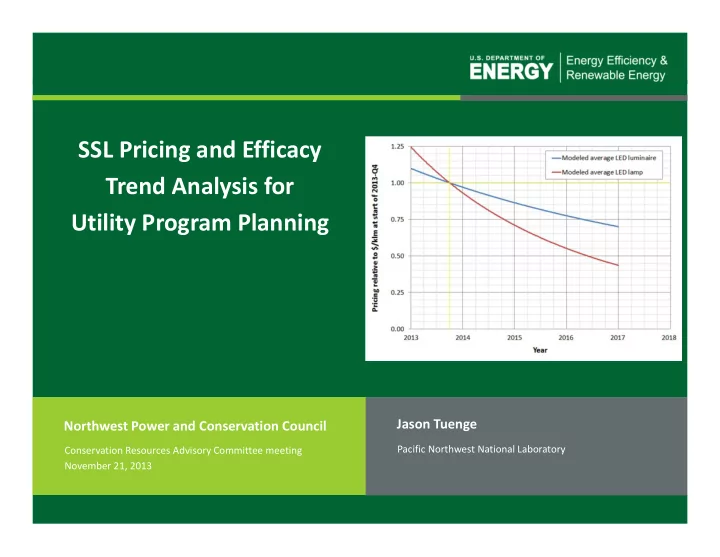
LED pricing trends—normalized to October 1, 2013

slide-16
SLIDE 16

16

LED pricing trends: Example projection

  • September 2013 LED directional lamp pricing from major retailers
  • Ace Hardware, Best Buy, The Home Depot, Lowe’s, Sears, True Value
  • No adjustment for possible upstream incentives
  • Cree, EcoSmart, Feit, GE, Insignia, LSGC, Philips, Samsung, Sylvania,

Utilitech, and TCP

  • CCT of 2700‐3000 K
  • CRI and ENERGY STAR certification not consistently indicated
  • Strong relationship between price and output—and diameter
  • Similar relationship observed for omnidirectional and decorative
slide-17
SLIDE 17

17

LED pricing trends: Example projection

slide-18
SLIDE 18

18

LED pricing trends: Example projection

Brand < 3” diameter > 3” diameter Lowest pricing ($/klm) Efficacy (lm/W) Lowest pricing ($/klm) Efficacy (lm/W) A 28 56 22 62 B 44 56 24 72 C 69 57 25 61 D 30 50 25 64 E 49 56 27 61 F 57 67 27 58 G * * 27 61 H 50 55 28 55 I * * 31 68 J 46 50 36 70 K 67 66 42 54 L 56 49 45 51 Mean 50 56 30 61 * No model available for this brand at these retailers.

slide-19
SLIDE 19

19

LED pricing trends: Example projection

Lamp diameter $/klm pricing at beginning of year 2014 2015 2016 2017 < 3 inch 47 36 28 22 > 3 inch 28 21 17 13

  • Applied current values to normalized lamp curve for projections
slide-20
SLIDE 20

20

Key findings

  • Projected average efficacies are below 2017 targets, but leading

products might still reach these goals on or ahead of schedule

  • In several key LED product categories, projected efficacies based on

LED Lighting Facts listings are substantially higher than projections based on the corresponding ENERGY STAR or DLC listings

  • Historical data indicates two distinct normalized curves—one for

LED lamps, and one for LED luminaires—can be used to make projections from current $/klm pricing for a given product category

  • LED lamp $/klm pricing is expected to decrease roughly 55% by

2017, relative to current pricing—a more modest decrease of 30% is projected for LED luminaires over this same period

slide-21
SLIDE 21

21

End of slides Thank you!