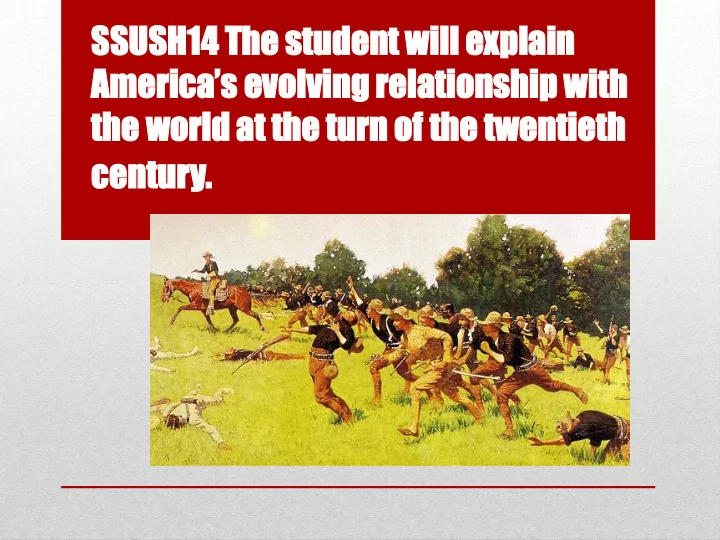
SS SSUS USH14 H14 Th The e st stude dent nt wil ill l ex - - PowerPoint PPT Presentation

ss ssus ush14 h14 th the e st stude dent nt wil ill l ex
SMART_READER_LITE
LIVE PREVIEW

SS SSUS USH14 H14 Th The e st stude dent nt wil ill l ex - - PowerPoint PPT Presentation

SS SSUS USH14 H14 Th The e st stude dent nt wil ill l ex explain lain Americas evolving relationship with th the e wor orld ld at at the the tu turn rn of of th the e tw twen entieth tieth ce centu tury. a. Explain


slide-1
SLIDE 1

SS SSUS USH14 H14 Th The e st stude dent nt wil ill l ex explain lain America’s evolving relationship with th the e wor

  • rld

ld at at the the tu turn rn of

  • f th

the e tw twen entieth tieth ce centu tury.

slide-2
SLIDE 2
  • a. Explain the Chinese Exclusion Act of 1882

and anti-Asian immigration sentiment on the west coast

  • Most Chinese immigrants to the U.S. entered on the west

coast.

  • Many Chinese came to the U.S. to escape poverty and

civil war in China and to help build the transcontinental railroad.

  • By the 1870s there was strong opposition to Chinese

immigration due to the fear of losing jobs to Chinese laborers.

slide-3
SLIDE 3

Chinese Exclusion Act

  • In 1882 the U.S. Congress passed the Chinese

Exclusion Act which prohibited any further Chinese immigration for 10 years. This was in part a result of nativism.

  • The Act was not repealed until 1943.
slide-4
SLIDE 4
  • b. Describe the Spanish-American War, the war in the

Philippines, and the debate over American expansionism.

  • In the1800s many Americans wanted to expand American

power overseas in reaction to European Imperialism: a continuation of Manifest Destiny

  • In Cuba, an island controlled by the Spanish, Cuban rebels

began to rise up against their Spanish rulers.

slide-5
SLIDE 5

Sp Span anish ish-Ame Americ rican an Wa War r (18 1898 98)

  • In 1895 Jose’ Marti (Cuba) started another revolution

against Spain. Spain responded by sending in Valeriano Weyler, who put nearly 300,000 Cubans in concentration camps.

  • U.S. helps Cuba – Causes of War
  • Yellow Journalism - exaggerating or stretching the truth. War
  • ften referred to as a “Media War”.
  • Sinking of the USS Maine – U.S. battleship explodes while

sitting in the harbor of Havana, Cuba. U.S. blames Spain.

  • April 1898 U.S. declares war on Spain
slide-6
SLIDE 6
slide-7
SLIDE 7

Spanish-American War

Remember the Maine!

slide-8
SLIDE 8
slide-9
SLIDE 9
slide-10
SLIDE 10
slide-11
SLIDE 11

Cuba

  • Teller Amendment: amendment to the U.S.

declaration of war against Spain which proclaimed that the United States would not establish permanent control over Cuba.

  • The U.S. Army invaded Cuba in 1898
  • After two weeks of fighting the Spanish surrendered

Cuba and Puerto Rico

  • Under the treaty the U.S.

would annex Puerto Rico and Guam, and Cuba would be given it’s freedom. Many Americans also wanted to annex the Philippines.

slide-12
SLIDE 12
  • War lasted 3 years, killing nearly 25,000 people.
  • U.S. gave Philippines partial home rule
  • 1946 given complete independence
  • Treaty of Paris (1898) – Ended war with following terms:
  • Cuba is independent
  • U.S. gets Puerto Rico, Guam, and the Philippines. They remain under

United States Military Government (USMG) for extended periods. Philippines became an independent nation in 1946.

  • U.S. pays Spain $20 million
  • As a result of the Spanish-American War:
  • U.S. now owns an empire
  • Ends U.S. isolationism
  • U.S. emerges as a world power

Ending the War

slide-13
SLIDE 13

The Philippines

  • The U.S. Navy attacked the Spanish fleet in the

Philippines and quickly defeated them.

  • The U.S. then invaded the islands with the aid of

Filipino rebels and captured the capital city.

  • The U.S. Army refused to recognize the new rebel

government.

How do you think the Filipino rebels felt about the U.S. Army?

slide-14
SLIDE 14

The annexation of the Philippines

  • Supporters of annexation argued that the islands would

give the U.S. an economical and military advantage.

  • Anti-imperialists argued against annexation worrying that

it would cost too much to support and defend the Philippines.

  • In 1898, the U.S. annexed the Philippines causing

Filipino rebels to attack American troops. The 1899 revolt was led by Emilio Aguinaldo.

  • The uprising was eventually put down, in part by the

American ability to stimulate the Filipino economy and promote education and health care systems.

slide-15
SLIDE 15

Expansionism Debate

slide-16
SLIDE 16

Important Additions to the United States

Hawaii was the first U.S. territory in the Pacific when it became a part

  • f the United States in 1898. It was

granted statehood on Aug 21, 1959 as the 50th state of the United States

  • f America.

Alaska was purchased from Russia in 1867, became a territory of the United States in 1912, and granted statehood on Jan 3, 1959 as the 49th state of the United States of America.

slide-17
SLIDE 17
  • c. Explain U.S. involvement in Latin America, as reflected by the Roosevelt Corollary

to the Monroe Doctrine and the creation of the Panama Canal.

slide-18
SLIDE 18
  • The Platt Amendment’s conditions prohibited the Cuban Government

from entering into any international treaty that would compromise Cuban independence or allow foreign powers to use the island for military purposes.

  • The United States also reserved the right to intervene in Cuban affairs in
  • rder to defend Cuban independence and to maintain “a government

adequate for the protection of life, property, and individual liberty.”

  • Other conditions of the Amendment demanded that the Cuban

Government implement plans to improve sanitary conditions on the island, relinquish claims on the Isle of Pines, and agree to sell or lease territory for coaling and naval stations to the United States. (Led to Guantanamo Bay Naval Base)

  • Finally, the amendment required the Cuban Government to conclude a

treaty with the United States that would make the Platt amendment legally binding, and the United States pressured the Cubans to incorporate the terms of the Platt Amendment in the Cuban constitution.

Platt Amendment –

Passed by Congress in 1901 under a US Army appropriations bill

slide-19
SLIDE 19

Panama Canal

  • To insure a quick response by the U.S. Navy worldwide, President

Theodore Roosevelt acquired the Panama Canal Zone in 1903

  • To acquire the area, which was part of Columbia, the U.S.

supported a revolt for Panamanian independence

  • Hay-Bunau-Varilla Treaty: signed on November 18, 1903, by the

United States and Panama, which established the Panama Canal Zone and the subsequent construction of the Panama Canal.

slide-20
SLIDE 20
slide-21
SLIDE 21
  • Panama Canal - A canal built by the U.S. cutting

across Central America to reduce travel time and provide a short cut between the oceans for commercial and military ships.

  • U.S. chose Panama for the canal, which belonged

to Colombia. They refused our offer…wanted more $.

  • US helps Panama rebel against Colombia
  • Panama accepts our offer ($10m and $250,000 a

year)

  • Canal built between 1904-1914
slide-22
SLIDE 22
slide-23
SLIDE 23

Panama Canal

  • Why build the canal?
slide-24
SLIDE 24
  • To expand his “big stick”

policy, President Roosevelt issued the Roosevelt Corollary stating that the U.S. would intervene in Latin American affairs when necessary

  • European powers were

getting involved in Latin America

  • TR wanted US to be the most

powerful influence in Latin America “BIG STICK DIPLOMACY”

Roosevelt Corollary to the Monroe Doctrine

slide-25
SLIDE 25
  • Based on the African

proverb “Speak softly and carry a big stick”

  • The Roosevelt Corollary

stated: the U.S. would use force to protect its economic interests in Latin America

What was the purpose of the Monroe Doctrine? How are the Roosevelt Corollary and the Monroe Doctrine connected?

Roosevelt Corollary to the Monroe Doctrine

slide-26
SLIDE 26

U.S. involvement in Latin America

slide-27
SLIDE 27

Roosevelt Corollary Monroe Doctrine

How are the two connected?

U.S. would use force to protect its economic interests in Latin America European colonization or interference in North or South America would be viewed as acts of aggression, requiring U.S. intervention.