Square, Inc. (Exact name of registrant as specified in its charter) - - PDF document

square inc
SMART_READER_LITE
LIVE PREVIEW

Square, Inc. (Exact name of registrant as specified in its charter) - - PDF document

UNITED STATES SECURITIES AND EXCHANGE COMMISSION Washington, D.C. 20549 ______________________ FORM 10-Q ______________________ (Mark One) QUARTERLY REPORT PURSUANT TO SECTION 13 OR 15(d) OF THE SECURITIES EXCHANGE ACT OF 1934 For the


slide-1
SLIDE 1

UNITED STATES SECURITIES AND EXCHANGE COMMISSION

Washington, D.C. 20549 ______________________

FORM 10-Q

______________________

(Mark One) ý QUARTERLY REPORT PURSUANT TO SECTION 13 OR 15(d) OF THE SECURITIES EXCHANGE ACT OF 1934

For the quarterly period ended March 31, 2016 OR

  • TRANSITION REPORT PURSUANT TO SECTION 13 OR 15(d) OF THE SECURITIES EXCHANGE ACT OF 1934

For the transition period from ________ to ________ Commission File Number: 001-37622

______________________

Square, Inc.

(Exact name of registrant as specified in its charter)

______________________

Delaware 80-0429876

(State or other jurisdiction of incorporation or organization) (IRS Employer Identification No.)

1455 Market Street, Suite 600 San Francisco, CA 94103

(Address of principal executive offices, including zip code)

(415) 375-3176

(Registrant’s telephone number, including area code)

______________________

Indicate by check mark whether the registrant (1) has filed all reports required to be filed by Section 13 or 15(d) of the Securities Exchange Act of 1934 during the preceding 12 months (or for such shorter period that the registrant was required to file such reports), and (2) has been subject to such filing requirements for the past 90 days. Yes ý No o Indicate by check mark whether the registrant has submitted electronically and posted on its corporate Web site, if any, every Interactive Data File required to be submitted and posted pursuant to Rule 405 of Regulation S-T (§232.405 of this chapter) during the preceding 12 months (or for such shorter period that the registrant was required to submit and post such files). Yes ý No o Indicate by check mark whether the registrant is a large accelerated filer, an accelerated filer, a non-accelerated filer, or a smaller reporting company. See definitions of “large accelerated filer,” “accelerated filer” and “smaller reporting company” in Rule 12b-2 of the Exchange Act. Large accelerated filer o Accelerated filer o Non-accelerated filer ý (Do not check if smaller reporting company) Smaller reporting company o Indicate by check mark whether the registrant is a shell company (as defined in Rule 12b-2 of the Exchange Act). Yes o No ý As of April 28, 2016 , the number of shares of the registrant’s Class A common stock outstanding was 51,465,931 and the number of shares of the registrant’s Class B common stock outstanding was 283,834,631 .

slide-2
SLIDE 2

TABLE OF CONTENTS Page No. PART I—Financial Information Item 1. Financial Statements Condensed Consolidated Balance Sheets (unaudited) 4 Condensed Consolidated Statements of Operations (unaudited) 5 Condensed Consolidated Statements of Comprehensive Loss (unaudited) 6 Condensed Consolidated Statements of Cash Flows (unaudited) 7 Notes to Condensed Consolidated Financial Statements (unaudited) 8 Item 2. Management’s Discussion and Analysis of Financial Condition and Results of Operations 23 Item 3. Quantitative and Qualitative Disclosures About Market Risk 33 Item 4. Controls and Procedures 33 PART II—Other Information Item 1. Legal Proceedings 35 Item 1A. Risk Factors 36 Item 2. Unregistered Sales of Equity Securities and Use of Proceeds 36 Item 3. Defaults Upon Senior Securities 36 Item 4. Mine Safety Disclosures 36 Item 5. Other Information 36 Item 6. Exhibits 37 Signatures 38

slide-3
SLIDE 3

SPECIAL NOTE REGARDING FORWARD-LOOKING STATEMENTS This Quarterly Report on Form 10-Q contains forward-looking statements within the meaning of Section 27A of the Securities Act of 1933, as amended, and Section 21E of the Securities Exchange Act of 1934, as amended, that involve substantial risks and uncertainties. Forward-looking statements generally relate to future events or our future financial or operating performance. In some cases, you can identify forward-looking statements because they contain words such as “may,” “will,” “should,” “expects,” “plans,” “anticipates,” “could,” “intends,” “target,” “projects,” “contemplates,” “believes,” “estimates,” “predicts,” “potential,”

  • r “continue,” or the negative of these words or other similar terms or expressions that concern our expectations, strategy, plans, or intentions. Forward-looking

statements contained in this Quarterly Report on Form 10-Q include, but are not limited to, statements about our future financial performance, our anticipated growth and growth strategies and our ability to effectively manage that growth, our anticipated expansion in international markets, our plans for funding and expanding Square Capital, our expectations regarding litigation, and the sufficiency of our cash and cash equivalents and cash generated from operations to meet

  • ur working capital and capital expenditure requirements.

The outcome of the events described in these forward-looking statements is subject to risks, uncertainties, and other factors described in the section titled “Risk Factors” and elsewhere in this Quarterly Report on Form 10-Q. We undertake no obligation to update any forward-looking statements made in this Quarterly Report on Form 10-Q to reflect events or circumstances after the date of this Quarterly Report on Form 10-Q or to reflect new information or the occurrence of unanticipated events, except as required by law.

slide-4
SLIDE 4

Part I—Financial Information Item 1. Financial Statements SQUARE, INC. CONDENSED CONSOLIDATED BALANCE SHEETS (Unaudited) (In thousands, except share and per share data) March 31, 2016 December 31, 2015 Assets Current assets: Cash and cash equivalents $ 370,646 $ 470,775 Short-term investments 43,447 — Restricted cash 13,542 13,537 Settlements receivable 189,049 142,727 Merchant cash advance receivable, net 48,157 36,473 Other current assets 55,211 42,051 Total current assets 720,052 705,563 Property and equipment, net 89,039 87,222 Goodwill 56,699 56,699 Acquired intangible assets, net 24,463 26,776 Long-term investments 29,715 — Restricted cash 14,994 14,686 Other assets 10,107 3,826 Total assets $ 945,069 $ 894,772 Liabilities and Stockholders’ Equity Current liabilities: Accounts payable $ 19,580 $ 18,869 Customers payable 283,860 224,811 Accrued transaction losses 15,419 17,176 Accrued expenses 97,335 44,401 Other current liabilities 33,738 28,945 Total current liabilities 449,932 334,202 Other liabilities 50,253 52,522 Total liabilities 500,185 386,724 Commitments and contingencies (Note 17) Stockholders’ equity: Preferred stock, $0.0000001 par value: 100,000,000 shares authorized at March 31, 2016, and December 31, 2015. None issued and outstanding at March 31, 2016, and December 31, 2015. — — Common stock, $0.0000001 par value: 1,000,000,000 Class A shares authorized at both March 31, 2016, and December 31, 2015; 31,717,133 issued and outstanding at both March 31, 2016, and December 31, 2015. 500,000,000 Class B shares authorized at both March 31, 2016, and December 31, 2015; 303,553,308 and 303,232,312 issued and outstanding at March 31, 2016, and December 31, 2015, respectively. — — Additional paid-in capital 1,149,634 1,116,882 Accumulated deficit (704,404) (607,649) Accumulated other comprehensive loss (346) (1,185) Total stockholders’ equity 444,884 508,048 Total liabilities and stockholders’ equity $ 945,069 $ 894,772 The accompanying notes are an integral part of these unaudited condensed consolidated financial statements. 4

slide-5
SLIDE 5

SQUARE, INC. CONDENSED CONSOLIDATED STATEMENTS OF OPERATIONS (Unaudited) (In thousands, except per share data) Three Months Ended March 31, 2016 2015 Revenue: Transaction revenue $ 300,453 $ 211,110 Starbucks transaction revenue 38,838 29,237 Software and data product revenue 23,796 8,006 Hardware revenue 16,182 2,204 Total net revenue 379,269 250,557 Cost of revenue: Transaction costs 194,276 132,107 Starbucks transaction costs 36,610 36,211 Software and data product costs 9,033 3,155 Hardware costs 26,740 4,197 Amortization of acquired technology 2,370 602 Total cost of revenue 269,029 176,272 Gross profit 110,240 74,285 Operating expenses: Product development 64,592 39,545 Sales and marketing 38,496 36,181 General and administrative 96,107 28,119 Transaction and advance losses 7,861 16,322 Amortization of acquired customer assets 317 468 Total operating expenses 207,373 120,635 Operating loss (97,133) (46,350) Interest (income) and expense, net 69 414 Other (income) and expense, net (786) 796 Loss before income tax (96,416) (47,560) Provision for income taxes 339 418 Net loss $ (96,755) $ (47,978) Net loss per share: Basic $ (0.29) $ (0.33) Diluted $ (0.29) $ (0.33) Weighted-average shares used to compute net loss per share Basic 331,324 145,069 Diluted 331,324 145,069 The accompanying notes are an integral part of these unaudited condensed consolidated financial statements. 5

slide-6
SLIDE 6

SQUARE, INC. CONDENSED CONSOLIDATED STATEMENTS OF COMPREHENSIVE LOSS (Unaudited) (In thousands) Three Months Ended March 31, 2016 2015 Net loss $ (96,755) $ (47,978) Net foreign currency translation adjustments 510 (227) Net unrealized gain (loss) on revaluation of intercompany loans 253 — Net unrealized gain (loss) on marketable securities 76 — Total comprehensive loss $ (95,916) $ (48,205) The accompanying notes are an integral part of these unaudited condensed consolidated financial statements. 6

slide-7
SLIDE 7

SQUARE, INC. CONDENSED CONSOLIDATED STATEMENTS OF CASH FLOWS (Unaudited) (In thousands) Three Months Ended March 31, 2016 2015 Cash flows from operating activities: Net loss $ (96,755) $ (47,978) Adjustments to reconcile net loss to net cash used in operating activities: Depreciation and amortization 9,118 5,546 Share-based compensation 31,198 13,461 Provision for transaction losses 7,182 13,757 Provision for uncollectible merchant cash advances 73 2,504 Deferred provision for income taxes 78 (207) Loss (gain) on disposal of property and equipment (38) 240 Changes in operating assets and liabilities: Settlements receivable (46,503) (34,030) Merchant cash advance receivable (11,756) (3,895) Other current assets (13,327) 3,210 Other assets (6,301) 821 Accounts payable 2,576 4,683 Customers payable 58,866 38,631 Charge-offs and recoveries to accrued transaction losses (8,939) (5,398) Accrued expenses 55,810 (5,443) Other current liabilities 4,567 (1,723) Other noncurrent liabilities (1,360) 4,871 Net cash used in operating activities (15,511) (10,950) Cash flows from investing activities: Purchase of marketable securities (73,086) — Purchase of property and equipment (7,527) (10,419) Payment for acquisition of intangible assets (400) (100) Change in restricted cash (313) — Business acquisitions (net of cash acquired) — (3,750) Net cash used in investing activities (81,326) (14,269) Cash flows from financing activities: Payments of offering costs related to initial public offering (5,406) — Proceeds from the exercise of stock options 556 1,749 Net cash (used in) provided by financing activities (4,850) 1,749 Effect of foreign exchange rate changes on cash and cash equivalents 1,558 (860) Net decrease in cash and cash equivalents (100,129) (24,330) Cash and cash equivalents, beginning of period 470,775 225,300 Cash and cash equivalents, end of period $ 370,646 $ 200,970 The accompanying notes are an integral part of these unaudited condensed consolidated financial statements. 7

slide-8
SLIDE 8

SQUARE, INC. NOTES TO CONDENSED CONSOLIDATED FINANCIAL STATEMENTS ( Unaudited ) NOTE 1 - DESCRIPTION OF BUSINESS AND SUMMARY OF SIGNIFICANT ACCOUNTING POLICIES Business Square, Inc. (together with its subsidiaries, Square or the Company) creates tools that help sellers of all sizes start, run, and grow their businesses. Square's point-of-sale service offers tools for every part of running a business, from accepting credit cards and tracking inventory, to real-time analytics and

  • invoicing. Square also offers sellers financial and marketing services, including small business financing and customer engagement tools. Businesses and

individuals can also use Square Cash, an easy way to send and receive money, as well as Caviar, a food delivery service for popular restaurants. Square was founded in 2009 and is headquartered in San Francisco, with offices in the United States, Canada, Japan, and Australia. Initial Public Offering In November 2015 , the Company completed its Initial Public Offering (IPO) in which it issued and sold 29,700,000 shares of Class A common stock at a public offering price of $9.00 per share and a selling stockholder sold 1,350,000 shares of Class A common stock. The Company did not receive any proceeds from the sale of shares by the selling stockholder. The total net proceeds received by the Company from the IPO were $245.7 million after deducting underwriting discounts and commissions of $14.7 million and other offering expenses of approximately $6.9 million . Basis of Presentation The accompanying interim condensed consolidated financial statements of the Company are unaudited. These interim condensed consolidated financial statements have been prepared in accordance with generally accepted accounting principles in the United States of America (U.S. GAAP) and the applicable rules and regulations of the Securities and Exchange Commission (SEC) for interim financial information. Accordingly, they do not include all of the information and footnotes required by U.S. GAAP for complete financial statements. The December 31, 2015 , condensed consolidated balance sheet was derived from the audited financial statements as of that date, but does not include all of the information and footnotes required by U.S. GAAP for complete financial statements. The accompanying unaudited interim condensed consolidated financial statements have been prepared on the same basis as the audited consolidated financial statements and, in the opinion of management, reflect all adjustments of a normal recurring nature considered necessary to state fairly the Company's financial position, results of operations, comprehensive loss, and cash flows for the interim periods. All intercompany transactions and balances have been eliminated in consolidation. The interim results for the three months ended March 31, 2016 are not necessarily indicative of the results that may be expected for the year ending December 31, 2016 , or for any other future annual or interim period. The information included in this Quarterly Report on Form 10-Q should be read in conjunction with “Management’s Discussion and Analysis of Financial Condition and Results of Operations,” “Quantitative and Qualitative Disclosures About Market Risk,” and the Consolidated Financial Statements and notes thereto included in Items 7, 7A, and 8, respectively, in the Company's Annual Report on Form 10-K for the year ended December 31, 2015 . Use of Estimates The preparation of the Company’s consolidated financial statements in conformity with U.S. GAAP requires management to make estimates and assumptions that affect the reported amounts of assets, liabilities, revenue and expenses, as well as related disclosure of contingent assets and liabilities. Actual results could differ from the Company’s estimates. To the extent that there are material differences between these estimates and actual results, the Company’s financial condition or operating results will be materially affected. The Company bases its estimates on past experience and other assumptions that the Company believes are reasonable under the circumstances, and the Company evaluates these estimates on an ongoing basis. Significant estimates, judgments and assumptions in these consolidated financial statements include, but are not limited to, those related to revenue recognition, accrued transaction losses, provision for uncollectible receivables related to merchant cash advances (MCAs), business combinations, goodwill and intangible assets, income taxes, and share-based compensation. 8

slide-9
SLIDE 9

Concentration of Credit Risk For the three months ended March 31, 2016 and 2015 , the Company had no customer other than Starbucks that accounted for greater than 10% of total net revenue. The Company had three third-party processors that represented approximately 48% , 34% , and 15% of settlements receivable as of March 31, 2016 . The same three parties represented approximately 56% , 23% , and 16% of settlements receivable as of December 31, 2015 . The Company places its cash and cash equivalents and investments in marketable securities with large, creditworthy financial institutions. Balances in these accounts may exceed federally insured limits at times. Significant Accounting Policies There have been no material changes to the Company’s significant accounting policies during the three months ended March 31, 2016 , as compared to the significant accounting policies described in the Company’s Annual Report on Form 10-K for the year ended December 31, 2015 . Recently Issued Accounting Standards In March 2016, the FASB issued ASU No. 2016-04, Recognition of Breakage for Certain Prepaid Stored-Value Products. This guidance specifies how prepaid stored-value product liabilities should be derecognized, thereby eliminating the current and potential future diversity in practice. This guidance is effective for financial statements issued for fiscal years beginning after December 15, 2017, and interim periods within those fiscal years, with early adoption permitted. The Company is currently evaluating the impact this new guidance may have on the consolidated financial statements. In March 2016, the FASB issued ASU No. 2016-08, Principal versus Agent Considerations, which provides implementation guidance on principal versus agent considerations in the new revenue recognition standard. This guidance clarifies how an entity should identify the unit of accounting (i.e., the specified good

  • r service) for the principal versus agent evaluation and how it should apply the control principle to certain types of arrangements. This guidance is effective for

financial statements issued for fiscal years beginning after December 15, 2017, and interim periods within those fiscal years, with early adoption permitted. The Company is currently evaluating the impact this new guidance may have on the consolidated financial statements. In March 2016, the FASB issued ASU No. 2016-09, Improvements to Employee Share-Based Payment Accounting , which is intended to simplify several aspects of the accounting for share-based payment transactions, including the income tax consequences, classification of awards as either equity or liabilities, and classification on the statement of cash flows. This guidance is effective for financial statements issued for fiscal years beginning after December 15, 2016, and interim periods within those fiscal years, with early adoption permitted. The Company is currently evaluating the impact this new guidance may have on the consolidated financial statements. NOTE 2 - RESTRICTED CASH As of both March 31, 2016 and December 31, 2015 , restricted cash of $13.5 million is related to pledged cash deposited into savings accounts at the financial institutions that process the Company's sellers' payment transactions. The Company uses the restricted cash to secure letters of credit with the financial institutions to provide collateral for cash flow timing differences in the processing of these payments. The Company has recorded this amount as a current asset on the condensed consolidated balance sheets due to the short-term nature of these cash flow timing differences and that there is no minimum time frame during which the cash must remain restricted. As of March 31, 2016 and December 31, 2015 , the remaining restricted cash of $15.0 million and $14.7 million , respectively, is primarily related to cash deposited into money market funds that is used as collateral pursuant to multi-year lease agreements entered into in 2012 and 2014 (see note 17 ). The Company has recorded this amount as a non-current asset on the consolidated balance sheets as the terms of the related leases extend beyond one year. 9

slide-10
SLIDE 10

NOTE 3 - FAIR VALUE OF FINANCIAL INSTRUMENTS The Company measures its cash equivalents and short-term and long-term investments at fair value. The Company classifies its cash equivalents and short-term and long-term investments within Level 1 or Level 2 of the fair value hierarchy because the Company values these investments using quoted market prices or alternative pricing sources and models utilizing market observable inputs. The Company’s financial assets and liabilities that are measured at fair value on a recurring basis are classified as follows (in thousands): March 31, 2016 December 31, 2015 Level 1 Level 2 Level 3 Level 1 Level 2 Level 3 Cash and Cash Equivalents: Money market funds $ 224,602 $ — $ — $ 337,234 $ — $ — U.S. agency securities — 2,500 — — — — Commercial paper — 5,346 — — — — Municipal securities — 1,672 — — — — Short-term securities: U.S. agency securities — 8,484 — — — — Corporate bonds — 4,543 — — — — Commercial paper — 20,430 — — — — U.S. government securities 9,990 — — — — — Long-term securities: — — — U.S. agency securities — 7,662 — — — — Corporate bonds — 5,908 — — — — U.S. government securities 16,145 — — — — — Total $ 250,737 $ 56,545 $ — $ 337,234 $ — $ — The carrying amounts of certain financial instruments, including cash equivalents, settlements receivable, merchant cash advance receivable, accounts payable, customers payable, settlements payable, and debt, approximate their fair values due to their short-term nature. If applicable, the Company will recognize transfers into and out of levels within the fair value hierarchy at the end of the reporting period in which the actual event or change in circumstance occurs. During the three months ended March 31, 2016 and 2015 , the Company did not have any transfers in or out of Level 1, Level 2, or Level 3 assets or liabilities. NOTE 4 - INVESTMENTS The Company determines the appropriate classification of its investments in marketable securities at the time of purchase and reevaluates such designation at each balance sheet date. The Company has classified and accounted for its marketable securities as available-for-sale. 10

slide-11
SLIDE 11

The Company's short-term and long-term investments as of March 31, 2016 are as follows (in thousands): Amortized Cost Gross Unrealized Gains Gross Unrealized Losses Fair Value Short-term securities: U.S. agency securities $ 8,479 $ 5 $ — $ 8,484 Corporate bonds 4,543 5 (5) 4,543 Commercial paper 20,430 — — 20,430 U.S. government securities 9,985 5 — 9,990 Total $ 43,437 $ 15 $ (5) $ 43,447 Long-term securities: U.S. agency securities $ 7,641 $ 21 $ — $ 7,662 Corporate bonds 5,901 7 — 5,908 U.S. government securities 16,107 38 — 16,145 Total $ 29,649 $ 66 $ — $ 29,715 For the three months ended March 31, 2016 , gains or losses realized on the sale of investments were insignificant. Investments are reviewed periodically to identify possible other-than-temporary impairments. As the Company has the ability and intent to hold these investments with unrealized losses until a recovery

  • f fair value, or for a reasonable period of time sufficient for the recovery of fair value, which may be maturity, the Company does not consider these investments

to be other-than-temporarily impaired at March 31, 2016 . The contractual maturities of the Company's short-term and long-term investments as of March 31, 2016 , are as follows (in thousands): Amortized Cost Fair Value Due in one year or less $ 43,437 $ 43,447 Due in one to five years 29,649 29,715 Total $ 73,086 $ 73,162 NOTE 5 - MERCHANT CASH ADVANCE RECEIVABLE, NET The Company enters into purchase and sale transactions with pre-qualified sellers in which the Company purchases a designated amount of future receivables for an upfront cash purchase price. The delivery of the future receivables purchased in exchange for the advance cash purchase price is facilitated through the merchant’s payment processing activities with the Company. There is no economic recourse to the seller in the event that the future receivables are not

  • generated. There is also no fixed period of time in which the seller must deliver the purchased future receivables to the Company, as delivery of the purchased

future receivables is contingent on the sellers’ generation of such receivables. The Company has limited contractual remedies in the event that a seller breaches its agreement with the Company (e.g., where a seller does not use the Company as its exclusive processor while future receivables purchased by the Company remain

  • utstanding). Although there is no economic recourse to the seller in the event that the future receivables are not generated, the degree of uncertainty related to this

economic benefit is mitigated by the extensive due diligence performed by the Company prior to purchasing the seller’s future receivables and is further mitigated by limited contractual remedies. The Company’s due diligence includes, but is not limited to, detailed analyses of the seller’s historical processing volumes, transaction count, chargebacks, growth, and account longevity. The Company is exposed to losses related to uncollectible receivables purchased by the Company other than receivables that are sold to third parties in accordance with the Company’s arrangements with these third parties. 11

slide-12
SLIDE 12

The Company establishes reserves for uncollectible receivables based on historical trends, adverse economic conditions, and specific merchant activity. Subsequent delivery to the Company of a previously designated uncollectible receivable is reflected as a reduction in the allowance for uncollectible receivables when the delivery of the receivable occurs. The following table summarizes the activities of the Company’s allowance for uncollectible receivables (in thousands): Three Months Ended March 31, 2016 2015 Allowance for uncollectible receivables, beginning of the period $ 7,443 $ 2,431 Provision for uncollectible receivables 73 2,504 Receivables charged off (58) — Allowance for uncollectible receivables, end of the period $ 7,458 $ 4,935 The table above includes a reduction in uncollectible receivables for the three months ended March 31, 2016 , primarily as a result of an update to the Company's provision estimates for Square Capital, which the Company continues to refine as more historical data becomes available. NOTE 6 - PROPERTY AND EQUIPMENT, NET The following is a summary of property, equipment, and internally-developed software at cost, less accumulated depreciation and amortization (in thousands): March 31, 2016 December 31, 2015 Computer equipment $ 46,751 $ 43,531 Office furniture and equipment 9,400 9,339 Leasehold improvements 67,714 65,298 Capitalized software 17,209 14,533 Construction in process 61 490 Total 141,135 133,191 Less: Accumulated depreciation and amortization (52,096) (45,969) Property and equipment, net $ 89,039 $ 87,222 Depreciation and amortization expense on property and equipment was $6.4 million for the three months ended March 31, 2016 . Depreciation and amortization expense on property and equipment was $4.5 million for the three months ended March 31, 2015 . Construction in Process Construction in process consists of leasehold improvements and furniture at the Company’s offices under construction as of March 31, 2016 and December 31, 2015 . Upon completion of construction, the assets will be depreciated over their useful lives. NOTE 7 - GOODWILL Goodwill is recorded when the consideration paid for an acquisition of a business exceeds the fair value of identifiable net tangible and intangible assets

  • acquired. As of March 31, 2016 and December 31, 2015 , goodwill was $56.7 million .

12

slide-13
SLIDE 13

The Company performs a goodwill impairment test annually on December 31 and more frequently if events and circumstances indicate that the asset might be impaired. For the periods presented, the Company had recorded no impairment charges. NOTE 8 - ACQUIRED INTANGIBLE ASSETS The following table presents the detail of acquired intangible assets as of the periods presented (in thousands): Balance at March 31, 2016 Cost Accumulated Amortization Net Patent $ 1,285 $ (374) $ 911 Technology Assets 29,045 (9,014) 20,031 Customer Assets 6,645 (3,124) 3,521 Total $ 36,975 $ (12,512) $ 24,463 Balance at December 31, 2015 Cost Accumulated Amortization Net Patent $ 1,285 $ (348) $ 937 Technology Assets 28,645 (6,644) 22,001 Customer Assets 6,645 (2,807) 3,838 Total $ 36,575 $ (9,799) $ 26,776 The weighted average amortization periods for acquired patents, acquired technology, and customer intangible assets are approximately thirteen years , three years , and six years , respectively. Amortization expense associated with other intangible assets was $2.7 million for the three months ended March 31, 2016 . Amortization expense associated with other intangible assets was $1.1 million for the three months ended March 31, 2015 . The total estimated annual future amortization expense of these intangible assets as of March 31, 2016 , are as follows (in thousands): 2016 (remaining 9 months) $ 6,259 2017 7,187 2018 5,687 2019 2,983 2020 1,087 Thereafter 1,260 Total $ 24,463 13

slide-14
SLIDE 14

NOTE 9 - OTHER CONSOLIDATED BALANCE SHEET COMPONENTS (CURRENT) Other Current Assets The following table presents the detail of other current assets (in thousands): March 31, 2016 December 31, 2015 Accounts receivable $ 3,268 $ 4,808 Prepaid expenses 12,789 7,101 Deferred reader costs 3,218 4,018 Inventory 14,878 11,864 Tenant improvement reimbursement receivable 2,054 1,788 Deferred hardware costs 2,559 1,709 Processing costs receivable 10,037 7,847 Other 6,408 2,916 Total $ 55,211 $ 42,051 Accrued Expenses The following table presents the detail of accrued expenses (in thousands): March 31, 2016 December 31, 2015 Accrued hardware costs $ 2,656 $ 11,622 Processing costs payable 14,651 11,417 Accrued professional fees 7,637 7,642 Accrued payroll 6,493 2,660 Litigation accrual 50,000 — Other accrued liabilities 15,898 11,060 Total $ 97,335 $ 44,401 Other Current Liabilities The following table presents the detail of other current liabilities (in thousands): March 31, 2016 December 31, 2015 Settlements payable 16,308 $ 13,105 Employee early exercised stock options 1,663 2,141 Accrued redemptions 1,134 1,066 Current portion of deferred rent 2,569 2,393 Deferred revenue 6,213 6,623 Other 5,851 3,617 Total $ 33,738 $ 28,945 14

slide-15
SLIDE 15

NOTE 10 - OTHER CONSOLIDATED BALANCE SHEET COMPONENTS (NON-CURRENT) Other Non-Current Assets The following table presents the detail of other non-current assets (in thousands): March 31, 2016 December 31, 2015 Deposits $ 2,054 $ 1,993 Deferred tax assets 122 188 Other 7,931 1,645 Total $ 10,107 $ 3,826 Other Non-Current Liabilities The following table presents the detail of other non-current liabilities (in thousands): March 31, 2016 December 31, 2015 Deferred rent $ 25,083 $ 25,543 Employee early exercised stock options 609 1,128 Deferred tax liabilities 299 299 Statutory liabilities 24,214 25,492 Other 48 60 Total $ 50,253 $ 52,522 NOTE 11 - DEBT In November 2015 , the Company entered into a new revolving credit agreement with certain lenders, which extinguished the prior revolving credit agreement, and provided for a $375.0 million revolving secured credit facility maturing in November 2020 . This revolving credit agreement is secured by certain tangible and intangible assets. Loans under the credit facility bear interest, at the Company’s option of (i) a base rate based on the highest of the prime rate, the federal funds rate plus 0.50% and an adjusted LIBOR rate for a one-month interest period in each case plus a margin ranging from 0.00% to 1.00% or (ii) an adjusted LIBOR rate plus a margin ranging from 1.00% to 2.00% . This margin is determined based on the Company’s total leverage ratio for the preceding four fiscal quarters. The Company is obligated to pay other customary fees for a credit facility of this size and type including an annual administrative agent fee of $0.1 million and an unused commitment fee of 0.15% . To date no funds have been drawn under the credit facility, with $375.0 million remaining available. The Company paid $0.1 million in unused commitment fees during the three months ended March 31, 2016 . NOTE 12 - ACCRUED TRANSACTION LOSSES The Company is exposed to transaction losses due to chargebacks as a result of fraud or uncollectibility. Recoveries are reflected as a reduction in the reserve for transaction losses when the recovery occurs. 15

slide-16
SLIDE 16

The following table summarizes the activities of the Company’s reserve for transaction losses (in thousands): Three Months Ended March 31, 2016 2015 Accrued transaction losses, beginning of the period $ 17,176 $ 8,452 Provision for transaction losses 7,182 13,757 Charge-offs and recoveries to accrued transaction losses (8,939) (5,398) Accrued transaction losses, end of the period $ 15,419 $ 16,811 NOTE 13 - INCOME TAXES The Company recorded an income tax expense of $0.3 million for the three months ended March 31, 2016 , compared to income tax expense of $0.4 million for the three months ended March 31, 2015 . The Company’s effective tax rate was approximately (0.4)% for the three months ended March 31, 2016 , compared to an effective tax rate of (0.9)% for the three months ended March 31, 2015 . The Company’s effective tax rate may be subject to fluctuation during the year as new information is obtained, which may affect the assumptions used to estimate the annual effective tax rate, including factors such as the mix of forecasted pre-tax earnings in the various jurisdictions in which we operate, valuation allowances against deferred tax assets, the recognition and de-recognition of tax benefits related to uncertain tax positions, and changes in or the interpretation of tax laws in jurisdictions where we conduct business. As of March 31, 2016 , the Company retains a full valuation allowance on its deferred tax assets in the U.S. and certain foreign jurisdictions. The realization of the Company’s deferred tax assets depends primarily on its ability to generate taxable income in future periods. The amount of deferred tax assets considered realizable in future periods may change as management continues to reassess the underlying factors it uses in estimating future taxable income. The income tax expense recorded for the three months ended March 31, 2016 , was primarily due to state and foreign income tax expense. The difference between the effective tax rate and the federal statutory tax rate for the three months ended March 31, 2016 , primarily relates to the valuation allowance on the Company’s deferred tax assets. The tax provision for the three months ended March 31, 2016 , was calculated on a jurisdiction basis. We estimated the foreign income tax provision using the effective income tax rate expected to be applicable for the full year. NOTE 14 - STOCKHOLDERS’ EQUITY Common Stock The Company has authorized the issuance of Class A common stock and Class B common stock. Class A common stock and Class B common stock are referred to as common stock throughout these Notes to the Condensed Consolidated Financial Statements, unless otherwise noted. As of March 31, 2016 , the Company was authorized to issue 1,000,000,000 shares of Class A common stock and 500,000,000 shares of Class B common stock, each with a par value of $0.0000001 per share. As of March 31, 2016 , there were 31,717,133 shares of Class A common stock and 303,553,308 shares of Class B common stock

  • utstanding, each with a par value of $0.0000001 per share.

16

slide-17
SLIDE 17

Stock Plans The Company maintains two share-based employee compensation plans: the 2009 Stock Plan (2009 Plan) and the 2015 Equity Incentive Plan (2015 Plan). The 2015 Plan serves as the successor to the 2009 Plan. The 2015 Plan became effective as of November 17, 2015. Outstanding awards under the 2009 Plan continue to be subject to the terms and conditions of the 2009 Plan. Under the 2015 Plan, shares of common stock are reserved for the issuance of incentive and nonstatutory stock options, restricted stock awards, restricted stock units (RSUs), performance shares and stock bonuses to qualified employees, directors and consultants. The shares may be granted at a price per share not less than the fair market value at the date of grant. Initially, 30,000,000 shares were reserved under the 2015 Plan and any shares subject to options or other similar awards granted under the 2009 Plan that expire, are forfeited, are repurchased by the Company or otherwise terminate unexercised will become available under the 2015 Plan. The number of shares available for issuance under the 2015 Plan will be increased on the first day of each fiscal year, in an amount equal to the least

  • f (i) 40,000,000 shares, (ii) 5% of the outstanding shares on the last day of the immediately preceding fiscal year or (iii) such number of shares determined by the

Company’s board of directors. As of March 31, 2016 , the total number of shares subject to stock options and RSUs outstanding under the 2015 Plan was 8,395,459 , and 42,414,446 shares were available for future issuance. As of March 31, 2016 , the total number of shares subject to stock options and RSUs

  • utstanding under the 2009 Plan was 101,516,657 . As of November 17, 2015, no additional securities will be issued under 2009 Plan.

A summary of stock option activity for the three months ended March 31, 2016 is as follows (in thousands, except share and per share data): Number of Stock Options Outstanding Weighted average exercise price Weighted average remaining contractual term (in years) Aggregate intrinsic value Balance at December 31, 2015 107,515,554 $ 6.99 7.87 $ 656,194 Granted 20,700 9.77 Exercised (327,976) 1.73 Forfeited (3,801,721) $ 12.03 Balance at March 31, 2016 103,406,557 6.82 7.72 874,966 Options vested and expected to vest at March 31, 2016 95,493,312 6.51 7.29 837,620 Options exercisable at March 31, 2016 100,569,757 6.76 7.67 857,167 Restricted Stock Activity The Company issued RSUs to certain employees in fiscal year 2015. These RSUs typically vest over a term of four years. Activity related to RSUs during the three months ended March 31, 2016 is set forth below: Number of RSUs Weighted average grant date fair value Unvested at December 31, 2015 3,632,765 $ 13.14 Granted 3,040,950 11.29 Forfeited (168,156) $ 13.61 Unvested at March 31, 2016 6,505,559 $ 12.26 17

slide-18
SLIDE 18

Share-Based Compensation The fair value of stock options and employee stock purchase plan shares granted to employees is estimated on the date of grant using the Black-Scholes- Merton option valuation model. Effective August 31, 2015, the Company modified all of its nonstatutory stock option grants to extend the exercise term for terminated employees who have completed two years of service. In the event of a termination, the modified expiration date will be the earlier of (i) three years from termination or (ii) one year following an initial public offering, if in each case, the date of termination occurs between August 31, 2015 and the nine-month anniversary of the initial public offering. In all cases, the grants remain subject to earlier expiration in accordance with their original terms. During the three months ended March 31, 2016 , share-based compensation expense included $0.7 million related to the vested portion of the impacted options, as a result of the modification. The Company will incur an additional $7.4 million of share-based compensation expense over the remaining vesting periods of the impacted options. The fair value of stock options granted was estimated using the following weighted-average assumptions: Three Months Ended March 31, 2016 2015 Dividend yield —% —% Risk-free interest rate 1.39% 1.63% Expected volatility 43% 54% Expected term (years) 6.08 6.15 The following table summarizes the effects of share-based compensation on the Company's condensed consolidated statements of operations (in thousands): Three Months Ended March 31, 2016 2015 Product development $ 21,947 $ 8,958 Sales and marketing 2,903 1,429 General and administrative 6,348 3,074 Total $ 31,198 $ 13,461 On November 17, 2015, the Company’s 2015 Employee Stock Purchase Plan (ESPP) became effective. During the three months ended March 31, 2016 , the Company recorded $1.5 million of share-based compensation expense related to the ESPP, which is included in the table above. There was no similar activity during the three months ended March 31, 2015 . As of March 31, 2016 , there was $241.6 million of total unrecognized compensation cost related to outstanding stock options that is expected to be recognized over a weighted-average period of 2.86 years . NOTE 15 - LOSS PER SHARE Basic net loss per share is computed by dividing the net loss by the weighted-average number of shares of common stock outstanding during the period. Diluted loss per share is the same as basic loss per share for all years presented because the effects of potentially dilutive items were anti-dilutive given the Company’s net loss. 18

slide-19
SLIDE 19

The following table presents the calculation of basic and diluted net loss per share (in thousands, except per share data): Three Months Ended March 31, 2016 2015 Net loss $ (96,755) $ (47,978) Basic shares: Weighted-average common shares outstanding 335,177 151,171 Weighted-average unvested shares (3,853) (6,102) Weighted-average shares used to compute basic net loss per share 331,324 145,069 Diluted shares: Weighted-average shares used to compute diluted loss per share 331,324 145,069 Net loss per share: Basic $ (0.29) $ (0.33) Diluted $ (0.29) $ (0.33) The following potential common shares were excluded from the calculation of diluted net loss per share because their effect would have been anti-dilutive for the periods presented (in thousands): Three Months Ended March 31, 2016 2015 Stock options and restricted stock units 109,912 90,583 Common stock warrants 9,544 15,762 Preferred stock warrants — 87 Convertible preferred stock — 135,253 Unvested shares 3,428 6,450 Employee stock purchase plan 635 — Total anti-dilutive securities 123,519 248,135 NOTE 16 - OTHER INCOME AND EXPENSE, NET Other income and expense, net, is comprised of the following (in thousands): Three Months Ended March 31, 2016 2015 Net (gain) loss on foreign exchange $ (897) $ 771 Other 111 25 Total other (income) and expense, net $ (786) $ 796 19

slide-20
SLIDE 20

NOTE 17 - COMMITMENTS AND CONTINGENCIES Operating and Capital Leases The Company has entered into various non-cancelable operating leases for certain offices with contractual lease periods expiring between 2014 and 2025 . The Company recognized total rental expenses under operating leases of $2.8 million for the three months ended March 31, 2016 , compared to $3.4 million for the three months ended March 31, 2015 . Future minimum lease payments under non-cancelable operating leases (with initial or remaining lease terms in excess of one year) and future minimum capital lease payments as of March 31, 2016 are as follows (in thousands): Capital Operating Year: 2016 (remaining 9 months) $ 49 $ 11,598 2017 50 15,607 2018 7 15,379 2019 — 15,414 2020 — 15,590 Thereafter — 51,629 Total $ 106 $ 125,217 Less amount representing interest (5) Present value of capital lease obligations 101 Less current portion of capital lease obligation (61) Non-current portion of capital lease obligation $ 40 Litigation The Company is currently a party to, and may in the future be involved in, various litigation matters (including intellectual property litigation), legal claims, and government investigations. Notably, the Company is currently involved in ongoing legal proceedings with Robert E. Morley and REM Holdings 3, LLC (REM). In two related proceedings, the Company is litigating disputes over certain patents and over Mr. Morley’s early involvement in the business enterprise that became Square. On December 1, 2010, the Company, along with its co-founder Jim McKelvey, filed a complaint (2010 Complaint) in the United States District Court for the Eastern District of Missouri (District Court), which, as amended, concerns the inventorship, ownership, implied license, non-infringement, invalidity, and unenforceability of three patents: U.S. Patent Nos. 7,918,394 (‘394 Patent), 7,810,729 (‘729 Patent), and 7,896,248 (‘248 Patent). All three patents are in a single patent family directed to card reader technology. The patents, which the U.S. Patent and Trademark Office (PTO) granted in 2010 and 2011, name Mr. Morley as the sole inventor and REM as their assignee of rights. The 2010 Complaint sought to add Mr. McKelvey as a named inventor of those patents given his significant contributions to the claimed inventions. REM counterclaimed, alleging infringement by Square of the three patents, and the Company subsequently requested that the PTO reexamine those patents. On January 17, 2012, the PTO issued a reexamination certificate invalidating the entirety of the ‘394 Patent. With the ‘394 Patent invalidated, two patents remained for consideration by the PTO: the ‘729 Patent and the ‘248 Patent. In April 2012, the PTO reexamination examiner closed prosecution on those two patents, rejecting all of the claims of the ‘729 Patent and 13 of the 20 claims of the ‘248 Patent as invalid in view of prior art. REM appealed the reexamination examiner’s rejections on these two remaining patents to the Patent Office Trial and Appeals Board (PTAB), and the Company appealed to have the PTAB reject the remaining seven claims of the ‘248 Patent and to recognize additional grounds for rejection of the previously rejected ‘248 Patent and ‘729 Patent claims. In March 2014, the PTAB issued a decision in the Company's favor, affirming the rejection of all claims of the ‘729 Patent, affirming the rejection of the 13 claims of the ‘248 Patent, and ruling that the reexamination examiner should also reject the remaining seven claims of the ‘248 Patent (having so ruled, the PTAB did not need to consider 20

slide-21
SLIDE 21

additional grounds for rejecting the ‘248 and ‘729 Patent claims). Following the PTAB’s ruling, REM filed a response on the ‘248 Patent, substantially amending (i.e., adding new limitations to) five of the seven claims the PTAB had found to be unpatentable. On June 5, 2015, the PTO reexamination examiner, having considered the newly amended claims on remand, issued a preliminary determination that the new limitations allowed those five dependent claims to overcome the grounds for the PTAB’s rejection ruling. The PTO reexamination examiner noted, however, that at least four of the five new claims were still unpatentable because they were indefinite, impermissibly broad, or lacked support in the specification. Additionally, on September 8, 2015, REM filed a notice of appeal at the Court of Appeals for the Federal Circuit challenging the PTAB’s decision regarding the ‘729 Patent. The Company's arguments with respect to the remaining claims of the ‘248 Patent at the PTAB and the appeal by REM with respect to the ‘729 Patent are still pending, and the Company intends to pursue them vigorously. With the exception of these five more recently amended claims, which have not yet progressed beyond preliminary reexamination examiner review, all of the claims from all three patents asserted in the 2010 Complaint have either been canceled or otherwise found unpatentable by the PTAB. On January 30, 2014, three weeks after the PTAB hearing that resulted in the rejection of all of Mr. Morley’s and REM’s remaining claims of the patents in the 2010 Complaint, Mr. Morley and REM filed a complaint against the Company and against Jack Dorsey and Mr. McKelvey, in the District Court, alleging that the formation of Square and the development of the Company's card reader and decoding technologies constituted, among other things, breach of an alleged joint venture, fraud, negligent misrepresentation, civil conspiracy, unjust enrichment, and misappropriation of trade secrets, as well as other related claims (2014 Complaint). Mr. Morley contends as part of his alleged joint venture claim, among others, that he was an equal partner with Mr. Dorsey and Mr. McKelvey in the business enterprise that ultimately evolved into Square, and that Mr. Dorsey and Mr. McKelvey breached their alleged joint venture agreement with Mr. Morley by excluding him from ownership in Square. Mr. Morley claims that to the extent the defendants contend that no joint venture was formed, Mr. McKelvey and

  • Mr. Dorsey committed fraud, negligent misrepresentation, and/or fraudulent nondisclosure. The 2014 Complaint also alleges infringement of another patent related

to the ‘248, ‘394, and ‘729 Patents, U.S. Patent No. 8,584,946 (‘946 Patent). Mr. Morley is seeking a judgment and order that Square, Mr. Dorsey, and

  • Mr. McKelvey hold ownership of Square in constructive trust for Mr. Morley, as well as a variety of additional damages, injunctive relief, royalties, and correction
  • f inventorship of certain of the Company's patents.

Even prior to the filing of the 2014 Complaint, on December 31, 2013, the Company had filed a petition at the PTAB requesting inter partes review (IPR) proceedings to invalidate the ‘946 Patent. On July 7, 2015, the PTAB issued a decision on the IPR, rejecting 12 of the 17 claims of the ‘946 patent, including all independent claims, to be invalid based on prior art. On November 20, 2015, the PTAB rejected two additional claims of the ‘946 patent in response to the Company's request for rehearing. Consequently, 14 of the 17 claims of the ‘946 patent stand rejected. On February 9, 2016, the Company filed an ex parte reexamination request at the patent office to invalidate the three remaining claims of the ‘946 patent. On March 30, 2016, the patent office granted the Company's request and instituted reexamination on all three claims. The Company moved to consolidate the 2014 Complaint with the 2010 Complaint (the Complaints), and the District Court granted the Company's motion

  • n July 16, 2014. The Company moved to dismiss certain claims as time barred under California and Delaware law, and the District Court denied the motion on

October 16, 2014, applying Missouri law. The Company moved to stay counts of the 2014 Complaint related to alleged infringement of the ‘946 Patent and inventorship of certain of its patents, pending the ongoing PTO proceedings, and on April 2, 2015, the District Court granted the Company's motion to stay. The District Court has issued a scheduling order that sets forth the current expected schedule of important events in the proceedings, but no assurances can be given that the schedule will not change. A two-week trial is currently scheduled for June 13, 2016. The Company is vigorously defending against the Complaints. Notably, the Company filed a Motion for Summary Judgment on January 20, 2016. On April 22, 2016, the District Court denied the Company's Motion for Summary

  • Judgment. The Company recently signed a binding term sheet with Mr. Morley and REM stipulating the material terms of a settlement. While the final definitive

agreement has not yet been finalized, the Company recorded a charge of $50.0 million in general and administrative expenses for three months ended March 31,

  • 2016. Until the Company enters into a final definitive agreement, the Company can make no assurances about the specific settlement terms, including monetary

and nonmonetary terms. Additionally, the Company is involved in a class action lawsuit concerning independent contractors in connection with the Company's Caviar business. On March 19, 2015, Jeffry Levin, on behalf of a putative nationwide class, filed a lawsuit in the Northern District of California against the Company's wholly

  • wned subsidiary, Caviar, Inc., which, as amended, alleges that Caviar misclassified Mr. Levin and other similarly situated couriers as independent contractors

and, in doing so, violated 21

slide-22
SLIDE 22

various provisions of the California Labor Code and California Business and Professions Code by requiring them to pay various business expenses that should have been borne by Caviar. Mr. Levin also sought an award of penalties pursuant to the Labor Code Private Attorneys General Act of 2004 on behalf of the putative class. On March 29, 2016, the Court entered a Notice of Intent to Dismiss the lawsuit, and on May 2, 2016, the Court dismissed the lawsuit in its entirety. The parties stipulated that certain dismissed claims may be pursued by a different courier, if plaintiff's counsel so chooses. In addition, from time to time, the Company is involved in various other litigation matters and disputes arising in the ordinary course of business. While it is not feasible to predict or determine the ultimate outcome of these matters, the Company believes that none of the Company's current legal proceedings will have a material adverse effect on the Company's business. NOTE 18 - SEGMENT AND GEOGRAPHICAL INFORMATION Operating segments are defined as components of an enterprise for which discrete financial information is available that is evaluated regularly by the chief operating decision maker (CODM) for purposes of allocating resources and evaluating financial performance. The Company’s CODM reviews financial information presented on a consolidated basis for purposes of allocating resources and evaluating financial performance. As such, the Company’s operations constitute a single operating segment and one reportable segment. Revenue Revenue by geography is based on the billing addresses of the merchants. The following table sets forth revenue by geographic area (in thousands): Three Months Ended March 31, 2016 2015 Revenue United States $ 367,164 $ 242,955 International 12,105 7,602 Total net revenue $ 379,269 $ 250,557 No individual country from the international markets contributed in excess of 10% of total revenue for three months ended March 31, 2016 , and 2015 . Long-Lived Assets The following table sets forth long-lived assets by geographic area (in thousands): March 31, 2016 December 31, 2015 Long-lived assets United States $ 166,670 $ 168,583 International 3,531 2,114 Total long-lived assets $ 170,201 $ 170,697 22

slide-23
SLIDE 23

NOTE 19 - SUPPLEMENTAL CASH FLOW INFORMATION The supplemental disclosures of cash flow information consist of the following (in thousands): Three Months Ended March 31, 2016 2015 Supplemental Cash Flow Data: Cash paid for interest $ 142 $ 418 Cash paid for income taxes 220 420 Supplemental disclosures of non-cash investing and financing activities: Change in purchases of property and equipment in accounts payable and accrued expenses (657) 3,662 Unpaid offering costs related to initial public offering 124 — Fair value of shares issued related to acquisitions — 22,887 Item 2. Management’s Discussion and Analysis of Financial Condition and Results of Operations You should read the following discussion and analysis in conjunction with the information set forth within the condensed consolidated financial statements and the notes thereto included elsewhere in this Quarterly Report on Form 10-Q, and with our Management's Discussion and Analysis of Financial Condition and Results of Operations and financial statements included in our Annual Report on Form 10-K for the year ended December 31, 2015 . The statements in this discussion regarding our expectations of our future performance, liquidity and capital resources, our plans, estimates, beliefs and expectations that involve risks and uncertainties, and other non-historical statements in this discussion, are forward-looking statements. These forward-looking statements are subject to numerous risks and uncertainties, including, but not limited to, the risks and uncertainties described under “Risk Factors” and elsewhere in this Quarterly Report on Form 10-Q. Our actual results may differ materially from those contained in or implied by any forward-looking statements. Overview We started Square in February 2009 to enable anyone with a mobile device to accept card payments, anywhere, anytime. While we found early success providing easy access to card payments, commerce extends beyond payments. In every transaction, we see opportunity for our sellers: to learn more about which products are selling best, to reinvest in their businesses, or to create and engage loyal buyers. Although we currently generate approximately 89% of our total net revenue from payment processing services, which include revenue generated from Starbucks, we have extended our product and service offerings to include additional software and data products, all to help sellers start, run, and grow their businesses. We work to democratize commerce—leveling the playing field for sellers of all sizes. Our focus on technology and design allows us to create products and services that are accessible, intuitive, and easy-to-use. We set attractive and transparent pricing that is easy for our sellers to understand. We provide a free software app with our affordable (often free) hardware to turn mobile devices into powerful POS solutions in minutes. Our insights into our sellers’ businesses have allowed us to develop services that are applicable to businesses of all types and sizes, from Square Analytics to digital receipts. We continue to add advanced software features that tailor our POS solution to specific types of sellers, such as open tickets for bars and restaurants and inventory management for retailers. We also bring further capabilities to our sellers through Build with Square, a suite of developer tools that allows sellers to process online payments on their own self- hosted website, customize any iOS point-of-sale to process payments with Square, and track, manage, and grow both their online and offline businesses in a single dashboard. Because of our approach, we have grown rapidly. Millions of sellers accept payments with Square. They span all types of businesses: from cabs to coffee shops, lawyers to landscapers, retail stores to restaurants. Although substantially all of our revenue is currently generated in the United States, we also serve sellers throughout Canada, Japan and, as of the first quarter of 2016, Australia. As this international base of sellers grows, we expect our Gross Payment Volume (GPV) and revenue in these 23

slide-24
SLIDE 24

regions to grow as well. We serve sellers of all sizes, ranging from a single vendor at a farmers’ market to multinational businesses. Our products and services are built to scale, so sellers can stay with us over the life of their businesses. The addition of new products and services is also a key part of our strategy. Our scale, growth, and unique insights enable us to serve sellers of all sizes with additional financial services and marketing services, further strengthening our business. For example, we expect sellers who grow sales as a result of deploying funds from Square Capital into their business will likely also process increased payment volume with us. We are also focused on evolving each of our services to best serve our sellers, as evidenced by Square Capital's recent expansion from offering merchant cash advances (MCAs) to offering merchant loans, which offer increased flexibility for sellers, and position the service for continued scalable growth. For the three months ended March 31, 2016 , we processed $10.3 billion of GPV, up 45% from the three months ended March 31, 2015 . For the three months ended March 31, 2016 , our total net revenue grew to $379 million , up 51% from the three months ended March 31, 2015 . For the three months ended March 31, 2016 , our Adjusted Revenue grew to $146 million , up 64% from the three months ended March 31, 2015 . We intend to continue to make investments that will serve sellers and buyers over the long term even if a return on these investments is not realized in the short term. For the three months ended March 31, 2016 and March 31, 2015 , we generated a net loss of $96.8 million and $48.0 million , respectively. Results of Operations Revenue (in thousands, except for percentages)

Three Months Ended March 31, 2016 2015 $ Change % Change Transaction revenue $ 300,453 $ 211,110 $ 89,343 42% Starbucks transaction revenue 38,838 29,237 $ 9,601 33% Software and data product revenue 23,796 8,006 $ 15,790 197% Hardware revenue 16,182 2,204 $ 13,978 634% Total net revenue $ 379,269 $ 250,557 $ 128,712 51%

Total net revenue for the three months ended March 31, 2016 , increased by $128.7 million , or 51% , compared to the three months ended March 31, 2015 . Transaction revenue for the three months ended March 31, 2016 , increased by $89.3 million , or 42% , compared to the three months ended March 31, 2015 . This increase was attributable to growth in GPV processed of $3.2 billion , or 45% , to $10.3 billion from $7.1 billion . The majority of GPV growth was derived from new sellers added within the three months ended March 31, 2016 ; a smaller portion was generated by GPV growth from the payment activity of existing sellers that were approved to transact with us on or prior to March 31, 2015 . Transaction revenue contributed 79% of total net revenue in the three months ended March 31, 2016 , compared to 84% in the three months ended March 31, 2015 . Starbucks transaction revenue for the three months ended March 31, 2016 , increased by $9.6 million , or 33% , compared to the three months ended March 31, 2015 . Starbucks transaction revenue contributed 10% of total net revenue in the three months ended March 31, 2016 , compared to 12% in the three months ended March 31, 2015 . Under our amended payment processing agreement effective October 1, 2015, Starbucks agreed to pay increased processing rates to us for as long as it continues to process transactions with us. While Starbucks announced that it would transition to another payment processor prior to the expiration of the payment processing agreement in the third quarter of 2016, we continued to process a portion of Starbucks payments, generating transaction revenue at the newly increased rates. Software and data product revenue for the three months ended March 31, 2016 , increased by $15.8 million , or 197% , compared to the three months ended March 31, 2015 . The increase was driven by the launch and expansion of new products and services in 2015 and 2016, including instant deposits. During the three months ended March 31, 2016 , Square Capital and Caviar remained the largest contributors to software and data product revenue. Software and data product revenue contributed 6% of total net revenue in the three months ended March 31, 2016 , compared to 3% in the three months ended March 31, 2015 . Hardware revenue for the three months ended March 31, 2016 , increased by $14.0 million , or 634% , compared to the three months ended March 31, 2015 . The increase primarily reflects growth in shipments of our Square Reader for Europay, 24

slide-25
SLIDE 25

MasterCard, and Visa (EMV) chip cards and near field communication (NFC) following its launch in the fourth quarter of 2015. We also continued to generate increased sales of Square Stand and third-party peripherals. Hardware revenue contributed 4% of total net revenue in the three months ended March 31, 2016 , compared to 1% in the three months ended March 31, 2015 . Total Cost of Revenue (in thousands, except for percentages)

Three Months Ended March 31, 2016 2015 $ Change % Change Transaction costs $ 194,276 $ 132,107 $ 62,169 47% Starbucks transaction costs 36,610 36,211 $ 399 1% Software and data product costs 9,033 3,155 $ 5,878 186% Hardware costs 26,740 4,197 $ 22,543 537% Amortization of acquired technology 2,370 602 $ 1,768 294% Total cost of revenue $ 269,029 $ 176,272 $ 92,757 53%

Total cost of revenue for the three months ended March 31, 2016 , increased by $92.8 million , or 53% , compared to the three months ended March 31, 2015 . Transaction costs for the three months ended March 31, 2016 , increased by $62.2 million , or 47% , compared to the three months ended March 31, 2015 . This increase was primarily attributable to growth in GPV processed of $3.2 billion , or 45% , compared to the three months ended March 31, 2015. Starbucks transaction costs for the three months ended March 31, 2016 , increased by $0.4 million , or 1% , compared to the three months ended March 31, 2015 . As a result of Starbucks' agreement to pay us increased processing rates effective October 1, 2015, growth in Starbucks transaction revenue

  • utpaced growth in Starbucks transaction costs compared to the prior year period.

Software and data product costs for the three months ended March 31, 2016 , increased by $5.9 million , or 186% , compared to the three months ended March 31, 2015 , primarily reflecting increased costs associated with growth and expansion of Caviar. To a lesser extent we also incurred increased amortization costs related to the development of certain software and data products. Hardware costs for the three months ended March 31, 2016 , increased by $22.5 million , or 537% , compared to the three months ended March 31, 2015 . The increase primarily reflects growth in shipments of our Square Reader for EMV chip cards and NFC following its launch in the fourth quarter of 2015, and to a lesser extent, increased sales of Square Stand and third-party peripherals. Hardware costs associated with the production of Square Stand exceed the revenue we derive from sales of Square Stand. For the three months ended March 31, 2016 , hardware costs grew more slowly than hardware revenue as a result of increased sales of third-party peripherals and the introduction of our Square Reader for EMV chip cards and NFC. Amortization of acquired technology for the three months ended March 31, 2016 , increased by $1.8 million , or 294% , compared to the three months ended March 31, 2015 . The increase was related to new technology assets obtained through acquisitions that occurred in 2015. 25

slide-26
SLIDE 26

Operating Expenses (in thousands, except for percentages)

Three Months Ended March 31, 2016 2015 $ Change % Change Product development $ 64,592

$

39,545

$

25,047 63 % % of total net revenue 17% 16% Sales and marketing $ 38,496

$

36,181

$

2,315 6 % % of total net revenue 10% 14% General and administrative $ 96,107

$

28,119

$

67,988 242 % % of total net revenue 25% 11% Transaction and advance losses $ 7,861

$

16,322

$

(8,461) (52)% % of total net revenue 2% 7% Amortization of acquired customer assets $ 317

$

468

$

(151) (32)% % of total net revenue —% —% Total operating expenses $ 207,373

$

120,635

$

86,738 72 %

Product development expenses for the three months ended March 31, 2016 , increased by $25.0 million , or 63% , compared to the three months ended March 31, 2015 , primarily due to an increase in engineering, design, and product personnel in the period from March 31, 2015 to March 31, 2016 , and increased tooling costs associated with the development of our next generation hardware products. For the three months ended March 31, 2016 , product development expenses included $21.9 million of share-based compensation expense, representing a $13.0 million increase compared to the three months ended March 31, 2015 . For the three months ended March 31, 2016 , product development expenses also included $3.1 million of depreciation expense, representing a $0.3 million increase compared to the three months ended March 31, 2015 . Sales and marketing expenses for the three months ended March 31, 2016 , increased by $2.3 million , or 6% , compared to the three months ended March 31, 2015 , primarily due to an increase in sales and marketing personnel in the period from March 31, 2015 to March 31, 2016 , and increased costs associated with our Square Cash peer-to-peer transfer service. This increase was offset in part by a decrease of $2.4 million in paid marketing expenses primarily due to elevated TV advertising in the prior year period. For the three months ended March 31, 2016 , sales and marketing expenses included $2.9 million of share- based compensation expense, representing a $1.5 million increase compared to the three months ended March 31, 2015 . General and administrative expenses for the three months ended March 31, 2016 , increased by $68.0 million , or 242% , compared to the three months ended March 31, 2015 , due in large part to an increase in customer support, legal, compliance, and finance personnel in the period from March 31, 2015 to March 31, 2016 . For the three months ended March 31, 2016 , general and administrative expenses included $50.0 million of expense related to a litigation accrual, with no similar activity during the three months ended March 31, 2015 . This accrual represents an estimate of potential losses related to ongoing legal proceedings with Robert E. Morley. The balance of the increased expenses in the period was primarily due to increased third-party legal, finance, consulting and certain software license expenses. For the three months ended March 31, 2016 , general and administrative expenses included $6.3 million of share-based compensation expense, representing a $3.3 million increase compared to the three months ended March 31, 2015 . Transaction and advance losses for the three months ended March 31, 2016 , decreased by $8.5 million compared to the three months ended March 31, 2015 . During the three months ended March 31, 2015 , we accrued an estimate of $5.7 million related to a fraud loss from a single seller, with no similar activity during the three months ended March 31, 2016 . The remaining decrease is primarily a result of an update to our provision estimates for Square Capital, which we continue to refine as more historical data becomes available. Amortization of acquired customer assets for the three months ended March 31, 2016 , decreased by $0.2 million compared to the three months ended March 31, 2015 , primarily as a result of certain customer assets reaching end of life. 26

slide-27
SLIDE 27

Interest and Other Income and Expense, Net (in thousands, except for percentages)

Three Months Ended March 31, 2016 2015 $ Change % Change Interest (income) and expense, net $ 69 $ 414 $ (345) (83)% Other (income) and expense, net (786) 796 $ (1,582) (199)%

Interest (income) and expense, net, for the three months ended March 31, 2016 , decreased by $0.3 million compared to the three months ended March 31, 2015 , primarily driven by interest income earned on our recent investment in marketable securities offsetting most of our interest expense. Other (income) and expense, net, for the three months ended March 31, 2016 , changed by $1.6 million compared to the three months ended March 31, 2015 , driven primarily by favorable fluctuations in foreign exchange rates. Provision for Income Taxes (in thousands, except for percentages)

Three Months Ended March 31, 2016 2015 $ Change % Change Provision for income taxes $ 339

$

418

$

(79) (19)% Effective tax rate (0.4)% (0.9)%

Provision for income taxes for the three months ended March 31, 2016 , decreased by $0.1 million compared to the three months ended March 31, 2015 . Key Operating Metrics and Non-GAAP Financial Measures We collect and analyze operating and financial data to evaluate the health of our business, allocate our resources, and assess our performance. In addition to revenue, net (loss) income, and other results under generally accepted accounting principles in the United States (GAAP), the following table sets forth key

  • perating metrics and non-GAAP financial measures we use to evaluate our business. Each of these metrics and measures excludes the effect of our payment

processing agreement with Starbucks. We do not intend to renew our payment processing agreement with Starbucks when it expires in the third quarter of 2016, and we amended the agreement to eliminate the exclusivity provision in order to permit Starbucks to begin transitioning to another payment processor starting October 1, 2015. Under the amendment, Starbucks also agreed to pay increased processing rates to us for as long as it continues to process transactions with us. Starbucks has announced that it will transition to another payment processor and will cease using our payment processing services altogether prior to the scheduled expiration of the agreement in the third quarter of 2016. As a result, we believe it is useful to exclude Starbucks activity to clearly show the impact Starbucks has had on our financial results historically, to provide insight into the impact of the expected termination of the Starbucks agreement on our revenues going forward, to facilitate period-to-period comparisons of our business, and to facilitate comparisons of our performance to that of other payment processors. Our agreements with other sellers, including Starbucks following the amendment described above, generally provide both those sellers and us the unilateral right to terminate such agreements at any time, without fine or penalty. Furthermore, we generally do not enter into long-term contractual agreements with sellers. Three Months Ended March 31, 2016 2015 $ Change % Change (in thousands, except GPV) Gross Payment Volume (GPV) (in millions) $ 10,290 $ 7,117 $ 3,174 45% Adjusted Revenue $ 146,155 $ 89,213 $ 56,942 64% Adjusted EBITDA $ (9,083) $ (20,129) $ 11,046 NM 27

slide-28
SLIDE 28

Gross Payment Volume (GPV) We define GPV as the total dollar amount of all card payments processed by sellers using Square, net of refunds. GPV excludes card payments processed for Starbucks. Additionally, GPV excludes activity related to our Square Cash peer-to-peer payments service. Adjusted Revenue Adjusted Revenue is a non-GAAP financial measure that we define as our total net revenue less transaction costs, adjusted to eliminate the effect of activity under our payment processing agreement with Starbucks. As described above, Starbucks has announced that it will transition to another payment processor and will cease using our payment processing services altogether, and we believe that providing Adjusted Revenue metrics that exclude the impact of our agreement with Starbucks is useful to investors. We believe it is useful to exclude transaction costs from Adjusted Revenue as this is a primary metric used by management to measure our business performance, and it affords greater comparability to other payment processing companies. Substantially all of the transaction costs excluded from Adjusted Revenue are interchange fees set by payment card networks and are paid to card issuers, with the remainder of such transaction costs consisting of assessment fees paid to payment card networks, fees paid to third-party payment processors, and bank settlement fees. While some payment processors present their revenue in a similar fashion to us, others present their revenue net of transaction costs because they pass through these costs directly to their sellers. Under our standard pricing model, we do not pass through these costs directly to our sellers. Adjusted Revenue has limitations as a financial measure, should be considered as supplemental in nature, and is not meant as a substitute for the related financial information prepared in accordance with GAAP. These limitations include the following:

  • Adjusted Revenue excludes transaction costs, which is our largest cost of revenue item; and
  • ther companies, including companies in our industry, may calculate Adjusted Revenue differently from how we calculate this measure or not at all,

which reduces its usefulness as a comparative measure. Because of these limitations, you should consider Adjusted Revenue alongside other financial performance measures, including total net revenue and our financial results presented in accordance with GAAP. The following table presents a reconciliation of total net revenue to Adjusted Revenue for each of the periods indicated: Three Months Ended March 31, 2016 2015 $ Change % Change (in thousands) Total net revenue $ 379,269 $ 250,557 $ 128,712 51% Less: Starbucks transaction revenue 38,838 29,237 9,601 33% Less: transaction costs 194,276 132,107 62,169 47% Adjusted Revenue $ 146,155 $ 89,213 $ 56,942 64% Adjusted EBITDA Adjusted EBITDA is a non-GAAP financial measure that represents our net loss, adjusted to eliminate the effect of Starbucks transaction revenue, Starbucks transaction costs and a litigation accrual described in Note 17 of the Notes to the Condensed Consolidated Financial Statements, before interest income and expense, provision or benefit for income taxes, depreciation, amortization, share-based compensation expense, other income and expense, the gain or loss on the sale of property and equipment and impairment of intangible assets. We have included Adjusted EBITDA in this Quarterly Report on Form 10-Q because it is a key measure used by our management to evaluate our operating performance, generate future operating plans, and make strategic decisions, including those relating to operating expenses and the allocation of internal resources. Accordingly, we believe that Adjusted EBITDA provides useful information to investors and

  • thers in understanding and evaluating our operating results in the same manner as our management and board of directors. In addition, it provides a useful

measure for period-to-period comparisons of our business, as it removes the effect of certain non-cash items and certain variable charges. 28

slide-29
SLIDE 29

We believe it is useful to exclude non-cash charges, such as depreciation and amortization, and share-based compensation expenses, from our Adjusted EBITDA because the amount of such expenses in any specific period may not directly correlate to the underlying performance of our business operations. We exclude Starbucks transaction revenue and Starbucks transaction costs because Starbucks has announced that it will transition to another payment processor prior to the scheduled expiration of our payment processing agreement in the third quarter of 2016. We believe that providing Adjusted EBITDA metrics that exclude the impact of our agreement with Starbucks is useful to investors. We exclude the litigation accrual described in Note 17 of the Notes to the Condensed Consolidated Financial Statements, gain or loss on the sale of property and equipment and impairment of intangible assets from Adjusted EBITDA because we do not believe that these items are reflective of our ongoing business operations. In addition, we believe it is useful to exclude interest income and expense, other income and expense, and provision or benefit from income taxes, as these items are not components of our core business operations. Adjusted EBITDA has limitations as a financial measure, should be considered as supplemental in nature and is not meant as a substitute for the related financial information prepared in accordance with GAAP. These limitations include the following:

  • although depreciation and amortization are non-cash charges, the assets being depreciated and amortized may have to be replaced in the future, and

Adjusted EBITDA does not reflect cash capital expenditure requirements for such replacements or for new capital expenditures or other capital commitments;

  • Adjusted EBITDA does not reflect changes in, or cash requirements for, our working capital needs;
  • Adjusted EBITDA does not reflect the effect of income taxes that may represent a reduction in cash available to us;
  • Adjusted EBITDA does not reflect the effect of foreign currency exchange gains or losses which is included in other income and expense; and
  • ther companies, including companies in our industry, may calculate Adjusted EBITDA differently from how we calculate this measure or not at all,

which reduces its usefulness as a comparative measure. Because of these limitations, you should consider Adjusted EBITDA alongside other financial performance measures, including net loss and our other financial results presented in accordance with GAAP. The following table presents a reconciliation of net loss to Adjusted EBITDA for each of the periods indicated: Three Months Ended March 31, 2016 2015 $ Change % Change (in thousands) Net loss $ (96,755) $ (47,978) $ (48,777) NM Starbucks transaction revenue (38,838) (29,237) (9,601) NM Starbucks transaction costs 36,610 36,211 399 1 % Share-based compensation expense 31,198 13,461 17,737 132 % Depreciation and amortization 9,118 5,546 3,572 64 % Litigation accrual 50,000 — 50,000 — % Interest (income) and expense 69 414 (345) (83)% Other (income) and expense (786) 796 (1,582) (199)% Provision for income taxes 339 418 (79) (19)% Loss (gain) on sale of property and equipment (38) 240 (278) (116)% Adjusted EBITDA $ (9,083) $ (20,129) $ 11,046 NM 29

slide-30
SLIDE 30

Liquidity and Capital Resources The following table summarizes our cash and cash equivalents, investments in marketable securities, and restricted cash (in thousands): March 31, 2016 December 31, 2015 Cash and cash equivalents $ 370,646 $ 470,775 Short-term investments $ 43,447 $ — Long-term investments $ 29,715 $ — Short-term restricted cash $ 13,542 $ 13,537 Long-term restricted cash $ 14,994 $ 14,686 The following table summarizes our cash flow activities (in thousands): Three Months Ended March 31, 2016 2015 Net cash used in operating activities $ (15,511) $ (10,950) Net cash used in investing activities $ (81,326) $ (14,269) Net cash (used in) provided by financing activities $ (4,850) $ 1,749 Effect of foreign exchange rate changes on cash and cash equivalents $ 1,558 $ (860) Net decrease in cash and cash equivalents $ (100,129) $ (24,330) Our principal sources of liquidity are our cash, cash equivalents and investments in marketable securities. As of March 31, 2016 , we had $443.8 million

  • f cash, cash equivalents and investments in marketable securities, which were held primarily in cash deposits, money market funds, U.S. government and agency

securities, commercial paper and corporate bonds. We consider all highly liquid investments with an original maturity of three months or less when purchased to be cash equivalents. Our investments in marketable securities are classified as available-for-sale. In November 2015, we completed our initial public offering in which we received total net proceeds of $245.7 million after deducting underwriting discounts and commissions of $14.7 million and other offering expenses of $6.9

  • million. Prior to our initial public offering, our principal source of liquidity was private sales of convertible preferred stock with total cash proceeds to us of $544.9

million. In addition, we have a revolving secured credit facility that matures in November 2020. To date, no funds have been drawn under the credit facility, with $375.0 million remaining available. Loans under the credit facility bear interest, at our option of (i) a base rate based on the highest of the prime rate, the federal funds rate plus 0.50% and an adjusted LIBOR rate for a one-month interest period in each case plus a margin ranging from 0.00% to 1.00%, or (ii) an adjusted LIBOR rate plus a margin ranging from 1.00% to 2.00%. This margin is determined based on our total leverage ratio for the preceding four fiscal quarters. We are

  • bligated to pay other customary fees for a credit facility of this size and type including an annual administrative agent fee of $0.1 million and an unused

commitment fee of 0.15% . We paid $0.1 million in unused commitment fees during the three months ended March 31, 2016 . We fund a majority of our MCAs from arrangements with third parties that commit to purchase the future receivables related to these advances. In addition to MCAs, we are expanding Square Capital further to offer new types of services, including merchant loans. We believe that our existing cash and cash equivalents and availability under our line of credit will be sufficient to meet our working capital needs and planned capital expenditures for at least the next 12

  • months. From time to time, we may seek to raise additional capital through equity, equity-linked, and debt financing arrangements. We cannot be assured that any

additional financing will be available to us on acceptable terms or at all. Short-term restricted cash of $13.5 million as of March 31, 2016 , reflects pledged cash deposited into savings accounts at the financial institutions that process our sellers' payments transactions. We use the restricted cash to secure letters of credit with these financial institutions to provide collateral for liabilities arising from cash flow timing differences in the processing 30

slide-31
SLIDE 31
  • f these payments. We have recorded this amount as a current asset on our condensed consolidated balance sheets given the short-term nature of these cash flow

timing differences and that there is no minimum time frame during which the cash must remain restricted. Long-term restricted cash of $15.0 million as of March 31, 2016 , reflects cash deposited into money market accounts that is used as collateral pursuant to multi-year lease agreements entered into in 2012 and 2014 for our office buildings. We have recorded this amount as a non-current asset on the condensed consolidated balance sheets as the terms of the related leases extend beyond one year. We experience significant day-to-day fluctuations in our cash and cash equivalents, settlements receivable and customers payable and hence working

  • capital. These fluctuations are primarily due to:
  • Timing of period end. For periods that end on a weekend or a bank holiday our cash and cash equivalents, settlement receivable and customer payable

amounts typically will be more than for periods ending on a weekday, as we settle to our sellers for payment processing activity on business days; and

  • Fluctuations in daily GPV. When daily GPV increases, our cash and cash equivalents, settlement receivable and customer payable amounts increase.

Typically our cash, cash equivalents, settlement receivable and customer payable balances at period end represent one to four days of receivables and disbursements to be made in the subsequent period. Customer payable and settlement receivable balances typically move in tandem, as pay-out and pay-in largely occur on the same business day. However, customer payable balances will be greater in amount than settlement receivable due to the fact that a subset of funds are held due to unlinked bank accounts, risk holds and chargebacks. Holidays and day-of-week may also cause significant volatility in daily GPV amounts. Cash Flows from Operating Activities Cash used in operating activities consisted of net loss adjusted for certain non-cash items including depreciation and amortization, share-based compensation expense, provisions for transaction losses, excess tax benefit from share based award activity, provision for uncollectible seller cash advances, deferred income taxes and impairment of intangible assets, as well as the effect of changes in operating assets and liabilities, including working capital. For the three months ended March 31, 2016 , cash used by operating activities was $15.5 million , as a result of a net loss of $96.8 million , offset by non- cash items consisting of share-based compensation of $31.2 million , depreciation and amortization of $9.1 million , and provision for transaction losses of $7.2 million . Additional uses of cash were from changes in operating assets and liabilities, including increases in settlements receivable of $46.5 million , other current assets of $13.3 million , and merchant cash advance receivables of $11.8 million , offset in part by increases in customers payable of $58.9 million and accrued expenses of $55.8 million . For the three months ended March 31, 2015 , cash used by operating activities was $11.0 million , as a result of a net loss of $48.0 million , offset in part by non-cash items consisting of share-based compensation expense of $13.5 million , provision for transaction losses of $13.8 million and depreciation and amortization of $5.5 million . Additional uses of cash were from changes in our operating assets and liabilities, including an increase in settlements receivable of $34.0 million , offset by an increase in customers payable of $38.6 million . Cash Flows from Investing Activities Cash flows used in investing activities primarily relate to capital expenditures to support our growth, changes in restricted cash, and business acquisitions. For the three months ended March 31, 2016 , cash used in investing activities was $81.3 million as a result of the purchase of marketable securities of $73.1 million and the purchase of property and equipment of $7.5 million . For the three months ended March 31, 2015 , cash used in investing activities was $14.3 million as a result of the purchase of property and equipment of $10.4 million and business acquisitions of $3.8 million . Cash Flows from Financing Activities 31

slide-32
SLIDE 32

For the three months ended March 31, 2016 , cash used in financing activities was $4.9 million as a result of payments in offering costs related to our initial public offering, offset in part by proceeds from the exercise of stock options. For the three months ended March 31, 2015 , cash provided by financing activities was $1.7 million as a result of proceeds from the exercise of stock

  • ptions.

Contractual Obligations and Commitments There were no material changes in our commitments under contractual obligations except for scheduled payments from the ongoing business, as disclosed in our Annual Report on Form 10-K for the year ended December 31, 2015 . Off-Balance Sheet Arrangements We do not have any off-balance sheet arrangements during the periods presented. 32

slide-33
SLIDE 33

Critical Accounting Policies and Estimates Our critical accounting policies are disclosed in our Annual Report on Form 10-K for the year ended December 31, 2015 . Our critical accounting policies have not materially changed during the three months ended March 31, 2016 . Our discussion and analysis of our financial condition and results of operations are based upon our financial statements, which have been prepared in accordance with GAAP. GAAP requires us to make certain estimates and judgments that affect the amounts reported in our financial statements. We base our estimates on historical experience, anticipated future trends and other assumptions we believe to be reasonable under the circumstances. Because these accounting policies require significant judgment, our actual results may differ materially from our estimates. We believe the assumptions and estimates associated with revenue recognition, accrued transaction losses, provision for uncollectible receivables related to MCAs, business combinations, goodwill and intangible assets, income taxes, and share-based compensation to have the greatest potential effect on our consolidated financial statements. Therefore, we consider these to be our critical accounting policies and estimates. Recent Accounting Pronouncements See “Recently Issued Accounting Standards” in Note 1 of the accompanying notes to our condensed consolidated financial statements. Item 3. Quantitative and Qualitative Disclosures About Market Risk We have operations both within the United States and globally, and we are exposed to market risks in the ordinary course of our business, including the effects of interest rate changes and foreign currency fluctuations. Information relating to quantitative and qualitative disclosures about these market risks is described below. Interest Rate Sensitivity Our cash and cash equivalents, and marketable securities as of March 31, 2016 , were held primarily in cash deposits, money market funds, U.S. government and agency securities, commercial paper and corporate bonds. The fair value of our cash, cash equivalents, and marketable securities would not be significantly affected by either an increase or decrease in interest rates due mainly to the short-term nature of a majority of these instruments. Additionally, we have the ability and the intent to hold these instruments until maturity which further reduces our risk. Any future borrowings incurred under our credit facility would accrue interest at a floating rate based on a formula tied to certain market rates at the time of incurrence (as described above). A 10% increase or decrease in interest rates would not have a material effect on our financial results. Foreign Currency Risk Most of our revenue is earned in U.S. dollars, and therefore our revenue is not currently subject to significant foreign currency risk. Our foreign

  • perations are denominated in the currencies of the countries in which our operations are located, and may be subject to fluctuations due to changes in foreign

currency exchange rates, particularly changes in the Japanese Yen, Canadian Dollar, and Australian Dollar. Fluctuations in foreign currency exchange rates may cause us to recognize transaction gains and losses in our statement of operations. A 10% increase or decrease in current exchange rates would not have a material impact on our financial results. Item 4. Controls and Procedures Evaluation of Disclosure Controls and Procedures As of the end of the period covered by this Quarterly Report on Form 10-Q, our management, with the participation of the Chief Executive Officer and Chief Financial Officer, performed an evaluation of the effectiveness of the design and operation of our disclosure controls and procedures as defined in Rule 13a- 15(e) promulgated under the Securities Exchange Act of 1934, as amended (the Exchange Act). Based upon that evaluation, the Chief Executive Officer and Chief Financial Officer concluded that as of March 31, 2016 , our disclosure controls and procedures were effective to provide reasonable 33

slide-34
SLIDE 34

assurance that information required to be disclosed in our reports filed or submitted under the Exchange Act were recorded, processed, summarized and reported within the time periods specified in the Securities and Exchange Commission’s rules and forms, and that information required to be disclosed by us in the reports we file under the Exchange Act (according to Rule 13(a)-15(e)) is accumulated and communicated to our management, including the Chief Executive Officer and Chief Financial Officer, as appropriate, to allow timely decisions regarding required disclosure. Changes in Internal Control over Financial Reporting There was no change in our internal control over financial reporting identified in connection with the evaluation required by Rule 13a-15(d) and 15d- 15(d) of the Exchange Act that occurred during the period covered by this Quarterly Report on Form 10-Q that has materially affected, or is reasonably likely to materially affect, our internal control over financial reporting. 34

slide-35
SLIDE 35

Part II—Other Information Item 1. Legal Proceedings We are currently a party to, and may in the future be involved in, various litigation matters (including intellectual property litigation), legal claims, and government investigations. Notably, we are currently involved in ongoing legal proceedings with Robert E. Morley and REM Holdings 3, LLC (REM). In two related proceedings, we are litigating disputes over certain patents and over Mr. Morley’s early involvement in the business enterprise that became Square. On December 1, 2010, we, along with our co-founder Jim McKelvey, filed a complaint (2010 Complaint) in the United States District Court for the Eastern District of Missouri (District Court), which, as amended, concerns the inventorship, ownership, implied license, non-infringement, invalidity, and unenforceability of three patents: U.S. Patent Nos. 7,918,394 (‘394 Patent), 7,810,729 (‘729 Patent), and 7,896,248 (‘248 Patent). All three patents are in a single patent family directed to card reader technology. The patents, which the U.S. Patent and Trademark Office (PTO) granted in 2010 and 2011, name Mr. Morley as the sole inventor and REM as their assignee of rights. The 2010 Complaint sought to add Mr. McKelvey as a named inventor of those patents given his significant contributions to the claimed inventions. REM counterclaimed, alleging infringement by Square of the three patents, and we subsequently requested that the PTO reexamine those patents. On January 17, 2012, the PTO issued a reexamination certificate invalidating the entirety of the ‘394 Patent. With the ‘394 Patent invalidated, two patents remained for consideration by the PTO: the ‘729 Patent and the ‘248 Patent. In April 2012, the PTO reexamination examiner closed prosecution on those two patents, rejecting all of the claims of the ‘729 Patent and 13 of the 20 claims of the ‘248 Patent as invalid in view of prior art. REM appealed the reexamination examiner’s rejections on these two remaining patents to the Patent Office Trial and Appeals Board (PTAB), and we appealed to have the PTAB reject the remaining seven claims of the ‘248 Patent and to recognize additional grounds for rejection of the previously rejected ‘248 Patent and ‘729 Patent claims. In March 2014, the PTAB issued a decision in our favor, affirming the rejection of all claims of the ‘729 Patent, affirming the rejection of the 13 claims of the ‘248 Patent, and ruling that the reexamination examiner should also reject the remaining seven claims of the ‘248 Patent (having so ruled, the PTAB did not need to consider additional grounds for rejecting the ‘248 and ‘729 Patent claims). Following the PTAB’s ruling, REM filed a response on the ‘248 Patent, substantially amending (i.e., adding new limitations to) five of the seven claims the PTAB had found to be unpatentable. On June 5, 2015, the PTO reexamination examiner, having considered the newly amended claims on remand, issued a preliminary determination that the new limitations allowed those five dependent claims to overcome the grounds for the PTAB’s rejection ruling. The PTO reexamination examiner noted, however, that at least four of the five new claims were still unpatentable because they were indefinite, impermissibly broad, or lacked support in the specification. Additionally, on September 8, 2015, REM filed a notice of appeal at the Court of Appeals for the Federal Circuit challenging the PTAB’s decision regarding the ‘729 Patent. Our arguments with respect to the remaining claims of the ‘248 Patent at the PTAB and the appeal by REM with respect to the ‘729 Patent are still pending, and we intend to pursue them vigorously. With the exception of these five more recently amended claims, which have not yet progressed beyond preliminary reexamination examiner review, all of the claims from all three patents asserted in the 2010 Complaint have either been canceled or otherwise found unpatentable by the PTAB. On January 30, 2014, three weeks after the PTAB hearing that resulted in the rejection of all of Mr. Morley’s and REM’s remaining claims of the patents in the 2010 Complaint, Mr. Morley and REM filed a complaint against us and against Jack Dorsey and Mr. McKelvey, in the District Court, alleging that the formation of Square and the development of our card reader and decoding technologies constituted, among other things, breach of an alleged joint venture, fraud, negligent misrepresentation, civil conspiracy, unjust enrichment, and misappropriation of trade secrets, as well as other related claims (2014 Complaint). Mr. Morley contends as part of his alleged joint venture claim, among others, that he was an equal partner with Mr. Dorsey and Mr. McKelvey in the business enterprise that ultimately evolved into Square, and that Mr. Dorsey and Mr. McKelvey breached their alleged joint venture agreement with Mr. Morley by excluding him from ownership in Square. Mr. Morley claims that to the extent the defendants contend that no joint venture was formed, Mr. McKelvey and

  • Mr. Dorsey committed fraud, negligent misrepresentation, and/or fraudulent nondisclosure. The 2014 Complaint also alleges infringement of another patent related

to the ‘248, ‘394, and ‘729 Patents, U.S. Patent No. 8,584,946 (‘946 Patent). Mr. Morley is seeking a judgment and order that Square, Mr. Dorsey, and

  • Mr. McKelvey hold ownership of Square in constructive trust for Mr. Morley, as well as a variety of additional damages, injunctive relief, royalties, and correction
  • f inventorship of certain of our patents.

Even prior to the filing of the 2014 Complaint, on December 31, 2013, we had filed a petition at the PTAB requesting inter partes review (IPR) proceedings to invalidate the ‘946 Patent. On July 7, 2015, the PTAB issued a decision on the IPR, rejecting 12 of the 17 claims of the ‘946 patent, including all independent claims, to be invalid based on prior art. On November 20, 2015, the PTAB rejected two additional claims of the ‘946 patent in response to our request for rehearing. Consequently, 14 35
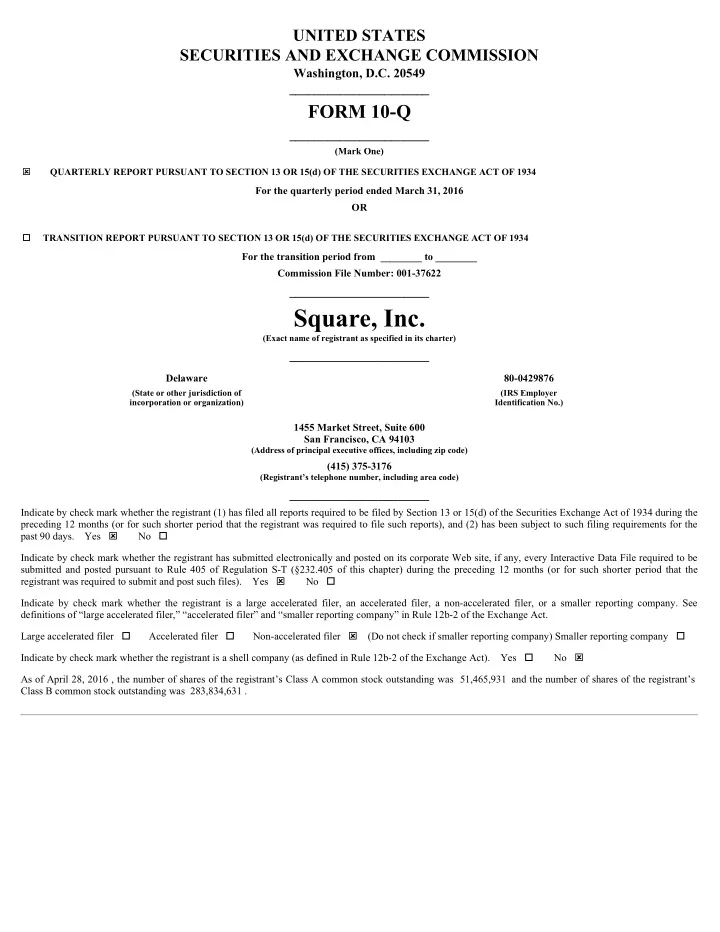
slide-36
SLIDE 36
  • f the 17 claims of the ‘946 patent stand rejected. On February 9, 2016, we filed an ex parte reexamination request at the patent office to invalidate the three

remaining claims of the ‘946 patent. On March 30, 2016, the patent office granted our request and instituted reexamination on all three claims. We moved to consolidate the 2014 Complaint with the 2010 Complaint (the Complaints), and the District Court granted our motion on July 16, 2014. We moved to dismiss certain claims as time barred under California and Delaware law, and the District Court denied the motion on October 16, 2014, applying Missouri law. We moved to stay counts of the 2014 Complaint related to alleged infringement of the ‘946 Patent and inventorship of certain of our patents, pending the ongoing PTO proceedings, and on April 2, 2015, the District Court granted our motion to stay. The District Court has issued a scheduling order that sets forth the current expected schedule of important events in the proceedings, but no assurances can be given that the schedule will not change. A two-week trial is currently scheduled for June 13, 2016. We are vigorously defending against the Complaints. Notably, we filed a Motion for Summary Judgment on January 20,

  • 2016. On April 22, 2016, the District Court denied our Motion for Summary Judgment. We recently signed a binding term sheet with Mr. Morley and REM

stipulating the material terms of a settlement. While the final definitive agreement has not yet been finalized, we have recorded a charge of $50.0 million in general and administrative expenses for three months ended March 31, 2016. Until we enter into a final definitive agreement, we can make no assurances about the specific settlement terms, including monetary and nonmonetary terms. Additionally, we are involved in a class action lawsuit concerning independent contractors in connection with our Caviar business. On March 19, 2015, Jeffry Levin, on behalf of a putative nationwide class, filed a lawsuit in the Northern District of California against our wholly owned subsidiary, Caviar, Inc., which, as amended, alleges that Caviar misclassified Mr. Levin and other similarly situated couriers as independent contractors and, in doing so, violated various provisions of the California Labor Code and California Business and Professions Code by requiring them to pay various business expenses that should have been borne by Caviar. Mr. Levin also sought an award of penalties pursuant to the Labor Code Private Attorneys General Act of 2004 on behalf of the putative class. On March 29, 2016, the Court entered a Notice of Intent to Dismiss the lawsuit, and on May 2, 2016, the Court dismissed the lawsuit in its entirety. The parties stipulated that certain dismissed claims may be pursued by a different courier, if plaintiff's counsel so chooses. In addition, from time to time, we are involved in various other litigation matters and disputes arising in the ordinary course of business. While it is not feasible to predict or determine the ultimate outcome of these matters, we believe that none of our current legal proceedings will have a material adverse effect on

  • ur business.

Item 1A. Risk Factors The risks described in Item 1A, “Risk Factors,” contained in our Annual Report on Form 10-K for the year ended December 31, 2015 , could materially and adversely affect our business, financial condition, and results of operations. There have been no material changes in such risks during the three months ended March 31, 2016 . Item 2. Unregistered Sales of Equity Securities and Use of Proceeds Not applicable. Item 3. Defaults Upon Senior Securities Not applicable. Item 4. Mine Safety Disclosures Not applicable. Item 5. Other Information Not applicable. 36

slide-37
SLIDE 37

Item 6. Exhibits The documents listed in the Exhibit Index of this Quarterly Report on Form 10-Q are filed with this Quarterly Report on Form 10-Q (numbered in accordance with Item 601 of Regulation S-K). 37

slide-38
SLIDE 38

SIGNATURES Pursuant to the requirements of the Securities Exchange Act of 1934, the registrant has duly caused this report to be signed on its behalf by the undersigned thereunto duly authorized. SQUARE, INC. Date: May 6, 2016 By: /s/ Jack Dorsey Jack Dorsey President, Chief Executive Officer, and Chairman (Principal Executive Officer) By: /s/ Sarah Friar Sarah Friar Chief Financial Officer (Principal Accounting and Financial Officer) 38

slide-39
SLIDE 39

EXHIBIT INDEX Exhibit Number Description 31.1 Certification of Chief Executive Officer pursuant to Exchange Act Rules 13a-14(a) and 15d-14(a), as adopted pursuant to Section 302 of the Sarbanes-Oxley Act of 2002. 31.2 Certification of Chief Financial Officer pursuant to Exchange Act Rules 13a-14(a) and 15d-14(a), as adopted pursuant to Section 302 of the Sarbanes-Oxley Act of 2002. 32.1† Certifications of Chief Executive Officer and Chief Financial Officer pursuant to 18 U.S.C Section 1350, as adopted pursuant to Section 906 of the Sarbanes-Oxley Act of 2002. 101.INS XBRL Instance Document. 101.SCH XBRL Taxonomy Extension Schema Document. 101.CAL XBRL Taxonomy Extension Calculation Linkbase Document. 101.DEF XBRL Taxonomy Extension Definition Linkbase Document. 101.LAB XBRL Taxonomy Extension Labels Linkbase Document. 101.PRE XBRL Taxonomy Extension Presentation Linkbase Document. † The certifications attached as Exhibit 32.1 that accompany this Quarterly Report on Form 10-Q are deemed furnished and not filed with the Securities and Exchange Commission and are not to be incorporated by reference into any filing of Square, Inc. under the Securities Act of 1933, as amended, or the Securities Exchange Act of 1934, as amended, whether made before or after the date of this Quarterly Report on Form 10-Q, irrespective of any general incorporation language contained in such filing. 39

slide-40
SLIDE 40

Exhibit 31.1 CERTIFICATION OF CHIEF EXECUTIVE OFFICER PURSUANT TO SECURITIES EXCHANGE ACT OF 1934 RULES 13a-14(a) AND 15d-14(a), AS ADOPTED PURSUANT TO SECTION 302 OF THE SARBANES-OXLEY ACT OF 2002 I, Jack Dorsey, certify that: 1. I have reviewed this Quarterly Report on Form 10-Q of Square, Inc.; 2. Based on my knowledge, this report does not contain any untrue statement of a material fact or omit to state a material fact necessary to make the statements made, in light of the circumstances under which such statements were made, not misleading with respect to the period covered by this report; 3. Based on my knowledge, the financial statements, and other financial information included in this report, fairly present in all material respects the financial condition, results of operations and cash flows of the registrant as of, and for, the periods presented in this report; 4. The registrant's other certifying officer and I are responsible for establishing and maintaining disclosure controls and procedures (as defined in Exchange Act Rules 13a-15(e) and 15d-15(e)) for the registrant and have: a. Designed such disclosure controls and procedures, or caused such disclosure controls and procedures to be designed under our supervision, to ensure that material information relating to the registrant, including its consolidated subsidiaries, is made known to us by others within those entities, particularly during the period in which this report is being prepared; b. Evaluated the effectiveness of the registrant's disclosure controls and procedures and presented in this report our conclusions about the effectiveness of the disclosure controls and procedures, as of the end of the period covered by this report based on such evaluation; and c. Disclosed in this report any change in the registrant's internal control over financial reporting that occurred during the registrant's most recent fiscal quarter (the registrant's fourth fiscal quarter in the case of an annual report) that has materially affected, or is reasonably likely to materially affect, the registrant's internal control over financial reporting; and 5. The registrant's other certifying officer and I have disclosed, based on our most recent evaluation of internal control over financial reporting, to the registrant's auditors and the audit committee of the registrant's board of directors (or persons performing the equivalent functions): a. All significant deficiencies and material weaknesses in the design or operation of internal control over financial reporting which are reasonably likely to adversely affect the registrant's ability to record, process, summarize and report financial information; and b. Any fraud, whether or not material, that involves management or other employees who have a significant role in the registrant's internal control over financial reporting. Date: May 6, 2016 By: /s/ Jack Dorsey Jack Dorsey President, Chief Executive Officer, and Chairman

slide-41
SLIDE 41

Exhibit 31.2 CERTIFICATION OF CHIEF FINANCIAL OFFICER PURSUANT TO SECURITIES EXCHANGE ACT OF 1934 RULES 13a-14(a) AND 15d-14(a), AS ADOPTED PURSUANT TO SECTION 302 OF THE SARBANES-OXLEY ACT OF 2002 I, Sarah Friar, certify that: 1. I have reviewed this Quarterly Report on Form 10-Q of Square, Inc.; 2. Based on my knowledge, this report does not contain any untrue statement of a material fact or omit to state a material fact necessary to make the statements made, in light of the circumstances under which such statements were made, not misleading with respect to the period covered by this report; 3. Based on my knowledge, the financial statements, and other financial information included in this report, fairly present in all material respects the financial condition, results of operations and cash flows of the registrant as of, and for, the periods presented in this report; 4. The registrant's other certifying officer and I are responsible for establishing and maintaining disclosure controls and procedures (as defined in Exchange Act Rules 13a-15(e) and 15d-15(e)) for the registrant and have: a. Designed such disclosure controls and procedures, or caused such disclosure controls and procedures to be designed under our supervision, to ensure that material information relating to the registrant, including its consolidated subsidiaries, is made known to us by others within those entities, particularly during the period in which this report is being prepared; b. Evaluated the effectiveness of the registrant's disclosure controls and procedures and presented in this report our conclusions about the effectiveness of the disclosure controls and procedures, as of the end of the period covered by this report based on such evaluation; and c. Disclosed in this report any change in the registrant's internal control over financial reporting that occurred during the registrant's most recent fiscal quarter (the registrant's fourth fiscal quarter in the case of an annual report) that has materially affected, or is reasonably likely to materially affect, the registrant's internal control over financial reporting; and 5. The registrant's other certifying officer and I have disclosed, based on our most recent evaluation of internal control over financial reporting, to the registrant's auditors and the audit committee of the registrant's board of directors (or persons performing the equivalent functions): a. All significant deficiencies and material weaknesses in the design or operation of internal control over financial reporting which are reasonably likely to adversely affect the registrant's ability to record, process, summarize and report financial information; and b. Any fraud, whether or not material, that involves management or other employees who have a significant role in the registrant's internal control over financial reporting. Date: May 6, 2016 By: /s/ Sarah Friar Sarah Friar Chief Financial Officer

slide-42
SLIDE 42

Exhibit 32.1 CERTIFICATIONS OF CHIEF EXECUTIVE OFFICER AND CHIEF FINANCIAL OFFICER PURSUANT TO 18 U.S.C. SECTION 1350, AS ADOPTED PURSUANT TO SECTION 906 OF THE SARBANES-OXLEY ACT OF 2002 I, Jack Dorsey, certify, pursuant to 18 U.S.C. Section 1350, as adopted pursuant to Section 906 of the Sarbanes-Oxley Act of 2002, that the Quarterly Report on Form 10-Q of Square, Inc. for the fiscal quarter ended March 31, 2016 fully complies with the requirements of Section 13(a) or 15(d) of the Securities Exchange Act of 1934 and that information contained in such Quarterly Report on Form 10-Q fairly presents, in all material respects, the financial condition and results of

  • perations of Square, Inc.

Date: May 6, 2016 By: /s/ Jack Dorsey Jack Dorsey President, Chief Executive Officer, and Chairman I, Sarah Friar, certify, pursuant to 18 U.S.C. Section 1350, as adopted pursuant to Section 906 of the Sarbanes-Oxley Act of 2002, that the Quarterly Report on Form 10-Q of Square, Inc. for the fiscal quarter ended March 31, 2016 fully complies with the requirements of Section 13(a) or 15(d) of the Securities Exchange Act of 1934 and that information contained in such Quarterly Report on Form 10-Q fairly presents, in all material respects, the financial condition and results of

  • perations of Square, Inc.

Date: May 6, 2016 By: /s/ Sarah Friar Sarah Friar Chief Financial Officer