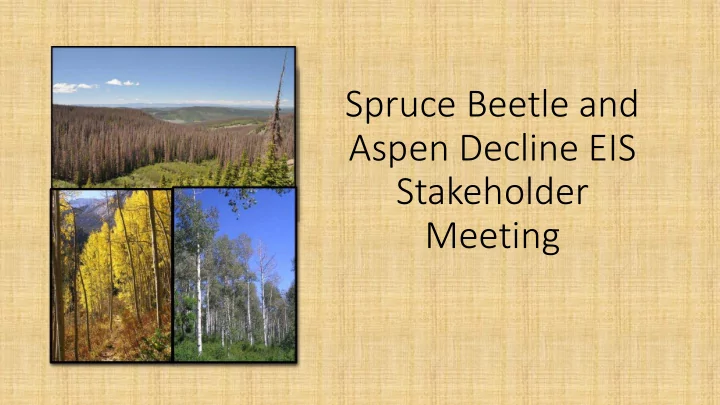
Spruce Beetle and Aspen Decline EIS Stakeholder Meeting EIS - - PowerPoint PPT Presentation
Spruce Beetle and Aspen Decline EIS Stakeholder Meeting EIS Update Objection process concluded May 5 8 objection letters, 4 objections resolved Copies available on SBEADMR project page Forest is addressing instructions from
EIS Update
- Objection process concluded May 5
- 8 objection letters, 4 objections resolved
- Copies available on SBEADMR project page
- Forest is addressing instructions from Reviewing Officer
- Awaiting Biological Opinion from Fish & Wildlife Service
- Final Record of Decision anticipated in June
- Implementation of field surveys this summer/fall
Purpose and Need
Public Safety
- Remove hazard trees near roads and infrastructure, both within and outside the
wildland urban interface (WUI).
- Increase the extent of defensible space around values at risk and provide safer
locations from which firefighters can initiate fire management actions. Resiliency
- Increase the forests’ ability to respond to multiple and interacting stresses,
including climate change, insect attack, drought or disease. Recovery
- Provide commercial forest products to local dependent industries
- Post harvest activities including: treat fuels, prepare sites, and re-establish and
maintain forest cover via replanting where seed sources are lacking.
4
- 1. Consult FEIS/ROD for direction on treatment priorities,
design features, and other implementation parameters Results used to verify or modify subsequent
- actions. Cycle continues through life of ROD
- 2. Delineate potential treatment areas within FEIS priority treatment areas (PTAs)
- 3. Conduct off-season workshop
5. Prepare detailed treatment plan with layout, applicable design features & monitoring requirements
- 6. Publish notice for opportunity to comment on updated treatment list and refined maps
- 4. Complete field surveys for treatments
- 7. Conduct public field trips of treatment areas
- 8. Finalize treatment design checklist
- 9. Implement treatments including administration of contract
terms, and other instruments incorporating plan requirements
- 10. Complete monitoring
- 11. Conduct formal post-treatment field review
- 12. Conduct management review by forest leadership team
- 13. Publish annual report of implementation activities
Figure 1 (Appendix E). Adaptive implementation and monitoring framework.
Adaptive Implementation Framework
- 1. Consult FEIS/ROD for direction on treatment priorities, design features,
and other implementation parameters
- 2. Delineate potential treatment areas within FEIS priority treatment areas (PTAs)
- 3. Conduct off-season workshop (NOW)
- 4. Complete field surveys for treatments
- 5. Prepare detailed treatment plan with layout, applicable design features
& monitoring requirements
- 6. Publish notice for opportunity to comment on updated treatment list and
refined maps
- 7. Conduct public field trips of treatment areas
- 8. Finalize treatment design checklist
Adaptive Implementation Framework
Pre-Implementation
- Review updated maps of proposed treatment units, evaluate, discuss and comment on
priority sequencing of treatments, treatment prescriptions, EIS/ROD compliance;
- Provide feedback to the Forest Service regarding prior-year Management Review;
- Input on types and location of monitoring. Participants will be invited to participate in
monitoring during summer field trips;
- Identify applicable peer-reviewed science to be considered in annual science
summary;
- Raise questions and make suggestions to be considered for further administrative
study and multi-party monitoring.
Stakeholder opportunities today (from Appendix E):
Priority Treatment Areas – East Zone
GA Name Combination Resiliency Salvage Total Gunnison Basin North 6296 6548 1548 14391 Gunnison Basin South 10430 4254 11085 25768 Total 16725 10802 12632 40160
GA & LAU Name Burn and Mechanical Gunnison Basin North 14384 Gunnison Basin South 12414 Total 26798
East Zone – Desired Condition & Trends
Integrated Planning Areas – East Zone (Timber, Fuels, Wildlife)
2017
- Skeleton*
- Nutras*
- Willow Mesa*
- Pauline*
- Small Sales*
2018
- Cooler*
- Sargents Mesa*
- Small Sales*
- Willow Creek
(noncommercial) 2019
- Alpine Plateau 1*
- Lujan*
- Small Sales*
- One Mile
(noncommercial) 2020
- Alpine Plateau 2*
- Small Sales*
*Recovery Treatment
Integrated Planning & Implementation
- Fuels removal and fuel loading reduction
- Identify strategic locations to reduce fuel loading and create discontinuous fuel continuity to
enhance protection of values at risk.
- Increase public and firefighter safety through reducing fuels along priority egress routes.
- Increase firefighter safety by reducing fuel loading to create safer locations from which firefighters
can plan and initiate tactical actions.
- Wildlife habitat objectives
- Identify key areas to provide snowshoe hare, pine marten, and lynx denning habitat
- Identify areas where high amounts of regeneration are expected post-treatment
- Retain snags by implementing design features
- Landscape-scale habitat connectivity
- Promote aspen regeneration
- Post-harvest site preparation and tree planting in areas where stocking does not
meet minimum standards
- Road maintenance
Los Pinos Pass/Big Meadows
- Recovery treatments
- Desired Future Condition
- Uneven age stand structure
- Diversify tree species
- Reforestation
Known Design Feature Triggers
- Wilderness Boundary
- Wetland areas—Willow Mesa
- Stream Crossings (temp roads)
- Maintain habitat connectivity
(lynx; American marten)
- Known goshawk nests in areas
- American marten documented in
areas
Sargents Mesa
- Recovery treatments
- Desired Future Condition
- Uneven age stand structure
- Diversify tree species
- Reforestation
Known Design Feature Triggers
- Continental Divide NST
- American marten documented in
area
- Wetland areas (buffer)
- Hydrology emphasis (headwaters
- f Tank 7 Creek)
Skeleton
- Recovery treatment
- Desired Future Condition
- Uneven age stand structure
- Diversify tree species
- Reforestation
Known Design Feature Triggers
- Wetland areas (north)
- Potential for Boreal Toads
- Survey to be conducted this
summer
Integrated Planning Areas – East Zone (Timber, Fuels, Wildlife)
- Resiliency treatment
- Desired Future Condition
- Reduce hazardous
fuels
- Promote aspen
regeneration using prescribed burns
- Enhance big game
habitat
- Design Feature Triggers
- Known flammulated
- wl nests and
potential for goshawk nests in areas
Priority Treatment Areas – West Zone
GA & LAU Name Combination Resiliency Salvage Total Uncompahgre Plateau 13673 14159 351 28183
GA & LAU Name Burn and Mechanical Uncompahgre Plateau 3857
West Zone – Desired Condition & Trends
Priority Treatment Areas – West Zone
GA & LAU Name Combination Resiliency Salvage Total San Juans 7772 2590 1830 12193
GA & LAU Name Burn and Mechanical San Juans 379
West Zone – Desired Condition & Trends
Integrated Planning Areas – West Zone (Timber, Fuels, Wildlife)
Little Cone FY 17 West Fork Road Treatment FY 17, High Mesa FY 18 and Big Park FY 19 Fuels/ Wildlife Treatment
Integrated Planning Areas – West Zone (Timber, Fuels, Wildlife)
Little Cone
- Planned FY 2017
- Found active beetle spots
- Combination of Recovery & Resiliency
- Desired Future Condition
- Uneven aged stand structure
- Design Feature Triggers
- Access, mostly land locked portion of forest
Integrated Planning Areas – West Zone (Timber, Fuels, Wildlife)
High Mesa
- Planned FY 2018
- Monitoring Spruce Beetle Activity
- Will conduct reconnaissance in
2016/2017
High Mesa FY 18 West Fork Road Area Big Park FY19
Big Park
- Planned FY 2019
- Will begin reconnaissance in 2017/18
Integrated Planning Areas – West Zone (Timber, Fuels, Wildlife)
West Fork (FSR 858/ 860)
- Planned FY 2018
- Will conduct reconnaissance in
2016/2017
- Apply design features to culverts
- Roadside Hazard Treatment
West Fork Road Area
Integrated Planning Areas – West Zone (Timber, Fuels, Wildlife)
Read Hill Spring Creek Fuels/ Wildlife Treatment
Integrated Planning Areas – West Zone (Timber, Fuels, Wildlife)
Reade Hill
- Implementation 2018
- Aspen Regeneration/WUI
- Desired Future Condition
- Multiple age-classes
- Opportunities and Need for
Coordination
- Power Transmission Line
- Electronic Site.
Integrated Planning Areas – West Zone (Timber, Fuels, Wildlife)
Spring Creek
- Implementation 2018
- Aspen Regeneration/WUI
- Desired Future Condition
- Multiple age-classes
- Opportunities and
Need for Coordination
- Power Transmission Line
Priority Treatment Areas – North Zone
GA Name Combination Resiliency Salvage Total Grand Mesa 8805 6149 485 15440
GA & LAU Name Burn and Mechanical Grand Mesa 9301
North Zone – Desired Condition & Trends
Priority Treatment Areas – North Zone
GA & LAU Name Combination Resiliency Salvage Total North Fork Valley 3356 4941 544 8842
GA & LAU Name Burn and Mechanical Mechanical Only Total North Fork Valley 2340 198 2538
North Zone – Desired Condition & Trends
Integrated Planning Areas – North Zone Commercial Treatments
2018
- Horse Mountain Salvage
2019
- Military Park
2020
- Hubbard
- Overland
Integrated Planning Areas – North Zone Commercial Treatments
Horse Mountain
- Planned FY 2018
- Found active beetle spots
- Combination of Recovery & Resiliency
- Desired Future Condition
- Uneven aged stand structure
- Diversify tree species
- Known Triggers for Design Features
- Snowmobile trails in area
- Known stream in N & S ends of sale
Integrated Planning Areas – North Zone Commercial Treatments Military Park
- Planned FY 2019
- Found active beetle spots
- Combination (Recovery, Resiliency)
- Desired Future Condition
- Uneven aged stand structure
- Diversify tree species
- Known Design Feature Triggers
- Range fences in area
- Fence or manage livestock post-treatment
- Wet areas are common
Integrated Planning Areas – North Zone Commercial Treatments
Hubbard
- Planned FY 2020
- Resiliency treatment
- Desired Future Condition
- Uneven aged stand structure
- Diversify tree species
- Known Design Feature Triggers
- Goshawk nests in area
- Cutthroat in area
- Wetlands
- Snowmobile trails in area
- Ditches
Integrated Planning Areas – North Zone Commercial Treatments
Overland
- Planned FY 2020
- Resiliency treatment
- Desired Future Condition
- Uneven aged stand structure
- Diversify tree species
- Known Design Feature Triggers
- Goshawk in area
- Peregrine Falcon in area
- Cutthroat in area
Non Non-Commercial Treatment Area – North Zone
Pla lanned Surv rveys in in the North Zone – All ll Treatment Areas
- Invasive plant surveys in high risk areas
- Northern Goshawk Surveys in Suitable Habitat
- Remote Camera stations to monitor Marten use and
presence
- Boreal Owl surveys/assessments in suitable spruce
habitat
- Dense Horizontal Cover Surveys
- Other Wildlife surveys as appropriate
- Archaeological Surveys