Spontaneous generation HISTORY OF LIFE principle that living - - PDF document

spontaneous generation history of life principle that
SMART_READER_LITE
LIVE PREVIEW

Spontaneous generation HISTORY OF LIFE principle that living - - PDF document

2/18/2013 Where does life on Earth come from? Spontaneous generation HISTORY OF LIFE principle that living things could arise from non living things ON EARTH Biogenesis principle that states that all living things come from other


slide-1
SLIDE 1

2/18/2013 1

HISTORY OF LIFE ON EARTH

Where does life on Earth come from?

  • Spontaneous generation

principle that living things could arise from non living things

  • Biogenesis

principle that states that all living things come from other living things

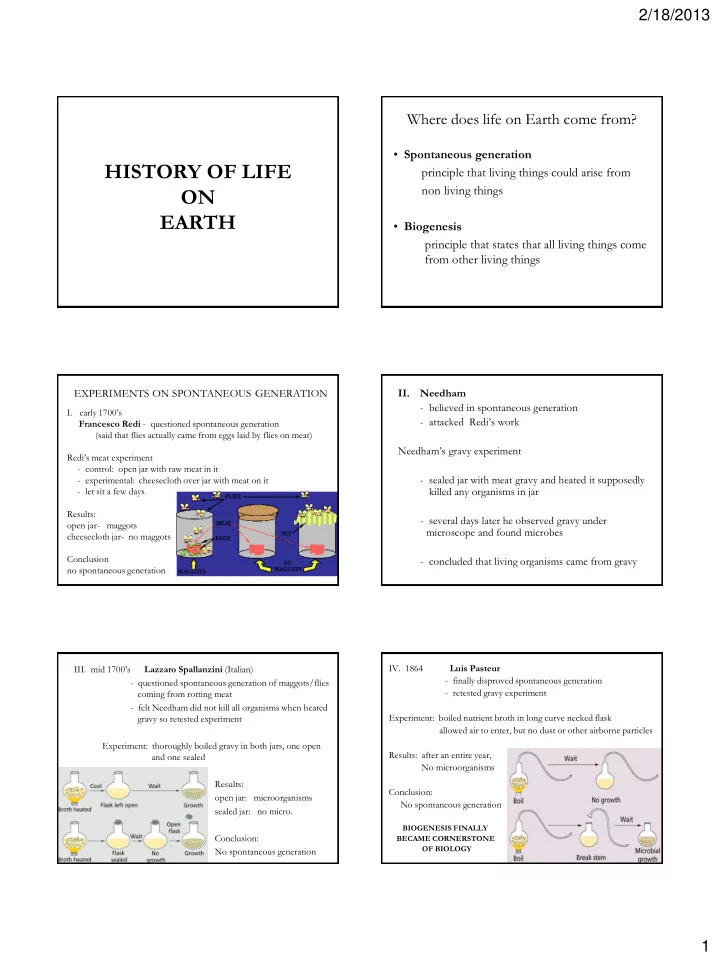
EXPERIMENTS ON SPONTANEOUS GENERATION

  • I. early 1700’s

Francesco Redi - questioned spontaneous generation (said that flies actually came from eggs laid by flies on meat) Redi’s meat experiment

  • control: open jar with raw meat in it
  • experimental: cheesecloth over jar with meat on it
  • let sit a few days

Results:

  • pen jar- maggots

cheesecloth jar- no maggots Conclusion no spontaneous generation

II. Needham

  • believed in spontaneous generation
  • attacked Redi’s work

Needham’s gravy experiment

  • sealed jar with meat gravy and heated it supposedly

killed any organisms in jar

  • several days later he observed gravy under

microscope and found microbes

  • concluded that living organisms came from gravy
  • III. mid 1700’s Lazzaro Spallanzini (Italian)
  • questioned spontaneous generation of maggots/flies

coming from rotting meat

  • felt Needham did not kill all organisms when heated

gravy so retested experiment Experiment: thoroughly boiled gravy in both jars, one open and one sealed Results:

  • pen jar: microorganisms

sealed jar: no micro. Conclusion: No spontaneous generation

  • IV. 1864

Luis Pasteur

  • finally disproved spontaneous generation
  • retested gravy experiment

Experiment: boiled nutrient broth in long curve necked flask allowed air to enter, but no dust or other airborne particles Results: after an entire year, No microorganisms Conclusion: No spontaneous generation

BIOGENESIS FINALLY BECAME CORNERSTONE OF BIOLOGY

slide-2
SLIDE 2

2/18/2013 2

EARTH’S HISTORY

Earth’s age: - about 4.6 billion years old THEORIES

  • Big Bang Theory
  • evidence shows 15 billion years ago universe was a concentrated super

dense mass

  • this mass exploded, hurled matter and energy into space
  • gravity pulled some matter together to form galaxies and stars
  • gravity also pulled matter into orbit around stars
  • sun attracted clumps of matter (planets), and planets attracted smaller

clumps of matter (moons)

  • meteors: thought to be bits of material left over from formation of
  • ur solar system.
  • Gas and dust cloud condensed into a sphere
  • millions of years afterward volcanic activity and

meteorites showers shook the earth

  • at about 3.8 billion years earth cooled and was

drenched with thundestorms for many thousands of years forming oceans

  • water vapor (from meteorites, which contain ice ) in

atmosphere cooled to help form oceans (thought this is where life first formed)

Determining the Age of the Earth

  • radioactive dating: how age of

earth determined

  • radioisotope: unstable isotopes of

certain elements that break down (decay) and lose

  • neutrons. As they break

down, they release charged particles (electrons) in the form of radioactivity

  • decay: changing of one element

into another as elec. are given off

  • half life: time period in which

half the initial number of atoms decay into atoms

  • f the element they change

into (non radioactive)

By knowing the time of the half life and how many have passed, number of years can be calculated by counting number of atoms left in sample.

FORMATION OF BASIC CHEMICALS OF LIFE We have a good idea of how old the earth is and how it formed, but what about life on earth?

Simple organic molecules energized by UV light and volcanic heat formed complex molecules that became building blocks of first cells.

Models of Formation of Life

  • 1. Primordial Soup Model

1920’s: Oparin (Russian), Haldane (British)

  • Atmosphere made of H2O vapor, NH3, CH4, and CO2

(no free O2- atmosphere couldn’t sustain life )

  • Thunderstorm drenched earth
  • Oceans contained large amount of organic molecules

(like soup with many vegetables and meats)

  • Molecules pushed together by energy of sun and lightening
  • Molecules split, and formed new organic molecules (a.a.,

nucleic acids)

slide-3
SLIDE 3

2/18/2013 3

1953: Miller, Urey Tested primordial soup model by placing same molecules in chamber with electric sparks. After few days found

  • rganic molecules were

formed.

Miller/Urey model later tested and proved incorrect. No ozone to protect earth so NH4 and CH4 destroyed. No organic molecules made.

  • 2. Bubble Model

1986: Luis Lerman Process to form life took place within bubbles on ocean’s surface.

  • CH4, NH3 from undersea volcanoes were trapped in

underwater bubbles and protected from UV

  • bubbles rose and burst

releasing molecules into air

  • now exposed to UV in

presence of O2 and able to react

  • organic molecules then

formed 3. Organic compounds come from beyond earth from meteorites rather than originating on the earth. (new hypothesis) NO ONE UNIFIED THEORY, BUT SCIENTISTS AGREE THAT LIFE FORMED FROM NON LIVING MOLECUELS THRU A SERIES OF CHEMICAL REACTIONS.

Organic Molecules become Cell Like Structures

Microspheres- spherical structures composed of many protein molecules organized as a membrane Coacervates- collections of droplets composed of different types of molecules (such as linked amino acids and sugars)

  • both can form spontaneously and contain lifelike

properties * growth * reproduction- budding * arise without direction from genes They are not alive because they do NOT have HEREDITY ***Microspheres may have led to cells***

FIRST LIFE FORMS/ORIGIN OF HEREDITY Why doesn’t DNA directly carry out protein synthesis? It is hypothesized that some RNA molecules act like proteins and catalyze reactions itself . (due to ability to take different shapes)

slide-4
SLIDE 4

2/18/2013 4

Roles of RNA

  • Ribozymes- type of RNA found in some unicellular eukarytoes
  • able to act as an enzyme and replicate itself

(Thomas Cech- early 1980’s)

  • Self replicating RNA- new studies indicate that life may have started

this way

  • it would:
  • a. have heredity: be able to provide hereditary

information that cell like structures lack

  • b. be able to respond to natural selection and evolve

DEVELOPMENT OF COMPLEX ORGANISMS

I. Prokaryotes

  • A. archaebacteria: unicellular organisms which have no peptidoglycans

in cell walls, unique lipids in cell membranes

  • thrived under harsh environmental conditions
  • most likely first organisms on earth
  • probably anaerobes (very little oxygen present)
  • chemiautotrophs: CO2 serves as carbon source to make
  • rganic molecules
  • evidence indicates eukaryotes evolved

from these

  • cyanobacteria: more modern photosynthetic bacteria that

released oxygen into the atmosphere (3.5 billion years ago)

  • B. eubacteria: unicellular, contain peptidoglycans in cell wall

and similar lipids in cell membrane as eukaryotes

II. Eukaryotes Endosymbiosis: mutually successful beneficial relationship between two organisms

mitochondria- evolved from non-photosynthetic bacteria invading bacteria chloroplasts- evolved from photosynthetic bacteria invading bacteria (closely related to cyanobacteria)

  • both have own genes
  • able to replicate on their own

(plasmids)

  • III. Land life

Formation of ozone in upper atmosphere allowed life on land. This occurred about 2.5 billion years ago:

  • Cyanobacteria added oxygen to atmosphere from

photosynthesis.

  • Oxygen destabilized by UV formed ozone.

Sea life  Plants & fungi  Arthropods  Vertebrates

slide-5
SLIDE 5

2/18/2013 5

First land life thought to be plants and fungi living together. (able to undergo photosynthesis)

Mutualism: relationship where both

  • rganisms work together and

benefit from each other Plants: evolved from photosynthetic protists (eukaryotes)

  • couldn’t get minerals from rocks

Fungi: could absorb minerals from rock,

  • couldn’t make nutrients
  • mycorrhizae: (fungus/roots)

relationshiop between fungi and plants 100 million years ago land became covered with dense forests.

  • Arthropods were first animals to invade land from sea

(hard outer segmented exoskeleton, jointed limbs) ex: lobsters, crabs, insects, spiders, scorpions

  • Vertebrates came next - came out of sea 370 M years ago
  • a. fishes (very successful, ½ all modern vertebrates)
  • b. amphibians (smooth skinned, four legs, need H2O)
  • ex: frogs, toads, salamanders
  • c. reptiles (watertight skin, can stay in dry areas)
  • ex: snakes, lizards, turtles, crocs
  • d. mammals and birds
  • birds evolved from feathered

dinosaurs during after Jurassic period

Mass extinction: episode where large numbers of species become extinct (due to weather or geologic changes on earth)

In our earth’s history there were five mass extinctions:

  • 440 M years ago: end of

Ordovician (fish and land invertebrates)

  • 360 M years ago: end of

Silurian (small mammals)

  • 245 M years ago: end of Permian (96% of all species lost)
  • 65 M years ago: 2/3 all species gone including dinosaurs
  • 35 M years ago: not as devastating