Spoken-Word Recognition Original Competition Model (Marslen-Wilson - - PowerPoint PPT Presentation

spoken word recognition
SMART_READER_LITE
LIVE PREVIEW

Spoken-Word Recognition Original Competition Model (Marslen-Wilson - - PowerPoint PPT Presentation

0 Spoken-Word Recognition Original Competition Model (Marslen-Wilson et al. 78, cohorts): Word onset activates all words consistent with acoustic input These candidates compete for recognition As input unfolds, candidates


slide-1
SLIDE 1

Garance PARIS 17th October 2008 Brueckenkurs

Spoken-Word Recognition

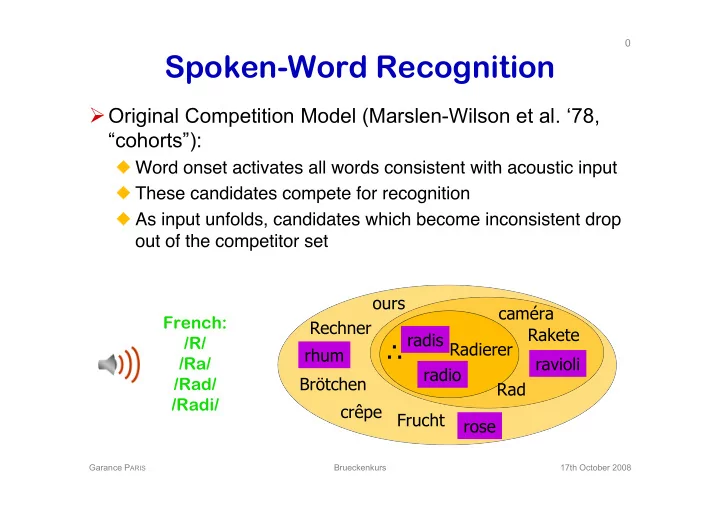
  • Original Competition Model (Marslen-Wilson et al. ‘78,

“cohorts”):

 Word onset activates all words consistent with acoustic input  These candidates compete for recognition  As input unfolds, candidates which become inconsistent drop

  • ut of the competitor set

French: /R/ Radierer . . . radis radio Rad Rakete caméra ravioli /Ra/ /Rad/ /Radi/ Rechner Frucht rose rhum

  • urs

Brötchen crêpe

slide-2
SLIDE 2

1

Garance PARIS 17th October 2008 Brueckenkurs

Comparison with Computers

  • Process complete words
  • Search through a list of words
  • Human processing: Incremental

More Properties of SPWR

  • Not only onset but also sounds in the middle of the word

and offsets activate candidates

  • Syntactical context has an influence (e.g. part-of-speech)‏
  • Words in all languages spoken are considered
slide-3
SLIDE 3

2

Garance PARIS

Eyetracking in Visual Worlds

slide-4
SLIDE 4

3

Garance PARIS 17th October 2008 Brueckenkurs

Example Study: Tanenhaus et al., ‘95

Eyetracking is well-suited to observe competition: When participants heard the noun onset “can” , they fixated both a “candle” and a “candy” in the display “Pick up the can…”

slide-5
SLIDE 5

4

Garance PARIS 17th October 2008 Brueckenkurs

Eyetracking with Bilinguals

  • Stimuli from the irrelevant language are never presented
  • Bilinguals look at crosslinguistic competitors whose name

is phonemically similar to the target

  • E.g., when asked to pick up a marker, Russian-English

bilinguals also briefly look at a stamp, /marka/ in Russian (Marian & Spivey, 2003)

“Pick up the marker”

slide-6
SLIDE 6

5

Garance PARIS 17th October 2008 Brueckenkurs

L1 Interference in L2 Processing

  • But: Not only the

lexicon interferes,

  • ther levels do, too!
  • Here: Phonemes

from L1 interfere with SPWR in L2

slide-7
SLIDE 7

6

Garance PARIS 17th October 2008 Brueckenkurs

Modelling

  • Forces clear specification of theories instead of vague

descriptions by requiring sufficient detail for implementation

  • Test the coherence of a theory, especially when

interactions between parts is complex

  • Generate testable predictions
  • Permit manipulations that may not be possible in

experiments (lesioning, long term changes, e.g. learning vocabulary in a foreign language)

slide-8
SLIDE 8

7

Garance PARIS 17th October 2008 Brueckenkurs

Connectionism/Neural Networks

  • Metaphor: Neurons
  • Simple units passing

activation (// electric brain activity)‏

  • Parallel processing
  • Learn from data
  • Modelling human

processing (“Coli”) + also used today in NLP