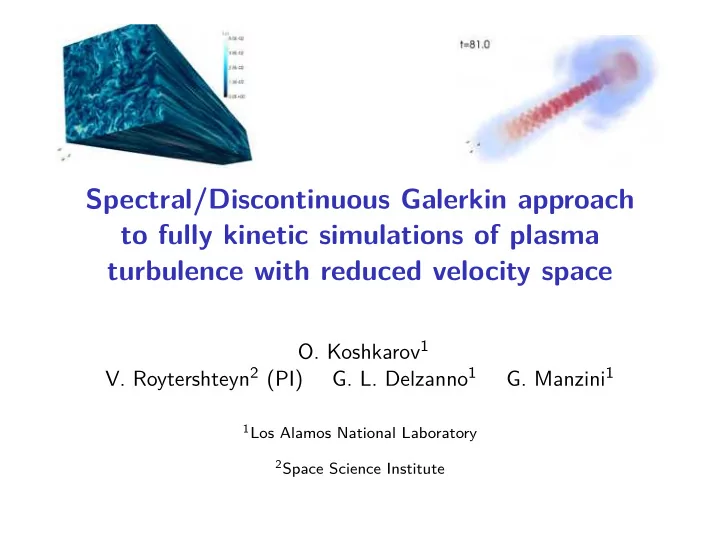
Spectral/Discontinuous Galerkin approach to fully kinetic - - PowerPoint PPT Presentation

spectral discontinuous galerkin approach to fully kinetic
SMART_READER_LITE
LIVE PREVIEW

Spectral/Discontinuous Galerkin approach to fully kinetic - - PowerPoint PPT Presentation

Spectral/Discontinuous Galerkin approach to fully kinetic simulations of plasma turbulence with reduced velocity space O. Koshkarov 1 V. Roytershteyn 2 (PI) G. L. Delzanno 1 G. Manzini 1 1 Los Alamos National Laboratory 2 Space Science Institute


slide-1
SLIDE 1

Spectral/Discontinuous Galerkin approach to fully kinetic simulations of plasma turbulence with reduced velocity space

  • O. Koshkarov1
  • V. Roytershteyn2 (PI)
  • G. L. Delzanno1
  • G. Manzini1

1Los Alamos National Laboratory 2Space Science Institute

slide-2
SLIDE 2

Motivation Spectral plasma solver Results Conclusion

We used Blue Waters to study plasma turbulence

NSF PRAC project #1614664

  • Plasma is pervasive in nature and

laboratory

  • Plasma is often in turbulent state
  • Turbulence is hard (a lot of scales)
  • Solar wind is the best accessible

example of astrophysical plasma turbulence

  • The project goal was to study solar

wind turbulence numerically in challenging regimes (close to the sun)

  • The project is at end
  • Next steps — new tools

(today’s topic) Kiyani et al., 2015

1/10

slide-3
SLIDE 3

Motivation Spectral plasma solver Results Conclusion

Vlasov-Maxwell system (VMS)

Microscopic description of collisionless plasmas

∂tfα+v·∇fα+ qα mα

  • E + v × B

c

  • ·∇vfα = 0

∂tE = c∇ × B − 4πj, ∂tB = −c∇ × E, ∇ · E = 4πρ, ∇ · B = 0, ρ =

  • α

  • fαd3v,

j =

  • α
  • fαvd3v,

where fα = fα(t, r, v), E = E(t, r), B = B(t, r).

Parameters of the Earth magnetotail, from Lapenta, JCP 2012

VMS is very difficult to solve! 6D + time ⋆ nonlinear ⋆ anisotropic ⋆ multi-scale

2/10

slide-4
SLIDE 4

Motivation Spectral plasma solver Results Conclusion

Numerical methods for VMS

  • Particle-in-cell (PIC) — standard method
  • Phase space discretization with macroparticles
  • Simple, robust, statistical noise, low accuracy, mostly explicit
  • Eulerian Vlasov solvers
  • Phase space discretization with grid
  • No statistical noise
  • Require a lot of resources: 10006 grid points = 8 exabyte
  • Transform methods — focus of this talk
  • Phase space discretization with spectral (moment) expansion
  • Fourier, Hermite basis — Armstrong et al., 70
  • Memory requirement/slow convergence might be an issue, but

Schumer & Holloway, 98; Camporeale et al, 06 showed that the Hermite basis can be optimized

  • Major advantage (for AW Hermite and Legendre basis):

Naturally bridges between fluid (few number of moments) and kinetic (large number of moments). Optimal way to include microscopic physics in large-scale simulations? (c.f., PIC-MHD coupling)

3/10

slide-5
SLIDE 5

Motivation Spectral plasma solver Results Conclusion

Spectral plasma solver framework

  • Galerkin spectral expansion for velocity space

f (t, x, v) =

  • n

Cn(t, x)Ψn

v − α

u

  • ,
  • Asymmetrically weighted Hermite polynomials
  • Natural fluid(macroscopic)-kinetic(microscopic) coupling
  • Usually small number of DOF is needed
  • Discontinuous Galerkin expansion for coordinate space

Cn(t, x) =

  • I,k

C I

k,n(t)ΦI k(x),

  • Very accurate — arbitrary order
  • Shocks and nontrivial geometry
  • Good parallel scaling
  • Advance the resulted system with explicit or implicit time

integration scheme.

  • Explicit — very fast for some problems
  • Implicit — can skip scales, conserves energy

4/10

slide-6
SLIDE 6

Motivation Spectral plasma solver Results Conclusion

Spectral plasma solver framework

Other discretizations

  • Velocity space

Fluid coupling Conservation properties Stability AW Hermite

  • SW Hermite
  • Legendre
  • /

/

  • Coordinate space
  • Pseudo spectral method based on Fourier modes

⋆ More than perfect when you fit into one node

  • Discontineous Galerkin

⋆ Great so far — perfect scalability, mass/energy conservation, arbitrary order, somewhat heavy with small CFL

  • Finite volume

⋆ Similar to DG, but with different compromises

5/10

slide-7
SLIDE 7

Motivation Spectral plasma solver Results Conclusion

Spectral plasma solver framework

Note on implementation

DG-Hermite decomposition of full Vlasov-Maxwell system:

  • Distributed memory based — 3D3V SPS-MPI via PETSc
  • Explicit time discretization (Family of different Runge-Kutta’s)
  • Implicit time discretization (conserves energy — implicit mid

point)

  • Non-linear solver: JFNK + GMRES/BCGS
  • Preconditioning (PILU from Hyper, Block Jacobi) — memory
  • ptimization is in progress

Other approaches to space discretization

  • Fourier + Hermite (efficient openMP based 2D3V and MPI

based 3D3V)

  • Finite volume/difference + Hermite
  • Legendre: Vlasov Poisson system (proof of concepts)
  • SW Hermite: Vlasov Poisson system (proof of concepts)

6/10

slide-8
SLIDE 8

Motivation Spectral plasma solver Results Conclusion

Parallel efficiency

  • 2D3V Orszag-Tang vortex test with explicit time integrator —

scales very well up to 50000 DOF per core

1 10 100 1000 288 576 1152 2304 4608 9216 18432 36864 Elapsed time in s per explicit time step Number of cores Scaling #1 Scaling #2 Scaling #3 Ideal slope 7/10

slide-9
SLIDE 9

Motivation Spectral plasma solver Results Conclusion

Example

2D Plasma turbulence: Orszag-Tang vortex

  • Excite two large scale flow vortices and let them evolve to

form small scale structures

  • SPS resolution: NxNy = 5122, NvxNvyNvz = 103
  • PIC resolution: NxNy = 35202, Np = 4000

8/10

slide-10
SLIDE 10

Motivation Spectral plasma solver Results Conclusion

Orszag-Tang vortex test

Spectrum and energy

  • Omnidirectional spectrum of magnetic field fluctuations
  • SPS is noiseless, but has numerical diffusion when spatial

resolution is not sufficient

  • Electromagnetic energy is consistent even with reduced

velocity space

9/10

slide-11
SLIDE 11

Motivation Spectral plasma solver Results Conclusion

Conclusion

  • Spectral Plasma Solver (SPS) is a unique framework to study

kinetic multi-scale plasma physics problems

  • Built-in fluid/kinetic coupling is efficient way to incorporate

microscopic physics

  • Reduced velocity space is able to reproduce important

microscopic physics

  • Mass, and energy conserving — accurate long time integration
  • Flexible time discretization — implicit or explicit as needed
  • Flexible spatial discretization (nontrivial boundary conditions)
  • Great parallel scalability (c.f. pure spectral methods)

10/10