SPECIALIST STUDIES Socio-economic Impacts Social Economic Noise - - PowerPoint PPT Presentation

specialist studies
SMART_READER_LITE
LIVE PREVIEW

SPECIALIST STUDIES Socio-economic Impacts Social Economic Noise - - PowerPoint PPT Presentation

SPECIALIST STUDIES Socio-economic Impacts Social Economic Noise Visual Heritage and cultural resources Waste Tourism Agriculture Transport Slide 22 SPECIALIST STUDY RESULTS Seismic Risk Seismic studies indicate that the design


slide-1
SLIDE 1

Slide 22

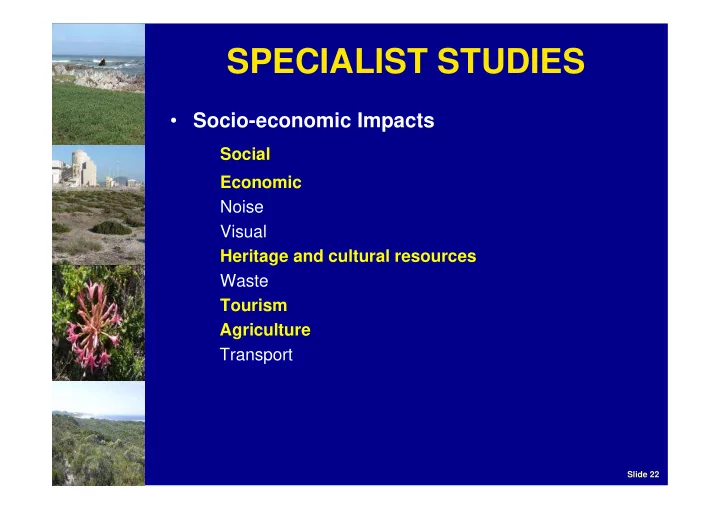
SPECIALIST STUDIES

  • Socio-economic Impacts

Social Economic Noise Visual Heritage and cultural resources Waste Tourism Agriculture Transport

slide-2
SLIDE 2

Slide 23

SPECIALIST STUDY RESULTS

  • Seismic Risk

Seismic studies indicate that the design basis for the respective sites in terms of peak ground acceleration values (PGA) are as follows: – Duynefontein – PGA ~0.30 g – Bantamsklip - PGA ~0.23 g – Thyspunt - PGA ~0.16 g

slide-3
SLIDE 3

Slide 24

SPECIALIST STUDY RESULTS

  • Impacts on Dune Geomorphology and associated

geo-hydrology (landforms, sand and water movement)

  • Groundwater does not ‘daylight’ at Duynefontein

and Bantamsklip sites: access roads and transmission lines can be built across the mobile dunes

  • The interaction between dune systems and

wetlands is complex at Thyspunt, since groundwater ‘daylights’ in many inter-dune areas

  • Haul roads and conveyor belts through Oyster Bay

dunefield at Thyspunt between the nuclear power station and the HV yard, may cause more significant dune geomorphology impacts than at the other two sites

slide-4
SLIDE 4

Slide 25

Thyspunt Oyster Bay Power station EIA corridor High voltage yard

Impacts on Dune Geomorphology

slide-5
SLIDE 5

Slide 26

SPECIALIST STUDY RESULTS

  • Impacts on Flora (plants)
  • Bantamsklip will experience the least potential

negative impact on plant communities and species

  • the ecosystems on this site are fairly common

along this section of coastline

  • Thyspunt has the greatest diversity of vegetation

communities (nine), including extensive and highly sensitive wetlands (6 of the 9 communities)

  • 383 plant species and low rare species count
  • Low endemism
  • Habitat resilience low for dunes, limestones and

wetlands

  • Important headland bypass dune system
slide-6
SLIDE 6

Slide 27

SPECIALIST STUDY RESULTS

  • Impacts on Wetlands

– Development of a nuclear power station at Duynefontein is unlikely to result in any unmitigable, highly significant negative impacts on wetlands – Development of the proposed nuclear power station at Bantamsklip would not be associated with any unmitigable impacts to wetland systems – Thyspunt wetland systems are complex and potential negative impacts could occur without appropriate mitigation – Additional monitoring in process to confirm assumptions about groundwater impacts on wetlands

slide-7
SLIDE 7

Slide 28

THYSPUNT WETLANDS

slide-8
SLIDE 8

Slide 29

SPECIALIST STUDY RESULTS

  • Impacts on Terrestrial Vertebrates (mammals and

birds)

  • Amount of land that is not of high faunal sensitivity at

Duynefontein is more than sufficient for the nuclear power station

  • At Bantamsklip the nuclear power station could have

significant negative potential impacts, without mitigation, because of the impacts on faunal habitats within the footprint

  • At Thyspunt a nuclear power station would have significant

potential negative impacts, without mitigation, because of the potential impacts on faunal habitats within the footprint, the development of two access roads and proposed infrastructure across the dunefield

slide-9
SLIDE 9

Slide 30

SPECIALIST STUDY RESULTS

  • Impacts on Terrestrial Invertebrates

(insects)

  • Potential impacts on terrestrial

invertebrate communities are similar for all alternative sites, with site-specific differences

  • Duynefontein:
  • None of the butterflies are endangered or

endemic

  • Low to very low overall insect sensitivity
  • New species of ant found is regarded as a

generalist (likely to be found on other areas of the site)

slide-10
SLIDE 10

Slide 31

SPECIALIST STUDY RESULTS

  • Impacts on Terrestrial Invertebrates
  • Thyspunt has the highest butterfly diversity and

conservation value of the alternative sites

  • From the viewpoint of potential positive impacts of

the nuclear power station, Duynefontein already positively benefits under the management of Eskom, which means that it would experience the least improvement in conservation status

  • Bantamsklip and Thyspunt would benefit

substantially from formal protection status, resulting in a net positive impact on insect communities

  • Additional site visits carried out in summer season
slide-11
SLIDE 11

Slide 32

SPECIALIST STUDY RESULTS

  • Economic Impacts
  • Positive macro-economic impacts will be greatest at

Bantamsklip and Duynefontein as the sites are situated in a province with a larger, more diversified economy. Nuclear- 1 would result in less dislocation of economic activities if located at Duynefontein than at either of the other two sites

  • Macroeconomic indicators favour Duynefontein and

Bantamsklip

  • Cost-effectiveness analysis indicates that Thyspunt is

slightly favoured relative to Duynefontein and more favoured relative to Bantamsklip.

  • The differences between the alternative sites are slight, and

all the sites would have positive economic impacts both on the local area and the province in which they are situated

  • The economic impact assessment gives greater weight to

the cost-effectiveness analysis, which favours Thyspunt

slide-12
SLIDE 12

Slide 33

SPECIALIST STUDY RESULTS

  • Heritage Impacts (archaeological sites,

cultural history and fossils)

  • All alternative sites contain significant heritage

resources

  • Duynefontein is palaeontologically highly

sensitive, but has less Stone Age heritage than Bantamsklip or Thyspunt

  • Thyspunt more sensitive than Bantamsklip in

terms of its heritage richness – sites mostly along coast at all sites. 200 m setback line recommended to protect heritage sites

  • Cultural history issues – Gamtkwa Community
slide-13
SLIDE 13

Slide 34

SPECIALIST STUDY RESULTS Marine Biology Impacts

  • Potential impacts similar at all sites and the

impacts can be mitigated if the proposed designs are implemented as planned

  • Potentially the most significant impacts are:

Disruption of the marine environment through the offshore disposal of sediment Release of warmed cooling water

  • Spoil disposal will have a potentially highly

significant long-term negative impact on the marine environment within a localised area (3 km2 initially to 6 km2 [2 x 3 km] after 5 years) – acceptable impact according to marine specialist

slide-14
SLIDE 14

Slide 35

SPECIALIST STUDY RESULTS

Marine Biology Impacts

  • Impacts on Chokka fishing industry:
  • Chokka spawn at depths less than 50 m
  • Recommended that spoil must be released in

depths more than 50 m (1.4 - 1.8 km offshore) and medium pumping rate

  • Warm water release recommendations to aid

heat dissipation:

  • tunnelled design
  • multiple release points
  • high flow rate
  • above sea floor
slide-15
SLIDE 15

Slide 36

SPECIALIST STUDY RESULTS

Marine Biology Impacts

  • Radionuclides such as Cesium (Cs-137) and

Strontium (Sr-90) present in oceans alongside

  • ther elements since 1940s
  • Background Cesium has been recorded at

Koeberg before the power station was established

  • detected in mussels, sand mussels and fish

below levels at which further investigation would be required

  • Strontium not recorded in marine organisms at

Koeberg

  • Due to few organisms in which Cesium has been

recorded, low concentrations and lack of Strontium, these nuclides have no detectable potential impact on marine organisms

slide-16
SLIDE 16

Slide 37

SPECIALIST STUDY RESULTS

Social Impacts

  • Potential negative impacts relate to

accommodation for temporary workers during construction

  • Potential positive impact is the provision
  • f electricity and related benefits to the

broader national and regional economies

  • Perceived risks associated with nuclear

incidents could potentially lead to a change in attitude and behaviour – reliable information is important

  • Need for Eskom to agree with authorities
  • n responsibility for infrastructure

provision

slide-17
SLIDE 17

Slide 38

SPECIALIST STUDY RESULTS Tourism Impacts

  • Communities at Thyspunt and Bantamsklip have

expressed opposition to the proposed power station

  • Thyspunt community highlighted the premium

nature of the top-end coastal vacation destination

  • Bantamsklip community emphasised the new

and fragile nature of the developing tourism product and the local dependence thereon

  • Some Duynefontein tourism stakeholders have

personal objections to another power station, however they recognise the potential for increased business and promote a generally positive outlook for tourism

slide-18
SLIDE 18

Slide 39

SPECIALIST STUDY RESULTS

Tourism Impacts

  • Assessment takes account decline in nature-

based tourism as well as an increase in business- related tourism associated with the proposed nuclear power station

  • Duynefontein – limited potential impact during

construction; potential 1.4% improvement during

  • peration
  • Bantamsklip - potential 5% positive impact

during construction; a potential 8.6% improvement during operation

  • Thyspunt – potential 7.9% negative impact during

construction; 0% impact during operation

slide-19
SLIDE 19

Slide 40

SPECIALIST STUDY RESULTS Agricultural Impacts

  • Agriculture around Thyspunt is based

mainly on milk production (2008: R150 m per annum)

  • Fynbos farming prevails at the

Bantamsklip although there is some dairy as well as grape, beef, sheep and game farming (2008: R29 m per annum)

  • Duynefontein is based on mixed farming

(2008: R75 m per annum)

slide-20
SLIDE 20

Slide 41

SPECIALIST STUDY RESULTS Agricultural Impacts

  • Duynefontein – no impact on agriculture

during construction and operation

  • Bantamsklip – negative potential impact
  • f dust (construction). Potential of less

than 5% increase in local market due to water limitations that restrict expansion

  • Thyspunt – negative potential impact of

dust (construction). Potential for 15% positive impact on production due to increased local market

slide-21
SLIDE 21

Slide 42

PROJECT ALTERNATIVES

  • Location of the power station (i.e. site selection)
  • Forms of power generation
  • Nuclear plant types
  • Layout of the nuclear plant
  • Fresh water supply and utilisation of abstracted groundwater
  • Management of brine
  • Intake of sea water
  • Outlet of water
  • Management of spoil material
  • Access to Thyspunt
  • Waste
  • No-development (i.e. ‘No-Go’)