Special values of trigonometric Dirichlet series Legacy of - - PowerPoint PPT Presentation

special values of trigonometric dirichlet series
SMART_READER_LITE
LIVE PREVIEW

Special values of trigonometric Dirichlet series Legacy of - - PowerPoint PPT Presentation

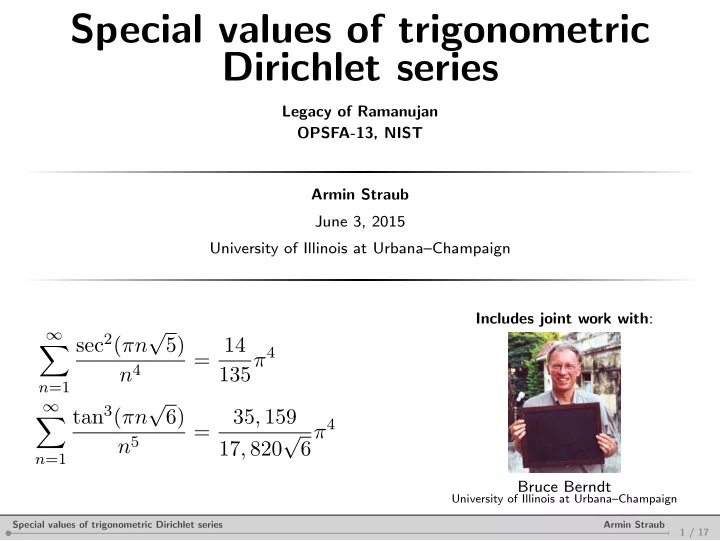
Special values of trigonometric Dirichlet series Legacy of Ramanujan OPSFA-13, NIST Armin Straub June 3, 2015 University of Illinois at UrbanaChampaign Includes joint work with : sec 2 ( n 5) = 14 135 4 n 4 n =1


slide-1
SLIDE 1

Special values of trigonometric Dirichlet series

Legacy of Ramanujan OPSFA-13, NIST Armin Straub June 3, 2015 University of Illinois at Urbana–Champaign ∞

  • n=1

sec2(πn √ 5) n4 = 14 135π4

  • n=1

tan3(πn √ 6) n5 = 35, 159 17, 820 √ 6π4

Includes joint work with: Bruce Berndt

University of Illinois at Urbana–Champaign

Special values of trigonometric Dirichlet series Armin Straub 1 / 17
slide-2
SLIDE 2

Rough outline

  • examples of special values of trigonometric Dirichlet series
  • main result on special values and outline of strategy
  • just a brief comment on convergence
  • introduction to Eichler integrals of Eisenstein series
  • open problems (possibly unimodularity, if time permits)
Special values of trigonometric Dirichlet series Armin Straub 2 / 17
slide-3
SLIDE 3

Basic examples of trigonometric Dirichlet series

  • Euler’s identity:

  • n=1

1 n2m = −1 2(2πi)2m B2m (2m)!

Special values of trigonometric Dirichlet series Armin Straub 3 / 17
slide-4
SLIDE 4

Basic examples of trigonometric Dirichlet series

  • Euler’s identity:

  • n=1

1 n2m = −1 2(2πi)2m B2m (2m)!

  • Half of the Clausen and Glaisher functions reduce, e.g.,

  • n=1

cos(πnτ) n2m = polym(τ), poly1(τ) = π2 12

  • 3τ 2 − 6τ + 2
  • .
Special values of trigonometric Dirichlet series Armin Straub 3 / 17
slide-5
SLIDE 5

Basic examples of trigonometric Dirichlet series

  • Euler’s identity:

  • n=1

1 n2m = −1 2(2πi)2m B2m (2m)!

  • Half of the Clausen and Glaisher functions reduce, e.g.,

  • n=1

cos(πnτ) n2m = polym(τ), poly1(τ) = π2 12

  • 3τ 2 − 6τ + 2
  • .
  • Ramanujan investigated trigonometric Dirichlet series of similar type.

From his first letter to Hardy:

  • n=1

coth(πn) n7 = 19π7 56700

In fact, this was already included in a general formula by Lerch.

Special values of trigonometric Dirichlet series Armin Straub 3 / 17
slide-6
SLIDE 6

One of Ramanujan’s most famous formulas

For α, β > 0 such that αβ = π2 and m ∈ Z,

α−m

  • ζ(2m + 1)

2 +

  • n=1

n−2m−1 e2αn − 1

  • = (−β)−m
  • ζ(2m + 1)

2 +

  • n=1

n−2m−1 e2βn − 1

  • −22m

m+1

  • n=0

(−1)n B2n (2n)! B2m−2n+2 (2m − 2n + 2)!αm−n+1βn. THM

Ramanujan, Grosswald Special values of trigonometric Dirichlet series Armin Straub 4 / 17
slide-7
SLIDE 7

One of Ramanujan’s most famous formulas

For α, β > 0 such that αβ = π2 and m ∈ Z,

α−m

  • ζ(2m + 1)

2 +

  • n=1

n−2m−1 e2αn − 1

  • = (−β)−m
  • ζ(2m + 1)

2 +

  • n=1

n−2m−1 e2βn − 1

  • −22m

m+1

  • n=0

(−1)n B2n (2n)! B2m−2n+2 (2m − 2n + 2)!αm−n+1βn. THM

Ramanujan, Grosswald
  • In terms of

ξs(τ) =

  • n=1

cot(πnτ) ns ,

Ramanujan’s formula takes the form

1 ex − 1 = 1

2 cot( x 2) − 1 2

τ 2m−2ξ2m−1(− 1

τ ) − ξ2m−1(τ) = (−1)k(2π)2k−1 k

  • s=0

B2s (2s)! B2k−2s (2k − 2s)!τ 2s−1.

Special values of trigonometric Dirichlet series Armin Straub 4 / 17
slide-8
SLIDE 8

One of Ramanujan’s most famous formulas

For α, β > 0 such that αβ = π2 and m ∈ Z,

α−m

  • ζ(2m + 1)

2 +

  • n=1

n−2m−1 e2αn − 1

  • = (−β)−m
  • ζ(2m + 1)

2 +

  • n=1

n−2m−1 e2βn − 1

  • −22m

m+1

  • n=0

(−1)n B2n (2n)! B2m−2n+2 (2m − 2n + 2)!αm−n+1βn. THM

Ramanujan, Grosswald
  • In terms of

ξs(τ) =

  • n=1

cot(πnτ) ns ,

Ramanujan’s formula takes the form

1 ex − 1 = 1

2 cot( x 2) − 1 2

τ 2m−2ξ2m−1(− 1

τ ) − ξ2m−1(τ) = (−1)k(2π)2k−1 k

  • s=0

B2s (2s)! B2k−2s (2k − 2s)!τ 2s−1.

  • Set m = 4 and τ = i to obtain

  • n=1

coth(πn) n7 = 19π7 56700.

Special values of trigonometric Dirichlet series Armin Straub 4 / 17
slide-9
SLIDE 9

Special values of trigonometric Dirichlet series

  • n=0

tanh((2n + 1)π/2) (2n + 1)3 = π3 32,

  • n=1

(−1)n+1 csch(πn) n3 = π3 360

EG

Ramanujan Special values of trigonometric Dirichlet series Armin Straub 5 / 17
slide-10
SLIDE 10

Special values of trigonometric Dirichlet series

  • n=0

tanh((2n + 1)π/2) (2n + 1)3 = π3 32,

  • n=1

(−1)n+1 csch(πn) n3 = π3 360

EG

Ramanujan

  • n=1

cot

  • πn 1+

√ 5 2

  • n3

= − π3 45 √ 5,

  • n=0

tan(π(2n + 1) √ 5) (2n + 1)5 = 23π5 3456 √ 5

EG

Berndt 1976-78

Let τ = (a+b√c)/2 for a, b, c ∈ Q with c > 0 and a2−cb2 = 4ε, ε = ±1. If k > 1,

  • n=1

cot(πnτ) n2k−1 = (−1)k−1(2π)2k−1 1 − ετ 2k−2

k

  • s=0

B2s (2s)! B2k−2s (2k − 2s)!τ 2s−1.

THM

Berndt 1976

Special values of trigonometric Dirichlet series Armin Straub 5 / 17
slide-11
SLIDE 11

Special values of trigonometric Dirichlet series

  • n=0

tanh((2n + 1)π/2) (2n + 1)3 = π3 32,

  • n=1

(−1)n+1 csch(πn) n3 = π3 360

EG

Ramanujan

  • n=1

cot

  • πn 1+

√ 5 2

  • n3

= − π3 45 √ 5,

  • n=0

tan(π(2n + 1) √ 5) (2n + 1)5 = 23π5 3456 √ 5

EG

Berndt 1976-78

Let τ = (a+b√c)/2 for a, b, c ∈ Q with c > 0 and a2−cb2 = 4ε, ε = ±1. If k > 1,

  • n=1

cot(πnτ) n2k−1 = (−1)k−1(2π)2k−1 1 − ετ 2k−2

k

  • s=0

B2s (2s)! B2k−2s (2k − 2s)!τ 2s−1.

THM

Berndt 1976

  • n=1

cot2(πnζ3) n4 = − 31 2835π4,

  • n=1

csc2(πnζ3) n4 = 1 5670π4

EG

Komori- Matsumoto- Tsumura 2013

(Here, ζ3 is the primitive third root of unity.)

Special values of trigonometric Dirichlet series Armin Straub 5 / 17
slide-12
SLIDE 12

Secant zeta function

  • Lal´

ın, Rodrigue and Rogers introduce and study ψs(τ) =

  • n=1

sec(πnτ) ns .

  • Clearly, ψs(0) = ζ(s). In particular, ψ2(0) = π2

6 .

Special values of trigonometric Dirichlet series Armin Straub 6 / 17
slide-13
SLIDE 13

Secant zeta function

  • Lal´

ın, Rodrigue and Rogers introduce and study ψs(τ) =

  • n=1

sec(πnτ) ns .

  • Clearly, ψs(0) = ζ(s). In particular, ψ2(0) = π2

6 . ψ2( √ 2) = −π2 3 , ψ2( √ 6) = 2π2 3

EG

LRR ’13

Special values of trigonometric Dirichlet series Armin Straub 6 / 17
slide-14
SLIDE 14

Secant zeta function

  • Lal´

ın, Rodrigue and Rogers introduce and study ψs(τ) =

  • n=1

sec(πnτ) ns .

  • Clearly, ψs(0) = ζ(s). In particular, ψ2(0) = π2

6 . ψ2( √ 2) = −π2 3 , ψ2( √ 6) = 2π2 3

EG

LRR ’13

For positive integers m, r, ψ2m(√r) ∈ Q · π2m.

CONJ

LRR ’13

  • proof completed independently by Berndt–S and Charollois–Greenberg
Special values of trigonometric Dirichlet series Armin Straub 6 / 17
slide-15
SLIDE 15

Special values of trigonometric Dirichlet series

  • n=1

sec2(πn √ 5) n4 = 14 135π4

EG

S 2014

Special values of trigonometric Dirichlet series Armin Straub 7 / 17
slide-16
SLIDE 16

Special values of trigonometric Dirichlet series

  • n=1

sec2(πn √ 5) n4 = 14 135π4

  • n=1

cot2(πn √ 5) n4 = 13 945π4

EG

S 2014

Special values of trigonometric Dirichlet series Armin Straub 7 / 17
slide-17
SLIDE 17

Special values of trigonometric Dirichlet series

  • n=1

sec2(πn √ 5) n4 = 14 135π4

  • n=1

cot2(πn √ 5) n4 = 13 945π4

  • n=1

csc2(πn √ 11) n4 = 8 385π4

  • n=1

sec3(πn √ 2) n4 = −2483 5220π4

  • n=1

tan3(πn √ 6) n5 = 35, 159 17, 820 √ 6π4

EG

S 2014

Special values of trigonometric Dirichlet series Armin Straub 7 / 17
slide-18
SLIDE 18

Special values of trigonometric Dirichlet series

  • For a, b ∈ Z, let triga,b = seca cscb be any product/quotient of

trigonometric functions.

  • n=1

triga,b(πnρ) ns ∈ πsQ(ρ) provided that

  • ρ is a real quadratic irrationality,
  • s max(a, b, 1) + 1 (so that the series converges),
  • s and b have the same parity.

THM

S 2014

Special values of trigonometric Dirichlet series Armin Straub 8 / 17
slide-19
SLIDE 19

Special values of trigonometric Dirichlet series

  • For a, b ∈ Z, let triga,b = seca cscb be any product/quotient of

trigonometric functions.

  • n=1

triga,b(πnρ) ns ∈ πsQ(ρ) provided that

  • ρ is a real quadratic irrationality,
  • s max(a, b, 1) + 1 (so that the series converges),
  • s and b have the same parity.

THM

S 2014

  • If, in addition, ρ2 ∈ Q and a + b 0, then the value is in (πρ)sQ.

  • n=1

(cos cot)(πn √ 2) n3 = 1 2 − 253 360 √ 2

  • π3

EG

(Here, (a, b) = (−2, 1) does not satisfy a + b 0.)

Special values of trigonometric Dirichlet series Armin Straub 8 / 17
slide-20
SLIDE 20

Strategy

  • Rough strategy how to evaluate ψa,b

s (ρ) = ∞

  • n=1

triga,b(πnρ) ns :

(triga,b = seca cscb)

Special values of trigonometric Dirichlet series Armin Straub 9 / 17
slide-21
SLIDE 21

Strategy

  • Rough strategy how to evaluate ψa,b

s (ρ) = ∞

  • n=1

triga,b(πnρ) ns :

(triga,b = seca cscb)

  • Trivial case: a 0 and b 0. If s > 1 has the same parity as b, then

ψa,b

s (τ) = πsf(τ),

where f(τ) is piecewise polynomial in τ with rational coefficients. In terms of Bernoulli polynomials we have, for 0 < τ < 1,

  • n=1

cos(2πnτ) n2m = (−1)m+1 2 (2π)2m (2m)! B2m(τ),

  • n=1

sin(2πnτ) n2m+1 = (−1)m+1 2 (2π)2m+1 (2m + 1)!B2m+1(τ).

EG

Special values of trigonometric Dirichlet series Armin Straub 9 / 17
slide-22
SLIDE 22

Strategy

  • Rough strategy how to evaluate ψa,b

s (ρ) = ∞

  • n=1

triga,b(πnρ) ns :

(triga,b = seca cscb)

  • Trivial case: a 0 and b 0. If s > 1 has the same parity as b, then

ψa,b

s (τ) = πsf(τ),

where f(τ) is piecewise polynomial in τ with rational coefficients.

  • sec

csc cot tan

Modular cases: If (a, b) is one of (1, 0), (0, 1), (−1, 1), (1, −1), then ψa,b

s (τ) are essentially Eichler integrals of Eisenstein series.

In terms of Bernoulli polynomials we have, for 0 < τ < 1,

  • n=1

cos(2πnτ) n2m = (−1)m+1 2 (2π)2m (2m)! B2m(τ),

  • n=1

sin(2πnτ) n2m+1 = (−1)m+1 2 (2π)2m+1 (2m + 1)!B2m+1(τ).

EG

Special values of trigonometric Dirichlet series Armin Straub 9 / 17
slide-23
SLIDE 23

Strategy

  • Rough strategy how to evaluate ψa,b

s (ρ) = ∞

  • n=1

triga,b(πnρ) ns :

(triga,b = seca cscb)

  • Trivial case: a 0 and b 0. If s > 1 has the same parity as b, then

ψa,b

s (τ) = πsf(τ),

where f(τ) is piecewise polynomial in τ with rational coefficients.

  • sec

csc cot tan

Modular cases: If (a, b) is one of (1, 0), (0, 1), (−1, 1), (1, −1), then ψa,b

s (τ) are essentially Eichler integrals of Eisenstein series.

  • For the general case, we use simple reduction identities, such as

sec2(τ) csc2(τ) = sec2(τ) + csc2(τ),

Special values of trigonometric Dirichlet series Armin Straub 9 / 17
slide-24
SLIDE 24

Strategy

  • Rough strategy how to evaluate ψa,b

s (ρ) = ∞

  • n=1

triga,b(πnρ) ns :

(triga,b = seca cscb)

  • Trivial case: a 0 and b 0. If s > 1 has the same parity as b, then

ψa,b

s (τ) = πsf(τ),

where f(τ) is piecewise polynomial in τ with rational coefficients.

  • sec

csc cot tan

Modular cases: If (a, b) is one of (1, 0), (0, 1), (−1, 1), (1, −1), then ψa,b

s (τ) are essentially Eichler integrals of Eisenstein series.

  • For the general case, we use simple reduction identities, such as

sec2(τ) csc2(τ) = sec2(τ) + csc2(τ), and (here, a is odd) seca(τ) = 1 (a − 1)!(D2 + (a − 2)2)(D2 + (a − 4)2) · · · (D2 + 12) sec(τ), to connect with the trivial and (derivatives of the) modular cases.

Special values of trigonometric Dirichlet series Armin Straub 9 / 17
slide-25
SLIDE 25

A glance at convergence

  • ψs(τ) =

sec(πnτ) ns

has singularity at rationals with even denominator

0.2 0.4 0.6 0.8 1.0 5 5

Re ψ2(τ + εi) with ε = 1/100

0.2 0.4 0.6 0.8 1.0 10 5 5 10

Re ψ2(τ + εi) with ε = 1/1000

Special values of trigonometric Dirichlet series Armin Straub 10 / 17
slide-26
SLIDE 26

A glance at convergence

  • ψs(τ) =

sec(πnτ) ns

has singularity at rationals with even denominator

0.2 0.4 0.6 0.8 1.0 5 5

Re ψ2(τ + εi) with ε = 1/100

0.2 0.4 0.6 0.8 1.0 10 5 5 10

Re ψ2(τ + εi) with ε = 1/1000

The series ψs(τ) =

sec(πnτ) ns

converges absolutely if

1 τ = p/q with q odd and s > 1, 2 τ is algebraic irrational and s 2.

THM

Luca, Lal´ ın– Rodrigue– Rogers 2013

  • Proof uses Thue–Siegel–Roth, as well as a result of Worley when

s = 2 and τ is irrational

Special values of trigonometric Dirichlet series Armin Straub 10 / 17
slide-27
SLIDE 27

Ramanujan-type transformation formulas by residues

  • Obviously, ψs(τ) =

sec(πnτ) ns satisfies ψs(τ + 2) = ψs(τ).

(1 + τ)2m−1ψ2m

  • τ

1 + τ

  • − (1 − τ)2m−1ψ2m
  • τ

1 − τ

  • = π2m rat(τ)

THM

LRR, BS 2013

Special values of trigonometric Dirichlet series Armin Straub 11 / 17
slide-28
SLIDE 28

Ramanujan-type transformation formulas by residues

  • Obviously, ψs(τ) =

sec(πnτ) ns satisfies ψs(τ + 2) = ψs(τ).

(1 + τ)2m−1ψ2m

  • τ

1 + τ

  • − (1 − τ)2m−1ψ2m
  • τ

1 − τ

  • = π2m rat(τ)

THM

LRR, BS 2013

Collect residues of the integral IC = 1 2πi

  • C

sin (πτz) sin(π(1 + τ)z) sin(π(1 − τ)z) dz zs+1 . C are appropriate circles around the origin such that IC → 0 as radius(C) → ∞.

proof

Special values of trigonometric Dirichlet series Armin Straub 11 / 17
slide-29
SLIDE 29

Ramanujan-type transformation formulas by residues

  • Obviously, ψs(τ) =

sec(πnτ) ns satisfies ψs(τ + 2) = ψs(τ).

(1 + τ)2m−1ψ2m

  • τ

1 + τ

  • − (1 − τ)2m−1ψ2m
  • τ

1 − τ

  • = π2m[z2m−1]

sin(τz) sin((1 − τ)z) sin((1 + τ)z)

THM

LRR, BS 2013

Collect residues of the integral IC = 1 2πi

  • C

sin (πτz) sin(π(1 + τ)z) sin(π(1 − τ)z) dz zs+1 . C are appropriate circles around the origin such that IC → 0 as radius(C) → ∞.

proof

Special values of trigonometric Dirichlet series Armin Straub 11 / 17
slide-30
SLIDE 30

Ramanujan-type transformation formulas by residues

  • Obviously, ψs(τ) =

sec(πnτ) ns satisfies ψs(τ + 2) = ψs(τ).

(1 + τ)2m−1ψ2m

  • τ

1 + τ

  • − (1 − τ)2m−1ψ2m
  • τ

1 − τ

  • = π2m[z2m−1]

sin(τz) sin((1 − τ)z) sin((1 + τ)z)

THM

LRR, BS 2013

ψ2

  • τ

2τ + 1

  • =

1 2τ + 1ψ2(τ) + π2 τ(3τ 2 + 4τ + 2) 6(2τ + 1)2

EG

Special values of trigonometric Dirichlet series Armin Straub 11 / 17
slide-31
SLIDE 31

Ramanujan-type transformation formulas by residues

  • Obviously, ψs(τ) =

sec(πnτ) ns satisfies ψs(τ + 2) = ψs(τ).

(1 + τ)2m−1ψ2m

  • τ

1 + τ

  • − (1 − τ)2m−1ψ2m
  • τ

1 − τ

  • = π2m[z2m−1]

sin(τz) sin((1 − τ)z) sin((1 + τ)z)

THM

LRR, BS 2013

ψ2

  • τ

2τ + 1

  • =

1 2τ + 1ψ2(τ) + π2 τ(3τ 2 + 4τ + 2) 6(2τ + 1)2

EG

  • Hence, ψ2m transforms under T 2 =

1 2 1

  • and R2 =

1 2 1

  • ,
  • Together, with −I, these two matrices generate Γ(2).
Special values of trigonometric Dirichlet series Armin Straub 11 / 17
slide-32
SLIDE 32

Special values from transformation formulas

For any positive rational r, ψ2m(√r) ∈ Q · π2m.

THM

LRR, BS 2013

Special values of trigonometric Dirichlet series Armin Straub 12 / 17
slide-33
SLIDE 33

Special values from transformation formulas

For any positive rational r, ψ2m(√r) ∈ Q · π2m.

THM

LRR, BS 2013

2 is fixed by τ → 3τ + 4

2τ + 3.

EG

Special values of trigonometric Dirichlet series Armin Straub 12 / 17
slide-34
SLIDE 34

Special values from transformation formulas

For any positive rational r, ψ2m(√r) ∈ Q · π2m.

THM

LRR, BS 2013

2 is fixed by τ → 3τ + 4

2τ + 3.

  • We have the functional equation

ψ2 3τ + 4 2τ + 3

  • = −

1 2τ + 3ψ2(τ) − (τ + 2)(3τ 2 + 8τ + 6) 6(2τ + 3)2 π2.

EG

Special values of trigonometric Dirichlet series Armin Straub 12 / 17
slide-35
SLIDE 35

Special values from transformation formulas

For any positive rational r, ψ2m(√r) ∈ Q · π2m.

THM

LRR, BS 2013

2 is fixed by τ → 3τ + 4

2τ + 3.

  • We have the functional equation

ψ2 3τ + 4 2τ + 3

  • = −

1 2τ + 3ψ2(τ) − (τ + 2)(3τ 2 + 8τ + 6) 6(2τ + 3)2 π2.

  • For τ =

√ 2 this reduces to

ψ2( √ 2) = (2 √ 2 − 3)ψ2( √ 2) + 2 3( √ 2 − 2)π2.

EG

Special values of trigonometric Dirichlet series Armin Straub 12 / 17
slide-36
SLIDE 36

Special values from transformation formulas

For any positive rational r, ψ2m(√r) ∈ Q · π2m.

THM

LRR, BS 2013

2 is fixed by τ → 3τ + 4

2τ + 3.

  • We have the functional equation

ψ2 3τ + 4 2τ + 3

  • = −

1 2τ + 3ψ2(τ) − (τ + 2)(3τ 2 + 8τ + 6) 6(2τ + 3)2 π2.

  • For τ =

√ 2 this reduces to

ψ2( √ 2) = (2 √ 2 − 3)ψ2( √ 2) + 2 3( √ 2 − 2)π2.

  • Hence, ψ2(

√ 2) = −π2 3 .

EG

Special values of trigonometric Dirichlet series Armin Straub 12 / 17
slide-37
SLIDE 37

Modular forms

There’s a saying attributed to Eichler that there are five funda- mental operations of arithmetic: addition, subtraction, multipli- cation, division, and modular forms.

Andrew Wiles (BBC Interview, “The Proof”, 1997)

Actions of γ = a b

c d

  • ∈ SL2(Z):
  • on τ ∈ H by

γ · τ = aτ + b cτ + d,

  • on f : H → C by

(f|kγ)(τ) = (cτ + d)−kf(γ · τ).

DEF

Special values of trigonometric Dirichlet series Armin Straub 13 / 17
slide-38
SLIDE 38

Modular forms

There’s a saying attributed to Eichler that there are five funda- mental operations of arithmetic: addition, subtraction, multipli- cation, division, and modular forms.

Andrew Wiles (BBC Interview, “The Proof”, 1997)

Actions of γ = a b

c d

  • ∈ SL2(Z):
  • on τ ∈ H by

γ · τ = aτ + b cτ + d,

  • on f : H → C by

(f|kγ)(τ) = (cτ + d)−kf(γ · τ).

DEF

A function f : H → C is a modular form of weight k if

  • f|kγ = f for all γ ∈ Γ,

Γ SL2(Z),

  • f is holomorphic

(including at the cusps).

DEF

Special values of trigonometric Dirichlet series Armin Straub 13 / 17
slide-39
SLIDE 39

Modular forms

There’s a saying attributed to Eichler that there are five funda- mental operations of arithmetic: addition, subtraction, multipli- cation, division, and modular forms.

Andrew Wiles (BBC Interview, “The Proof”, 1997)

Actions of γ = a b

c d

  • ∈ SL2(Z):
  • on τ ∈ H by

γ · τ = aτ + b cτ + d,

  • on f : H → C by

(f|kγ)(τ) = (cτ + d)−kf(γ · τ).

DEF

A function f : H → C is a modular form of weight k if

  • f|kγ = f for all γ ∈ Γ,

Γ SL2(Z),

  • f is holomorphic

(including at the cusps).

DEF

f(τ + 1) = f(τ), τ −kf(−1/τ) = f(τ).

EG

SL2(Z)

Special values of trigonometric Dirichlet series Armin Straub 13 / 17
slide-40
SLIDE 40

Eisenstein series and Eichler integrals

Eisenstein series of weight 2k:

G2k(τ) = ′

m,n∈Z

1 (mτ + n)2k

EG

SL2(Z)

Special values of trigonometric Dirichlet series Armin Straub 14 / 17
slide-41
SLIDE 41

Eisenstein series and Eichler integrals

Eisenstein series of weight 2k:

σk(n) =

  • d|n

dk

G2k(τ) = ′

m,n∈Z

1 (mτ + n)2k = 2ζ(2k) + 2(2πi)2k Γ(2k)

  • n=1

σ2k−1(n)qn

EG

SL2(Z)

Special values of trigonometric Dirichlet series Armin Straub 14 / 17
slide-42
SLIDE 42

Eisenstein series and Eichler integrals

Eisenstein series of weight 2k:

σk(n) =

  • d|n

dk

G2k(τ) = ′

m,n∈Z

1 (mτ + n)2k = 2ζ(2k) + 2(2πi)2k Γ(2k)

  • n=1

σ2k−1(n)qn

EG

SL2(Z)

  • An Eichler integral is what we get by integrating a weight k modular

form k − 1 times.

As usual, the derivative is D = 1 2πi d dτ = q d dq .

Special values of trigonometric Dirichlet series Armin Straub 14 / 17
slide-43
SLIDE 43

Eisenstein series and Eichler integrals

Eisenstein series of weight 2k:

σk(n) =

  • d|n

dk

G2k(τ) = ′

m,n∈Z

1 (mτ + n)2k = 2ζ(2k) + 2(2πi)2k Γ(2k)

  • n=1

σ2k−1(n)qn

EG

SL2(Z)

  • An Eichler integral is what we get by integrating a weight k modular

form k − 1 times.

As usual, the derivative is D = 1 2πi d dτ = q d dq .

  • n=1

σ2k−1(n)qn

integrate

− − − − − →

  • n=1

σ2k−1(n) n2k−1 qn =

  • n=1

σ1−2k(n)qn

EG

Special values of trigonometric Dirichlet series Armin Straub 14 / 17
slide-44
SLIDE 44

Eisenstein series and Eichler integrals

Eisenstein series of weight 2k:

σk(n) =

  • d|n

dk

G2k(τ) = ′

m,n∈Z

1 (mτ + n)2k = 2ζ(2k) + 2(2πi)2k Γ(2k)

  • n=1

σ2k−1(n)qn

EG

SL2(Z)

  • An Eichler integral is what we get by integrating a weight k modular

form k − 1 times.

As usual, the derivative is D = 1 2πi d dτ = q d dq .

  • n=1

σ2k−1(n)qn

integrate

− − − − − →

  • n=1

σ2k−1(n) n2k−1 qn =

  • n=1

σ1−2k(n)qn

EG

  • Eichler integrals are characterized by

F|2−k(γ − 1) = poly(τ), deg poly k − 2.

Special values of trigonometric Dirichlet series Armin Straub 14 / 17
slide-45
SLIDE 45

Eisenstein series and Eichler integrals

Eisenstein series of weight 2k:

σk(n) =

  • d|n

dk

G2k(τ) = ′

m,n∈Z

1 (mτ + n)2k = 2ζ(2k) + 2(2πi)2k Γ(2k)

  • n=1

σ2k−1(n)qn

EG

SL2(Z)

  • An Eichler integral is what we get by integrating a weight k modular

form k − 1 times.

As usual, the derivative is D = 1 2πi d dτ = q d dq .

  • n=1

σ2k−1(n)qn

integrate

− − − − − →

  • n=1

σ2k−1(n) n2k−1 qn =

  • n=1

σ1−2k(n)qn

EG

  • Eichler integrals are characterized by

F|2−k(γ − 1) = poly(τ), deg poly k − 2.

  • poly(τ) is a period polynomial of the modular form f.

The period polynomial encodes the critical L-values of f.

Special values of trigonometric Dirichlet series Armin Straub 14 / 17
slide-46
SLIDE 46

Eisenstein series and Eichler integrals

Eisenstein series of weight 2k:

σk(n) =

  • d|n

dk

G2k(τ) = ′

m,n∈Z

1 (mτ + n)2k = 2ζ(2k) + 2(2πi)2k Γ(2k)

  • n=1

σ2k−1(n)qn

EG

SL2(Z)

  • An Eichler integral is what we get by integrating a weight k modular

form k − 1 times.

As usual, the derivative is D = 1 2πi d dτ = q d dq .

The series

  • n1

cot(πnτ) n2k−1 is an Eichler integral of G2k(τ).

EG

Special values of trigonometric Dirichlet series Armin Straub 14 / 17
slide-47
SLIDE 47

Eisenstein series and Eichler integrals

Eisenstein series of weight 2k:

σk(n) =

  • d|n

dk

G2k(τ) = ′

m,n∈Z

1 (mτ + n)2k = 2ζ(2k) + 2(2πi)2k Γ(2k)

  • n=1

σ2k−1(n)qn

EG

SL2(Z)

  • An Eichler integral is what we get by integrating a weight k modular

form k − 1 times.

As usual, the derivative is D = 1 2πi d dτ = q d dq .

The series

  • n1

cot(πnτ) n2k−1 is an Eichler integral of G2k(τ).

EG

  • Differentiating the cotangent series 2k − 1 times, after using

cot(πτ) = 1 π

  • j∈Z

1 τ + j ,

lim

N→∞ N
  • j=−N

we indeed get G2k, up to a factor and the constant term.

Special values of trigonometric Dirichlet series Armin Straub 14 / 17
slide-48
SLIDE 48

Ramanujan’s famous formula, again

For α, β > 0 such that αβ = π2 and m ∈ Z,

α−m

  • ζ(2m + 1)

2 +

  • n=1

n−2m−1 e2αn − 1

  • = (−β)−m
  • ζ(2m + 1)

2 +

  • n=1

n−2m−1 e2βn − 1

  • −22m

m+1

  • n=0

(−1)n B2n (2n)! B2m−2n+2 (2m − 2n + 2)!αm−n+1βn. THM

Ramanujan, Grosswald Special values of trigonometric Dirichlet series Armin Straub 15 / 17
slide-49
SLIDE 49

Ramanujan’s famous formula, again

For α, β > 0 such that αβ = π2 and m ∈ Z,

α−m

  • ζ(2m + 1)

2 +

  • n=1

n−2m−1 e2αn − 1

  • = (−β)−m
  • ζ(2m + 1)

2 +

  • n=1

n−2m−1 e2βn − 1

  • −22m

m+1

  • n=0

(−1)n B2n (2n)! B2m−2n+2 (2m − 2n + 2)!αm−n+1βn. THM

Ramanujan, Grosswald
  • In terms of

ξs(τ) =

  • n=1

cot(πnτ) ns ,

Ramanujan’s formula takes the form

1 ex − 1 = 1

2 cot( x 2) − 1 2

τ 2m−2ξ2m−1(− 1

τ ) − ξ2m−1(τ) = (−1)k(2π)2k−1 k

  • s=0

B2s (2s)! B2k−2s (2k − 2s)!τ 2s−1.

Special values of trigonometric Dirichlet series Armin Straub 15 / 17
slide-50
SLIDE 50

Ramanujan’s famous formula, again

For α, β > 0 such that αβ = π2 and m ∈ Z,

α−m

  • ζ(2m + 1)

2 +

  • n=1

n−2m−1 e2αn − 1

  • = (−β)−m
  • ζ(2m + 1)

2 +

  • n=1

n−2m−1 e2βn − 1

  • −22m

m+1

  • n=0

(−1)n B2n (2n)! B2m−2n+2 (2m − 2n + 2)!αm−n+1βn. THM

Ramanujan, Grosswald
  • In terms of

ξs(τ) =

  • n=1

cot(πnτ) ns ,

Ramanujan’s formula takes the form

1 ex − 1 = 1

2 cot( x 2) − 1 2

τ 2m−2ξ2m−1(− 1

τ ) − ξ2m−1(τ) = (−1)k(2π)2k−1 k

  • s=0

B2s (2s)! B2k−2s (2k − 2s)!τ 2s−1.

  • Adjusting for the missing term in ξ2k−1, the RHS is the period

polynomial of the Eisenstein series G2k.

Special values of trigonometric Dirichlet series Armin Straub 15 / 17
slide-51
SLIDE 51

Some open questions

  • We have seen how to evaluate trigonometric series such as

  • n=1

sec2(πn √ 5) n4 = 14 135π4.

  • However, our method proceeds in a very recursive way. Can we give

more explicit results or proofs?

Special values of trigonometric Dirichlet series Armin Straub 16 / 17
slide-52
SLIDE 52

Some open questions

  • We have seen how to evaluate trigonometric series such as

  • n=1

sec2(πn √ 5) n4 = 14 135π4.

  • However, our method proceeds in a very recursive way. Can we give

more explicit results or proofs?

  • In which cases can we evaluate more general series such as the

following?

  • n=1

cot(πnτ1) · · · cot(πnτr) ns

  • n=1

(−1)n+1 csc(πnζ5) csc(πnζ2

5) · · · csc(πnζ4 5)

n6 = π6 935, 550

EG

Komori- Matsumoto- Tsumura 2013

(Here, ζ5 is the primitive fifth root of unity.)

Special values of trigonometric Dirichlet series Armin Straub 16 / 17
slide-53
SLIDE 53

THANK YOU!

Slides for this talk will be available from my website: http://arminstraub.com/talks

  • B. Berndt, A. Straub

On a secant Dirichlet series and Eichler integrals of Eisenstein series Preprint, 2014

  • A. Straub

Special values of trigonometric Dirichlet series and Eichler integrals The Ramanujan Journal (special issue dedicated to Marvin Knopp), 2015

Special values of trigonometric Dirichlet series Armin Straub 17 / 17
slide-54
SLIDE 54

Unimodular polynomials

p(x) is unimodular if all its zeros have absolute value 1.

DEF

Special values of trigonometric Dirichlet series Armin Straub 18 / 23
slide-55
SLIDE 55

Unimodular polynomials

p(x) is unimodular if all its zeros have absolute value 1.

DEF

  • Kronecker: if p(x) ∈ Z[x] is monic and unimodular,

hence Mahler measure 1,

then all of its roots are roots of unity.

Special values of trigonometric Dirichlet series Armin Straub 18 / 23
slide-56
SLIDE 56

Unimodular polynomials

p(x) is unimodular if all its zeros have absolute value 1.

DEF

  • Kronecker: if p(x) ∈ Z[x] is monic and unimodular,

hence Mahler measure 1,

then all of its roots are roots of unity. x2 + 6

5x + 1 =

  • x + 3+4i

5

x + 3−4i

5

  • EG
Special values of trigonometric Dirichlet series Armin Straub 18 / 23
slide-57
SLIDE 57

Unimodular polynomials

p(x) is unimodular if all its zeros have absolute value 1.

DEF

  • Kronecker: if p(x) ∈ Z[x] is monic and unimodular,

hence Mahler measure 1,

then all of its roots are roots of unity. x2 + 6

5x + 1 =

  • x + 3+4i

5

x + 3−4i

5

  • EG

x10 + z9 − z7 − z6 − z5 − z4 − z3 + z + 1 has only the two real roots 0.850, 1.176 off the unit circle.

Lehmer’s conjecture: 1.176 . . . is the smallest Mahler measure (greater than 1)

EG

Lehmer

Special values of trigonometric Dirichlet series Armin Straub 18 / 23
slide-58
SLIDE 58

Ramanujan polynomials

  • Following Gun–Murty–Rath, the Ramanujan polynomials are

Rk(X) =

k

  • s=0

Bs s! Bk−s (k − s)!Xs−1.

Special values of trigonometric Dirichlet series Armin Straub 19 / 23
slide-59
SLIDE 59

Ramanujan polynomials

  • Following Gun–Murty–Rath, the Ramanujan polynomials are

Rk(X) =

k

  • s=0

Bs s! Bk−s (k − s)!Xs−1.

All nonreal zeros of Rk(X) lie on the unit circle.

For k 2, R2k(X) has exactly four real roots which approach ±2±1.

THM

Murty- Smyth- Wang ’11 1.0 0.5 0.0 0.5 1.0 1.0 0.5 0.0 0.5 1.0

R20(X)

Special values of trigonometric Dirichlet series Armin Straub 19 / 23
slide-60
SLIDE 60

Ramanujan polynomials

  • Following Gun–Murty–Rath, the Ramanujan polynomials are

Rk(X) =

k

  • s=0

Bs s! Bk−s (k − s)!Xs−1.

All nonreal zeros of Rk(X) lie on the unit circle.

For k 2, R2k(X) has exactly four real roots which approach ±2±1.

THM

Murty- Smyth- Wang ’11

R2k(X) + ζ(2k − 1) (2πi)2k−1 (X2k−2 − 1) is unimodular.

THM

Lal´ ın-Smyth ’13 1.0 0.5 0.0 0.5 1.0 1.0 0.5 0.0 0.5 1.0

R20(X)

1.0 0.5 0.0 0.5 1.0 1.0 0.5 0.0 0.5 1.0

Rfull

20 (X)

Special values of trigonometric Dirichlet series Armin Straub 19 / 23
slide-61
SLIDE 61

Unimodularity of period polynomials

For any Hecke cusp form (for SL2(Z)), the odd part of its period polynomial has

  • trivial zeros at 0, ±2, ±1

2,

  • and all remaining zeros lie on the unit circle.

THM

Conrey- Farmer- Imamoglu 2012 Special values of trigonometric Dirichlet series Armin Straub 20 / 23
slide-62
SLIDE 62

Unimodularity of period polynomials

For any Hecke cusp form (for SL2(Z)), the odd part of its period polynomial has

  • trivial zeros at 0, ±2, ±1

2,

  • and all remaining zeros lie on the unit circle.

THM

Conrey- Farmer- Imamoglu 2012

For any Hecke eigenform (for SL2(Z)), the full period polynomial has all zeros on the unit circle.

THM

El-Guindy– Raji 2013 Special values of trigonometric Dirichlet series Armin Straub 20 / 23
slide-63
SLIDE 63

Unimodularity of period polynomials

For any Hecke cusp form (for SL2(Z)), the odd part of its period polynomial has

  • trivial zeros at 0, ±2, ±1

2,

  • and all remaining zeros lie on the unit circle.

THM

Conrey- Farmer- Imamoglu 2012

For any Hecke eigenform (for SL2(Z)), the full period polynomial has all zeros on the unit circle.

THM

El-Guindy– Raji 2013

What about higher level?

Q

Special values of trigonometric Dirichlet series Armin Straub 20 / 23
slide-64
SLIDE 64

Generalized Ramanujan polynomials

  • Consider the following generalized Ramanujan polynomials:

Rk(X; χ, ψ) =

k

  • s=0

Bs,χ s! Bk−s,ψ (k − s)! X − 1 M k−s−1 (1 − Xs−1)

  • Essentially, period polynomials:

χ, ψ primitive, nonprincipal

Rk(LX + 1; χ, ψ) = const · ˜ Ek(X; ¯ χ, ¯ ψ)|2−k(1 − RL)

Special values of trigonometric Dirichlet series Armin Straub 21 / 23
slide-65
SLIDE 65

Generalized Ramanujan polynomials

  • Consider the following generalized Ramanujan polynomials:

Rk(X; χ, ψ) =

k

  • s=0

Bs,χ s! Bk−s,ψ (k − s)! X − 1 M k−s−1 (1 − Xs−1)

  • Essentially, period polynomials:

χ, ψ primitive, nonprincipal

Rk(LX + 1; χ, ψ) = const · ˜ Ek(X; ¯ χ, ¯ ψ)|2−k(1 − RL)

  • For even k > 1,

Rk(X; 1, 1) =

k

  • s=0

Bs s! Bk−s (k − s)!Xs−1.

  • Rk(X; χ, ψ) is self-inversive.

PROP

Berndt-S 2013

Special values of trigonometric Dirichlet series Armin Straub 21 / 23
slide-66
SLIDE 66

Generalized Ramanujan polynomials

  • Consider the following generalized Ramanujan polynomials:

Rk(X; χ, ψ) =

k

  • s=0

Bs,χ s! Bk−s,ψ (k − s)! X − 1 M k−s−1 (1 − Xs−1)

  • Essentially, period polynomials:

χ, ψ primitive, nonprincipal

Rk(LX + 1; χ, ψ) = const · ˜ Ek(X; ¯ χ, ¯ ψ)|2−k(1 − RL)

  • For even k > 1,

Rk(X; 1, 1) =

k

  • s=0

Bs s! Bk−s (k − s)!Xs−1.

  • Rk(X; χ, ψ) is self-inversive.

PROP

Berndt-S 2013

If χ, ψ are nonprincipal real, then Rk(X; χ, ψ) is unimodular.

CONJ

Special values of trigonometric Dirichlet series Armin Straub 21 / 23
slide-67
SLIDE 67

Generalized Ramanujan polynomials

Rk(X; χ, 1) For χ real, conjecturally unimodular unless:

  • χ = 1: R2k(X; 1, 1) has real roots approaching ±2±1
  • χ = 3−: R2k+1(X; 3−, 1) has real roots approaching −2±1

EG

Special values of trigonometric Dirichlet series Armin Straub 22 / 23
slide-68
SLIDE 68

Generalized Ramanujan polynomials

Rk(X; χ, 1) For χ real, conjecturally unimodular unless:

  • χ = 1: R2k(X; 1, 1) has real roots approaching ±2±1
  • χ = 3−: R2k+1(X; 3−, 1) has real roots approaching −2±1

EG

Rk(X; 1, ψ) Conjecturally:

  • unimodular for ψ one of

3−, 4−, 5+, 8±, 11−, 12+, 13+, 19−, 21+, 24+, . . .

  • all nonreal roots on the unit circle if ψ is one of

1+, 7−, 15−, 17+, 20−, 23−, 24−, . . .

  • four nonreal zeros off the unit circle if ψ is one of

35−, 59−, 83−, 131−, 155−, 179−, . . .

EG

Special values of trigonometric Dirichlet series Armin Straub 22 / 23
slide-69
SLIDE 69

Generalized Ramanujan polynomials

  • A second kind of generalized Ramanujan polynomials:

Rk(X) =

k

  • s=0

Bs s! Bk−s (k − s)!Xs−1 Sk(X; χ, ψ) =

k

  • s=0

Bs,χ s! Bk−s,ψ (k − s)! LX M k−s−1

  • Obviously, Sk(X; 1, 1) = Rk(X).
Special values of trigonometric Dirichlet series Armin Straub 23 / 23
slide-70
SLIDE 70

Generalized Ramanujan polynomials

  • A second kind of generalized Ramanujan polynomials:

Rk(X) =

k

  • s=0

Bs s! Bk−s (k − s)!Xs−1 Sk(X; χ, ψ) =

k

  • s=0

Bs,χ s! Bk−s,ψ (k − s)! LX M k−s−1

  • Obviously, Sk(X; 1, 1) = Rk(X).

If χ is nonprincipal real, then Sk(X; χ, χ) is unimodular (up to trivial zero roots).

CONJ

Special values of trigonometric Dirichlet series Armin Straub 23 / 23