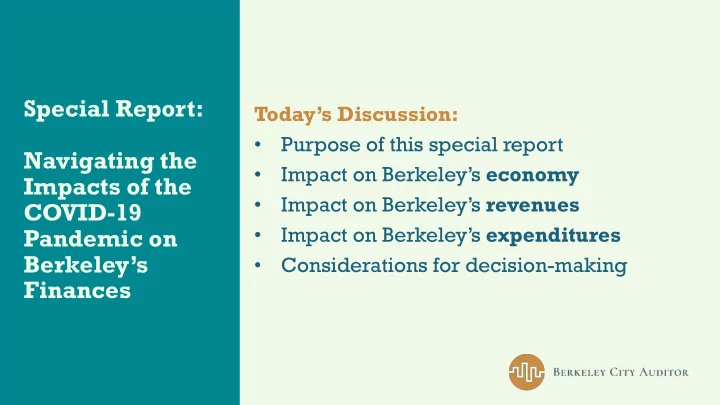
SLIDE 1 Today’s Discussion:
- Purpose of this special report
- Impact on Berkeley’s economy
- Impact on Berkeley’s revenues
- Impact on Berkeley’s expenditures
- Considerations for decision-making
Special Report: Navigating the Impacts of the COVID-19 Pandemic on Berkeley’s Finances
SLIDE 2 Our purpose is to:
- Provide long-term perspective in facing
the budget challenges of the pandemic
- Provide high-level analysis of
information and data available
- Offer considerations from government
finance experts to help make the tough decisions ahead
- Provide context to complement the work
- f other City departments during this time
The COVID-19 pandemic is a public health crisis with social and economic impacts that may last for years. Response to this economic downturn will require a marathon approach rather than a sprint.
SLIDE 3 Impact on Berkeley’s Economy
The shelter-in-place order is significantly impacting Berkeley’s jobs, businesses, and cultural identity.
This economic shock is unprecedented—public health risk is driving the severity and duration. The City is in a relatively strong fiscal position, but will face difficult tradeoffs in
economic downturn. Impact to federal and state economies may reduce funding to Berkeley. 27% of Berkeley workers are at high risk of unemployment and many are already unemployed due to the pandemic.
SLIDE 4 Impact on Berkeley’s Economy
Without federal and state aid, Berkeley will be stretched to address unmet needs.
The closure of UC Berkeley will further impact the local economy. Nearly 86% of students have moved out of university residences. If closures to continue into the fall, businesses that count on income from the university community will suffer, and sales and use tax revenue will decrease.
Some individuals and businesses are left out of federal relief bills or struggle to get benefits, including:
residents
without banking relationships to banks issuing relief loans Vulnerable residents are disproportionately impacted by the pandemic, including:
- Low income residents
- Undocumented workers
- Seniors
- Unhoused residents
- People in abusive
households
healthcare, transit, delivery, and grocery services, among others
SLIDE 5
Impact on Berkeley’s Economy
Legislative Analyst Office: Unemployment in California worse than Great Recession.
SLIDE 6 Impact on Berkeley’s Revenues
Revenues will decrease as some expenditures increase.
Revenues from sales and use tax, property transfer tax, and hotel occupancy tax will decline in the short term. Berkeley will see moderate impact on property tax and business license tax revenue over the next one to two fiscal years. Federal and state financial assistance may help cover some costs of the COVID-19 response, but will not make up for all lost revenues. Measure P funding for initiatives to support affordable housing may change to the extent that the pandemic affects property values and sales. Measure U1 revenues used to assist in housing retention and rapid rehousing for unhoused residents may be impacted to the extent the pandemic affects rental income for
- wners of five or more residential rental units.
Some actions the City has taken to assist small businesses and residents will also affect revenue, such as reducing parking enforcement and temporary stoppage of commercial refuse services.
SLIDE 7
Impact on Berkeley’s Revenues
Revenue Source % of General Fund Potential Impact Estimated First Impact Property Tax 34% Likely to change to the extent that COVID-19 affects the housing market and property values 12+ months Sales and Use Tax 10% Will decline significantly with restaurants and many other businesses closed or scaled back. Impact will be multiplied if COVID- 19 forces UC Berkeley to extend online classes into the fall Immediately Business License Tax 10% Business licenses are taxed based on a percentage of the previous year's gross receipts. This revenue will likely decrease by about 10- 15% over the next 2 fiscal years. 12+ months Property Transfer Tax 6% During the Great Recession, property transfer taxes declined by 51% and did not rebound until 2016. This revenue will likely not be lost, but deferred. Immediately Transient Occupancy Tax (Hotel Tax) 4% This revenue remained relatively flat during the Great Recession. However, tax revenue will decline now as the shelter-in-place order affects occupancy. Immediately Parking and Moving Violations 4% Berkeley has relaxed parking enforcement to promote social distancing. Immediately
SLIDE 8 Impact on Berkeley’s Expenditures
Some expenditures are increasing as emergency
demand for some city services grows.
Berkeley has taken immediate action including, but not limited to:
- Establishing the Berkeley Relief Fund
for small businesses, residential renters, and arts organizations
- Setting up a COVID-19 testing site for
vulnerable community members and essential workers
- Convening a task force to help skilled
nursing and long term care facilities to limit the spread of COVID-19 and prepare for an outbreak
- Placing unhoused residents living in
shelters into hotel rooms Berkeley is facing some immediate increases in costs to protect public health and welfare. COVID-19 will likely increase the cost to provide health insurance and retirement contributions for city employees.
SLIDE 9 Considerations for Navigating the Challenges
As revenues decline, the City will need to balance pandemic response with long-term financial planning to reduce overall
- expenditures. Experts recommend the City:
- Ensure social equity by evaluating the
need to support Berkeley’s residents, businesses, and community agencies comprehensively, rather than on a
- ne-at-a-time basis, so that city
resources are distributed fairly and in proportion to the level of need.
- Reduce expenditures to focus on
essential activities that prioritize public health and safety, as well as community value.
- Leverage current and potential federal
and state aid in a comprehensive approach to address needs.
- Coordinate Berkeley’s resources to
provide aid not supported by federal and state funding.
- Take a long-term view to spending
reserves to make sure enough funds are available to pull the City through a potentially long economic downturn.
- Consider hiring freeze, voluntary
separations
SLIDE 10 Considerations for Navigating the Challenges
Experts advise taking a long-term view in spending reserves so that funds will be available for the duration
Berkeley is fortunate to have a reserve fund of $36 million, giving the City more flexibility during economic downturns. Reserves are made up of:
maintaining fiscal stability to address unexpected shortfalls
- Catastrophic Reserves for
maintaining operations in the case of a public emergency The City Council established a stronger reserve policy in January 2017 following a City Auditor report. Catastrophic reserve usage policy was adopted in February 2018.
Use reserves as part of a plan with defined end dates and a specific goal. Do not rely solely on reserves, but use them in combination with other measures to reduce expenditures and mitigate revenue loss. Develop multiple scenarios with specific criteria for when and how much of the reserves can be used.
SLIDE 11
THANK YOU Thanks to staff in the City Manager’s Office, the Budget Office, and the Finance Department for their consultation on this special report. Thanks also to the dedicated City Council members and city staff working to serve the Berkeley community during this challenging time.
SLIDE 12
THANK YOU Thanks to my staff for their dedication to this work: Lead Auditor Caitlin Palmer and Team Members Farkhad Askarov, Tracy Yarlott-Davis, and Sheila Soo.