
SLIDE 1
26/03/2018
Th The e role
- le of
- f tr
trad adit itio ional l kno nowle ledge exp xperts in n the the con
- nservatio
ion an and use use of
- f Neg
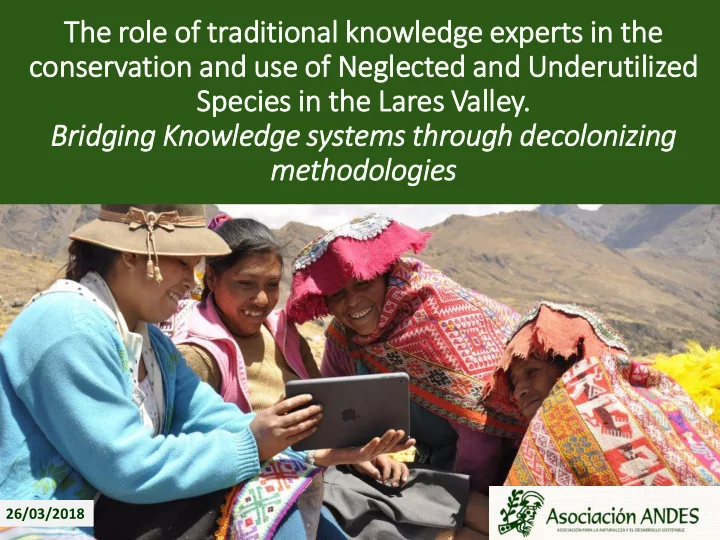
Spec pecie ies in n the the La Lares Val alle ley. Bri - - PowerPoint PPT Presentation
Th The e role ole of of tr trad adit itio ional l kno nowle ledge exp xperts in n the the con onservatio ion an and use use of of Neg egle lected an and Und nderutil iliz ized Spec pecie ies in n the the La Lares Val
26/03/2018
The Lares Valley
Cusco
The Lares Valley
➢ High mountain system of agriculture of 3 main altitudinal zones (high diversity
➢ Each zone hosts diverse range of crops; potato (& livestock) fodder crops in high zones; maize & other Andean root & tuber crops – mid zones; etc. ➢ High diversity within crop species. ➢ Farmer´s livelihoods: based
bio- diverse Andean crops and barter markets (reciprocal relationships) ➢ Main economic activity of families is agriculture (men and women participate in) ➢ Marginalized socioeconomic population, vulnerable to climate change
The Lares Valley
➢ Scaling-up biodiversity management taking lessons learned in the biocultural territory of the Potato Park and adapting them to the reality of Lares ( for the project: 13 rural communities, 1361 Quechua families, who represent some
the poorest population of Peru) ➢ Started with the project “Putting Lessons into Practice: Scaling up Peoples’ Biodiversity Management for Food Security”
The Sowing Diversity = Harvesting Security Program
➢ Strengthen farmers’ seed systems (rights & technical) for food security ➢ Active from lowland paddy fields, to high mountain altitudes and semi- arid regions ➢ 518 Farmers Field Schools in Particiatory Plant Breeding and Neglected and Underutilized Species. ➢ Implemented in Vietnam, Laos, Myanmar, Peru, Zimbabwe ➢ 50 Partners and allies - Local to National
The Sowing Diversity = Harvesting Security Program
The objectives of the SD=HS Program are: ➢ To uphold, strengthen and mainstream the rights and technical capacities of indigenous peoples and smallholder farmers, and ➢ To influence local to global policies and institutions on the access to and sustainable use of plant genetic resources for food and nutrition security under conditions of climate change.
The Sowing Diversity = Harvesting Security Program
ANDES works in 3 pillars:
Pillar 1 – Scaling up models (Key activities. Participatory Plant Breeding of native corn and potatoes within FFS, Training on Integrated pest and Diseases management and agro- ecological practices, Seed management and production in the Seed Multiplication Center) Pillar 3 – Women, Seeds and Nutrition: (Key activities: Baseline study on Nutrition and Neglected and Underutilized Species (NUS), Inventory of Species using GIS technology, Farmers Field Schools on Nutrition and sustainable and nutritious diets using NUS), Pillar 4 – Governance and Knowledge Systems (Local to global policy- maker influencing through evidence and indigenous communities upraising)
Asociación ANDES
established in 1995 as a non-profit civil society organization focused
and agricultural systems for food security ANDES developed a community managed, integrated agricultural landscape management approach for the protection
sovereignty and “Buen Vivir”. The first of these areas is the Potato Park, established in 2002; it has become an internationally recognized model which is being scaled up and replicated in Peru and globally.
Asociación ANDES Vision
Andean Indigenous communities with the capacity and access to effective strategies for conservation and sustainable use of their biocultural heritage, food sovereignty, and harmonious relations between the realms of humans, nature and the sacred
Mission
Promote a holistic approach to conservation and development based on rights and the ancestral Andean principle and philosophy of well-being, Sumaq Kausay
Objectives
traditional knowledge and practices with science and adaptation to processes of global change
that integrate traditional knowledge and science
programs
related to the rights of indigenous peoples, traditional agricultural and food systems, and the rights of our Mother Earth, la Pachamama.
Principles of the SD=HS approach - Andean education principles
Ruway (or Llankay) means to do, and learning while doing is a key component of learning in the Andes. Agricultural knowledge is passed from one generation to the next while practicing agriculture in the field. Learning by doing incorporates audio, visual, and tactile senses into learning and memory. Yachay relates to thinking and knowing. This aspect of learning is often prioritized in formal education systems. Learning through observation, logical thinking, experimentation and analysis embody Yachay learning. Munay refers to the heart and feelings, but not only in the sense of affect and love. This refers particularly to our connection to other individuals and groups, to the Pacha Mama, and all the elements of the
connections to the world, for example through policy development, reflect Munay learning.
Principles of the SD=HS approach - The multiple evidence approach
➢ Use flexible methods and Multiple Evidence Base approach to collect and validate scientific information and traditional knowledge and create epistemological bridges between these two knowledge systems ➢ Mixed methods integrating qualitative and quantitative data through a sequencing
➢ Use of triangulation of data in the qualitative approach (questionnaire, observation and focus groups)
Knowledge-based participatory Action-research (IIED, ANDES, 2017)
Principles of the SD=HS approach - Decolonizing methodologies
➢ The aim is to ensure that research with indigenous peoples can be more respectful, ethical, sympathetic and useful. It is based on developing relationships and following community protocols, and explicitly addresses issues of power and rights (Smith, 1999). ➢ This methodology sought to place control of actions and decisions that affect their lives in the hands of indigenous peoples themselves: from how problems and actions are conceptualized to how actions are taken and by whom (Argumedo 2012)
Principles of the SD=HS approach - Decolonizing methodologies
➢ FPIC Practiced on the field by ensuring the engagement of the communities of Lares in the design, implementation and evaluation of the research. Their participation aimed to empower participants and local institutions allowing its involvement as facilitators along the process. Three main strategies enhance the participation:
relationships with the community participating, much of the work is done in the Lares
elected in each participating communities to be surveyors and facilitators. They were trained to ensure the reliability of the results and their operative autonomy.
Bui uild ldin ing g the he br bridges s thr hrou
h trad adit itio ional al tool tools: the he role le of f the he local l resear archer – FFS and Local researchers
Farmers Field Schools Local researchers Objectives Develop new knowledge and skills in the community as well as better understanding
productive processes. Strengthen and create new skills and knowledge on biodiverse and sustainable diets linked to use and conservation of local biodiversity. Strengthen farmers’ capacities in plant breeding. Create capacities in understanding public policies related to farmers’ rights Develop the capacities of smallholder farmers as decision-makers and solution
so they develop their own research agenda. Link local and scientific knowledge systems providing access to new capacities, information and evidence resulting from participative studies useful at the local level. Actors Communities linked by a bio-cultural protocol 1 FFS at least in each of the agro-ecological zone Groups of 10-20 farmers per are/community 2 Facilitators/local researchers 1 professional from ANDES Local technician team elected in their community during assembly. Professionals from ANDES Universities and International Research Center researchers Project collaborators.
Bui uild ldin ing g the he br bridges s thr hrou
h trad adit itio ional al tool tools: the he role le of f the he local l resear archer – FFS and Local researchers
Duration Productive/farming cycle Permanent, part of the team of ANDES in charge of the implementation of research projects. Financing Per project Per project/ANDES budget Key Processes Facilitating; planning, learning cycle, training/knowledge transfer, development of collective action. Facilitating, motivating, diagnosis, investigations (planning, baseline studies, experimentation, analysis), feedback, monitoring and evaluation Challenges Integrate the main educational Andean principles. Integrate State institution Establish FFS networks Develop the FFS as community processes Creating Research networks Develop research agendas Harmonize the interests of the projects with the interest of the communities and farmers.
Bui uild ldin ing g the he br bridges thr hrou
h trad adit itio ional al tools tools: : the he role le of f the he local l resear archer – The Yupana Matrix
Bui uild ldin ing g the he br bridges thr hrou
h trad adit itio ional al tools tools: : the he role le of f the he local l resear archer – The Yupana Matrix
Bui uild ldin ing g the he br bridges thr hrou
h trad adit itio ional al tools tools: : the he role le of f the he local l resear archer – Khipu Database
Bridging” TK and Science” the example of Neglected and Underutilized Species. – Participatory Baselining
The specific objectives of the process were: ➢ To assess the households dietary diversity. ➢ To explore social strategies and especially the food coping strategies during food scarcity periods. ➢ To analyze how women and men manage the NUS system, including coping strategies, social access, diversity of uses, knowledge management. ➢ To explore the contribution of NUS in the well-being local concept, looking at the inequalities between households and the local strategies to address them. ➢ To map the institutional opportunities to enhance the NUS systems. ➢ To assess participatory perceptions of underlying causes of malnutrition SDHS project, Pilar 3: baseline study was conducted on NUS and nutrition in 2016. The goal of this research was to assess the contribution of Neglected and Underutilized Species (NUS) in the food security strategies of households in the communities of the Lares Valley in a context of climate change.
Bridging” TK and Science” the example of Neglected and Underutilized Species. – Participatory Baselining
NUS have variously been defined as “useful plants belonging to a large, biodiverse group of thousands of domesticated, semi-domesticated or wild species which are marginalized, if not entirely ignored, by researchers, breeders and policy makers” (Padulosi et al. 2013).
Bridging” TK and Science” the example of Neglected and Underutilized Species. – Participatory Mapping and Assessments
Bridging” TK and Science” the example of Neglected and Underutilized Species. – NUS: a biocultural component
Bridging” TK and Science” the example of Neglected and Underutilized Species. – Use of apps for TK survey
Bridging” TK and Science” the example of Neglected and Underutilized Species. – Use of apps for TK survey
The he Chala halakuy Park as BCH Territ itory mo model l
Its Main Objectives: ➢ Conservation of Genetic Diversity of Potatoes in a Center of Origin and Diversity (Infra/intra specific) ➢ Conservation of landraces, NUS and WCR ➢ Conservation of Ecosystem Structure and Functions ➢ Agroecology-based Sustainable Food Production ➢ (Agro) Biodiversity-based Endogenous Development and Wellbeing (income and food sovereignty) ➢ Enhancement of Local Human and Institutional Capacities for the C&SU of Indigenous Peoples’ Biocultural Heritage ➢ Cross fertilization between science and IK (Farmer-scientist collaboration) ➢ Effective Coordination and Cooperation with Government Sectors
The Association of Communities of the Potato Park : first BCH model, TK-based Integrated Landscape Approach for the in situ conservation and sustainable use of PGRFA, systematically organized as Biocultural Heritage Territory, with interventions targeted at potato populations (association with other native Andean species).
The he Chala halakuy Park as BCH Territ itory mo model l
On April 2014, six communities of the district of Lares signed the constitution act of the “Association of communities of the Chalakuy Park” Next step: scaling-up of the Chalakuy Park of Lares to be a locally managed Indigenous Biocultural Territory using the Indigenous Biocultural Heritage Area (IBCHA) model developed by Asociación ANDES. An IBCHA incorporates the best of contemporary science and conservation models and rights-based governance approaches, including the IUCN’s Category V Protected Areas, as well as positive and defensive protection mechanisms for safeguarding the Collective Biocultural Heritage (CBCH) of indigenous peoples. The enhancement of biodiversity management within the Chalakuy Park applies the Indigenous Biocultural Heritage Area (IBCHA) model for local management developed by the ANDES and the Potato Park. Scaling-up sustainable systems is the adaptation of lessons learned in the Potato Park and their application to the social-ecological reality of Lares.
The he Chala halakuy Park as BCH Territ itory mo model l
The project aims to enhance community capacity to develop place-based adaptation approaches that integrate mountain-specific climate strategies, research and knowledge, link traditional knowledge and science and advocate for associated policy changes. In the Chalakuy Park, traditional knowledge practices shape biodiversity conservation and restoration:
good nutritional practices and diversifies livelihoods.
for medicinal uses
Ne Next xt Step teps: : Up p scali aling and nd down down scali aling in n the he Regio gion
IFAD’s definition of scaling up: 'Scaling up means expanding, replicating, adapting and sustaining successful policies, programs or projects in geographic space’ It includes in the SDHS project:
experimentation, policy analysis
In this case, it is not only a program that is scaled up, but also the bio cultural heritage approach linked to it.
Ne Next xt Step teps: : Up p scali aling and nd down down scali aling in n the he Regio gion
Vertical Scaling- Up:
Policy, legal, political, regulatory changes to institutionalise the innovation at national or regional level
Horizontal Scaling-out
Expansion or replication: innovations may be replicated in different geographic sites or can be extended to serve larger or different population groups.
Ne Next xt Step teps: : Up p scali aling and nd down down scali aling in n the he Regio gion
to influence policy reforms from local to national and international levels.
frameworks relevant to the Right to Food & Farmers Rights and C & SU of TK
citizenship while conserving their biocultural heritage territory
ecosystem/landscape
replicating the repatriation of potatoes in the Potato Park to the diverse agro- ecological food zones in Lares (ANDES)
networks