Campaign to Stop Climate ChangeOne village, One Action at a Time: - - PDF document

campaign to stop climate change one village one action at
SMART_READER_LITE
LIVE PREVIEW

Campaign to Stop Climate ChangeOne village, One Action at a Time: - - PDF document

Campaign to Stop Climate ChangeOne village, One Action at a Time: Winning Activities Selected from Japans 47 Prefectures in FY2007 Prefecture Applicants Summary of Activities Constructed a rice storage facility by using cold energy


slide-1
SLIDE 1

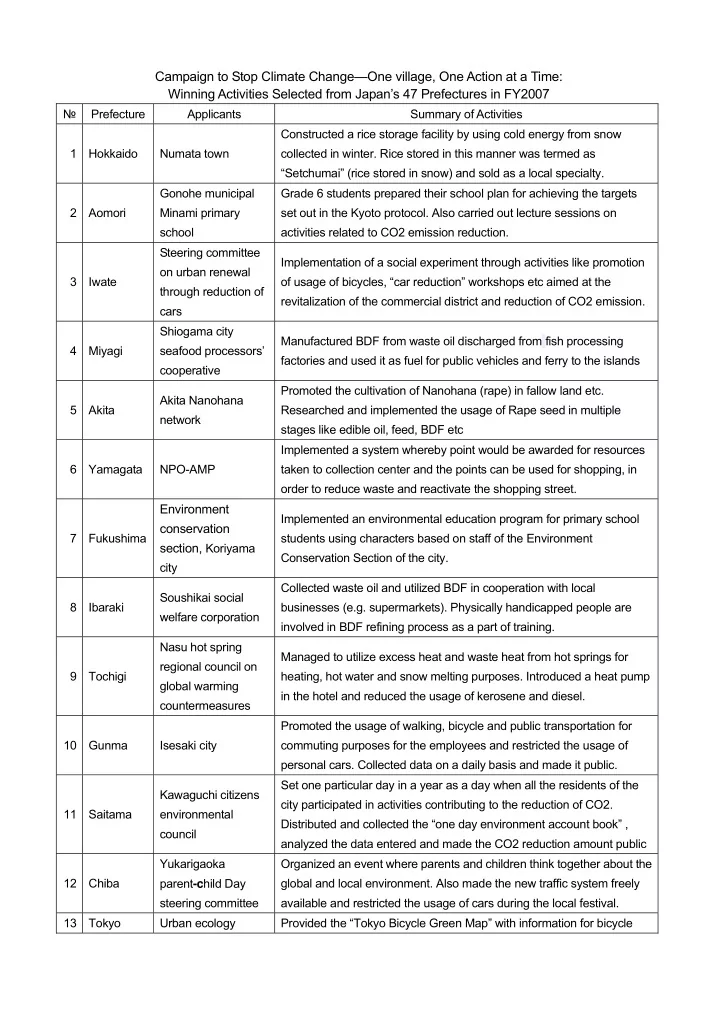
Campaign to Stop Climate Change—One village, One Action at a Time: Winning Activities Selected from Japan’s 47 Prefectures in FY2007

№ Prefecture Applicants Summary of Activities 1 Hokkaido Numata town Constructed a rice storage facility by using cold energy from snow collected in winter. Rice stored in this manner was termed as “Setchumai” (rice stored in snow) and sold as a local specialty. 2 Aomori Gonohe municipal Minami primary school Grade 6 students prepared their school plan for achieving the targets set out in the Kyoto protocol. Also carried out lecture sessions on activities related to CO2 emission reduction. 3 Iwate Steering committee

  • n urban renewal

through reduction of cars Implementation of a social experiment through activities like promotion

  • f usage of bicycles, “car reduction” workshops etc aimed at the

revitalization of the commercial district and reduction of CO2 emission. 4 Miyagi Shiogama city seafood processors’ cooperative Manufactured BDF from waste oil discharged from fish processing factories and used it as fuel for public vehicles and ferry to the islands 5 Akita Akita Nanohana network Promoted the cultivation of Nanohana (rape) in fallow land etc. Researched and implemented the usage of Rape seed in multiple stages like edible oil, feed, BDF etc 6 Yamagata NPO-AMP Implemented a system whereby point would be awarded for resources taken to collection center and the points can be used for shopping, in

  • rder to reduce waste and reactivate the shopping street.

7 Fukushima Environment conservation section, Koriyama city Implemented an environmental education program for primary school students using characters based on staff of the Environment Conservation Section of the city. 8 Ibaraki Soushikai social welfare corporation Collected waste oil and utilized BDF in cooperation with local businesses (e.g. supermarkets). Physically handicapped people are involved in BDF refining process as a part of training. 9 Tochigi Nasu hot spring regional council on global warming countermeasures Managed to utilize excess heat and waste heat from hot springs for heating, hot water and snow melting purposes. Introduced a heat pump in the hotel and reduced the usage of kerosene and diesel. 10 Gunma Isesaki city Promoted the usage of walking, bicycle and public transportation for commuting purposes for the employees and restricted the usage of personal cars. Collected data on a daily basis and made it public. 11 Saitama Kawaguchi citizens environmental council Set one particular day in a year as a day when all the residents of the city participated in activities contributing to the reduction of CO2. Distributed and collected the “one day environment account book” , analyzed the data entered and made the CO2 reduction amount public 12 Chiba Yukarigaoka parent-child Day steering committee Organized an event where parents and children think together about the global and local environment. Also made the new traffic system freely available and restricted the usage of cars during the local festival. 13 Tokyo Urban ecology Provided the “Tokyo Bicycle Green Map” with information for bicycle

slide-2
SLIDE 2

№ Prefecture Applicants Summary of Activities Tokyo users to promote a transport modal shift from cars to bicycles for short trips within central Tokyo. 15 Kanagawa Atsugi Nakacho shopping street promotion association Collected organic waste in stations located within the shopping street and awarded points based on weight. Collected waste was dried and composted and used for producing vegetables sold in the shopping street. 15 Niigata Council on Nagaoka method for garbage recycling system Distributes soil which contains organisms to decompose organic matter to households. Dwellers mix garbage with the soil and store home

  • temporarily. The mixture is collected twice a week and after further

fermentation it is returned to households to mix with garbage again. 16 Yamanashi Tsuru city Constructed a small scale hydroelectric plant in a river in front of the city

  • ffice. Used the project for powering the city office and also as material

for dissemination of environmental education. About 40% of the installation cost was supplied through a public offered bond. 17 Shizuoka Kawanehoncho regional council on global warming countermeasures Created a “green curtain” screening the windows on the south side by supplying bitter melon vines etc to households and businesses to reduce electricity consumption for air conditioning in summer. 18 Toyama Toyama city Changed the old rail track to LRT (Light Rail Transit) and managed to greatly increase the convenience to the public by improving the service level and creating a barrier free environment. Aims to create a compact city that does not depend on cars. 19 Ishikawa Kanazawa Shinkin bank Provided an installment deposit for environmentally conscious consumers with a premium interest rate and contributed 0.02% of the contract amount to environmental groups. 20 Fukui Environmental partner Ikeda Build and operates a system where points are awarded for participation in environmental protection activities (collection of organic waste and waste oil, etc.) The points can be used in local shopping streets. 21 Nagano Society for spread of environmental management system Coordinated various activities (refraining from commuting by cars, light down after 10 pm etc.) at a time on the environment day in corporation with businesses and households in the region. The result of the activity is converted into CO2 and reported to the participants. 23 Gifu Tono cypress products distribution cooperatives Utilize wood sawdust and chips as fuel for the power generation facility in a timber factory. The electricity is used in the factory and excess heat is used for drying the timber. 23 Aichi Central branch of the association of professional engineers, Japan Developed the “traffic game” which explains the necessity and method

  • f “environmentally friendly choice of transportation”, and provided free

copies of the manual and know-how as a material for environmental education. 24 Mie Eco-bag promotion council Carried out various activities relating to reduction of plastic shopping bags like making plastic shopping bags payable, distributing reusable shopping bags for free, banning the usage of plastic shopping bags for waste disposal etc.

slide-3
SLIDE 3

№ Prefecture Applicants Summary of Activities 25 Shiga Nanohana (rape blossoms) project network Pioneered the “Nanohana project” which is a combined effort containing rape cultivation in fallow land, production of edible oil, collection of waste oil, manufacture of soap and BDF, etc. 26 Kyoto Kyoto prefectural Kita-kuwata high school Prepared log house and furniture from local Japanese Cedar and Cypress and decreased CO2 emission from wood mileage. Carried out PR activities regarding CO2 reduction from using local timber products. 27 Osaka Osaka Amechan project promotion center Carried out dissemination activities by printing and distributing the information to prevent global warming on candy wrappers. 28 Hyogo Hyogo prefectural Miki-kita high school Implemented the “Eco bag campaign” in cooperation with the local shopping streets to reduce usage of plastic shopping bags. Also implemented the “Hand held fan campaign” by using round fans made

  • f bamboo and paper to reduce usage of air conditioning.

29 Nara Nara Kotsu bus lines Co.,Ltd. Implemented a traffic regulation around the station where the lane towards the station was used only by buses and taxis during morning rush hour. Contributed to the reduction of CO2 from usage of private cars by promoting the usage of public transportation. 30 Wakayama Kishu eco navito Installed public funded power generation facilities using renewable

  • energy. Until now 4 stations (solar, wind) have been installed in the

northern region of the prefecture. Planning to install a micro hydroelectric power plant in the southern region. 31 Tottori Hikona area Kid’s environment patrol team Started the collection of waste oil for lake water purification in Lake

  • Nakaumi. Manufactured soap and BDF from waste oil. Collected used

disposable wooden chopsticks for usage as raw material for pulp. 32 Shimane Federation of residents' associations in Agenogi district 2 Collected and composted leaves from Japanese Cypress trees on roadsides and reduced CO2 emission and energy consumption during incineration. 33 Okayama Meiken lamwood Corporation Produced electricity by using waste wood chips from timber processing as fuel, which was sufficient for the whole factory and the excess heat was used for drying of timber. A part of the wood chips was processed as pellets and sold as fuel. 34 Hiroshima Higashi-hiroshima environment family Set the target of 6% reduction in households electricity consumption as compared to the previous year and checked the invoices from the power company on actual usage of electricity. Implemented a local emission trading system with the aim to achieve the target as a whole group. 35 Yamaguchi Yasunari Co.,Ltd. Developed a cellulose fiber insulation material made from waste paper. Also formulated a collection system where local currency would be supplied to anyone taking used newspapers to the factory. 36 Tokushima The Sun and green recycling association Managed to reduce CO2 emission in the office by using solar panels, solar water heater, and natural air circulation system to reduce the usage of air conditioning.

slide-4
SLIDE 4

№ Prefecture Applicants Summary of Activities 37 Kagawa Mitoyo municipal Takase primary school Students conducted a survey on waste of energy and managed to reduce of electricity usage in the school by collecting and practicing the knack for energy saving. Also prepared an advertisement on energy saving and made a public appeal. 38 Ehime Matsuyama network

  • n prevention of

global warming Made a public call for slogans composed in the haiku style for the promotion of effective global warming prevention actions (reduction of usage of air conditioning, plastic shopping bags, etc.), and prepared stickers based on the slogans selected as excellent work. 39 Kochi Association for environmental education in primary curriculum, Kochi university Conducted awareness raising programs on prevention of global warming for children including watching a drama and giving them practical experience lessons. 40 Fukuoka Hayama healthcare and energy saving republic Managed to visualize the power consumption of each household by installing “energy saving navigation systems”. Also promoted activities like environmental bookkeeping and energy saving actions. 41 Saga Association of Genki, Yuki, Kakki (vibrant energy of

  • rganic cycle)

Reactivated the traditional practice of “creek culture”. It involves catching fish and returning back the mud from the creek to the agricultural land, after cultivation of crops and emptying water from the

  • creeks. Conducted safety inspection on hazardous substances.

42 Nagasaki Nagasaki leaders network on garbage reduction Promoted composting of garbage and organic vegetable cultivation by conducting a “healthy vegetable contest” on an island which depends largely on food brought in from the mainland. 43 Kumamoto Minamata city Prepared original environmental management system certification for households, shops, schools, kindergartens and hotels and promoted environment protection activities in the city. 44 Oita Hita City Managed to segregate and collect garbage and livestock droppings for biomass energy recovery. All the primary and junior high schools in the city obtained the “EMS certification for schools” and implemented a successful environmental education program. 45 Miyazaki Biomass research group and Miyazaki city Citizens voluntary group and the local government respectively collected waste oil and managed to manufacture BDF 46 Kagoshima Osaki town Provided gift vouchers to households who registered for “domestic energy saving campaign” and successfully managed to reduce the annual electricity usage by more than 6%. 47 Okinawa Hantagawa community center Started the cultivation of the Okinawa landraces of soya which were abandoned being replaced by cheaper imported soya beans and made tofu using traditional materials and tools.

slide-5
SLIDE 5

Campaign to Stop Climate Change—One village, One Action at a Time: Winning Activities Selected from Japan’s 47 Prefectures in FY2008

№ Prefecture Applicants Summary of Activities 1 Hokkaido Wakkanai alternative and renewable energy study group Installed wind power plants to take advantage of strong wind with average speed reaching over 7.5m/s. Established a facility for environmental education called “Wakkanai school of wind” and involved in dissemination of renewable energy. 2 Aomori Aomori prefectural Sanbongi agricultural high school Introduced energy and environmental education in the curriculum and implemented a project to maintain room temperature without using air conditioning as an extracurricular activity. 3 Iwate Iwate biodiesel fuel network collects and processes used cooking oil into biodiesel fuel, which is then used as an alternative for diesel. Various enterprises are working together to share information and ensure fuel quality and fuel-supply stability, and to find uses for the byproducts. 4 Miyagi Sendai municipal Kita-Rokubancho primary school Grade 6 students have made an aquarium of fishes and other

  • rganisms in the nearby river. And reduced energy required for

maintenance by using solar and wind energy, green walls of plants. 5 Akita Study group on wooden structure for public works This study group has developed and constructed wooden structures (all wooden dams) using the famous local Japanese cedar wood. 6 Yamagata Yamagata prefectural Okitama agricultural high school Reduced food processing waste (strained lees from juice and wine processing factories) by producing feed for livestock. 7 Fukushima Aizuwakamatsu municipal waste carriers cooperative The consolidation of routes traveled by waste collection trucks is helping to reduce CO2 emissions. In addition, by changing pricing system from flat-rate to metered pricing urged to cut emissions of waste. 8 Ibaraki Ibaraki prefectural Aso high school Incorporated environmental considerations on annual school excursion. Key features are making environmental objectives, purchasing green electricity, planting trees, carrying reusable chopsticks and bags, learning about aboriginal Ainu culture, etc. 9 Tochigi Nasunogahara land improvement district association Has utilized micro hydroelectric system on an irrigation canal, solar system on the embankments of water reservoirs, and biomass energy recovery using methane fermented from livestock waste. 10 Gunma Kotsu-kotsu bear families This organization is raising awareness on global warming through a range of activities, including seminars for children using the bear cub characters. 11 Saitama Tsubasa-Yu lifestyle workshop Implemented production of biogas and liquid fertilizer from organic

  • waste. Have utilized the Japanese paper which can be recycled locally

and helped to reduce paper waste. 12 Chiba Kuru-kuru (bicycle recycle) study group Students dismantle and repair bicycles abandoned in the university and rent them out to promote the use of bicycles instead of cars. 13 Tokyo Green curtain Has promoted “growing green curtain of foliage" movement to grow

slide-6
SLIDE 6

№ Prefecture Applicants Summary of Activities supporters’ group plants covering its outer walls as a way to block the sun in the summer and keep rooms cool, holding down the use of air conditioners. 14 Kanagawa Yokohama football club The first Professional soccer league team (J-league) to acquire ISO 14001 certification. Has conducted PR campaign to raise awareness for environmental conservation among its supporters. 15 Niigata Snow-country housing study group Has developed and promoted houses where snow in winter is stored in a snow room to use it in summer for air conditioning and storage of food products. 16 Yamanashi Masuho town regional council on global warming countermeasures This community-sponsored solar power system was installed at the public nursery. The revenue from the sale of electricity is being used for a local currency to be used in shopping streets within the town. 17 Shizuoka Wakuwaku Saigo Used paper from the local community and businesses is collected and sold and the proceeds from sale of this paper is used to install solar systems at the local primary and junior high schools. 18 Toyama Takaoka municipal Fushiki primary school district women’s association Used disposable wooden chopsticks are collected and sent to the local paper mill where it is recycled as raw material for pulp. 19 Ishikawa Kaga city women’s council Citizens voluntarily separate and compost their garbage to reduce the amount of waste incineration. 20 Fukui Fukui city Yashiro-Kita community center Local citizens associated with the community center have been the driving force behind environmental PDCA cycle (Plan - Do - Check - Action) to promote global warming prevention activities. 21 Nagano Hakuba environmental education promotion council All the ski resorts in the village have joined together to declare an environmental friendly ski area. They have carried out activities like collection of waste oil, production of BDF, composting of waste , implementation of eco drive (no engine idling) etc 22 Gifu Gifu prefectural Ena agricultural high school Used Chestnut shells discarded during the production process of local specialty sweets for composting, hence reducing the amount of waste incineration. 23 Aichi Tahara Nanohana (rape) eco network and Tahara city Promotion of cultivation of Nanohana (rape), production of edible oil, collection and refining of waste oil and usage as BDF. 24 Mie Whole Mie eco lifestyle action council Reducion in the usage of disposable plastic shopping bags by making plastic bags payable in almost all parts of the prefecture. 25 Shiga Calbee Konan Co., Ltd. Switched to local purchasing of raw materials for potato chips produced

  • locally. Reduction of transportation time and distance helped maintain

the freshness of the potato and also reduced CO2 emission. 26 Kyoto Kyoto municipal Kumogahata junior high school Achieved reduction of CO2 emission from classrooms by 80% by usage

  • f renewable energy (wood stoves, solar panel, wind power etc).

Firewood making was carried out by whole local community.

slide-7
SLIDE 7

№ Prefecture Applicants Summary of Activities 27 Osaka Study group on educational materials about food mileage Developed a shopping game that helps understand the emission of CO2 in the transportation of food products. Responding to a request from other regions, prepared other local versions of the game. 28 Hyogo Hyogo prefectural Harima agricultural high school Greening cow barns resulted in reduction of cooling cost in summer, reduction of CO2 emission, as well as improvement of the local landscape. 29 Nara Nara prefectural Oji technical high school Developed a windmill with automatic pitch adjustment on vertical rotors, which can utilize even small winds and also results in reduction of noise. 30 Wakayama Global environment No.1 Made a simple organic waste treatment apparatus that uses earthworms and utilize it at primary schools for treatment of garbage, preparing good quality soil and promoting environmental education. 31 Tottori Misasa hotspring tourism association Produced compost from garbage derived from the local hot spa facilities etc and supplied it to local farmers. Vegetables grown by using the compost are used in the local school canteens and hotels. 32 Shimane Study group on Japanese folk dwellings Reform, move and rebuild the traditional Japanese houses (“kominka”) by using traditional Craftsmanship. 33 Okayama Yubara hotspring innkeepers association Produced BDF from waste oil collected from the local households and hot spa facilities. 34 Hiroshima Numakuma forum to stop global warming Organized over 100 visiting lectures that uses hand made teaching materials and promoted the usage of “environmental household account book” and “eco activities check book”. 35 Yamaguchi Tabuse municipal Higashi-Tabuse primary school Prepared “Mottainai cards” that called for the reduction in the usage of electricity and water, and conducted energy saving patrols to reduce electricity and water consumption in the school. 36 Tokushima Zero waste Awaodori festival steering committee Installed a waste station in the venue for Awawa-Odori (dance) visited by 1.3 million people and helped promote recycling by carrying out segregation and collection of waste. 37 Kagawa Naoshima project “Wa Gafé Goo” , Kagawa university Students have operated an environmental friendly café that carries out activities like composting of garbage, usage of local food products, purchase of green electricity etc 38 Ehime Nankai broadcasting Co., Ltd. and Mikan theater company A song and dance produced by a local musical troupe was broadcasted with cooperation of a local TV station that helped increase awareness

  • n activities relating to prevention of global warming.

39 Kochi Kochi biomass farm Utilized wood pellets as alternative fuel for heating during greenhouse cultivation of vegetables and flowers in winter 40 Fukushima The Merry Corporation The company rented out garbage treatment equipments to restaurants etc and produced quality compost from the collected matter. Vegetables and fruits fertilized with the compost were sold to local restaurants etc. 41 Saga Imari Hachigame plan Promoted food waste recycling by activities like production of compost from garbage, production of BDF from waste oil, Nanohana project

slide-8
SLIDE 8

№ Prefecture Applicants Summary of Activities (multistage usage of rape seed) etc. 42 Nagasaki Sasebo eco plaza Carried out activities like reuse and repair of used furniture, clothing and

  • toys. The activities were carried out at an old closed school which itself

was repaired. 43 Kumamoto Minangata (southward) green club Families grow bitter melon vines from seedlings and use nets to guide the vines along exterior walls of their home. These “green curtains” keep room cooler during the summer, reduce the need for air conditioning. 44 Oita Japanese cedar and cypress conservation society Prepared cedar clappers from local cedar engraved with a message on global warming prevention and used it while supporting baseball teams in the national high school baseball games at Koshien ball park. 45 Miyazaki Nangoku-kosan Co., Ltd The area is famous for its chicken farms. The company used chicken droppings as a fuel for its boiler hence reducing the usage of fossil fuel. 46 Kagoshima Okuchi-shuzo Co., Ltd. Adopted returnable bottles for shochu (Japanese distilled spirit). Also utilized shochu residue as feed for livestock, livestock excreta to prepare compost, and compost to grow sweet potatoes for the shochu. 47 Okinawa Okinawa prefectural Miyako vocational high school Promoted pesticide-free cultivation of buckwheat in the Idle land after harvesting of sugarcane, in order to make sugarcane cultivation economically sustainable, to preserve groundwater resource, and to reduce food mileage.