
SLIDE 1
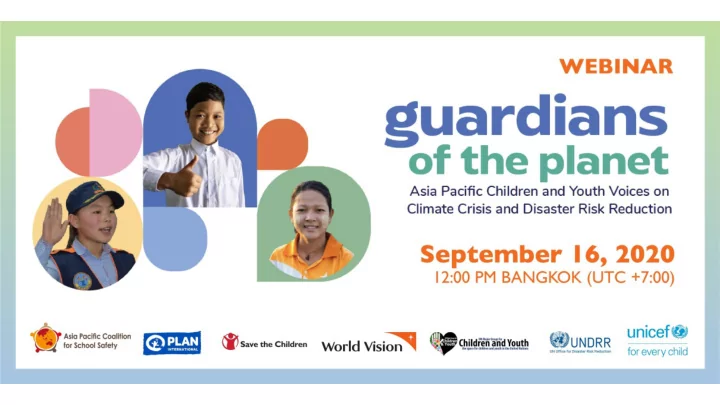
SPEAKERS & PANELIST Vanda Lengkong, Shaheen Chughtai, Meimei - - PowerPoint PPT Presentation
SPEAKERS & PANELIST Vanda Lengkong, Shaheen Chughtai, Meimei Leung, Regional Cherian Thomas, Regional Head of Disaster Risk Regional Advocacy & Humanitarian Emergency Leader, South Asia & Management for Asia Campaigns Director,
Shaheen Chughtai, Regional Advocacy & Campaigns Director, Asia, Save the Children Christabel Chan, Regional Humanitarian Emergency Affairs Specialist, Asia Pacific, World Vision Cherian Thomas, Regional Leader, South Asia & Pacific, World Vision Meimei Leung, Regional Humanitarian Emergency Affairs Director, Asia Pacific, World Vision Vanda Lengkong, Head of Disaster Risk Management for Asia Region, Plan International
HOST
SPEAKERS & PANELIST
Animesh Kumar, Deputy Head, Asia-Pacific, United Nations Office for Disaster Risk Reduction
Cooperation, Vietnam Disaster Management Authority Russell Miles, Director, Climate Resilience & Development Section, Sustainability & Climate Change Branch, Dept of Foreign Affairs & Trade, Australian Government
Lily, 12 years old, Thailand Kritika, 16 years old, Nepal Saleha, 18 years old, India Grace, 16 years old, Australia
SPEAKERS & PANELIST
MODERATOR
Nghia Trinh, Secretariat of Asia Pacific Coalition for School Safety
AGENDA
Opening remarks World Vision Background and Consultation key findings World Vision Sharing by 12 years old Climate Activist Thailand (Unicef) Sharing by 16 years old C&Y Rep Nepal (UNMGCY) Sharing by 18 years old C&Y Rep India (UNMGCY) Sharing by 18 years old C&Y Rep Australia (WV) "The Red Alert Campaign: Amplifying children's voices in inclusive DRR & CCA policy development, practice and research“ Save the Children “Girls, Youth and women leadership in combating climate crisis” Plan International Vietnam child-centered DRR policy and program Gov’t of Vietnam Integrating Climate and DRR Action in Australia’s Aid Program Gov’t of Australia Panel Discussion and Q&A APCSS secretariat Closing remarks UNDRR
Cherian Thomas, Regional Leader, South Asia & Pacific, World Vision
‒ Available on ReliefWeb: https://reliefweb.int/report/ban gladesh/guardians-planet-asia- pacific-children-and-youth- voices-climate-crisis-and
‒ 55 pages, with 4 Annexes ‒ Available on ReliefWeb today, an email will also be sent to all registered participants https://reliefweb.int/report/world/g uardians-planet-asia-pacific- children-and-youth-voices- climate-crisis-and-disaster
Hashtag #GuardiansOfThePlanet
Meimei Leung, Regional Humanitarian Emergency Affairs Director, Asia Pacific, World Vision
Purpose of Consultation
voices of boys, girls and youth to Government, UN agencies and stakeholders to influence policies and commitment on Climate Crisis & DRR
Preparation for Asia Pacific Ministerial Conference on Disaster Risk Reduction 2020
Countries directly participated in consultation
Regional consultation, with C&Y reps from 21 countries in Asia Pacific
93% of children and youth see Disaster Risk Reduction and Climate Change adaptation as an important issue
Across the region, “Climate crisis” is ranked as the top concerns of all children and youth. 15% of respondents picked “Climate crisis” as their 1st concern for the future followed by “Access to work or employment” (13%), “Access to education” (13%), and “Safe from disaster impacts” (11%). “Climate crisis” remains the top 3 concerns in almost all age groups and countries.
Children and Youth are no strangers to the Climate Crisis
With hydro-meteorological disasters risks (e.g. flooding, drought, typhoon/cyclone, El Niño and La Niña) accounting for over 50% of the reported experience by children and youth.
Of children and youth have experienced disaster risks in the past 12 months
Children and Youth are no strangers to the Climate Crisis
23% reported experiencing extreme temperature, while 30% experienced floods or more intense rains. Decrease in economic opportunities is also reported as a visible impact of climate change.
Of children and youth have noticed more climate related disasters locally in last 2 years
Call for inclusive approach to DRR and CCA processes
In the face of the growing impact and frequency of climate disasters, children and youth identified themselves as the most vulnerable group followed by the “elderly” and “people with physical disability”.
Call for inclusive approach to DRR and CCA processes
Disability and inclusion has always been high on the list of concerns of children and youth. There is a strong call to gov’ts to collaborate with different stakeholders to include the most vulnerable groups, especially children and youth, and children with disabilities in addressing the negative impacts of hazards including climate crisis in every country.
It is important to note that while most respondent pointed out insufficient support, the proportion of children and youth choosing “No” increases according to the age groups
Of children and youth felt that C&Y with disabilities are not given enough support to prepare for disasters
Strengthen Education Curriculum on Climate Change Adaptation
Children and youth recommended that governments develop curriculum towards resilience building and include DRR and climate change topics in the school syllabuses. This points to a strong need to strengthen formal educational materials on Climate Change Adaptation.
Formal Education it is particularly significant in the younger age groups; 15% were informed via news and 13% via social media.
Of children & youth indicated that formal education is a major channel to learn about climate change and disaster risks,
Mainstream and Localize Children and Youth Voices in Climate Discussions
Children and youth emphasized the urgent need to empower them and be given the opportunity to be heard and involved. Children and youth recognized their potential as agents of change among peers and can contribute to community resilience building, averting and mitigating the climate crisis. Governments and stakeholders should strengthen
processes, including setting up more formal platforms and communication channels between policy makers and children and youth.
All responsible to act on disaster risk reduction and address the climate crisis
Inclusive platform for C&Y to speak and contribute in decision making process DRR/CCA formal education in school curriculum, with improved access for disabled C&Y Empower C&Y to take actions to address climate crisis and disaster risks
Read the Report for more details.
Lily, 12 years old, Thailand
Kritika, 16 years old, Nepal
Saleha, 18 years old, India
I am Saleha Khan, from Chikkalwadi, Shivajinagar, Mumbai East, India I have been a member of Children and Youth Group – 2015 – 2017 in DRR programme in Urban areas supported by Save the Children India I have learned to do Risk Mapping, DRR Planning and implementing I have been trained as a Task Force Member: First Aid, Early Warning, Shelter, Psycho-Social Care.. To bring awareness in our communities regarding the issues identified in our Risk
example, Street Lights were always dim, Water issues and also Eve Teasing, Drug Addiction also
As Children and Youth Group, we used every opportunity to demonstrate our work and also share our good practices. In 2019 January, there was World Congress on Disaster Management organized by IIT Mumbai, TISS, Government of Maharashtra and DMICS. In this, our youth group shared our risk analysis, planning and also performed street play about the issues. I was also co-chair with Mr Animesh Kumar, UNDRR Deputy Chief on Risk Vulnerability and Resilience session
As a representative of Children and Youth, I was sent to New York in 2017 September where I had opportunity to meet with Ministers, Heads of States and also Big Donors like Bill and Melinda Gates. At that time, Melinda and I had a contract to develop Water Sanitation and Hygiene champions in our slums I succeeded and newspapers have also covered this.
My Children and Youth Group would like to work with other platforms in other countries to make sure that both at local, national and international level Voices of Children and Youth is always heard.. We are committed to this. Give us that OPPORTUNITY!!!
Grace, 16 years old, Australia
Shaheen Chughtai, Regional Advocacy & Campaigns Director, Asia, Save the Children
What are children and youth telling us?
children and youth: over 77% reported having noticed more climate-related disasters locally in the previous two years.
Disaster Risk Reduction (DRR) and Climate Change Adaptation (CCA) processes, including stronger formal education on these subjects.
CCA as important, emphasizing the urgent need to for them to be empowered, heard, involved.
Supporting children and youth as agents of change Participation in events, media and social media Networking to build capacity and influence Advocacy and media skills capacity building
July 2020t regional launch –
attended a regional campaign discussion.
children and youth held in 7 countries to share concerns and ideas, and make new connections
children's knowledge and capacity
July 2020t regional launch –
Hong Kong, Indonesia, Korea, Myanmar, Nepal, Pakistan, Philippines, Sri Lanka, and Vietnam
Bangladesh, Indonesia, Korea, Myanmar, Nepal, Sri Lanka and Vietnam including advocacy and media activities.
from the Earth Observatory of Singapore were published in six countries. Regional Op-Ed with Stockholm Environment Institute was covered by Reuters, Aljazeera and Asia Times.
pandemic threats, and a green COVID-19 recovery.
July 2020t regional launch
develop their strategies and plan activities
regional and global opportunities on the road to COP26
awareness, e.g. video messages on Sustainability Day etc.
partnerships
grassroots movement of young southern voices
Vanda Lengkong, Head of Disaster Risk Management for Asia Region, Plan International
33
By Vanda Lengkong Head DRM Plan International Asia Pacific
34
suppressed by poverty, violence, exclusion and discrimination.
time
35
For Plan International
equal access to their rights, and this should not be hindered by the threat of climate change.
and magnifies gender inequalities, especially for girls.
participation in climate decisions and action must therefore be a priority The global climate movement is being powered by girl activists, yet national climate strategies barely consider their rights. Climate action without girls and young women will fail to tackle the climate crisis today and will create bigger challenges in the future
Plan International support girls, boys and youth to understand climate change, its impacts and how they can adapt. Through
action and adaptation in their countries and communities
36
Cl Clim imate te change ge yo youth th acti tivi vism sm
Implement Child Centered Climate Change Adaptation programing Influencing work in collaboration with partners at different level Information and knowledge management
Our recommendation to the governments and relevant stakeholders:
risks faced by the most vulnerable.
leaders to account.
confidently and safely speak out about climate change.
responsible for the most emissions, provide support for the people and communities most affected by the climate crisis
38
PROTECT GIRLS EDUCATION SUPPORT GIRLS’ LEADERSHIP PROVIDE EQUAL ECONOMIC OPPORTUNITIES
https://plan-international.org/emergencies/effects-
39
https://plan-international.org/asia
Deputy Director, Science Technology & International Cooperation – VNDMA (Vietnam Disaster Management Authority) Deputy Chief of staff, VietNam DRR Partnership
Deputy Director Science Technology and International Cooperation Vietnam Disaster Management Authority Standing Office of the Central Steering Committee for Natural Disaster Prevention and Control The Government of Viet Nam
risk reduction for the period of the 2017-2021
needed?
Vietnam
Why are child ildren and dis isaster ris isk k reduction in in Vie ietnam ?
The joint MARD-UNICEF vision paper on child-centered disaster risk reduction in Vietnam by 2030 states: Climate change-related natural disasters with a high frequency and intensity have exacerbated the vulnerability of people living in difficult regions.
Agricultural GDP growth was negative 0.18% for the first time. This was also the first time Vietnam called for international support to cope with drought and salinity. It was estimated that 520,000 children and one million women were affected.
August 2 to August 4, 2017, causing 33 deaths, including 11 women, 8 children, destroying a total of 236 houses andd damaged 46 schools ... The total damage was estimated at over VND1,400 billion.
The total damage was estimated at VND60,000 billion.
significant, causing serious damages to many schools and health stations. The total number of deaths and missing was 224, including 31 children 78 women. The economic loss was estimated at about VND20,000 billion (~US$860).”
Why are child ildren and dis isaster ris isk k reduction in in Vie ietnam ?
malnutrition, poor sanitation, lack of care, and language barriers.
dependence on parents and caregivers.
interrupted.
nutrition, health and sponsorship, which causes long-term impacts.
Part rtnership ip program between MARD and UNIC ICEF on child ild-centered disa isaster risk risk reductio ion in in th the 2017-2021 perio riod: : 3 key pil illa lars
As a result, disaster risk is reduced and resilience is strengthened
Enhance institutional capacity Reduce children’s vulnerability Enhance the capacity of children, households and community
and life skills.
the youth including application of new technologies
vulnerability through combined solutions in the fields of education, health, nutrition, clean water, environmental sanitation and social protection system
integrating disaster risk management into the economic development plan
Key y exp xpected outcomes
framework
for disaster preparedness and response, including a legal framework which faciliates the timely implementation of international humanitarian assistance activities
solutions in the fields
education, health, nutrition, clean water, environmental sanitation and social protection system.
society from natural disasters
into the economic development plan and sectorial plans.
with other countries
Basic implementation strategy in DRR: international cooperation
children and disaster risk reduction is required due to scale and comlexity of natural hazards associated with climate change
framework and a key principle in building child-centered disaster resilience
need to work together to increase the synergy and promote disaster risk reduction
Achie ieved progress in in chil ild-centered dis isaster r ris risk reductio ion effort rts in in Vie ietnam
Vietnam is committed to implementing international frameworks such as the Sendai Framework, Convention on the Rights of the Child. Vietnam is also increasingly integrating disaster risk management into socio-economic development plans at the national, subnational levels and in sectors. Some specific results:
centered disaster risk reduction in Vietnam by 2030
province
and Response to nutritional emmergencies and the National Strategy on communication to change disaster preparedness and response behaviors being developed
reduction initiatives for some sectors.
Achie ieved progress in in chil ild-centered dis isaster r ris risk reductio ion effort rts in in Vie ietnam
and Training with the main action program as follows:
standards of “safe schools from natural disasters”.
curriculum to make appropriate adjustments in line with the overall orientation of the general education program.
suitable to particular regions and education levels.
prevention that are suitable to disaster characteristics of each region.
students in schools and educational institutions. Develop guiding materials for students to acquire risk identification and drowning prevention skills.
Achie ieved progress in in chil ild-centered dis isaster r ris risk reductio ion effort rts in in Vie ietnam
centered methodology has been comprehensively evaluated to answer the question why natural disasters have severe impacts on vulnerable children and people and make recommendations to address these issues.
urgent ODA to be rapidly approved, strengthening leadership in Disaster Risk Reduction and urgent support from the ministerial level to the prime minister level and enhancing communication effectiveness.
Achie ieved progress in in chil ild-centered dis isaster r ris risk reductio ion effort rts in in Vie ietnam
which capacity building is a key component. A TOT course was conducted, in which participants were guided through steps of risk analysis and mapping with specialized computer softwares leveraging online data resources. This activity provided VDMA’s technical officers with professional knowledge and skills to conduct human-centered risk assessment to high-risk communities in 63 provinces in Vietnam.
partnership program with UNICEF, VDMA conducted a training course to study the state model for natural disaster management in Japan. Many useful lessons has been drawn after the course to renovate the disaster management system in Vietnam.
Achie ieved progress in in chil ild-centered dis isaster r ris risk reductio ion effort rts in in Vie ietnam
schools across the country with the aim of raising awareness and promoting actions towards education and practices of disaster-resilient
partnership program on disaster prevention in schools for the 2018-2023 period, in which UNICEF provided consultancy support. Outstanding events were held in Hoa Binh, Dong Thap and Ninh Thuan with the participation of 3,000 students. The closing ceremony with the attendance
Key messages delivered were equality, inclusion, system and institution building and community engagement to build a safe society from natural disasters.
Orie rientatio ions in in partnership ip program with ith UNIC ICEF and other partners
comprehensively identify loopholes in the legal system and make recommendations for improvement.
MARD for the 2018 - 2023 period on school education about climate change, disaster risk reduction and safe school from natural disasters.
based on the analysis of gap capacity of Central and Provincial Steering Committee for Natural Disaster Prevention and Control and General Department of Disaster Prevention and Control of Vietnam through children’s perspective and review results of legal framework on disaster prevention.
Assembly and Ministry of Planning and Investment in supervising the implementation of the Law on Natural Disaster Prevention and Control (including fieldwork and policy dialogue) and relevant decrees and circulars such as No. 05 on integrating disaster risk management into the child-centered socio-economic development plan. Make recommendations for timely adjustment of policies and laws accordingly.
prevention and control week in response to Vietnam’s National Disaster Prevention and Control Day on May 22.
and Control Day (October 13).
Russell Miles, Director, Climate Resilience and Development Section, Sustainability and Climate Change Branch, Department of Foreign Affairs & Trade, Australian Government
INTEGRATING CLIMATE AND DRR ACTION IN AUSTRALIA’S AID PROGRAM
Russell Miles Director | Mechanisms and Adaptation Section Sustainability and Climate Change Branch
Climate e cha hang nge e in the Aid Program am 56
Russell Miles Director | Resilience and Development Section Sustainability and Climate Change Branch Department of Foreign Affairs and Trade Phone +61 2 6178 4692 Russell.miles@dfat.gov.au
WHY INTEGRATE CLIMATE CHANGE?
Climate e cha hang nge e in the Aid Program am 57
growth challenges. Without intervention, the impacts of climate change will erode and reverse development, security and diplomatic gains in the region.
term resilience to negative climate impacts.
and bolster sustainable development and growth pathways in our region – strengthening development outcomes, particularly poverty reduction, and increasing disaster resilience.
Climate e cha hang nge e in the Aid Program am 58
Imp Implementin ing the St Strategy involves:
considerations across the aid program
investments to achieve
capacity for climate action (including through our aid suppliers)
CLIMATE ACTION IN THE AUSTRALIAN AID PROGRAM
Climate e cha hang nge e in the Aid Program am 59
committed to provide at least $200m per year in climate finance from the aid program from 2014/15 to 2020.
OUR CLIMATE FINANCE HAS A STRONG FOCUS ON THE INDO-PACIFIC…
Climate e cha hang nge e in the Aid Program am 60
CLIMATE ACTION OCCURS ACROSS MOST SECTORS OF OUR AID PROGRAM…
Climate e cha hang nge e in the Aid Program am 61
Climate finance in 2015/16 Finance provided AUD (millions)
Building resilience General Development Support Agriculture Infrastructure Education Health
Lily, Thailand Kritika, Nepal Saleha, India Grace, Australia
MODERATOR
Nghia Trinh, Secretariat of Asia Pacific Coalition for School Safety
Shaheen Chughtai, Save the Children Meimei Leung, World Vision Vanda Lengkong, Plan International Animesh Kumar, UNDRR
Disaster Management Authority Russell Miles, DFAT, Govt of Australia
Animesh Kumar, Deputy Head, Asia-Pacific, United Nations Office for Disaster Risk Reduction
For questions and enquiry, please contact christabel_chan@wvi.org