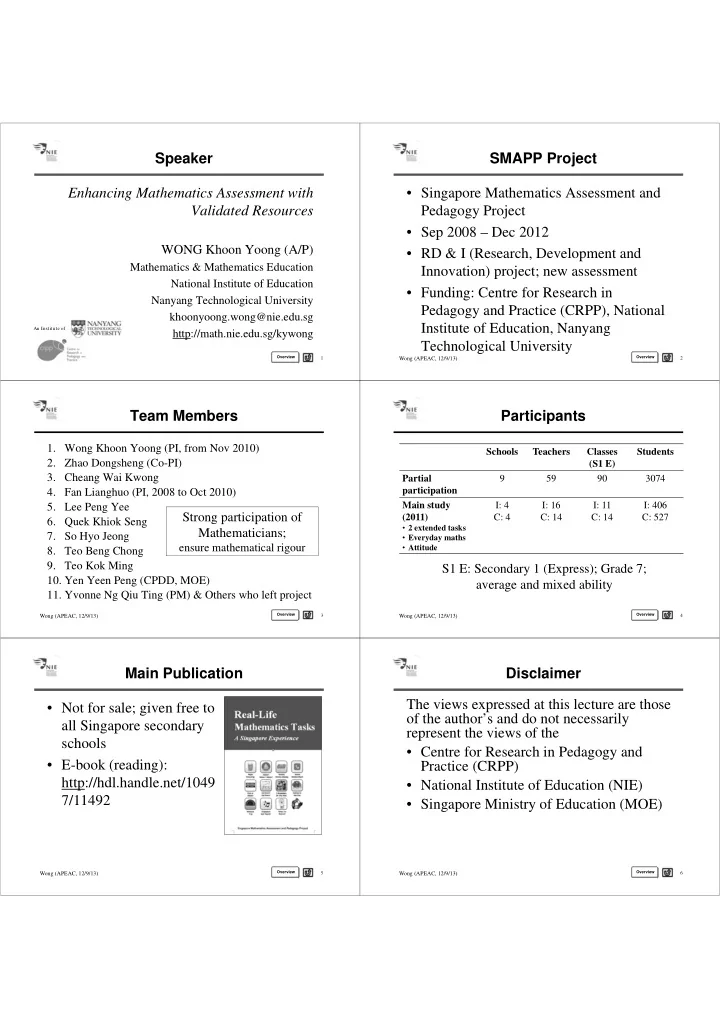
Speaker SMAPP Project Enhancing Mathematics Assessment with - - PDF document

speaker smapp project enhancing mathematics assessment
SMART_READER_LITE
LIVE PREVIEW

Speaker SMAPP Project Enhancing Mathematics Assessment with - - PDF document

Speaker SMAPP Project Enhancing Mathematics Assessment with Singapore Mathematics Assessment and Validated Resources Pedagogy Project Sep 2008 Dec 2012 WONG Khoon Yoong (A/P) RD & I (Research, Development and Mathematics


slide-1
SLIDE 1

Overview

1

Speaker Enhancing Mathematics Assessment with Validated Resources

WONG Khoon Yoong (A/P)

Mathematics & Mathematics Education National Institute of Education Nanyang Technological University khoonyoong.wong@nie.edu.sg http://math.nie.edu.sg/kywong

An Institute of

Overview

Wong (APEAC, 12/9/13)

2

SMAPP Project

  • Singapore Mathematics Assessment and

Pedagogy Project

  • Sep 2008 – Dec 2012
  • RD & I (Research, Development and

Innovation) project; new assessment

  • Funding: Centre for Research in

Pedagogy and Practice (CRPP), National Institute of Education, Nanyang Technological University

Overview

Wong (APEAC, 12/9/13)

3

Team Members

  • 1. Wong Khoon Yoong (PI, from Nov 2010)
  • 2. Zhao Dongsheng (Co-PI)
  • 3. Cheang Wai Kwong
  • 4. Fan Lianghuo (PI, 2008 to Oct 2010)
  • 5. Lee Peng Yee
  • 6. Quek Khiok Seng
  • 7. So Hyo Jeong
  • 8. Teo Beng Chong
  • 9. Teo Kok Ming
  • 10. Yen Yeen Peng (CPDD, MOE)
  • 11. Yvonne Ng Qiu Ting (PM) & Others who left project

Strong participation of Mathematicians;

ensure mathematical rigour

Overview

Participants

Schools Teachers Classes (S1 E) Students Partial participation 9 59 90 3074 Main study (2011)

  • 2 extended tasks
  • Everyday maths
  • Attitude

I: 4 C: 4 I: 16 C: 14 I: 11 C: 14 I: 406 C: 527

S1 E: Secondary 1 (Express); Grade 7; average and mixed ability

Wong (APEAC, 12/9/13)

4

Overview

Wong (APEAC, 12/9/13)

5

Main Publication

  • Not for sale; given free to

all Singapore secondary schools

  • E-book (reading):

http://hdl.handle.net/1049 7/11492

Overview

Wong (APEAC, 12/9/13)

6

Disclaimer The views expressed at this lecture are those

  • f the author’s and do not necessarily

represent the views of the

  • Centre for Research in Pedagogy and

Practice (CRPP)

  • National Institute of Education (NIE)
  • Singapore Ministry of Education (MOE)
slide-2
SLIDE 2

Overview

Wong (APEAC, 12/9/13)

7

Overview

  • 1. Maths disciplinary tasks
  • 2. IT-based assessment system
  • 3. Attitudes toward learning maths

Overview

Wong (APEAC, 12/9/13)

9

Real-Life Contexts

  • Singapore Maths Curriculum (2013):

stronger emphasis on “solve real-world problems”; “connect mathematics that they have learnt to the real world”

  • Help students gain knowledge about the

world, while honing their maths skills

  • Aligned with international trends

Overview

Wong (APEAC, 12/9/13)

10

OECD: Mathematical Literacy

  • An individual’s capacity
  • to identify and understand the role that

mathematics plays in the world,

  • to make well-founded judgements and
  • to use and engage with mathematics in

ways that

  • meet the needs of that individual’s life as

a constructive, concerned and reflective citizen

Overview

Wong (APEAC, 12/9/13)

11

Design Framework (2009)

Overview

Wong (APEAC, 12/9/13)

12

Two Types of SMAPP Tasks a) 11 extended tasks, multiple competencies (computation, reasoning, explanation), mathematically rigorous; take about one hour to complete; learning experiences; delivered through IT system b) 10 short paper-pencil problems (Everyday Maths Items), similar to PISA; exercises or tests

Overview

Wong (APEAC, 12/9/13)

13

Extended Tasks: Principles

a) Links to real life scenario b) Real and relevant data c) Curriculum connection d) Multiple competencies and content knowledge assessment e) Experience enriching f) Scaled levels of difficulties

  • Zhao, D.S., Cheang, W. K., Teo, K. M., & Lee, P. Y. (2011). Some

principles and guidelines for designing mathematical disciplinary tasks for Singapore schools. In J. Clark, B. Kissane, J. Mousley, T. Spencer & S. Thorton (Eds.), Mathematics: Traditions and (new) practices: Proceedings

  • f the AAMT-MERGA conference (pp. 1107-1115). Adelaide: Australian

Association of Mathematics Teachers.

slide-3
SLIDE 3

Overview

11 Extended Tasks: IT based

* Based on teachers’ contributions in November 2010

No. Task Titles Topics 1 Paper Recycling Arithmetic 2 Red or Black? Arithmetic, Algebra 3 Malacca Trip Rate, Speed, Algebra, Inequalities 4 Water Water Water! Mensuration, Statistics 5 Up Down Up Down!! Statistics 6 Singapore Got Talent Geometry 7 Money Money Money Linear Graphs 8 Three Rockstars on the Wall Angles, Parallel Lines 9* When to Retire? Numbers, Algebra 10* Which Mobile Plan? Statistics, Percentages 11* Outing to the Zoo Data handling, Algebra

Wong (APEAC, 12/9/13)

14

Overview

Wong (APEAC, 12/9/13)

16

2 Extended Tasks: Findings

Tasks Max Female Male Overall % Paper Recycling 33 20.8 (273) 20.5 (86) 20.8 (364) 63% Red or Black? 31 16.4 (287) 16.5 (90) 16.2 (383) 52%

  • Successful with routine questions
  • Weak in unfamiliar units, multi-step questions,

giving reasons, explain own ideas

  • Cheang, Teo, Zhao,

http://repository.nie.edu.sg/jspui/handle/10497/8158

Overview

Wong (APEAC, 12/9/13)

17

Decibel Question: Try It

The loudness of sound is measured in decibels (dB). Noise from heavy traffic is about 85 dB and this can cause hearing damage if one is exposed to it for 8 hours

  • r more. For every 3 dB over 85 dB, the exposure time

before damage occurs is decreased by half. (a) If the noise is 88 dB, what is the exposure time before damage occurs? (b) John likes to listen to his music using ear-plugs at high volume of 100 dB. How long could he do this before damage occurs?

Overview

Wong (APEAC, 12/9/13)

18

Decibel Question: Results

a) Correct answer with working (27%); Correct answer, no working (10%); Wrong proportional reasoning (4%) b) Full mark (21%); Partial (24.5 %); Wrong (45%) Popular method: stepwise decrease

  • 39%: relevant to daily life (most

relevant and challenging)

Overview

Wong (APEAC, 12/9/13)

19

Easiest: Sale (72%)

A particular item costs $6. Shop X advertises, “buy four items for the price of three”. (a) How much does a customer have to pay for 4 such items in shop X? (0.98/1) (b) What is the percentage discount for the customer who buys 4 such items from shop X? (1.61/2) (c) Another shop Y offers, “buy three at the regular price and pay 50% for the fourth item.” Shop Z offers a voucher of 10% on the total amount paid. Your parents wish to buy 4 such items. Out of these 3 shops (X, Y, and Z), which shop gives the best deal? (3.52/5) (d) Other than the amount you have to pay, what other reasons would you give to your parents to support your choice? (0.34/1)

Overview

Wong (APEAC, 12/9/13)

20

Everyday Maths Items: Admin

  • 5 items administered in March 2011 as

“pre” test

  • 5 items in Sept 2011 as “post” test
  • But not parallel items
  • Pre-post labels for identification only
slide-4
SLIDE 4

Overview

Wong (APEAC, 12/9/13)

21

Everyday Maths Items: Findings

Question Context (Topic) Facility Index 1 Sale (Percentage, discount) 71.7 2 Tourism (Interpretation of table and pie chart, rate) 64.9 3 Kool Biscuits: Reduced fat (Percentage) 61.8 4 Population (Interpretation of table, significant figures, rate) 57.4 5 Types of fires (Interpretation of table, percentage change) 54.6 6 Decibels (Four operations, rate) 40.8 7 Earthquake (Powers of 2) 36.6 8 Mobile plan (Rate, line graph) 35.5 9* Hokkien char mee (Interpretation of chart, percentage) 26.1 10* Math Olympiad (Line graph, bar graph, misuse of graphs) 22.2

n  814 S1E Re-arranged in order of facility

Overview

Wong (APEAC, 12/9/13)

22

Everyday Maths Items: Groups

Group Male Female Overall Sample Size Intervention 38.0 (11.4) 37.9 (12.4) 38.0 (12.1) 327 Comparison 37.6 (11.4) 42.6 (12.5) 40.6 (12.3) 487 Overall 37.7 (11.4) 40.5 (12.6) 39.5 (12.3) Sample Size 284 530 814

Overview

Wong (APEAC, 12/9/13)

23

Everyday Maths Items: Observations

  • Lack of experience with real-life contexts
  • Inappropriate use of maths skills
  • Amount of reading
  • Maths beyond S1 level; more suitable for

upper secondary

  • Student perceptions: neutral in terms of

interest, relevance; a bit challenging, less confident

Overview

IT-Based Assessment: Trends

  • International trend: Develop IT-based

assessment of construct-response items; efficiency and commercial, technical issues

  • Singapore: Math Explorer can grade

multi-line steps; defunct

  • SMAPP: IT-based assessment based on

pedagogy, assessment for learning

Wong (APEAC, 12/9/13)

25

Overview

Assessment for Learning (AfL)

  • Provide informative feedback to students to enhance

their performance (Sadler, Black, Wiliam, Hattie, etc.)

Marking (Evidence) Feedback Assessment Teaching

Wong (APEAC, 12/9/13)

26

Overview

  • 1. Deliver tasks (extended)
  • 2. Capture answers; closed

& open questions

  • 3. Automatic & Semi-

automatic marking

  • 4. Customisable feedback
  • 5. Student responses to
  • nline feedback (*)
  • 6. Reports by questions,

students, class

  • 7. Follow up activities (*)

(*) Not successful

IT Platform with AfL Features

Wong (APEAC, 12/9/13)

27

slide-5
SLIDE 5

Overview

Delivery & Capture

  • Online calculator
  • Entry of mathematical symbols and expressions
  • Simple animations

Capture of student answers

Wong (APEAC, 12/9/13)

28

Overview

Marking and Feedback

Correct answer Semi-automatic marking Customisable feedback Question

Wong (APEAC, 12/9/13)

29

Overview

Wong (APEAC, 12/9/13)

30

Automatic & Semi-automatic Marking

  • Closed questions: Automatic marking
  • Expedite marking; alleviate teacher marking

workload

  • Consistency in marking
  • Open questions, workings: Semi-automatic marking
  • Teacher selects score from given scheme
  • Recommend teachers mark by questions to note

different student solutions

  • Expedite marking; alleviate teacher marking

workload

  • Consistency in marking

Overview

Customisable Feedback

  • Every question is tagged to

several feedback comments

  • Correct answer: Gives

general praise and reiterates the correct procedure

  • Wrong or incomplete

answer: Hints on how to proceed further

Wong (APEAC, 12/9/13)

31

Overview

Teacher Can Add Feedback

  • Teachers can enter own feedback comments
  • Comments can be saved and shared within

school

Wong (APEAC, 12/9/13)

32

Overview

Students’ Responses to Feedback

  • After marking and entering feedback: Students asked

to reflect on teacher feedback

  • 3 choices of student responses; encourage

metacognition and reflection

  • Teachers to follow up

Wong (APEAC, 12/9/13)

33

slide-6
SLIDE 6

Overview

Report System

  • By students, questions, class; mean and

frequency

  • Can be downloaded into EXCEL format

Wong (APEAC, 12/9/13)

34

Overview

Paper Recycling: Teacher

  • Responses from Teachers (n = 10).

Questions Mean SD Appreciate the connections of mathematics with real life situations. 4.20 0.92 It is easy to add my own feedback to the system. 3.75 1.04 By focussing on open-ended questions, I know more about my students’ thinking, e.g., different methods used. 3.44 1.13 I prefer this system to manual marking. 3.33 1.12

Wong (APEAC, 12/9/13)

35

Overview

Paper Recycling: Students

  • Online survey; n = 99 (2011)
  • 5-point Likert Scale

Questions Mean SD I find the scenario provided in the task realistic. 3.70 1.00 I prefer to do this task on paper rather than doing it using the IT platform. 3.49 1.18 I have no difficulty following the instructions given. 3.43 1.22 I find the scenario provided in the task interesting. 3.34 1.14 I gained some new mathematical knowledge/skills by working on the task. 3.12 1.04 The IT platform is helpful for me to do this task. 3.02 1.55

Wong (APEAC, 12/9/13)

36

Overview

Paper Recycling: Student Interviews

  • Some preferred to work on paper rather than
  • nline; need to familiarise students with IT-

based assessment; future trend?

  • Some students aware of benefits of IT: lessen time,

easy to search for information, do not waste paper, can erase answer easily

  • Knowledge about recycling: Ah…save earth, like

save trees then the trees can produce oxygen for us and that it can reverse the effects of global warming

Wong (APEAC, 12/9/13)

37

Overview

Attitudes Toward Learning Maths

  • Curriculum: Desirable outcome; one factor for

effective problem solving (Singapore Maths Curriculum)

  • Learning : Positive, significant but moderate correlate

(about .3) with achievement; US National Mathematics Advisory Panel (2008): “Children’s goals and beliefs about learning are related to their mathematics performance” (p. xx)

  • Teaching : Ways to improve attitudes
  • Research: Not necessarily causal with achievement;

design and validation of instruments; define construct

Wong (APEAC, 12/9/13)

39

Overview

ALMQ: Development

  • 2010: 57 items. 9-point Likert; greater variation, but

students may not be able to make fine distinctions

  • Exploratory factor analysis and confirmatory factor

analysis

  • 2011: 24 items; 6 constructs, 4 items per construct:

a) Check solutions b) Confidence c) Enjoyment d) Use of IT e) Multiple solutions f) Usefulness

  • Cronbach’s alphas acceptable, 0.63 to 0.90

Wong (APEAC, 12/9/13)

40

slide-7
SLIDE 7

Overview

ALMQ: Your Score?

  • 9 = Agree totally; 1 = Disagree totally
  • Negative items: 10 – your point

Wong (APEAC, 12/9/13)

42

Scales Items Check solutions 1, 7, 13*, 19 Confidence 2, 8, 14, 20* Enjoyment 3, 9*, 15, 21 Use of IT 4*, 10, 16, 22 Multiple solutions 5*, 11, 17, 23 Usefulness 6, 12, 18*, 24

Overview

ALMQ: Results

  • Less positive over time from March to Oct 2011

Group Male Female Overall Sample Size Intervention March 6.37 (1.08) 6.02 (1.04) 6.11 (1.06) 365 Sept 5.78 (1.22) 5.65 (1.07) 5.69 (1.11) 352 Comparison March 6.28 (1.23) 6.12 (1.00) 6.18 (1.10) 483 Sept 5.78 (1.26) 5.54 (1.11) 5.64 (1.18) 495 Overall March 6.31 (1.18) 6.07 (1.02) 6.15 (1.08) Sept 5.78 (1.24) 5.59 (1.09) 5.66 (1.15) Sample Size March 287 561 848 Sept 296 551 847

Wong (APEAC, 12/9/13)

43

Overview

Everyday Maths vs. ALMQ (Post)

  • “Expected” values for 4 scales
  • Not familiar (IT, Multiple solutions), low correlations

Wong (APEAC, 12/9/13)

44

Attitude Everyday (n  800) Paper (n  350) Red? (n  350) Overall .290 .296 .299 Check solutions .281 .266 .274 Confidence .272 .260 .272 Enjoyment .231 .194 .224 Use of IT .032 .103 .107 Multiple solutions .178 .193 .210 Usefulness .273 .291 .232

Overview

Teacher Professional Development

  • Important part of project
  • 1. 8 teacher workshops for all participating

schools

  • 2. 3 mini workshops for individual schools
  • 3. School meetings to discuss findings
  • Use of SMAPP IT system
  • Assessment literacy
  • Task design; teachers created 3 extended tasks
  • Data analysis and interpret findings

Wong (APEAC, 12/9/13)

46

slide-8
SLIDE 8

P a g e | 11 Paper Recycling : Arithmetic Number of Trees to be saved 1. (a) The length and breadth of an A0 paper are 0.841 m and 1.189 m respectively. Which of the following expressions is correct to obtain the area of an A0 paper? [1] (1) (0.841 + 1.189) × 2 (2) 0.841 × 1.189 (3) 1.189 ÷ 0.841 (4) 1.189 – 0.841 ( ) (b) An A1 paper is obtained by folding an A0 paper into two equal halves lengthwise. Similarly, an A2 paper is obtained by folding an A1 paper into two equal halves lengthwise. Table 1 shows the estimated area of the “A” series paper size and the number of sheets of paper that can be obtained from an A0 paper. Fill in the blanks with the correct answers. [4] Table 1 “A” series paper size Paper Size Estimated Area (m2) Number of sheets of paper that can be

  • btained from

an A0 paper A0 1 1 A1 0.5 2 A2 0.25 4 A3 8 A4 0.0625 A5 32 A6 0.015625 A7 0.0078125 128 A8 0.00390625 256 (c) i. Based on your answer to the area of an A5 paper, find its estimated area in square centimetres. (1 m2 = 10 000 cm2). [1]

  • ii. Find the number of sheets of A5 paper

that can be obtained from a sheet of A2 paper. [1] (d) Looking at the packaging of the printing paper, Shamila sees “80 g/m2” (80 grams per square metre) printed on it.

  • i. What is the mass of one sheet of A4

paper? [2]

  • ii. One

ream

  • f

paper contains 500 sheets of printing paper. What is the total mass

  • f
  • ne

ream

  • f

A4 paper (excluding the mass of the packaging)? Give your answer in kg. [2] P a g e | 12 Paper Recycling : Arithmetic (e) There are 1200 students in Shamila’s

  • school. It is estimated that each student

uses about 3 reams of A4 paper per year (for notes, test and exam papers, etc.). If the school uses only recycled paper, how many trees can be saved each year? (Recall that 1 tonne of paper 17 trees.) [3] (f) If the school uses a lighter type of paper (70 g/m2 instead of 80 g/m2), how many more trees can be saved each year? Give your answer as a whole number. [2] Benefits of using Recycled paper Shamila wants to make a poster to present some of the facts and figures on the benefits of recycling paper and using recycled paper. Besides the number of trees that can be saved, she plans to include other information on the benefits to the environment if the school converts to recycled paper. You are approached to help her solve the rest of the problems. 2. (a) By searching for “advantages of recycling paper” on a search engine, find and write down 2 benefits of recycling paper. [2] (b) It is estimated that each mature tree can absorb 16 kg of carbon dioxide and produce 10 kg of oxygen each year. If the school saves 150 trees per year by using

  • nly recycled paper,

i. how much carbon dioxide could have been absorbed by those 150 trees per year? [1] ii. how much oxygen could have been produced by those 150 trees per year? [1] (c) On average, a car emits about 0.16 kg of carbon dioxide for every kilometre travelled (http://www.carpages.co.uk/co2). If it emits the same amount of carbon dioxide as found in (b)(i), how far has it travelled in km? [2] Save Water! 3. (a) Fill in the blanks based on the information from the poster below. A wall poster at Changi Airport states that every tonne of paper recycled can save __________ litres

  • f

water and ___________ litres of oil. [2]

slide-9
SLIDE 9

P a g e | 162 Attitudes toward Learning Mathematics Questionnaire Singapore Mathematics Assessment and Pedagogy Project Student Questionnaire School Class Name Index Number Gender Date

Dear students: The purpose of this survey is to find out how Secondary One students think and feel about mathematics. Your responses will help us understand students like you better. All responses will be kept strictly confidential. Please answer ALL the questions as best as you can. For each question, please tick ( ) your answer. There is no correct or wrong answer to each question. Thank you for your cooperation. Please take note of the following scale: 1 - Disagree totally 2 - Disagree a lot 3 - Disagree 4 - Disagree a little 5 - Neither Disagree nor agree 6 - Agree a little 7 - Agree 8 - Agree a lot 9 - Agree totally

Attitudes Disagree Totally Agree Totally 1 2 3 4 5 6 7 8 9

  • 1. When I know I have made a mistake in

solving a problem, I will try to find out why. O O O O O O O O O

  • 2. I am good at using mathematics to solve

real-life problems. O O O O O O O O O

  • 3. I enjoy doing mathematics.

O O O O O O O O O

  • 4. I do not like to use the computer to learn

mathematics. O O O O O O O O O

  • 5. I do not like to think of other ways to solve

the same problem. O O O O O O O O O

  • 6. Mathematics is important.

O O O O O O O O O 7. After I have solved a problem, I will go through the solution again and check if I have made any mistakes. O O O O O O O O O

  • 8. I am confident in solving mathematics

problems. O O O O O O O O O

  • 9. I find mathematics boring.

O O O O O O O O O

  • 10. I can learn mathematics from playing

computer games. O O O O O O O O O P a g e | 163 Attitudes toward Learning Mathematics Questionnaire Attitudes Disagree Totally Agree Totally 1 2 3 4 5 6 7 8 9

  • 11. I often figure out different ways to solve

mathematics problems. O O O O O O O O O

  • 12. I think mathematics is useful in solving

real world problems. O O O O O O O O O

  • 13. Once I have worked out an answer to a

problem, I do not check my answer. O O O O O O O O O

  • 14. I find mathematics easy.

O O O O O O O O O

  • 15. Overall, I have good feelings about

mathematics. O O O O O O O O O

  • 16. IT (Information Technology) has been

helpful to my mathematics learning. O O O O O O O O O

  • 17. I try to understand the different solutions

given by my classmates. O O O O O O O O O

  • 18. I think mathematics is useful only for tests.

O O O O O O O O O 19. After I have solved a problem, I will ask myself if the answer makes sense to the given problem. O O O O O O O O O

  • 20. I am not good at giving reasons in

mathematics. O O O O O O O O O

  • 21. Solving mathematics problems is fun to

me. O O O O O O O O O

  • 22. Mathematics software (e.g., graphing)

helps me to learn mathematics. O O O O O O O O O

  • 23. After I have solved a problem, I will look

for other methods to solve it. O O O O O O O O O 24. Mathematics helps me to understand reports and advertisements about prices, sale, percentages etc. O O O O O O O O O