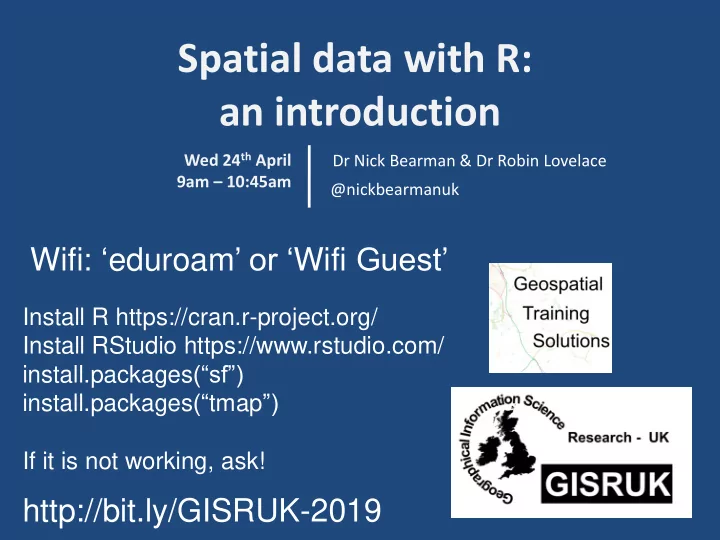
SLIDE 1 Dr Nick Bearman & Dr Robin Lovelace Wed 24th April 9am – 10:45am @nickbearmanuk
Spatial data with R: an introduction
Wifi: ‘eduroam’ or ‘Wifi Guest’
Install R https://cran.r-project.org/ Install RStudio https://www.rstudio.com/ install.packages(“sf”) install.packages(“tmap”) If it is not working, ask!
http://bit.ly/GISRUK-2019
SLIDE 2
- Log on!
- Toilets
- Fire Alarm
- Presentations, handouts and data online
Housekeeping
http://bit.ly/GISRUK-2019
SLIDE 3 R as a GIS
- Command line driven, rather than GUI
- Disadvantages
– Remembering commands
– Steeper learning curve
SLIDE 4 R as a GIS
– Easy to record what you did and repeat specific pieces of work – Lots of reproducible examples on the web – Easily scriptable. – 134,567 maps? Easy! (354 areas X ~392 variables) – 2011 Census Open Atlas
– http://www.alex-singleton.com/r/2014/02/05/2011-census-open-atlas-project-version-two/
SLIDE 5 R in Action
Economically active – Full-time students
SLIDE 6 Age structure – 18 to 19 Age structure – 20 to 24
SLIDE 8 Ethnic group: white
SLIDE 9 R as a GIS
Topography
http://topography.geotheory.co.uk/
SLIDE 10 https://gist.github.com/halhen/659780120accd82e043986c8b57deae
SLIDE 11 https://gist.github.com/halhen/659780120accd82e043986c8b57deae0
SLIDE 12 Other GIS software?
- R is very different to ArcGIS, but can do many of
the same operations
- R is free (as is QGIS)
- R is increasingly popular in academic sector
- Try data in QGIS if you like
All can be useful
SLIDE 13 This is the console where you can type in commands Here will show either your files (the files tab) or your plots (the plots tab) This lists the variables you have
SLIDE 14 Working Directory
- R uses a ‘working directory’ to store your
files in
- You might have a different one for each
project / piece of work
setwd(“M:/Documents/GIS”)
SLIDE 15
Variables
R uses variables to store information – listed in your ‘workspace’ (top-right) house.prices <- c(120,150,212, 99,199,299,159)
SLIDE 16
Variables and Assignments
house.prices <- c(120,150,212,99,199,299,159)
SLIDE 17
Variables and Assignments
house.prices <- c(120,150,212,99,199,299,159)
SLIDE 18
Variables and Assignments
house.prices <- c(120,150,212,99,199,299,159)
SLIDE 19
Variables and Assignment
sthelens <- st_read("sthelens.shp")
SLIDE 20
Variables and Assignment
sthelens <- st_read("sthelens.shp")
SLIDE 21
Variables and Assignment
sthelens <- st_read("sthelens.shp")
SLIDE 22
Variables and Assignment
sthelens <- st_read("sthelens.shp")
SLIDE 23 Variables and Assignment
sthelens <- st_read("sthelens.shp")
StHelens ≠ sthelens ≠ STHELENS
SLIDE 24 Data Formats
- Data frames are like a table or spreadsheet
- dataframe[rows,cols]
- dataframe[1,] first row
- dataframe[,1] first col
SLIDE 25 Practical Approach
- (Primarily) self-led practical
- Good to explore the options
- Ask questions as we go through
- Try things
- Use the help ?command
- You will need to install the libraries
- install.packages(“sf”)
- library(sf)
SLIDE 26
SLIDE 27
SLIDE 28
SLIDE 29
SLIDE 30 R Scripts
– Easier to correct code – Can easily re run sections of code, or all code if you need to start again – Easy to share code
SLIDE 31
This is the console where you can type in commands Here will show either your files (the files tab) or your plots (the plots tab) This lists the variables you have This is where you can write scripts
SLIDE 32
SLIDE 33 Load R
- You will need to install the libraries
- install.packages(“sf”)
- library(sf)
Bit.ly/GISRUK-2019
SLIDE 34
Workbook.pdf Bit.ly/GISRUK-2019