Span-program-based G ( k ) G ( 1 ) k 1 quantum algorithm for . - - PowerPoint PPT Presentation

span program based
SMART_READER_LITE
LIVE PREVIEW

Span-program-based G ( k ) G ( 1 ) k 1 quantum algorithm for . - - PowerPoint PPT Presentation

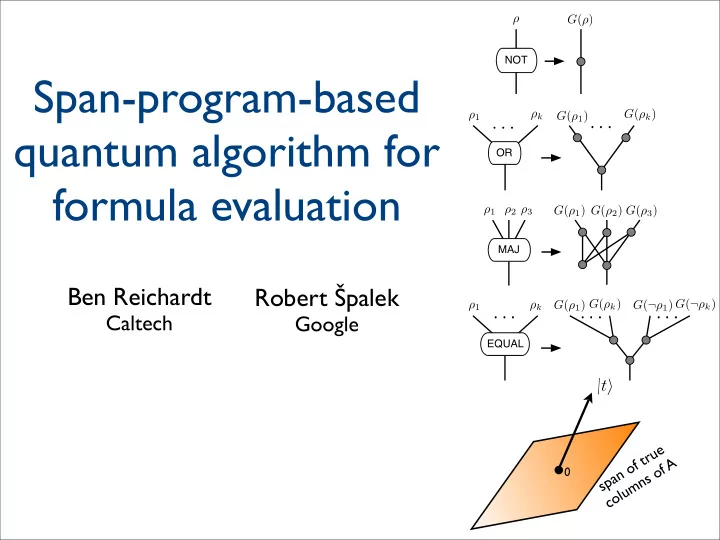
G ( ) NOT Span-program-based G ( k ) G ( 1 ) k 1 quantum algorithm for . . . . . . OR formula evaluation G ( 1 ) G ( 2 ) G ( 3 ) 1 2 3 MAJ Ben Reichardt Robert palek G ( k ) G ( k ) G ( 1


slide-1
SLIDE 1

Span-program-based quantum algorithm for formula evaluation

Robert Špalek

Google

Ben Reichardt

Caltech

. . .

OR

. . .

G(ρ1) G(ρk) ρ1 ρk

NOT

G(ρ) ρ

MAJ

ρ1 ρ2 ρ3 G(ρ3) G(ρ2) G(ρ1)

EQUAL

G(ρ1) ρ1 G(¬ρ1)

. . .

ρk

. . . . . .

G(ρk) G(¬ρk) ) ρ ρ ) ) )

|t

s p a n

  • f

t r u e c

  • l

u m n s

  • f

A

slide-2
SLIDE 2

Problem: Evaluate φ(x).

x12 x11 x10 x6

x1

x9 x8 x7 x5 x4 x2 x3

AND AND OR AND AND OR OR

ϕ(x) x1

Def: Read-once formula φ on gate set S = Tree of nested gates from S, with each input appearing once Ex: S = {AND, OR}:

slide-3
SLIDE 3

x12 x11 x10 x6

x1

x9 x8 x7 x5 x4 x2 x3

AND AND OR AND AND OR OR

ϕ(x) x1

Gates cannot have fan-out! (unlike in a circuit)

Ex: S = {AND, OR}: Def: Read-once formula φ on gate set S = Tree of nested gates from S, with each input appearing once Problem: Evaluate φ(x).

slide-4
SLIDE 4

OR

x2 x1 xN · · ·

Classical complexity of formula evaluation

[Snir ‘85, Saks & Wigderson ‘86, Santha ‘95] Balanced AND-OR

x1 MAJ MAJ MAJ MAJ MAJ MAJ x1 x1 MAJ MAJ MAJ MAJ MAJ

ϕ(x)

MAJ MAJ

. . .

Balanced MAJ3

Ω((7/3)depth) = R2(f) = O((2.6537…)depth)

[Jayram, Kumar, Sivakumar ’03]

AND OR OR AND AND AND AND

x6 x8 x7 x5 x4 x2 x3 x1

Θ(N) Θ(N0.753…)

(fan-in two)

slide-5
SLIDE 5 x1 MAJ MAJ MAJ MAJ MAJ MAJ x1 x1 MAJ MAJ MAJ MAJ MAJ

ϕ(x)

MAJ MAJ

. . .

Balanced MAJ3

OR

x2 x1 xN · · ·

Classical

Θ(N)

AND OR OR AND AND AND AND

x6 x8 x7 x5 x4 x2 x3 x1

Θ(N0.753…)

[S‘85, SW‘86, S‘95]

Balanced AND-OR

Ω((7/3)d), O((2.6537…)d)

[JKS ’03]

Quantum

Θ(√N) [Grover ‘96]

. . .

(fan-in two)

Θ(2d=Nlog32) Θ(√N)

[Farhi & Goldstone & Gutmann ’07, ACRŠZ ‘07] [RŠ ‘07]

slide-6
SLIDE 6

Balanced, more gates [RŠ, STOC‘08]

NAND NAND NAND NAND NAND NAND NAND

x1 x2 x3 x4 x5 x7 x6 x8

Two generalizations of [FGG ‘07] AND-OR algorithm: Unbalanced AND-OR [ACRŠZ, FOCS‘07]

  • Theorem: A balanced (“adversary-

bound-balanced”) formula φ over a gate set including all three-bit gates (and more…) can be evaluated in O(ADV(φ)) queries (optimal!).

  • Theorem ([FGG ‘07, CCJY ‘07]):

A balanced binary AND-OR formula can be evaluated in time N½+o(1).

  • Theorem:
  • An “approximately balanced” AND-OR

formula can be evaluated with O(√N) queries (optimal for read-once!).

  • A general AND-OR formula can be

evaluated with N½+o(1) queries.

slide-7
SLIDE 7
  • Best quantum lower bound is

[LLS‘05]

  • Expand majority into {AND, OR} gates:

∴ {AND, OR} formula size is ≤ 5d ∴ O(√5d) = O(2.24d)-query algorithm

x1

MAJ MAJ MAJ MAJ MAJ MAJ

x1 x1

MAJ MAJ MAJ MAJ MAJ

ϕ(x)

MAJ MAJ

. . .

Recursive 3-bit majority tree

d 3d MAJ3(x1, x2, x3) = (x1 ∧ x2) ∨ (x3 ∧ (x1 ∨ x2)) Ω

  • ADV(ϕ) = 2d

[FGG, ACRŠZ ‘07]

  • New: O(2d)-query quantum algorithm

[RŠ ‘07] algorithm

  • Theorem: A balanced (“adversary-

bound-balanced”) formula φ over a gate set including all three-bit gates (and more…) can be evaluated in O(ADV(φ)) queries (optimal!).

slide-8
SLIDE 8

PARITY

G(ρ1) ρ1 ρ2 G(ρ2) G(¬ρ2) G(¬ρ1)

MAJ

ρ1 ρ2 ρ3 G(ρ3) G(ρ2) G(ρ1)

EQUAL

G(ρ1) ρ1 G(¬ρ1)

. . .

ρk

. . . . . .

G(ρk) G(¬ρk)

NAND 3

(with appropriate edge weights)

Converting formula into a tree

. . .

OR

. . .

G(ρ1) G(ρk) ρ1 ρk

NOT

G(ρ) ρ

slide-9
SLIDE 9
  • Main Theorem:
  • φ(x)=1 AG has λ=0 eigenvector with

Ω(1) support on the root.

  • φ(x)=0 AG has no eigenvectors
  • verlapping the root with |λ|<1/O(ADV(φ)).

⇒ ⇒

MAJ

ρ1 ρ2 ρ3 G(ρ3) G(ρ2) G(ρ1)

3

MAJ3

x4 x1 x2 x3 x4 x1 x2 x3 x4 x1 x2 x3 PARITY

G(ρ1) ρ1 ρ2 G(ρ2) G(¬ρ2) G(¬ρ1)

slide-10
SLIDE 10
  • Main Theorem:
  • φ(x)=1 AG has λ=0 eigenvector with

Ω(1) support on the root.

  • φ(x)=0 AG has no eigenvectors
  • verlapping the root with |λ|<1/O(ADV(φ)).

⇒ ⇒ quantitative bounds needed to analyze the running time

slide-11
SLIDE 11

|eigenvector corr. eigenvalue ±δ

|λ λ ± δ

Precision-δ phase estimation

  • n a unitary U, starting at an

e-state, returns the e-value to precision δ, except w/ prob. 1/4. It uses O(1/δ) calls to c-U.

  • Start at the root
  • Apply phase estimation to the quantum walk with precision 1/O(ADV(φ))
  • If measured phase is 0, output “φ(x)=1.”

Otherwise, output “φ(x)=0.”

Fast Quantum Algorithm:

Running time is O(ADV(φ)) ⇒ ⇒

  • Main Theorem:
  • φ(x)=1 AG has λ=0 eigenvector with

Ω(1) support on the root.

  • φ(x)=0 AG has no eigenvectors
  • verlapping the root with |λ|<1/O(ADV(φ)).
slide-12
SLIDE 12

1 1 1 1 11 1 1 0 0 x= 1 1 1 1 1 1 1 1 1 1

(each edge labeled by the evaluation of the NAND sub-formula above it)

00 01 10 11 1 1 1

NAND

Input dependence

  • Substitutions define G(0N); to

define graph G(x), delete edges to all leaves evaluating to xi=1.

Computation of formula Eigenvalue-zero eigenvector of tree

Q: What is an eigenvalue-0

eigenvector of a graph?

A: Assignment of coefficients

to each vertex, such that sum

  • f neighboring coefficients

adds up to 0.

slide-13
SLIDE 13

1 1 1 1 11 1 1 0 0 x=

r

Induction Claim: Each edge

gives a “dual-rail” encoding for the evaluation of the sub- formula above that edge… sub-formula φv v “output edge”

Supported here ⇔ φv(x)=true Supported here ⇔ φv(x)=false

The λ=0 eigenvector

  • f G(φv,x) is:

Computation of formula Eigenvalue-zero eigenvector of tree

slide-14
SLIDE 14

MAJ3

1 ω ω2

3-Majority gate gadget

MAJ3 ϕ1 ϕ2 ϕ3

1 1 1 1 1 1 1

G(ϕ1) G(ϕ2) G(ϕ3)

ω = e2πi/3

slide-15
SLIDE 15

1 ω ω2 r v1 v2 v3 s w1 w2 w3 c

  • Induction hypothesis: λ=0 eigenvectors
  • n sub-formula graphs G(φi) compute

the sub-formulas

Computation of MAJ3 gate Eigenvalue-zero eigenvector of graph

  • Constraints

1 1 1 1 1 ω ω2

   αr αv1 αv2 αv3     = 0 AG

=   1 1 1 1 ω2 1 1 ω 1         αs αc αw1 αw2 αw3      

  • When can αr be nonzero (i.e., gadget evaluates to true)?
  • 1. Only depends on first constraint eq.’s ( )
  • 2. Need , but
  • 3. Can only have if input i evaluates to true

αv1, αv2, αv3 αv1 + αv2 + αv3 = 0 αv1 + ωαv2 + ω2αv3 = 0 αvi = 0

✓MAJ3

  • At least two inputs φi must be true to satisfy both

constraints nontrivially.

slide-16
SLIDE 16

Induction Claim: Each edge

(p,v) gives a “dual-rail” encoding…

v Supported on p ⇔ φv(x)=true Supported on v ⇔ φv(x)=false

The λ=0 eigenvector

  • f G(φv,x) is:

p

General graph gadgets

Input edges Output edge Arbitrary weighted bipartite graph

slide-17
SLIDE 17
  • Substitution rules defining G come from span programs.
  • Def: A span program P is:
  • A target vector t in vector space

V over C,

  • Input vectors vj each associated with a literal from

Span program P computes fP: {0,1}n→{0,1}, fP(x) = 1 ⇔ t lies in the span of { true vj }

  • Ex. 1: P:

with a,b,c distinct and nonzero. ➡ fP = MAJ3

Span program definition

{x1, x1, . . . , xn, xn}

  • x1

x2 x3 t = ( 1

0 )

( 1

a )

( 1

b )

( 1

c )

[Karchmer, Wigderson ’93]

slide-18
SLIDE 18

Span program ⇔ Bipartite graph gadget

E.g., MAJ3: input edges

  • utput edge

constraints x1 x2 x3 1 1 1 a b c t =

  • 1
  • with t=(1,0,…,0)

1 1 1 a b c

aO bO bC

a1 a2 a3 b1 b2 b3

In general:

. . .

t =      1 . . .     

A

slide-19
SLIDE 19
  • Ex.: MAJ3(x1, x2, MAJ3(x4,x5,x6)):

SP composition Graph gadget composition

Composing span programs

  • Given span programs for g, h1, …, hk, immediately get s.p. for

f = g ◦ (h1, . . . , hk)

  • utput

inputs

⇔ t x1 x2 1 x3 x4 x5 1 1 1 1 a b c 1 1 1 1 a b c

MAJ3 MAJ3

a b c a b c

slide-20
SLIDE 20
  • Ex.: MAJ3(x1, x2, MAJ3(x4,x5,x6)):

SP composition Graph gadget composition

Composing span programs

  • Given span programs for g, h1, …, hk, immediately get s.p. for

f = g ◦ (h1, . . . , hk) ⇔ t x1 x2 1 x3 x4 x5 1 1 1 1 a b c 1 1 1 1 a b c

a b c a b c

slide-21
SLIDE 21

. . . .

  • . .

. .

∴ ⇔ ⇔

. . .

aO bO

a1 a2 a3 b1 b2 b3 am bm … cC c1

TRUE TRUE

t =      1 . . .     

A

       

Eigenvalue-zero lemmas

  • Define: GP(x) by deleting edges to true input literals
  • Lemma: fP(x)=1 ⇔ ∃ λ=0 eigenvector of AGP(x) supported on aO.
slide-22
SLIDE 22
  • Define: GP(x) by deleting edges to true input literals
  • Lemma: fP(x)=1 ⇔ ∃ λ=0 eigenvector of AGP(x) supported on aO.
  • Lemma: Delete output edge (aO, bO). Then

fP(x)=0 ⇔ ∃ λ=0 eigenvector supported on bO.

Eigenvalue-zero lemmas . . . .

  • . .

. .

Proof: fP(x) is false ⇔ |t〉not in span of true columns of A

. . .

bO |t

span of true columns of A

slide-23
SLIDE 23

. . .

bO

  • Define: GP(x) by deleting edges to true input literals
  • Lemma: fP(x)=1 ⇔ ∃ λ=0 eigenvector of AGP(x) supported on aO.
  • Lemma: Delete output edge (aO, bO). Then

fP(x)=0 ⇔ ∃ λ=0 eigenvector supported on bO.

Eigenvalue-zero lemmas . . . .

  • . .

. .

Proof: fP(x) is false ⇔ |t〉not in span of true columns of A ⇔ ∃ |b〉with =1, orthogonal to all true columns of A b|t |t |b

span of true columns of A

FALSE FALSE

A†|b |b

slide-24
SLIDE 24
  • Lemma: fP(x)=1 ⇔ ∃ λ=0 eigenvector of AGP(x) supported on aO.
  • Assume that f(x)=1, and that for all true inputs i, we have constructed

normalized λ=0 eigenvectors with squared support ≥ γ on ai.

Q: How large can we make |aO|2 in a normalized λ=0 eigenvector?

  • Answer: Fix aO=1 and try to minimize the eigenvector’s norm. We want

the shortest witness vector:

Eigenvalue-zero lemmas

. . .

aO

a1 a2 a3 am …

t =      1 . . .     

A

       

Quantitative

TRUE TRUE

Π min

|w:Π|w=|w A|w=|t

|w2

= projection onto true input coords.

= (AΠ)−|t2

:= wsize(P, x)

slide-25
SLIDE 25
  • Assume: For all inputs i we have constructed normalized λ=0

eigenvectors with squared support ≥ γ on ai or bi.

  • Lemma: f(x)=1 unit-normalized λ=0 eigenvector with
  • Lemma: f(x)=0 unit-normalized λ=0 eigenvector with

Eigenvalue-zero lemmas Quantitative

⇒ ∃ ⇒ ∃

|t |b

span of true columns of A

|aO|2 ≥ γ wsize(P, x) |bO|2 ≥ γ wsize(P, x) wsize(P, x) := min

|w:Π|w=|w A|w=|t

|w2 wsize(P, x) := min

|b: t|b=1 ΠA†|b=|t

A†|b2

  • Def: Witness size of P

wsize(P) = max

x

wsize(P, x)

slide-26
SLIDE 26
  • Construct the eigenvectors starting at the leaves, and working down.

Eigenvector equations are

  • Induction assumption: Input ratios ri = ai/bi satisfy:
  • Solve equations for rO = aO/bO, apply Woodbury identity, expand the Taylor

series in λ of the matrix inverse (on the range and its Schur complement separately), bound the higher-order terms, QED.

  • The first-order term is the same as the factor wsize(P, x) lost in the λ=0

analysis (not so surprisingly)

Small λ≠0 analysis

λbC = ACJaJ λbO = AOJaJ + aO λaJ = AIJ

†bI + AOJ †bO + ACJ †bC

. . . .

  • . .

. .

i false i true

  • 1
  • . . .

aO bO

a1 a2 a3 b1 b2 b3 am bm … cC c1

⇒ ⇒ ri ∈

  • − ∞, −1

siλ

  • ri ∈ (0, siλ)
slide-27
SLIDE 27
  • Quantum algorithm for evaluating “span programs”:
  • Span program Associated graph with detectable spectral gap

Algorithm using a quantum walk

  • Behaves well under composition/recursion:
  • Possible extensions: Interesting quantum algorithms based directly on

asymptotically large span programs?

compose compose

→ ↔

Framework for quantum algorithms based on span programs:

Span program P Graph GP with detectable spectral gap Algorithm using a quantum walk Composed span program for φ Span programs for gates Gate graph gadgets Graph G(φ)

slide-28
SLIDE 28

Summary of technical results

  • Def: Let S’ = { arbitrary two- or three-bit gates, O(1)-fan-in EQUAL gates}

Let S = { O(1)-size {AND, OR, NOT, PARITY} formulas on inputs that are themselves possibly elements of S’ }

  • E.g.,
  • (Idea: Gates other than AND, OR, PARITY need to have balanced inputs.

AND, OR, PARITY gates can have constant-factor unbalanced inputs)

  • Def: Read-once formula φ is “adversary-bound-balanced” if for each gate

g, the adversary bounds for its input sub-formulas are all the same.

  • Main Theorem: Any adversary-balanced formula φ over gate set S can

be evaluated in O(ADV(φ)) queries. Time complexity is the same, up to poly-log N factor, in coherent RAM model

after preprocessing.

ϕ = g ◦ (ϕ , . . . , ϕ ) MAJ3(x1, x2, x3) ∧ (x4 ⊕ x5 ⊕ · · · ⊕ (xk−1 ∨ xk))

slide-29
SLIDE 29

Questions?

slide-30
SLIDE 30

Binary gates on up to three bits. Up to equivalences—permutation of inputs, complemen inputs or output—there are fourteen binary gates on three inputs x1, x2, x3. Adversary nctions on up to four bits have been computed by [HLˇ S06], and see [Rˇ S07]. Gate Adversary lower bound x1 1 x1 ∧ x2 √ 2 x1 ⊕ x2 2 x1 ∧ x2 ∧ x3 √ 3 x1 ⊕ x2 ⊕ x3 3 x1 ⊕ (x2 ∧ x3) 1 + √ 2 x1 ∨ (x2 ∧ x3) √ 3 (x1 ∧ x2) ∨ (x1 ∧ x3) 2 x1 ∨ (x2 ∧ x3) ∨ (x2 ∧ x3) √ 5 MAJ3(x1, x2, x3) = (x1 ∧ x2) ∨ ((x1 ∨ x2) ∧ x3) 2 MAJ3(x1, x2, x3) ∨ (x1 ∧ x2 ∧ x3) √ 7 EQUAL(x1, x2, x3) = (x1 ∧ x2 ∧ x3) ∨ (x1 ∧ x2 ∧ x3) 3/ √ 2 (x1 ∧ x2 ∧ x3) ∨ (x1 ∧ x2)

  • 3 +

√ 3

3-bit gates

Fact: A(f⊕g)=A(f)+A(g), A(f∧g)=√(A(f)2+A(g)2) if f, g have disjoint inputs.