Spacetime Replication of Continuous Variable Quantum Information - - PowerPoint PPT Presentation

spacetime replication of continuous variable
SMART_READER_LITE
LIVE PREVIEW

Spacetime Replication of Continuous Variable Quantum Information - - PowerPoint PPT Presentation

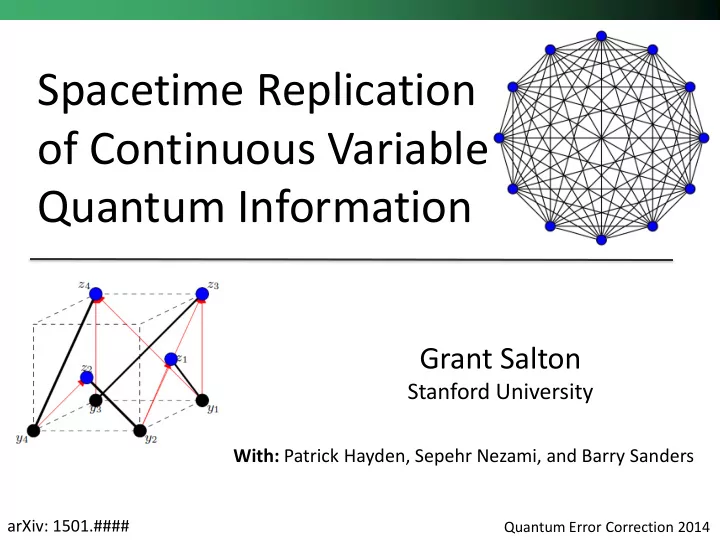
Spacetime Replication of Continuous Variable Quantum Information Grant Salton Stanford University With: Patrick Hayden, Sepehr Nezami, and Barry Sanders arXiv: 1501.#### Quantum Error Correction 2014 Outline Part 1: Replicating


slide-1
SLIDE 1

Spacetime Replication

  • f Continuous Variable

Quantum Information

Quantum Error Correction 2014

Grant Salton

Stanford University

With: Patrick Hayden, Sepehr Nezami, and Barry Sanders

arXiv: 1501.####

slide-2
SLIDE 2

Outline

  • Part 1: Replicating information in spacetime

– Complete characterization of which spacetime regions can contain the same quantum information – Quantum error correcting code to realize any allowed configuration of regions

  • Part 2: Continuous variable codes

– A general CV code for any allowed configuration – A specific code for a simple, yet non-trivial configuration (+ an optical implementation!)

slide-3
SLIDE 3

Quantum Information Bedrock

Quantum information cannot be cloned. Information cannot propagate faster than light – no signaling Quantum information cannot be replicated on a spatial slice. And yet… x t Quantum information must be widely replicated in spacetime. Hayden and May precisely characterized which forms of replication are possible.

slide-4
SLIDE 4

Replicating info in causal diamonds

x t Hayden and May: Replication is possible iff every pair of causal diamonds is causally related: i.e., there exists a causal curve from Di to Dj or vice-versa. Define causal diamond Dj to be the intersection of the future of yj and the past of zj. Dj consists of the points that can both be affected by an event at yj and can affect the state at zj.

slide-5
SLIDE 5

Causal diamond geometry

Diamond becomes a line segment when top and bottom are lightlike separated:

slide-6
SLIDE 6

The causal merry-go-round

φ is encoded into ((2,3)) threshold quantum error correcting code at s One share sent to each of yj Each share is then sent at the speed of light along a red ray 2 share pass through each causal diamond yjzj The same quantum information is replicated in each causal diamond

slide-7
SLIDE 7

G = (V,E) graph of causal relationships: Encode φ into a quantum error correcting code with one share for each edge. Code property: φ can be recovered provided all the shares associated to any Dj Transport each edge share according to directed edge in the graph Then all shares required to recover φ at Dj pass through Dj . Unusual QEC: ~n2 qubits but recovery using (n-1). Vanishing fraction O(1/n).

General procedure

slide-8
SLIDE 8

Outline

  • Part 1: Replicating information in spacetime

– Complete characterization of which spacetime regions can contain the same quantum information – Quantum error correcting code to realize any allowed configuration of regions

  • Part 2: Continuous variable codes

– A general CV code for any allowed configuration – A specific code for a simple, yet non-trivial configuration (+ an optical implementation!)

slide-9
SLIDE 9

Continuous variable quantum information

Image: Miloslav Dušek

Continuous variables are a promising, experimentally feasible avenue for explicit demonstration of information replication Existing experimental progress along the lines of our proposed scheme The CV code we propose is more efficient than the qubit code just described

slide-10
SLIDE 10

Continuous Variable Quantum Info

Encode our state in a continuous variable degree of freedom: optical mode. Generalize the Pauli group ----- Heisenberg-Weyl group n bosonic modes. Each mode has two quadratures Generators of translations (displacements) in p quadrature Generators of translations (displacements) in x quadrature

slide-11
SLIDE 11

CV Code for general replication

Suppose we have N spacetime regions in which we want to perform information replication: Construct the graph of causal relations (complete graph, N vertices) Assign one mode per edge

modes

The code is actually a CSS code, so we build the X-type and P-type generators separately Motivated by homology

slide-12
SLIDE 12

CV Code for general replication

X-type stabilizer generators are triangular subgraphs including vertex 1: 1 2 3 N i j

slide-13
SLIDE 13

CV Code for general replication

1 2 3 N i i+1 i-1 1 2 3 N i i+1 i-1 i+1 1 2 3 N i i-1 P-type stabilizer generators are also subgraphs:

slide-14
SLIDE 14

CV Code for general replication

1 2 3 N i j 1 2 3 N i i+1 i-1

slide-15
SLIDE 15

Motivation for the general code

Code is subspace of wavefunctions stabilized by subgroup of commuting operators: D1 D2 D3 D4 Choose: Commutativity condition:

slide-16
SLIDE 16

Four regions

G = (V,E) graph of causal relationships: Our general code uses six modes to complete the task BUT! We can bring this number down using a property

  • f the physical configuration

Use the ability of one share to traverse three diamonds 3 2 5 1 4

slide-17
SLIDE 17

3 2 5 1 4

A five mode code

X P The error model: Loss of a known subset of modes Equivalent to arbitrary displacements on the ‘lost’ modes

x eigenstate

slide-18
SLIDE 18

Optical implementation

Encoding Encoding requires two sets of entangled photons and passive beamsplitters We then carry out the replication task and need to recover the state using a known subset of the modes.

slide-19
SLIDE 19

Optical implementation

Decoding using only modes 1 and 2 This error is easily corrected by completing the interferometer on modes 1 and 2 3 2 5 1 4

slide-20
SLIDE 20

Optical implementation

Recovery from loss of modes 2 and 3 Is a measurement of the quadrature of the mode, followed by a rescaling of the resulting classical data by a factor of -1 Is a displacement of the upper mode by an amount corresponding to the classical data in the lower mode 3 2 5 1 4

slide-21
SLIDE 21

Optical implementation

Recovery from loss

  • f modes 2 and 4

Recovery from loss

  • f modes 1 and 5

3 2 5 1 4 3 2 5 1 4

slide-22
SLIDE 22

Conclusions: Part 2

  • Continuous variable code

– More efficient than qubit code – Based on ideas from homology

  • Specific 5 mode code

– ad hoc construction – Optical implementation

  • Design optical apparatus capable of demonstrating

spacetime information replication

slide-23
SLIDE 23

Next steps…

  • Characterize the codes that arise when we

have redundancy in the graph of causal structure

  • Recruit experimentalists!
slide-24
SLIDE 24

Summary

  • Information replication

– Complete characterization of the allowed configurations – Only constrained by no-cloning & no-signaling – Realized with QEC!

  • Continuous variables

– General solution in terms of CV code based on – Specific 5 mode code complete with optical implementation

D1 D2 D3 D4

homology