South Fork Kings GSA Technical Workshop Projects and Management - - PowerPoint PPT Presentation

south fork kings gsa technical workshop projects and
SMART_READER_LITE
LIVE PREVIEW

South Fork Kings GSA Technical Workshop Projects and Management - - PowerPoint PPT Presentation

South Fork Kings GSA Technical Workshop Projects and Management Actions April 18, 2019 Overview Tulare Lake Subbasin Water Budget Update Projects and Management Actions Summary of Water Budget Improvements Aquifer Storage and


slide-1
SLIDE 1

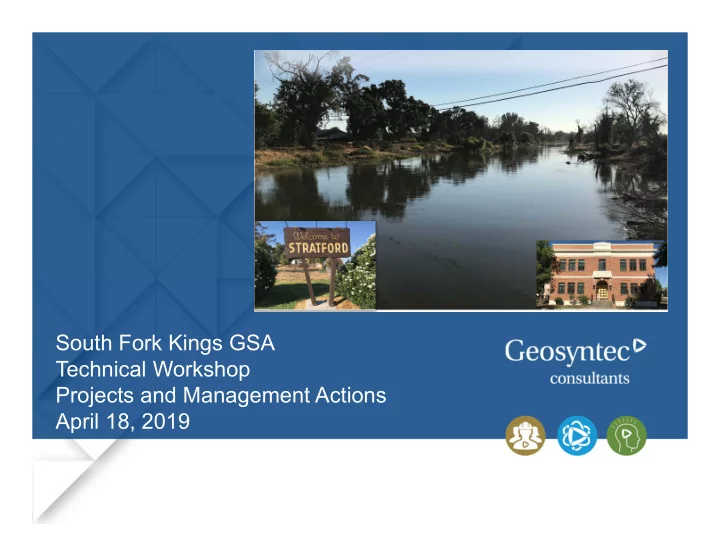
South Fork Kings GSA Technical Workshop Projects and Management Actions April 18, 2019

slide-2
SLIDE 2

Overview

  • Tulare Lake Subbasin Water Budget Update
  • Projects and Management Actions

– Summary of Water Budget Improvements – Aquifer Storage and Recovery (ASR) – Water Banking

  • If we have time

– Surrounding GSA Activities – Monitoring network

slide-3
SLIDE 3

Water Budget Update…. The Model is DONE! …. (for now)

slide-4
SLIDE 4

SFKGSA Zone Budget

Version 7 Model Water Balance (Wood, 3/27/2019)

slide-5
SLIDE 5

Upper Aquifer Overdraft :

‐37,808 ‐50,870 ‐44,896

slide-6
SLIDE 6

Lower Aquifer Overdraft

‐1,494 ‐12,112 ‐4,411

slide-7
SLIDE 7

Pumping vs Storage Loss

1998 1999 2000 2001 2002 2003 2004 2005 2006 2007 2008 2009 2010 2011 2012 2013 2014 2015 2016

y = 0.9036x + 52698 R² = 0.812

‐100,000 ‐80,000 ‐60,000 ‐40,000 ‐20,000 20,000 ‐160,000 ‐140,000 ‐120,000 ‐100,000 ‐80,000 ‐60,000 ‐40,000 ‐20,000

Annual Storage Loss (AF) Pumping (AF/Yr)

SFKGSA Pumping vs Annual Storage Loss (1998‐2016 Base Period)

2016 Overdraft = 66,825

Sustainable Yield 60,000 AF Annual Overdraft ‐20,000 to ‐80,000 AF ‐44,600 AF/Yr LT Average

slide-8
SLIDE 8

Projects and Management Actions

slide-9
SLIDE 9

Overdraft Reduction Menu

0% 10% 20% 30% 40% 50% 60% 70% 80% 90% 100% SFKGSA

% Total Pumping

Sustainable Yield Overdraft

Overdraft Management Actions “Menu”

slide-10
SLIDE 10

SFKGSA Overdraft Reduction Targets

0% 10% 20% 30% 40% 50% 60% 70% 80% 90% 100% SFKGSA

% Total Pumping

Sustainable Yield Overdraft

Overdraft Management Actions “Menu”

Demand Management 20,000‐25,000 AF (on 50,000 acres) Supply Enhancement 20,000‐25,000 AF (within and outside SFKGSA)

Overdraft 45,000 Sustainable Yield 60,000

Adjoining Basins

105,000 60,000

slide-11
SLIDE 11

SFKGSA Overdraft Reduction Targets

GW Measurment and Reporting, 1,338 Inflow/outflow improvement, 5,352 SW Delivery Improvement, 4,460 On‐Farm Improvements, 2,230 Conservation Reuse, 669 Land Retirement, 1,338 Cropping Program, 6,913 Mid‐Kings Recharge, 6,690 El Rico Surface Storage, 3,122 SFKGSA Surface Storage, 2,230 SFKGSA/Westlands ASR, 10,258

Supply Management (50%) Demand Management (50%) Targets in AF/Yr on average over 50 years

slide-12
SLIDE 12

Demand Management Actions

  • GW measurement and reporting – 1,340 AF/Y

– Incentive to reduce pumping (leaky pipe example ) – GSA or County ordinance – Equivalent to 1% current pumping or 140 gal saved per acre

  • Improvements from other GSA’s – 5,000 AF/Y

– Estimated and requires further integration of water balances between GSA’s – Equivalent to 30% improvement of boundary inflow/outflow

  • On-farm improvements - 2,230 AF/Y

– Grower support/outreach – Irrigation efficiency improvements & water treatment – Equivalent to 1% of current demand or 0.6 inches saved per acre – Grants & partnerships

slide-13
SLIDE 13

Demand Management Actions

  • SW delivery improvement – 4,460 AF/Y

– Lemoore Canal system improvements in selected areas – Piping or canal extensions if appropriate – Delivery scheduling optimization – Equivalent to 5% net efficiency improvement or 45 AF per mile – Grants and partnerships

  • Conservation/Re-use – 670 AF/Y (0.6 MGD)

– City of Lemoore, Industrial (e.g. Leprino) – Equivalent to 5% of demand or 50 gallons per person per yr – Grants and partnerships

  • Land retirement – 1,340 AF/Y

– Opt‐in with incentives – Equivalent to 500 acres or two 250 acre solar farms

slide-14
SLIDE 14

Demand Management Actions

  • Cropping Program – 7,000 AF

– Optimize crop type, crop rotation, and fallowing frequency and tie to forecast hydrology – Fallowing targets based on year classification – Target 15,000 acres registered in program (27% of area) – Year class based on forecast hydrology (% Kings River supply)

  • Extreme Dry : <40% ; 12,750 acres fallow ; 4 yrs out of 50
  • Normal/Dry : 40‐80% ; 7,500 acres fallow ; 24 years out of 50
  • Normal/Wet : 80‐140% Kings River Supply ; 22 years out of 50

– Opt‐in with incentives (compensation for fallowing)

slide-15
SLIDE 15

Forecast Hydrology from Wood

Storage project yields and cropping program demand reduction targets are based on this forecast hydrology

slide-16
SLIDE 16

Forecast Hydrology from Wood

Storage project yields and cropping program demand reduction targets are based on this forecast hydrology

High Fallow Years “Normal” Fallow Years “Modest” Fallow Years

slide-17
SLIDE 17

Demand Management Actions

  • Storage and Aquifer Recharge – 21,000 AF

– Variety of storage and recharge projects – Storage volume targets based on year classification – Year class based on forecast hydrology (% Kings River supply)

  • Extreme Dry : <40% ; No Storage; 4 yrs out of 50
  • Normal/Dry : 40‐80% ; Low – Modest storage; 24 yrs out of 50
  • Normal/Wet : 80‐140+% ; Modest to high storage ; 22 yrs out of 50
slide-18
SLIDE 18

Forecast Hydrology from Wood

Storage project yields and cropping program demand reduction targets are based on this forecast hydrology High Storage Years No Storage Modest Storage Low Storage

slide-19
SLIDE 19

Supply Management (Storage) Actions

  • Local groundwater recharge (flood flows) : 6,300 AF/Y

– Participate in Mid‐Kings GSA recharge project(s) – 1,560 acres of recharge ponds currently identified – SFKGSA Finances upsize of program by 20%

  • Local surface water storage (flood flows) : 5,000 AF/Y

– Joint El Rico/SFKGSA GSA storage project

  • 6,400 acres of recharge ponds currently identified
  • SFKGSA upsize program by 50%
  • Focus on Southern portion of GSA (Stratford)
  • Groundwater storage : 10,000 AF/Y

– SFKGSA Aquifer Storage and Recovery project – Joint effort with Westlands/Westside GSA

slide-20
SLIDE 20

Financing Management Actions

  • Financing Plan

– GSA Operations – Demand management programs – Supply management projects

  • Water bank/trading platform

– Method for integrating and financing all of the above actions – Prospectus, plan, and framework – Pilot program

slide-21
SLIDE 21

Aquifer Storage and Recovery SFKGSA’s “Big” Supply Management Action

slide-22
SLIDE 22

Aquifer Storage and Recovery

  • Inject water into an

aquifer for storage and subsequent withdrawal

  • No evaporative loss

compared to surface storage or recharge basins

  • No “perching” concerns

compared to recharge basins

  • Has a good track record

for municipal use by injecting treated drinking water

slide-23
SLIDE 23

ASR Sites Nationally

slide-24
SLIDE 24

Aquifer Storage and Recovery

  • Utilize “excess” water when

available, possibly including A- zone aquifer.

  • Injection into B-Zone aquifer to

increase aquifer storage and improve hydraulic gradient

  • Partnership Project with

Westside Basin

Potential ASR Project Area

slide-25
SLIDE 25

Westlands ASR Pilot Test Location

slide-26
SLIDE 26

Westlands ASR Pilot Test

slide-27
SLIDE 27

ASR Site with Wellhead Treatment System

slide-28
SLIDE 28

ASR Pilot Project Performance

50 feet of head build‐ up (aquifer storage)

  • ver 3 months

178 AF injection over 85 days 178 AF recovery over 60 days @ 60% efficiency Well backflush to maintain injection efficiency

slide-29
SLIDE 29

Regulatory Approvals

  • Regional Board approved intermittent chlorination - no

full drinking water treatment required.

  • Monitoring for multiple constituents, including pathogens
  • Modeling of % recovery of injected water
  • Approval as EPA Class V injection well
  • Pilot test was exempt from CEQA
slide-30
SLIDE 30

Conclusions

  • ASR is feasible in aquifer system
  • Numerous, but not unexpected, operational considerations
  • Programmatic CEQA necessary for widespread use

We are discussing possibility of further exploration of this concept with Westlands as a joint SGMA implementation project

slide-31
SLIDE 31

Water Bank

slide-32
SLIDE 32

Why Water Banking in SFK?

  • Provides a mechanism to implement project and

management actions to achieve overdraft reduction (45,000 AF/Yr)

  • Provides a pathway with less regulatory controls
  • Focuses on incentives to encourage

participation

  • Can create business rules to discourage or

prevent unwanted transactions or projects

  • Becomes the platform for managing sustainable

yield (60,000 AF/Yr)

slide-33
SLIDE 33

What is a Water Bank?

  • Groundwater banks redistribute the authority to

withdraw groundwater from sellers to buyers

  • The aquifer itself, managed by the GSA, can be

a “buyer” of groundwater

Supply Sellers/Lessors: Water right holders Projects: Reallocate available water Demand Buyers/Lessees:

  • Mitigation for

new uses

  • Reliability for

existing uses

  • Groundwater

Sustainability Banking Functions

  • Certifies validity of water rights
  • Business rules for bank
  • Tracks transactions
  • Marketing
  • Regulatory interaction
  • Monitors progress towards

bank goals

slide-34
SLIDE 34

Bank Value Analogy

Water Balance Current Water Balance Future Projects and Management Actions 105,000 AF @ $200 AF = $21M/Yr 60,000 AF @ $500 AF = $30M/Yr $$ Investments to reduce overdraft and achieve sustainability

slide-35
SLIDE 35

What creates “value” in the water bank?

The bank can “oversee” the re-distribution of aquifer storage credits and debits, with the aim of:

1. Achieving sustainable pumping targets by 2040 2. providing financial mechanisms that incentivize and fund projects 3. Establishing a platform for managing the value created from sustainable pumping after 2040

slide-36
SLIDE 36

Why would it work?

A water bank can help achieve sustainable yield and then maintain the resulting yield and value if…..

  • If there is a financial incentive to do so

– What’s in it for me? – Financial benefit or avoided cost (now or in the future)

  • If there is a time incentive to do so

– Why should I do this now? – Pay less/get more now, vs pay more/get less later

  • If an aquifer credit is required as part of transactions

– The aquifer needs to be part of the “win”

  • If it avoids more stringent regulation in the future

– The alternatives are stop pump orders, taxation, or state intervention

slide-37
SLIDE 37

Who runs the bank?

  • Public entity, private entity or quasi-governmental NGO
  • The banker needs to have ability, trust, and authority to

enforce the rules of the bank, certify transactions, maintain the accounting system, and report/verify results

  • “Transaction fees” include

– financial compensation to the banker – overdraft mitigation to the aquifer

– Fee and value structure may shift when aquifer achieves sustainable yield

slide-38
SLIDE 38

Examples

Transactions that can be facilitated, certified, and monetized via a water bank

  • Fallowing
  • On-farm efficiency
  • Irrigation efficiency improvements
  • Aquifer recharge (surface or injection)
slide-39
SLIDE 39

NEXT STEPS

slide-40
SLIDE 40

NEXT STEPS

  • 1. Submit the Pie Chart to Wood for final Forecast

Model Run

  • 2. Meeting with TAG to discuss the Actions and

expected yield (the Pie Chart)

  • 3. Prepare Projects & Management Actions Memo

– Demand Management Actions – Supply Management Actions – Financing/Water Bank Options