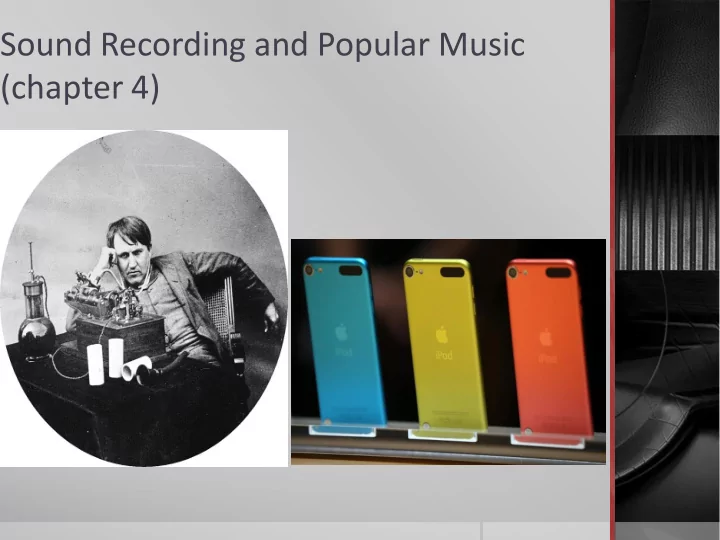
Sound Recording and Popular Music (chapter 4) The medium of sound - - PowerPoint PPT Presentation

sound recording and popular music
SMART_READER_LITE
LIVE PREVIEW

Sound Recording and Popular Music (chapter 4) The medium of sound - - PowerPoint PPT Presentation

Sound Recording and Popular Music (chapter 4) The medium of sound recording has Throughout its history, popular had an immense impact on our music has been banned by parents, culture. The music that helps to business outlets, radio


slide-1
SLIDE 1

Sound Recording and Popular Music (chapter 4)

slide-2
SLIDE 2
  • The medium of sound recording has

had an immense impact on our

  • culture. The music that helps to

shape our identities and comfort us during the transition from childhood to adulthood resonates throughout

  • ur lives. It stirs debate among

parents and teenagers, teachers and students, politicians and performers.

  • Throughout its history, popular

music has been banned by parents, business outlets, radio stations, school officials, and even governments seeking to protect young people from the raw language and corrupting excesses

  • f the music world.
  • “If people knew what this

stuff was about, we’d probably all get arrested.” –Bob Dylan, 1966, talking about rock and roll

  • “Music should never

be harmless.”

  • –Robbie Robertson, The Band
slide-3
SLIDE 3

U.S. Popular Music and the Formation of Rock

  • In general, pop music appeals

either to a wide cross section

  • f the public or to sizable

subdivisions within the larger public based on age, region,

  • r ethnic background
  • (for example, teenagers,

southerners, Mexican Americans). U.S. popular music today encompasses styles as diverse as blues, country, Tejano, salsa, jazz, rock, reggae, punk, hip-hop, and electronica.

slide-4
SLIDE 4

Rock and Roll Is Here to Stay

  • The cultural storm called rock and

roll hit in the 1950s.

  • (Like the early meaning of jazz, rock

and roll was a blues slang term that sometimes meant “sex.”)

  • It combined the vocal and

instrumental traditions of popular music with the rhythm-and-blues sounds of Memphis and the country beat of Nashville.

  • Many social, cultural, economic,

and political factors contributed to the growth of rock and roll around the 1940s and 1950s.

  • The migration of southern blacks

to northern cities in search of better jobs during the first half of the twentieth century had helped spread different popular music styles.

slide-5
SLIDE 5

Youth Culture Cements Rock’s Place

  • Another reason for the growth of

rock and roll can be found in the repressive and uneasy atmosphere of the 1950s. With the constant concern over the atomic bomb, the Cold War, and communist witch-hunts, young people were seeking forms of escape from the menacing world created by adults.

  • Perhaps most significant to the

growth of rock and roll, the border that had separated white and black cultures began to break down.

  • Radio, which saw its network

programs converting to television, was seeking inexpensive forms of

  • content. Radio deejays, particularly

Alan Freed in Cleveland (and later on WINS in New York), began exposing more white people to black music. Some white teens cruising the radio dial had already discovered black-

  • riented stations, however, and had

adopted the different rhythms as dance music.

slide-6
SLIDE 6

Rock ‘N’ Roll explodes

slide-7
SLIDE 7

A Changing Industry: Reformations in Popular Music

  • The British Are Coming!
  • Motor City Music: Detroit Gives America Soul
  • Popular Music Reflects the Times
  • Alternative Sounds of Punk and Grunge
  • Hip-Hop Redraws Musical Lines
slide-8
SLIDE 8

The British Are Coming!

  • Until 1964, rock-and-roll recordings

had traveled on a one-way ticket to Europe

  • This changed almost overnight. In

1964, the Beatles invaded with their mop-top haircuts and pop reinterpretations of American blues and rock and roll.

  • By the end of the year, more than

thirty British hits had landed on American Top 10 lists.

slide-9
SLIDE 9

Britain Invades

slide-10
SLIDE 10

Motor City Music: Detroit Gives America Soul

  • soul: music that mixes

gospel, blues, and urban and southern black styles with slower, more emotional, and melancholic lyrics.

  • These Motown groups had

a more stylized, softer sound than the grittier southern soul (or funk) of Brown and Pickett.

  • Motown producers realized

at the outset that by cultivating romance and dance over rebellion and politics, black music could attract a young, white audience.

slide-11
SLIDE 11

Sounds of Soul

slide-12
SLIDE 12

Popular Music Reflects the Times

  • Folk Inspires Protest
  • Bob Dylan took his stage name

from Welsh poet Dylan Thomas.

  • He led a folk music movement in

the early 1960s with engaging, socially provocative lyrics.

slide-13
SLIDE 13

My Generation

slide-14
SLIDE 14

Rock Becomes Mainstream

  • Following the historic Woodstock concert in August 1969,

which drew more than 400,000 fans to a New York farm, the deaths of Joplin and Hendrix in 1970, and the announcement late in 1970 that the Beatles had officially disbanded, rock music reached a crossroads.

  • Considered a major part of the rebel counterculture in the

1960s (despite its profits), rock music in the 1970s, was increasingly viewed as the centerpiece of mainstream consumer culture. With major music acts earning huge profits, rock soon became another product line for manufacturers and retailers to promote, package, and sell.

slide-15
SLIDE 15

Up from the Underground

slide-16
SLIDE 16

Hip-Hop Redraws Musical Lines

  • Hip-hop exploded as a popular genre

in 1986 with the commercial successes of groups like Run-DMC, the Fat Boys, and LL Cool J.

  • Because most major labels and many

black radio stations rejected the rawness of hip-hop, the music spawned hundreds of new independent labels

  • .
slide-17
SLIDE 17

Up from the Underground

slide-18
SLIDE 18
  • Hip-hop, like punk, defies

mainstream culture.

  • Some rap has drawn criticism from

both the white and black communities for lyrics that degrade women or applaud violence.

  • Chuck D of Public Enemy has

maintained that most hip-hop music offers interpretations of urban experience and the war on drugs that are very different from network news portrayals

  • Throughout hip-hop’s history,

artists have occasionally characterized themselves as street reporters who tell alternative stories of city life.

  • .
slide-19
SLIDE 19

Up from the Underground