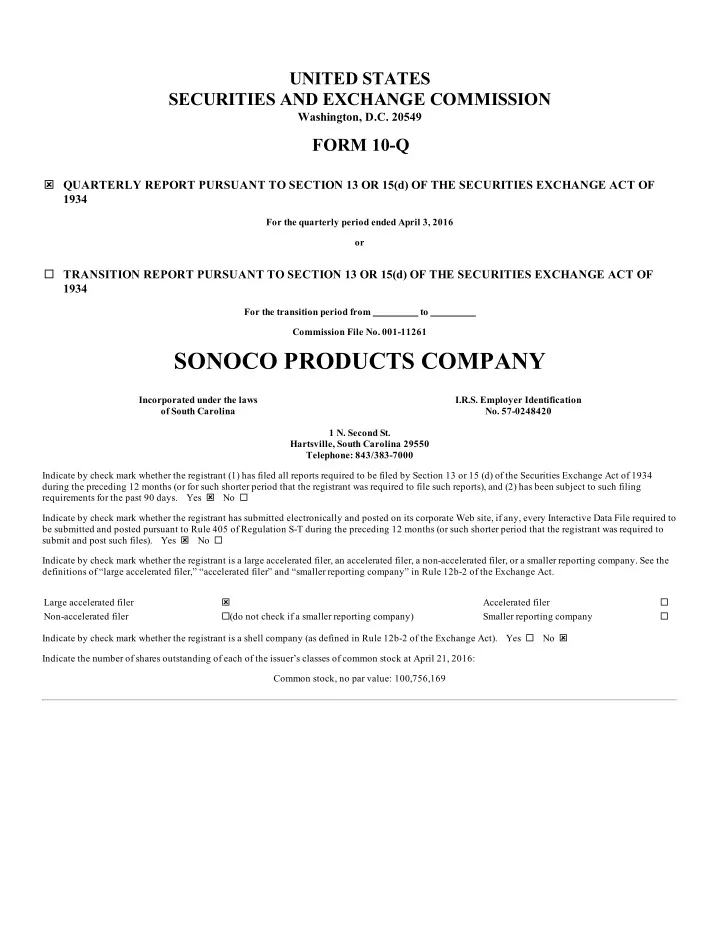
SONOCO PRODUCTS COMPANY Incorporated under the laws I.R.S. Employer - - PDF document

sonoco products company
SMART_READER_LITE
LIVE PREVIEW

SONOCO PRODUCTS COMPANY Incorporated under the laws I.R.S. Employer - - PDF document

UNITED STATES SECURITIES AND EXCHANGE COMMISSION Washington, D.C. 20549 FORM 10-Q QUARTERLY REPORT PURSUANT TO SECTION 13 OR 15(d) OF THE SECURITIES EXCHANGE ACT OF 1934 For the quarterly period ended April 3, 2016 or TRANSITION REPORT


slide-1
SLIDE 1

UNITED STATES SECURITIES AND EXCHANGE COMMISSION

Washington, D.C. 20549

FORM 10-Q

ý QUARTERLY REPORT PURSUANT TO SECTION 13 OR 15(d) OF THE SECURITIES EXCHANGE ACT OF 1934

For the quarterly period ended April 3, 2016

  • r

¨ TRANSITION REPORT PURSUANT TO SECTION 13 OR 15(d) OF THE SECURITIES EXCHANGE ACT OF 1934

For the transition period from to Commission File No. 001-11261

SONOCO PRODUCTS COMPANY

Incorporated under the laws

  • f South Carolina

I.R.S. Employer Identification

  • No. 57-0248420

1 N. Second St. Hartsville, South Carolina 29550 Telephone: 843/383-7000 Indicate by check mark whether the registrant (1) has filed all reports required to be filed by Section 13 or 15 (d) of the Securities Exchange Act of 1934 during the preceding 12 months (or for such shorter period that the registrant was required to file such reports), and (2) has been subject to such filing requirements for the past 90 days. Yes ý No ¨ Indicate by check mark whether the registrant has submitted electronically and posted on its corporate Web site, if any, every Interactive Data File required to be submitted and posted pursuant to Rule 405 of Regulation S-T during the preceding 12 months (or such shorter period that the registrant was required to submit and post such files). Yes ý No ¨ Indicate by check mark whether the registrant is a large accelerated filer, an accelerated filer, a non-accelerated filer, or a smaller reporting company. See the definitions of “large accelerated filer,” “accelerated filer” and “smaller reporting company” in Rule 12b-2 of the Exchange Act. Large accelerated filer

ý Accelerated filer ¨

Non-accelerated filer

¨(do not check if a smaller reporting company) Smaller reporting company ¨

Indicate by check mark whether the registrant is a shell company (as defined in Rule 12b-2 of the Exchange Act). Yes ¨ No ý Indicate the number of shares outstanding of each of the issuer’s classes of common stock at April 21, 2016: Common stock, no par value: 100,756,169

slide-2
SLIDE 2

SONOCO PRODUCTS COMPANY INDEX PART I. FINANCIAL INFORMATION 3 Item 1. Financial Statements: 3 Condensed Consolidated Balance Sheets - April 3, 2016 (unaudited) and December 31, 2015 (unaudited) 3 Condensed Consolidated Statements of Income – Three Months Ended April 3, 2016 (unaudited) and March 29, 2015 (unaudited) 4 Condensed Consolidated Statements of Comprehensive Income – Three Months Ended April 3, 2016 (unaudited) and March 29, 2015 (unaudited) 5 Condensed Consolidated Statements of Cash Flows – Three Months Ended April 3, 2016 (unaudited) and March 29, 2015 (unaudited) 6 Notes to Condensed Consolidated Financial Statements 7 Report of Independent Registered Public Accounting Firm 23 Item 2. Management’s Discussion and Analysis of Financial Condition and Results of Operations. 24 Item 3. Quantitative and Qualitative Disclosures About Market Risk. 33 Item 4. Controls and Procedures. 33 PART II. OTHER INFORMATION 34 Item 1. Legal Proceedings. 34 Item 2. Unregistered Sales of Equity Securities and Use of Proceeds. 35 Item 6. Exhibits. 35 2

slide-3
SLIDE 3

Part I. FINANCIAL INFORMATION Item 1. Financial Statements. SONOCO PRODUCTS COMPANY CONDENSED CONSOLIDATED BALANCE SHEETS (unaudited) (Dollars and shares in thousands)

April 3, 2016 December 31, 2015*

Assets Current Assets Cash and cash equivalents $ 152,338 $ 182,434 Trade accounts receivable, net of allowances 679,528 627,962 Other receivables 38,049 46,801 Inventories: Finished and in process 152,750 139,589 Materials and supplies 249,783 245,894 Prepaid expenses 48,037 64,698 1,320,485 1,307,378 Property, Plant and Equipment, Net 1,121,818 1,112,036 Goodwill 1,154,955 1,140,461 Other Intangible Assets, Net 239,897 245,095 Long-term Deferred Income Taxes 53,098 52,626 Other Assets 157,752 156,089 Total Assets $ 4,048,005 $ 4,013,685 Liabilities and Equity Current Liabilities Payable to suppliers $ 495,200 $ 508,057 Accrued expenses and other 281,521 294,227 Notes payable and current portion of long-term debt 117,134 113,097 Accrued taxes 22,413 7,135 916,268 922,516 Long-term Debt, Net of Current Portion 1,015,804 1,015,270 Pension and Other Postretirement Benefits 412,968 432,964 Deferred Income Taxes 78,185 72,933 Other Liabilities 39,438 37,129 Commitments and Contingencies Sonoco Shareholders’ Equity Common stock, no par value Authorized 300,000 shares 100,752 and 100,944 shares issued and outstanding at April 3, 2016 and December 31, 2015, respectively 7,175 7,175 Capital in excess of stated value 392,150 404,460 Accumulated other comprehensive loss (663,857) (702,533) Retained earnings 1,828,242 1,803,827 Total Sonoco Shareholders’ Equity 1,563,710 1,512,929 Noncontrolling Interests 21,632 19,944 Total Equity 1,585,342 1,532,873 Total Liabilities and Equity $ 4,048,005 $ 4,013,685 * The year-end condensed consolidated balance sheet data was derived from audited financial statements, but does not include all disclosures required by accounting principles generally accepted in the United States of America. See accompanying Notes to Condensed Consolidated Financial Statements 3

slide-4
SLIDE 4

SONOCO PRODUCTS COMPANY CONDENSED CONSOLIDATED STATEMENTS OF INCOME (unaudited) (Dollars and shares in thousands except per share data)

Three Months Ended April 3, 2016 March 29, 2015

Net sales $ 1,226,276 $ 1,206,052 Cost of sales 981,023 985,662 Gross profit 245,253 220,390 Selling, general and administrative expenses 134,193 96,665 Restructuring/Asset impairment charges 9,228 (359) Income before interest and income taxes 101,832 124,084 Interest expense 14,189 13,775 Interest income 402 554 Income before income taxes 88,045 110,863 Provision for income taxes 29,194 26,221 Income before equity in earnings of affiliates 58,851 84,642 Equity in earnings of affiliates, net of tax 1,339 1,046 Net income $ 60,190 $ 85,688 Net (income)/loss attributable to noncontrolling interests (276) 92 Net income attributable to Sonoco $ 59,914 $ 85,780 Weighted average common shares outstanding: Basic 101,628 101,283 Diluted 102,329 102,167 Per common share: Net income attributable to Sonoco: Basic $ 0.59 $ 0.85 Diluted $ 0.59 $ 0.84 Cash dividends $ 0.35 $ 0.32 See accompanying Notes to Condensed Consolidated Financial Statements 4

slide-5
SLIDE 5

SONOCO PRODUCTS COMPANY CONDENSED CONSOLIDATED STATEMENTS OF COMPREHENSIVE INCOME (unaudited) (Dollars in thousands)

Three Months Ended April 3, 2016 March 29, 2015

Net income $ 60,190 $ 85,688 Other comprehensive income/(loss): Foreign currency translation adjustments 30,828 (62,986) Changes in defined benefit plans, net of tax 5,948 6,273 Changes in derivative financial instruments, net of tax 1,900 (1,205) Other comprehensive income/(loss) 38,676 (57,918) Comprehensive income 98,866 27,770 Net (income)/loss attributable to noncontrolling interests (276) 92 Other comprehensive (income)/loss attributable to noncontrolling interests (1,412) 631 Comprehensive income attributable to Sonoco $ 97,178 $ 28,493 See accompanying Notes to Condensed Consolidated Financial Statements 5

slide-6
SLIDE 6

SONOCO PRODUCTS COMPANY CONDENSED CONSOLIDATED STATEMENTS OF CASH FLOWS (unaudited) (Dollars in thousands)

Three Months Ended April 3, 2016 March 29, 2015

Cash Flows from Operating Activities: Net income $ 60,190 $ 85,688 Adjustments to reconcile net income to net cash provided by operating activities: Asset impairment — 275 Depreciation, depletion and amortization 53,572 51,877 Gain on reversal of Fox River environmental reserves — (32,543) Share-based compensation expense 4,840 3,878 Equity in earnings of affiliates (1,339) (1,046) Cash dividends from affiliated companies 1,150 450 Net gain on disposition of assets (1,242) (8,369) Pension and postretirement plan expense 10,657 13,012 Pension and postretirement plan contributions (32,042) (17,017) Tax effect of share-based compensation exercises 1,120 3,404 Excess tax benefit of share-based compensation (1,161) (3,400) Net increase in deferred taxes 220 3,405 Change in assets and liabilities, net of effects from acquisitions, dispositions, and foreign currency adjustments: Trade accounts receivable (41,623) (48,936) Inventories (11,218) (6,066) Payable to suppliers (17,213) 7,094 Prepaid expenses 4,427 530 Accrued expenses (6,171) (4,036) Income taxes payable and other income tax items 28,415 15,301 Other assets and liabilities 13,805 (3,171) Net cash provided by operating activities 66,387 60,330 Cash Flows from Investing Activities: Purchase of property, plant and equipment (55,685) (40,954) Proceeds from the sale of assets 2,592 30,708 Investment in affiliates and other, net 46 (2,808) Net cash used in investing activities (53,047) (13,054) Cash Flows from Financing Activities: Proceeds from issuance of debt 13,787 14,127 Principal repayment of debt (10,993) (12,802) Net increase in outstanding checks 9,841 8,752 Excess tax benefit of share-based compensation 1,161 3,400 Cash dividends (35,396) (32,263) Shares acquired (18,931) (7,591) Shares issued 559 1,165 Net cash used in financing activities (39,972) (25,212) Effects of Exchange Rate Changes on Cash (3,464) 17,572 Net (Decrease)/Increase in Cash and Cash Equivalents (30,096) 39,636 Cash and cash equivalents at beginning of period 182,434 161,168 Cash and cash equivalents at end of period $ 152,338 $ 200,804 See accompanying Notes to Condensed Consolidated Financial Statements 6

slide-7
SLIDE 7

SONOCO PRODUCTS COMPANY NOTES TO CONDENSED CONSOLIDATED FINANCIAL STATEMENTS (Dollars in thousands except per share data) (unaudited) Note 1: Basis of Interim Presentation In the opinion of the management of Sonoco Products Company (the “Company” or “Sonoco”), the accompanying unaudited condensed consolidated financial statements contain all adjustments (consisting of only normal recurring adjustments, unless otherwise stated) necessary to state fairly the consolidated financial position, results of operations and cash flows for the interim periods reported herein. Operating results for the three months ended April 3, 2016, are not necessarily indicative of the results that may be expected for the year ending December 31, 2016. These condensed consolidated financial statements should be read in conjunction with the consolidated financial statements and the notes thereto included in the Company’s Annual Report on Form 10-K for the fiscal year ended December 31, 2015. With respect to the unaudited condensed consolidated financial information of the Company for the three-month periods ended April 3, 2016 and March 29, 2015 included in this Form 10-Q, PricewaterhouseCoopers LLP reported that they have applied limited procedures in accordance with professional standards for a review of such information. However, their separate report dated May 6, 2016 appearing herein, states that they did not audit and they do not express an opinion on that unaudited financial information. Accordingly, the degree of reliance on their report on such information should be restricted in light of the limited nature of the review procedures applied. PricewaterhouseCoopers LLP is not subject to the liability provisions of Section 11 of the Securities Act of 1933 for their report on the unaudited financial information because that report is not a “report” or a “part” of a registration statement prepared or certified by PricewaterhouseCoopers LLP within the meaning of Sections 7 and 11 of the Act. Note 2: New Accounting Pronouncements In March 2016, the Financial Accounting Standards Board (FASB) issued ASU 2016-09, "Improvements to Employee Share-Based Payment Accounting," which simplifies several aspects of the accounting for share-based payment transactions, including 1) accounting for income taxes, 2) classification of excess tax benefits in the statement of cash flows, 3) forfeitures, 4) minimum statutory tax withholding requirements, 5) cash flow classification of employee taxes withheld in the form of shares, 6) the practical expedient for estimating the expected term, and 7) intrinsic value. The guidance is effective for annual reporting periods beginning after December 15, 2016, and interim periods within those annual periods. The Company does not expect the implementation of ASU 2016-09 to have a material effect on its consolidated financial statements. In March 2016, the FASB issued ASU 2016-08, "Revenue from Contracts with Customers," "Principal versus Agent Considerations (Reporting Revenue Gross versus Net)," which provides guidance on recording revenue on a gross basis versus a net basis based on the determination of whether an entity is a principal or an agent when another party is involved in providing goods or services to a customer. The amendments in this Update affect the guidance in ASU No. 2014-09 and are effective in the same time frame as ASU 2014-09 as discussed below. In February 2016, the FASB issued ASU 2016-02, which changes accounting for leases and requires lessees to recognize the assets and liabilities arising from all leases, including those classified as operating leases under previous accounting guidance on the balance sheet and requires disclosure

  • f key information about leasing arrangements to increase transparency and comparability among organizations. The accounting for lessors does not

fundamentally change except for changes to conform and align guidance to the lessee guidance. The guidance is effective for reporting periods beginning after December 15, 2018, including interim periods within those fiscal years and requires retrospective application. The Company is still assessing the impact of ASU 2016-02 on its consolidated financial statements. In April 2015, the FASB issued ASU 2015-03, "Simplifying the Presentation of Debt Issuance Costs," which requires that debt issuance costs related to a recognized debt liability be presented in the balance sheet as a direct deduction from the carrying amount of that debt liability, consistent with debt discounts, and not recorded as separate assets. This update was effective for reporting periods beginning after December 15, 2015, and was required to be applied on a retrospective basis. Accordingly, the Company adopted ASU 2015-03 in the first quarter of 2016, and reclassified debt issuance costs totaling $6,427 and $6,584 from "Other Assets" to "Long-Term Debt, Net of Current Portion" on the Company's Condensed Consolidated Balance Sheets as of April 3, 2016 and December 31, 2015, respectively. In May 2014, the FASB issued ASU 2014-09, "Revenue From Contracts With Customers," which changes the definitions/criteria used to determine when revenue should be recognized from being based on risks and rewards to being based on control. Among other changes, ASU 2014-09 changes the manner in which variable consideration is recognized, requires recognition of the time value of money when payment terms exceed one year, provides clarification on accounting for contract costs, and expands disclosure requirements. The effective date for implementation of ASU

7

slide-8
SLIDE 8

SONOCO PRODUCTS COMPANY NOTES TO CONDENSED CONSOLIDATED FINANCIAL STATEMENTS (Dollars in thousands except per share data) (unaudited) 2014-09 has been deferred and is now effective for reporting periods beginning after December 15, 2017. The Company is still assessing the impact

  • f ASU 2014-09 on its consolidated financial statements.

During the three-month period ended April 3, 2016, there have been no other newly issued nor newly applicable accounting pronouncements that have had, or are expected to have, a material impact on the Company’s financial statements. Further, at April 3, 2016, there were no other pronouncements pending adoption that are expected to have a material impact on the Company’s consolidated financial statements. Note 3: Acquisitions Acquisition-related costs of $326 and $1,166 were incurred in the three months ended April 3, 2016 and March 29, 2015, respectively. These costs consisted primarily of legal and professional fees and are included in "Selling, general and administrative expenses" in the Company's Condensed Consolidated Statements of Income. Note 4: Shareholders' Equity Earnings per Share The following table sets forth the computation of basic and diluted earnings per share:

Three Months Ended April 3, 2016 March 29, 2015

Numerator: Net income attributable to Sonoco $ 59,914 $ 85,780 Denominator: Weighted average common shares outstanding: Basic 101,628,000 101,283,000 Dilutive effect of stock-based compensation 701,000 884,000 Diluted 102,329,000 102,167,000 Reported net income attributable to Sonoco per common share: Basic $ 0.59 $ 0.85 Diluted $ 0.59 $ 0.84

Certain stock appreciation rights to purchase shares of the Company's common stock are not dilutive because the exercise price is greater than the market price of the stock at the end of the reporting period. The average number of stock appreciation rights that were not dilutive and therefore not included in the computation of diluted earnings per share was 1,429,743 and 395,883 during the three month periods ended April 3, 2016 and March 29, 2015, respectively. No adjustments were made to reported net income attributable to Sonoco in the computations of earnings per share. Stock Repurchases On February 10, 2016, the Company’s Board of Directors restored the remaining share repurchase authorization of the Company's common stock to its original 5,000,000 shares. During the three months ended April 3, 2016, a total of 353,722 shares were repurchased under this authorization at a cost of $15,318; accordingly, at April 3, 2016, a total of 4,646,278 shares remain available for repurchase. The Company frequently repurchases shares of its common stock to satisfy employee tax withholding obligations in association with certain share-based compensation awards. These repurchases, which are not part of a publicly announced plan or program, totaled 87,163 shares in the three months ended April 3, 2016 at a cost of $3,613, and 166,485 shares in the three months ended March 29, 2015 at a cost of $7,591.

8

slide-9
SLIDE 9

SONOCO PRODUCTS COMPANY NOTES TO CONDENSED CONSOLIDATED FINANCIAL STATEMENTS (Dollars in thousands except per share data) (unaudited) Dividend Declarations On February 10, 2016, the Board of Directors declared a regular quarterly dividend of $0.35 per share. This dividend was paid on March 10, 2016 to all shareholders of record as of February 24, 2016. On April 20, 2016, the Board of Directors declared a regular quarterly dividend of $0.37 per share. This dividend is payable June 10, 2016 to all shareholders of record as of May 13, 2016. Note 5: Restructuring and Asset Impairment The Company has engaged in a number of restructuring actions over the past several years. Actions initiated in 2016 and 2015 are reported as “2016 Actions” and “2015 Actions,” respectively. Actions initiated prior to 2015, all of which were substantially complete at April 3, 2016, are reported as “2014 and Earlier Actions.” Following are the total restructuring and asset impairment charges/(credits), net of adjustments, and gains on dispositions recognized by the Company during the periods presented:

April 3, 2016 March 29, 2015

Restructuring/Asset impairment: 2016 Actions $ 6,413 $ — 2015 Actions 2,766 (851) 2014 and Earlier Actions 49 492 Restructuring/Asset impairment charges $ 9,228 $ (359) Income tax benefit (2,920) (11,591) Costs attributable to noncontrolling interests, net of tax (7) (15) Total impact of restructuring/asset impairment charges, net of tax $ 6,301 $ (11,965)

Pre-tax restructuring and asset impairment charges are included in “Restructuring/Asset impairment charges” in the Condensed Consolidated Statements of Income. When recognizable in accordance with GAAP, the Company expects to recognize future additional charges totaling approximately $4,250 in connection with previously announced restructuring actions. The Company believes that the majority of these charges will be incurred and paid by the end of 2016. The Company continually evaluates its cost structure, including its manufacturing capacity, and additional restructuring actions are likely to be undertaken. The Company is attempting to sell a paper mill in France. In January 2016, the Company received a non-binding proposal from a prospective buyer for the purchase of this business. The proposal is subject to the results of an environmental review and other due diligence, which is ongoing. If a sale is consummated under the current terms of this proposal, the Company estimates that it would recognize a loss of approximately $12,000. Should a sale not occur, the Company expects to pursue the closure of this facility in which case the Company estimates that it would incur additional severance, liquidation and other closing-related costs in excess of $15,000.

9

slide-10
SLIDE 10

SONOCO PRODUCTS COMPANY NOTES TO CONDENSED CONSOLIDATED FINANCIAL STATEMENTS (Dollars in thousands except per share data) (unaudited) 2016 Actions During 2016, the Company announced the closure of one of its packaging services centers in Mexico (part of the Display and Packaging segment). In addition, approximately 60 positions were eliminated in the first quarter of 2016 in conjunction with the Company's ongoing

  • rganizational effectiveness efforts.

Below is a summary of 2016 Actions and related expenses by segment and by type incurred and estimated to be incurred through completion.

2016 Actions

First Quarter 2016 Estimated Total Cost

Severance and Termination Benefits Consumer Packaging $ 965 $ 1,515 Display and Packaging 1,376 3,076 Paper and Industrial Converted Products 2,411 2,661 Protective Solutions 322 322 Corporate 1,429 1,429 Asset Impairment / Disposal of Assets Consumer Packaging (306) (306) Other Costs Consumer Packaging 198 698 Display and Packaging — 50 Paper and Industrial Converted Products 18 18 Total Charges and Adjustments $ 6,413 $ 9,463

The following table sets forth the activity in the 2016 Actions restructuring accrual included in “Accrued expenses and other” on the Company’s Condensed Consolidated Balance Sheets:

2016 Actions

Severance and Termination Benefits Asset Impairment/ Disposal

  • f Assets

Other Costs Total

Accrual Activity 2016 Year to Date Liability at December 31, 2015 $ — $ — $ — $ — 2016 charges/(income) 6,503 (306) 216 6,413 Cash receipts/(payments) (2,962) 1,114 (170) (2,018) Asset write downs/disposals — (808) — (808) Foreign currency translation 5 — — 5 Liability at April 3, 2016 $ 3,546 $ — $ 46 $ 3,592

"Other costs" consist primarily of costs related to plant closures including equipment removal, utilities, plant security, property taxes and

  • insurance. The Company expects to pay the majority of the remaining 2016 Actions restructuring costs by the end of 2016 using cash generated from
  • perations.

10

slide-11
SLIDE 11

SONOCO PRODUCTS COMPANY NOTES TO CONDENSED CONSOLIDATED FINANCIAL STATEMENTS (Dollars in thousands except per share data) (unaudited) 2015 Actions During 2015, the Company initiated the following restructuring actions in its Consumer Packaging segment: the closure of six rigid paper facilities (two in the United States, one in Canada, one in Russia, one in Germany, and one in the United Kingdom); the closure of a production line at a thermoforming plant in the United States; and the sale of a portion of its metal ends and closures business in the United States. Restructuring actions initiated in the Paper and Industrial Converted Products segment include the closures of a tubes and cores plant and a recycling business in the United States. The Company also recognized an asset impairment charge related to the potential disposition of a paper mill in France. Restructuring actions initiated in the Display and Packaging segment consisted of the closure of a printed backer card facility in the United States. In addition, the Company continued to realign its cost structure, resulting in the elimination of approximately 235 positions. Below is a summary of 2015 Actions and related expenses by segment and by type incurred and estimated to be incurred through completion.

2016 2015 Total Incurred to Date Estimated Total Cost

2015 Actions

First Quarter 2016 First Quarter 2015

Severance and Termination Benefits Consumer Packaging $ 1,790 $ 2,201 $ 16,837 $ 16,837 Display and Packaging 6 — 1,121 1,121 Paper and Industrial Converted Products 98 3,028 8,577 8,577 Protective Solutions — — 39 39 Corporate — 1,166 2,775 2,775 Asset Impairment / Disposal of Assets Consumer Packaging (10) (7,331) (4,313) (4,313) Display and Packaging — — 474 474 Paper and Industrial Converted Products — 2 10,198 10,198 Other Costs Consumer Packaging 375 75 1,775 2,725 Display and Packaging — — 351 401 Paper and Industrial Converted Products 507 8 758 858 Corporate — — 11 11 Total Charges and Adjustments $ 2,766 $ (851) $ 38,603 $ 39,703

The following table sets forth the activity in the 2015 Actions restructuring accrual included in “Accrued expenses and other” on the Company’s Condensed Consolidated Balance Sheets:

2015 Actions

Severance and Termination Benefits Asset Impairment/ Disposal

  • f Assets

Other Costs Total

Accrual Activity 2016 Year to Date Liability at December 31, 2015 $ 15,376 $ — $ — $ 15,376 2016 charges 1,894 — 882 2,776 Adjustments — (10) — (10) Cash payments (3,924) 10 (766) (4,680) Asset write downs/disposals — — — — Foreign currency translation 111 — 2 113 Liability at April 3, 2016 $ 13,457 $ — $ 118 $ 13,575

“Other costs” consist primarily of costs related to plant closures including equipment removal, utilities, plant security, property taxes and

  • insurance. The Company expects to pay the majority of the remaining 2015 Actions restructuring costs by the end of 2016 using cash generated from
  • perations.

11

slide-12
SLIDE 12

SONOCO PRODUCTS COMPANY NOTES TO CONDENSED CONSOLIDATED FINANCIAL STATEMENTS (Dollars in thousands except per share data) (unaudited) 2014 and Earlier Actions 2014 and Earlier Actions are comprised of a number of plant closures and workforce reductions initiated prior to 2015. Charges for these actions in both 2016 and 2015 relate primarily to the cost of plant closures including severance, equipment removal, plant security, property taxes and insurance. The Company expects to recognize future pretax charges of approximately $100 associated with 2014 and Earlier Actions. Below is a summary of expenses/(income) incurred by segment for 2014 and Earlier Actions for the three month periods ended April 3, 2016 and March 29, 2015.

2016 2015 2014 & Earlier Actions

Three Months Three Months

Consumer Packaging $ — $ 32 Paper and Industrial Converted Products (2) 364 Protective Solutions 51 96 Total Charges and Adjustments $ 49 $ 492

The accrual for 2014 and Earlier Actions totaled $360 and $824 at April 3, 2016 and December 31, 2015, respectively, and is included in “Accrued expenses and other” on the Company’s Condensed Consolidated Balance Sheets. The accrual relates primarily to environmental remediation costs at a former paper mill in the United States and unpaid severance. The Company expects the majority of the liability associated with 2014 and Earlier Actions to be paid by the end of 2016 using cash generated from operations. Note 6: Accumulated Other Comprehensive Loss The following table summarizes the components of accumulated other comprehensive loss and the changes in the balances of each component of accumulated other comprehensive loss, net of tax as applicable, for the three months ended April 3, 2016 and March 29, 2015:

Gains and Losses on Cash Flow Hedges Defined Benefit Pension Items Foreign Currency Items Accumulated Other Comprehensive Loss

Balance at December 31, 2015 $ (5,152) $ (444,244) $ (253,137) $ (702,533) Other comprehensive income/(loss) before reclassifications 411 — 30,828 31,239 Amounts reclassified from accumulated other comprehensive loss to net income 1,514 5,948 — 7,462 Amounts reclassified from accumulated other comprehensive loss to fixed assets (25) — — (25) Net current-period other comprehensive income 1,900 5,948 30,828 38,676 Balance at April 3, 2016 $ (3,252) $ (438,296) $ (222,309) $ (663,857) Balance at December 31, 2014 $ (5,962) $ (475,286) $ (127,603) $ (608,851) Other comprehensive income/(loss) before reclassifications (3,479) — (62,986) (66,465) Amounts reclassified from accumulated other comprehensive loss to net income 2,511 6,273 — 8,784 Amounts reclassified from accumulated other comprehensive loss to fixed assets (237) — — (237) Net current-period other comprehensive income/(loss) (1,205) 6,273 (62,986) (57,918) Balance at March 29, 2015 $ (7,167) $ (469,013) $ (190,589) $ (666,769) 12

slide-13
SLIDE 13

SONOCO PRODUCTS COMPANY NOTES TO CONDENSED CONSOLIDATED FINANCIAL STATEMENTS (Dollars in thousands except per share data) (unaudited) The following table summarizes the effects on net income of significant amounts classified out of each component of accumulated other comprehensive loss for the three-month periods ended April 3, 2016 and March 29, 2015:

Amount Reclassified from Accumulated Other Comprehensive Loss Three Months Ended Details about Accumulated Other Comprehensive Loss Components April 3, 2016 March 29, 2015 Affected Line Item in the Condensed Consolidated Statements of Net Income

Gains and losses on cash flow hedges Foreign exchange contracts $ (2,240) $ (4,088) Net sales Foreign exchange contracts 1,045 2,401 Cost of sales Commodity contracts (1,511) (2,423) Cost of sales (2,706) (4,110) Total before tax 1,192 1,599 Tax (provision)/benefit $ (1,514) $ (2,511) Net of tax Defined benefit pension items Amortization of defined benefit pension items(a) $ (7,143) $ (7,445) Cost of sales Amortization of defined benefit pension items(a) (2,381) (2,481) Selling, general and administrative (9,524) (9,926) Total before tax 3,576 3,653 Tax benefit $ (5,948) $ (6,273) Net of tax Total reclassifications for the period $ (7,462) $ (8,784) Net of tax

(a) See Note 10 for additional details. At April 3, 2016, the Company had commodity contracts outstanding to fix the costs of certain anticipated purchases of natural gas and aluminum, and foreign currency contracts to hedge certain anticipated foreign currency denominated sales and purchases. The amounts included in accumulated other comprehensive loss related to these cash flow hedges were net losses of $4,754 ($3,252 after tax) at April 3, 2016, and net losses

  • f $8,036 ($5,152 after tax) at December 31, 2015.

The cumulative tax benefit on Cash Flow Hedges included in Accumulated Other Comprehensive Loss was $1,502 at April 3, 2016, and $2,884 at December 31, 2015. During the three-month period ended April 3, 2016, the tax benefit on Cash Flow Hedges changed by $(1,382). The cumulative tax benefit on Defined Benefit Pension Items was $244,212 at April 3, 2016, and $247,788 at December 31, 2015. During the three-month period ended April 3, 2016, the tax benefit on Defined Benefit Pension Items changed by $(3,576). During the three-month period ended April 3, 2016, changes in noncontrolling interests included foreign currency translation adjustments of $1,412.

13

slide-14
SLIDE 14

SONOCO PRODUCTS COMPANY NOTES TO CONDENSED CONSOLIDATED FINANCIAL STATEMENTS (Dollars in thousands except per share data) (unaudited) Note 7: Goodwill and Other Intangible Assets Goodwill A summary of the changes in goodwill by segment for the three months ended April 3, 2016 is as follows:

Consumer Packaging Display and Packaging Paper and Industrial Converted Products Protective Solutions Total

Goodwill at December 31, 2015 $ 487,342 $ 204,629 $ 227,325 $ 221,165 $ 1,140,461 Foreign currency translation 10,401 — 4,093 — 14,494 Goodwill at April 3, 2016 $ 497,743 $ 204,629 $ 231,418 $ 221,165 $ 1,154,955

The Company assesses goodwill for impairment annually and from time to time when warranted by the facts and circumstances surrounding individual reporting units or the Company as a whole. As part of this testing, the Company analyzes certain qualitative and quantitative factors in determining goodwill impairment. In its most recent annual assessment, completed in the third quarter of 2015, the Company concluded that there was no impairment of goodwill for any of its reporting units. The assessment reflected a number of significant management assumptions and estimates including the Company's forecast of sales volumes and prices, profit margins, income taxes, capital expenditures and changes in working capital requirements. Changes in these assumptions and/or discount rates could materially impact the Company's conclusions. Although no reporting units failed the assessments noted above, in management’s opinion, the reporting units having the greatest risk of a significant future impairment if actual results fall short of expectations are Display and Packaging, and Paper and Industrial Converted Products -

  • Europe. Total goodwill associated with these reporting units was approximately $204,600 and $87,300, respectively, at April 3, 2016.

A large portion of sales in the Display and Packaging reporting unit is concentrated in one customer. Subsequent to the annual testing this customer informed the Company of its decision not to renew a contract to continue operating a packaging center in Irapuato, Mexico. This triggering event resulted in a reassessment of the most recent annual impairment test for the Display and Packaging reporting unit completed as of the third quarter of 2015. Accordingly, the Company reperformed the impairment analysis for this reporting unit taking into consideration the effect on sales and operating profit of the lower business volume and concluded that goodwill in the Display and Packaging reporting unit was not impaired. The remaining business with this customer is currently under negotiations for contract renewal. If a significant amount of business were lost and not replaced under similar terms, it is likely that a goodwill impairment charge could be incurred. There have been no other triggering events identified between the most recent annual impairment test and April 3, 2016. Other Intangible Assets A summary of other intangible assets as of April 3, 2016 and December 31, 2015 is as follows:

April 3, 2016 December 31, 2015

Other Intangible Assets, gross Patents $ 13,102 $ 12,716 Customer lists 386,586 381,938 Trade names 19,286 19,246 Proprietary technology 17,754 17,738 Land use rights 303 297 Other 1,248 1,223 Other Intangible Assets, gross $ 438,279 $ 433,158 Accumulated Amortization $ (198,382) $ (188,063) Other Intangible Assets, net $ 239,897 $ 245,095

Other intangible assets are amortized on a straight-line basis over their respective useful lives, which generally range from three to forty years. The Company has no intangible assets with indefinite lives.

14

slide-15
SLIDE 15

SONOCO PRODUCTS COMPANY NOTES TO CONDENSED CONSOLIDATED FINANCIAL STATEMENTS (Dollars in thousands except per share data) (unaudited) Aggregate amortization expense was $8,336 and $8,150 for the three months ended April 3, 2016 and March 29, 2015, respectively. Amortization expense on other intangible assets is expected to total approximately $32,000 in 2016, $31,200 in 2017, $30,400 in 2018, $29,400 in 2019 and $27,500 in 2020. Note 8: Financial Instruments and Derivatives The following table sets forth the carrying amounts and fair values of the Company’s significant financial instruments for which the carrying amount differs from the fair value.

April 3, 2016 December 31, 2015 Carrying Amount Fair Value Carrying Amount Fair Value

Long-term debt, net of current portion $ 1,015,804 $ 1,103,943 $ 1,015,270 $ 1,081,732

The carrying value of cash and cash equivalents, short-term debt and long-term variable-rate debt approximates fair value. The fair value of long-term debt is determined based on recent trade information in the financial markets of the Company’s public debt or is determined by discounting future cash flows using interest rates available to the Company for issues with similar terms and maturities. It is considered a Level 2 fair value measurement. Cash Flow Hedges At April 3, 2016 and December 31, 2015, the Company had derivative financial instruments outstanding to hedge anticipated transactions and certain asset and liability related cash flows. These contracts, which have maturities ranging from May 2016 to December 2016, qualify as cash flow hedges under U.S. GAAP. To the extent considered effective, the changes in fair value of these contracts are recorded in other comprehensive income and reclassified to income or expense in the period in which the hedged item impacts earnings. The Company has determined all hedges to be highly effective and as a result no material ineffectiveness has been recorded. Commodity Cash Flow Hedges The Company has entered into certain derivative contracts to manage the cost of anticipated purchases of natural gas and aluminum. At April 3, 2016, natural gas swaps covering approximately 4.9 MMBTUs were outstanding. These contracts represent approximately 74% and 19% of anticipated U.S. and Canadian usage for the remainder of 2016 and 2017, respectively. Additionally, the Company had swap contracts covering 3,340 metric tons of aluminum and 1,980 short tons of OCC, representing approximately 54% and 1% of anticipated usage for the remainder of 2016,

  • respectively. The fair values of the Company’s commodity cash flow hedges netted to loss positions of $(3,794) and $(3,611) at April 3, 2016 and

December 31, 2015, respectively. The amount of the loss included in Accumulated Other Comprehensive Loss at April 3, 2016, that is expected to be reclassified to the income statement during the next twelve months is $(3,342).

15

slide-16
SLIDE 16

SONOCO PRODUCTS COMPANY NOTES TO CONDENSED CONSOLIDATED FINANCIAL STATEMENTS (Dollars in thousands except per share data) (unaudited) Foreign Currency Cash Flow Hedges The Company has entered into forward contracts to hedge certain anticipated foreign currency denominated sales and purchases forecast to

  • ccur in 2016. The net positions of these contracts at April 3, 2016 were as follows (in thousands):

Currency Action Quantity

Colombian peso purchase 4,246,472 Mexican peso purchase 420,109 Canadian dollar purchase 62,960 Russian ruble purchase 6,428 British pound purchase 4,499 Turkish lira purchase 1,001 New Zealand dollar sell (468) Australian dollar sell (1,348) Polish zloty sell (1,919) Euro sell (4,587)

The fair value of these foreign currency cash flow hedges netted to a loss position of $(1,085) at April 3, 2016 and $(4,612) at December 31, 2015, respectively. During the three months ended April 3, 2016, certain foreign currency cash flow hedges related to construction in progress were settled as the related capital expenditures were made. Losses from these hedges totaling $25 were reclassified from accumulated other comprehensive loss and included in the carrying value of the assets acquired. During the next twelve months, a loss of $(1,146) is expected to be reclassified from Accumulated Other Comprehensive Loss to the income statement. Other Derivatives The Company routinely enters into forward contracts or swaps to economically hedge the currency exposure of intercompany debt and existing foreign currency denominated receivables and payables. The Company does not apply hedge accounting treatment under ASC 815 for these

  • instruments. As such, changes in fair value are recorded directly to income and expense in the periods that they occur.

The net positions of these contracts at April 3, 2016, were as follows (in thousands):

Currency Action Quantity

Colombian peso purchase 66,739,152 Mexican peso purchase 213,071 Canadian dollar purchase 19,957 British pound purchase 12,000 Euro sell (38,268)

The fair value of the Company’s other derivatives was $(802) and $(2,180) at April 3, 2016 and December 31, 2015, respectively.

16

slide-17
SLIDE 17

SONOCO PRODUCTS COMPANY NOTES TO CONDENSED CONSOLIDATED FINANCIAL STATEMENTS (Dollars in thousands except per share data) (unaudited) The following table sets forth the location and fair values of the Company’s derivative instruments at April 3, 2016 and December 31, 2015:

Description Balance Sheet Location April 3, 2016 December 31, 2015 Derivatives designated as hedging instruments: Commodity Contracts Prepaid expenses $ 9 $ 8 Commodity Contracts Accrued expenses and other $ (3,622) $ (3,425) Commodity Contracts Other liabilities $ (181) $ (194) Foreign Exchange Contracts Prepaid expenses $ 827 $ 156 Foreign Exchange Contracts Accrued expenses and other $ (1,912) $ (4,768) Derivatives not designated as hedging instruments: Foreign Exchange Contracts Prepaid expenses $ 722 $ 50 Foreign Exchange Contracts Accrued expenses and other $ (1,524) $ (2,230)

While certain of the Company’s derivative contract arrangements with its counterparties provide for the ability to settle contracts on a net basis, the Company reports its derivative positions on a gross basis. There are no collateral arrangements or requirements in these agreements.

Description Location of Gain

  • r (Loss)

Recognized in Income Statement

The following tables set forth the effect of the Company’s derivative instruments on financial performance for the three months ended April 3, 2016 and March 29, 2015:

Description Amount of Gain or (Loss) Recognized in OCI on Derivatives (Effective Portion) Location of Gain

  • r (Loss)

Reclassified from Accumulated OCI Into Income (Effective Portion) Amount of Gain or (Loss) Reclassified from Accumulated OCI Into Income (Effective Portion) Location of Gain

  • r (Loss)

Recognized in Income on Derivatives (Ineffective Portion) Amount of Gain

  • r (Loss) Recognized

in Income on Derivatives (Ineffective Portion)

Derivatives in Cash Flow Hedging Relationships:

Three months ended April 3, 2016 Foreign Exchange Contracts $ 2,317 Net sales $ (2,240) Net sales $ — Cost of sales $ 1,045 Commodity Contracts $ (1,766) Cost of sales $ (1,511) Cost of sales $ 110 Three months ended March 29, 2015 Foreign Exchange Contracts $ (4,301) Net sales $ (4,088) Net sales $ — Cost of sales $ 2,401 Commodity Contracts $ (2,150) Cost of sales $ (2,423) Cost of sales $ 40

Description Location of Gain or (Loss) Recognized in Income Statement Gain or (Loss) Recognized

Derivatives not Designated as Hedging Instruments:

Three months ended April 3, 2016 Foreign Exchange Contracts Cost of sales $ — Selling, general and administrative $ (498) Three months ended March 29, 2015 Foreign Exchange Contracts Cost of sales $ — Selling, general and administrative $ 285 17

slide-18
SLIDE 18

SONOCO PRODUCTS COMPANY NOTES TO CONDENSED CONSOLIDATED FINANCIAL STATEMENTS (Dollars in thousands except per share data) (unaudited) Note 9: Fair Value Measurements Fair value is defined as an exit price, representing the amount that would be received to sell an asset or paid to transfer a liability in an orderly transaction between market participants. Fair value is a market-based measurement that is determined based on assumptions that market participants would use in pricing an asset or liability. A three-tier fair value hierarchy is used to prioritize the inputs in measuring fair value as follows: Level 1 – Observable inputs such as quoted market prices in active markets; Level 2 – Inputs, other than quoted prices in active markets, that are observable either directly or indirectly; and Level 3 – Unobservable inputs for which there is little or no market data, which require the reporting entity to develop its own assumptions. The following table sets forth information regarding the Company’s financial assets and financial liabilities, excluding retirement and postretirement plan assets, measured at fair value on a recurring basis:

Description April 3, 2016 Level 1 Level 2 Level 3

Hedge derivatives, net: Commodity contracts $ (3,794) $ — $ (3,794) $ — Foreign exchange contracts (1,085) — (1,085) — Non-hedge derivatives, net: Foreign exchange contracts (802) — (802) — Deferred compensation plan assets 469 469 — —

Description December 31, 2015 Level 1 Level 2 Level 3

Hedge derivatives, net: Commodity contracts $ (3,611) $ — $ (3,611) $ — Foreign exchange contracts (4,612) — (4,612) — Non-hedge derivatives, net: Foreign exchange contracts (2,180) — (2,180) — Deferred compensation plan assets 460 460 — —

As discussed in Note 8, the Company uses derivatives to mitigate the effect of raw material and energy cost fluctuations, foreign currency fluctuations and, from time to time, interest rate movements. Fair value measurements for the Company’s derivatives are classified under Level 2 because such measurements are estimated based on observable inputs such as interest rates, yield curves, spot and future commodity prices and spot and future exchange rates. Certain deferred compensation plan liabilities are funded by assets invested in various exchange traded mutual funds. These assets are measured using quoted prices in accessible active markets for identical assets. The Company does not currently have any nonfinancial assets or liabilities that are recognized or disclosed at fair value on a recurring basis. None of the Company’s financial assets or liabilities is measured at fair value using significant unobservable inputs. There were no transfers in or out

  • f Level 1 or Level 2 fair value measurements during the three month period ended April 3, 2016.

18

slide-19
SLIDE 19

SONOCO PRODUCTS COMPANY NOTES TO CONDENSED CONSOLIDATED FINANCIAL STATEMENTS (Dollars in thousands except per share data) (unaudited)

Note 10: Employee Benefit Plans Retirement Plans and Retiree Health and Life Insurance Plans The Company provides non-contributory defined benefit pension plans for a majority of its employees in the United States and certain of its employees in Mexico and Belgium. The Company also sponsors contributory defined benefit pension plans covering the majority of its employees in the United Kingdom, Canada, and the Netherlands. In addition, the Company provides postretirement healthcare and life insurance benefits to a limited number of its retirees and their dependents in the United States and Canada, based on certain age and/or service eligibility requirements. The Company froze participation in its U.S. qualified defined benefit pension plan effective December 31, 2003 for newly hired salaried and non-union hourly employees. At that time, the Company adopted a defined contribution plan, the Sonoco Investment and Retirement Plan (SIRP), covering its non- union U.S. employees hired on or after January 1, 2004, and former participants of the U.S. qualified defined benefit pension plan who elected to transfer out

  • f that plan and into the SIRP under a one-time option effective January 1, 2010. On January 1, 2013, the SIRP was merged into the Sonoco Savings Plan and

the name was changed to the Sonoco Retirement and Savings Plan. The Company provides an annual contribution to participant accounts in the Sonoco Retirement and Savings Plan, called the Sonoco Retirement Contribution (SRC), equal to 4% of the participant's eligible pay plus 4% of eligible pay in excess of the social security wage base. On February 4, 2009, the U.S. qualified defined benefit pension plan was amended to freeze plan benefits for all active participants effective December 31, 2018. Remaining active participants in the U.S. qualified plan will become eligible for SRC contributions effective January 1, 2019. The components of net periodic benefit cost include the following:

Three Months Ended April 3, 2016 March 29, 2015

Retirement Plans Service cost $ 5,023 $ 5,253 Interest cost 15,326 16,933 Expected return on plan assets (22,044) (22,726) Amortization of net transition obligation — 40 Amortization of prior service cost 193 180 Amortization of net actuarial loss 9,596 9,728 Net periodic benefit cost $ 8,094 $ 9,408 Retiree Health and Life Insurance Plans Service cost $ 85 $ 178 Interest cost 130 222 Expected return on plan assets (404) (393) Amortization of prior service credit (128) (25) Amortization of net actuarial loss (137) (5) Net periodic benefit income $ (454) $ (23) The Company made aggregate contributions of $18,690 and $4,152 to its defined benefit retirement and retiree health and life insurance plans during the three months ended April 3, 2016 and March 29, 2015, respectively. The Company anticipates that it will make additional aggregate contributions of approximately $22,300 to its defined benefit retirement and retiree health and life insurance plans over the remainder of 2016. Sonoco Retirement Contribution (SRC) The Sonoco Retirement Contribution, which is funded annually in the first quarter, totaled $13,352 during the three months ended April 3, 2016, and $12,865 during the three months ended March 29, 2015. No additional SRC contributions are expected during the remainder of 2016. The Company recognized expense related to the SRC of $3,018 and $3,627 for the three month periods ended April 3, 2016 and March 29, 2015, respectively. 19

slide-20
SLIDE 20

SONOCO PRODUCTS COMPANY NOTES TO CONDENSED CONSOLIDATED FINANCIAL STATEMENTS (Dollars in thousands except per share data) (unaudited) Note 11: Income Taxes The Company’s effective tax rate for the three-month periods ending April 3, 2016 and March 29, 2015, was 33.2% and 23.7%, respectively. The rates for the three-month periods of both years varied from the U.S. statutory rate due primarily to the favorable effect of certain international

  • perations that are subject to tax rates generally lower than the U.S. rate, the favorable effect of the manufacturer’s deduction on U.S. taxes, and the

effect of changes in uncertain tax positions. The effective tax rate for the three-month period ended March 29, 2015 was further reduced by the recognition of beneficial tax attributes associated with the disposition of the Company's Canton, Ohio metal ends and closures facilities. The Company and/or its subsidiaries file federal, state and local income tax returns in the United States and various foreign jurisdictions. With few exceptions, the Company is no longer subject to U.S. federal, or non-U.S., income tax examinations by tax authorities for years before 2012. With respect to state and local income taxes, the Company is no longer subject to examination for years prior to 2011, with few exceptions. The Company’s total liability for uncertain tax benefits has not changed significantly since December 31, 2015. The Company has $3,300 of reserves for uncertain tax benefits for which it believes it is reasonably possible that a resolution may be reached within the next twelve months. Although the Company’s estimate for the potential outcome for any uncertain tax issue is highly judgmental, management believes that any reasonably foreseeable outcomes related to these matters have been adequately provided for. However, future results may include favorable or unfavorable adjustments to estimated tax liabilities in the period the assessments are made or resolved or when statutes of limitation on potential assessments expire. Additionally, the jurisdictions in which earnings or deductions are realized may differ from current estimates. As a result, the Company’s effective tax rate may fluctuate significantly on a quarterly basis. The Company has operations and pays taxes in many countries outside

  • f the U.S. and taxes on those earnings are subject to varying rates. The Company is not dependent upon the favorable benefit of any one jurisdiction

to an extent that loss of those benefits would have a material effect on the Company’s overall effective tax rate. Note 12: Segment Reporting The Company reports its financial results in four reportable segments: Consumer Packaging, Display and Packaging, Paper and Industrial Converted Products, and Protective Solutions. The Consumer Packaging segment includes the following products and services: round and shaped rigid containers and trays (both composite and thermoformed plastic); blow-molded plastic bottles and jars; extruded and injection-molded plastic products; printed flexible packaging; global brand artwork management; and metal and peelable membrane ends and closures. The Display and Packaging segment includes the following products and services: designing, manufacturing, assembling, packing and distributing temporary, semipermanent and permanent point-of-purchase displays; supply chain management services, including contract packing, fulfillment and scalable service centers; retail packaging, including printed backer cards, thermoformed blisters and heat sealing equipment; and paper amenities, such as coasters and glass covers. The Paper and Industrial Converted Products segment includes the following products: paperboard tubes and cores; fiber-based construction tubes and forms; wooden, metal and composite wire and cable reels and spools; and recycled paperboard, linerboard, corrugating medium, recovered paper and material recycling services. The Protective Solutions segment includes the following products: custom-engineered, paperboard-based and expanded foam protective packaging and components; and temperature-assured packaging. The following table sets forth net sales, intersegment sales and operating profit for the Company’s reportable segments. “Segment operating profit” is defined as the segment’s portion of “Income before interest and income taxes” excluding restructuring charges, asset impairment charges, acquisition-related costs, and certain other items, if any, the exclusion of which the Company believes improves comparability and analysis of the financial performance of the business. General corporate expenses have been allocated as operating costs to each of the Company’s reportable

  • segments. "Other, net" for the three months ended March 29, 2015 is largely comprised of a $32,543 gain from the reversal of environmental liability

reserves related to Fox River.

20

slide-21
SLIDE 21

SONOCO PRODUCTS COMPANY NOTES TO CONDENSED CONSOLIDATED FINANCIAL STATEMENTS (Dollars in thousands except per share data) (unaudited) SEGMENT FINANCIAL INFORMATION

Three Months Ended April 3, 2016 March 29, 2015

Net sales: Consumer Packaging $ 527,338 $ 519,877 Display and Packaging 144,267 145,786 Paper and Industrial Converted Products 423,074 422,311 Protective Solutions 131,597 118,078 Consolidated $ 1,226,276 $ 1,206,052 Intersegment sales: Consumer Packaging $ 1,332 $ 1,680 Display and Packaging 497 397 Paper and Industrial Converted Products 26,381 27,551 Protective Solutions 586 608 Consolidated $ 28,796 $ 30,236 Income before interest and income taxes: Segment operating profit: Consumer Packaging $ 62,865 $ 54,028 Display and Packaging 3,281 838 Paper and Industrial Converted Products 33,299 27,797 Protective Solutions 12,026 9,685 Restructuring/Asset impairment charges (9,228) 359 Other, net (411) 31,377 Consolidated $ 101,832 $ 124,084

Note 13: Commitments and Contingencies Pursuant to U.S. GAAP, accruals for estimated losses are recorded at the time information becomes available indicating that losses are probable and that the amounts are reasonably estimable. As is the case with other companies in similar industries, the Company faces exposure from actual or potential claims and legal proceedings from a variety of sources. Some of these exposures, as discussed below, have the potential to be material. Environmental Matters The Company is subject to a variety of environmental and pollution control laws and regulations in all jurisdictions in which it operates. Fox River Settlement and Remaining Claim In March 2014, U.S. Paper Mills Corp. (U.S. Mills), a wholly owned subsidiary of the Company, and five other defendants reached a settlement with the United States Environmental Protection Agency (EPA) and the Wisconsin Department of Natural Resources (WDNR) for natural resource damages and the environmental cleanup of the lower Fox River in Wisconsin. The terms of the settlement, which became final on April 7, 2015, required U.S. Mills to pay $14,700, which was paid in April 2014, and protects U.S. Mills from claims by other parties relating to natural resource damages and the cleanup of the lower Fox River, except claims pursuant to Section 107 of the Comprehensive Environment Response, Compensation and Liability Act (CERCLA). The finalization of the settlement leaves intact a claim by Appvion, Inc., under Section 107 of CERCLA against eight defendants, including U.S. Mills, to recover response costs allegedly incurred by Appvion consistent with the national contingency plan for responding to release or threatened release of hazardous substances into the lower Fox River. The claim is asserted for approximately $200,000. Although the Company believes that the maximum amount for which the defendants could be liable is substantially less, the court has not yet ruled on the issue. At December 31, 2015, U.S. Mills had reserves totaling $3,896 for potential liabilities associated with the Appvion claim. Through April 3, 2016, the Company has spent approximately $304 on legal costs related to this claim, leaving a reserve of $3,592 remaining at April 3, 2016. The actual costs that may be incurred associated with the Appvion claim are dependent upon many factors and it is possible that costs could ultimately be higher than the amount provided for in the

21

slide-22
SLIDE 22

SONOCO PRODUCTS COMPANY NOTES TO CONDENSED CONSOLIDATED FINANCIAL STATEMENTS (Dollars in thousands except per share data) (unaudited) remaining reserve. Because of the continuing uncertainties surrounding U.S. Mills' possible liability, including a potentially favorable resolution, the Company cannot currently estimate its potential liability, damages or range of potential loss, if any, beyond the amounts reserved, and an adverse resolution of these matters could have an adverse effect on the Company's financial position, results of operations and/or cash flows. The Company believes that the maximum additional exposure to its consolidated financial position beyond the amount reserved at is limited to the equity position of U.S. Mills, which was approximately $125,000 at April 3, 2016. Tegrant On November 8, 2011, the Company completed the acquisition of Tegrant. During its due diligence, the Company identified several potential environmentally contaminated sites. The total remediation cost of these sites was estimated to be $18,850 at the time of acquisition and an accrual in this amount was recorded on Tegrant’s opening balance sheet. Since the acquisition, the Company has spent a total of $741 on remediation of these

  • sites. During 2014 and 2015, the Company increased its reserves for these sites by a total of $392 in order to reflect its best estimate of what it is

likely to pay in order to complete the remediation. At April 3, 2016 and December 31, 2015, the Company's accrual for Tegrant's environmental contingencies totaled $18,501 and $18,521, respectively. The Company cannot currently estimate its potential liability, damages or range of potential loss, if any, beyond the amounts accrued with respect to this exposure. However, the Company does not believe that the resolution of this matter has a reasonable possibility of having a material adverse effect on the Company's financial statements. Village of Rockton The previously disclosed actions instituted by the Village of Rockton against the Company on September 15, 2014, were dismissed with prejudice by stipulation of the parties on April 19, 2016, with no impact to the Company’s financial statements. Other environmental matters The Company has been named as a potentially responsible party at several other environmentally contaminated sites. All of the sites are also the responsibility of other parties. The potential remediation liabilities are shared with such other parties, and, in most cases, the Company’s share, if any, cannot be reasonably estimated at the current time. However, the Company does not believe that the resolution of these matters has a reasonable possibility of having a material adverse effect on the Company's financial statements. Summary As of April 3, 2016 and December 31, 2015, the Company (and its subsidiaries) had accrued $24,806 and $25,195, respectively, related to environmental contingencies. These accruals are included in “Accrued expenses and other” on the Company’s Condensed Consolidated Balance Sheets. Other Legal Matters In addition to those matters described above, the Company is subject to other various legal proceedings, claims, and litigation arising in the

  • rdinary course of business. While the outcome of these matters could differ from management’s expectations, the Company does not believe the

resolution of these matters has a reasonable possibility of having a material adverse effect on the Company’s financial statements.

22

slide-23
SLIDE 23

Report of Independent Registered Public Accounting Firm To the Shareholders and Directors of Sonoco Products Company: We have reviewed the accompanying condensed consolidated balance sheet of Sonoco Products Company (the "Company") and its subsidiaries as of April 3, 2016, and the related condensed consolidated statements of income and comprehensive income for the three-month periods ended April 3, 2016 and March 29, 2015 and the condensed consolidated statement of cash flows for the three-month periods ended April 3, 2016 and March 29,

  • 2015. These interim financial statements are the responsibility of the Company’s management.

We conducted our review in accordance with the standards of the Public Company Accounting Oversight Board (United States). A review of interim financial information consists principally of applying analytical procedures and making inquiries of persons responsible for financial and accounting

  • matters. It is substantially less in scope than an audit conducted in accordance with the standards of the Public Company Accounting Oversight Board

(United States), the objective of which is the expression of an opinion regarding the financial statements taken as a whole. Accordingly, we do not express such an opinion. Based on our review, we are not aware of any material modifications that should be made to the accompanying condensed consolidated interim financial statements for them to be in conformity with accounting principles generally accepted in the United States of America. We previously audited, in accordance with the standards of the Public Company Accounting Oversight Board (United States), the consolidated balance sheet as of December 31, 2015, and the related consolidated statements of income, of comprehensive income, of changes in total equity, and

  • f cash flows for the year then ended (not presented herein), and in our report dated February 29, 2016, we expressed an unqualified opinion on those

consolidated financial statements. In our opinion, the information set forth in the accompanying condensed consolidated balance sheet as of December 31, 2015, is fairly stated in all material respects in relation to the consolidated balance sheet from which it has been derived. As discussed in Note 2 to the accompanying consolidated interim financial statements, the Company changed its method of accounting for Debt Issuance Costs in the three- month period ended April 3, 2016. The accompanying December 31, 2015 consolidated balance sheet reflects this change. /s/ PricewaterhouseCoopers LLP Charlotte, North Carolina May 6, 2016

23

slide-24
SLIDE 24

SONOCO PRODUCTS COMPANY Item 2. Management’s Discussion and Analysis of Financial Condition and Results of Operations. Statements included in this Quarterly Report on Form 10-Q that are not historical in nature, are intended to be, and are hereby identified as “forward-looking statements” for purposes of the safe harbor provided by Section 21E of the Securities Exchange Act of 1934, as amended. In addition, the Company and its representatives may from time to time make other oral or written statements that are also "forward-looking statements." Words such as “estimate,” “project,” “intend,” “expect,” “believe,” “consider,” “plan,” “strategy,” “opportunity,” "commitment," “target,” “anticipate,” “objective,” “goal,” “guidance,” “outlook,” “forecast,” “future,” "re-envision," “will,” “would,” "can," "could," "may," "might," “aspires,” "potential," or the negative thereof, and similar expressions identify forward-looking statements. Forward-looking statements include, but are not limited to, statements regarding:

  • availability and supply of raw materials, and offsetting high raw material costs;
  • improved productivity and cost containment;
  • improving margins and leveraging strong cash flow and financial position;
  • effects of acquisitions and dispositions;
  • realization of synergies resulting from acquisitions;
  • costs, timing and effects of restructuring activities;
  • adequacy and anticipated amounts and uses of cash flows;
  • expected amounts of capital spending;
  • refinancing and repayment of debt;
  • financial strategies and the results expected of them;
  • financial results for future periods;
  • producing improvements in earnings;
  • profitable sales growth and rates of growth;
  • market leadership;
  • research and development spending;
  • extent of, and adequacy of provisions for, environmental liabilities;
  • adequacy of income tax provisions, realization of deferred tax assets, outcomes of uncertain tax issues and tax rates;
  • goodwill impairment charges and fair values of reporting units;
  • future asset impairment charges and fair values of assets;
  • anticipated contributions to pension and postretirement benefit plans, fair values of plan assets, long-term rates of return on plan assets, and

projected benefit obligations and payments;

  • creation of long-term value and returns for shareholders;
  • continued payment of dividends; and
  • planned stock repurchases.

Such forward-looking statements are based on current expectations, estimates and projections about our industry, management's beliefs and certain assumptions made by management. Such information includes, without limitation, discussions as to guidance and other estimates, perceived

  • pportunities, expectations, beliefs, plans, strategies, goals and objectives concerning our future financial and operating performance. These

statements are not guarantees of future performance and are subject to certain risks, uncertainties and assumptions that are difficult to predict. Therefore, actual results may differ materially from those expressed or forecasted in such forward-looking statements. The risks, uncertainties and assumptions include, without limitation:

  • availability and pricing of raw materials, energy and transportation, and the Company's ability to pass raw material, energy and

transportation price increases and surcharges through to customers or otherwise manage these commodity pricing risks;

  • costs of labor;
  • work stoppages due to labor disputes;
  • success of new product development, introduction and sales;
  • consumer demand for products and changing consumer preferences;
  • ability to be the low-cost global leader in customer-preferred packaging solutions within targeted segments;
  • competitive pressures, including new product development, industry overcapacity, and changes in competitors' pricing for products;

24

slide-25
SLIDE 25

SONOCO PRODUCTS COMPANY

  • ability to maintain or increase productivity levels, contain or reduce costs, and maintain positive price/cost relationships;
  • ability to negotiate or retain contracts with customers, including in segments with concentration of sales volume;
  • ability to improve margins and leverage cash flows and financial position;
  • continued strength of our paperboard-based tubes and cores and composite can operations;
  • ability to manage the mix of business to take advantage of growing markets while reducing cyclical effects of some of the Company's existing

businesses on operating results;

  • ability to maintain innovative technological market leadership and a reputation for quality;
  • ability to profitably maintain and grow existing domestic and international business and market share;
  • ability to expand geographically and win profitable new business;
  • ability to identify and successfully close suitable acquisitions at the levels needed to meet growth targets, and successfully integrate newly

acquired businesses into the Company's operations;

  • the costs, timing and results of restructuring activities;
  • availability of credit to us, our customers and suppliers in needed amounts and on reasonable terms;
  • effects of our indebtedness on our cash flow and business activities;
  • fluctuations in obligations and earnings of pension and postretirement benefit plans;
  • accuracy of assumptions underlying projections of benefit plan obligations and payments, valuation of plan assets, and projections of long-

term rates of return;

  • cost of employee and retiree medical, health and life insurance benefits;
  • resolution of income tax contingencies;
  • foreign currency exchange rate fluctuations, interest rate and commodity price risk and the effectiveness of related hedges;
  • changes in U.S. and foreign tax rates, and tax laws, regulations and interpretations thereof;
  • accuracy in valuation of deferred tax assets;
  • accuracy of assumptions underlying projections related to goodwill impairment testing, and accuracy of management's assessment of goodwill

impairment;

  • accuracy of assumptions underlying fair value measurements, accuracy of management's assessments of fair value and fluctuations in fair

value;

  • liability for and anticipated costs of environmental remediation actions;
  • effects of environmental laws and regulations;
  • perational disruptions at our major facilities;
  • failure or disruptions in our information technologies;
  • loss of consumer or investor confidence;
  • ability to protect our intellectual property rights;
  • actions of domestic or foreign government agencies and changes in laws and regulations affecting the Company;
  • international, national and local economic and market conditions and levels of unemployment; and
  • economic disruptions resulting from terrorist activities and natural disasters.

More information about the risks, uncertainties and assumptions that may cause actual results to differ materially from those expressed or forecasted in forward-looking statements is provided in the Company's Annual Report on Form 10-K under Item 1A - "Risk Factors" and throughout other sections of that report and in other reports filed with the Securities and Exchange Commission. In light of these various risks, uncertainties and assumptions, the forward-looking events discussed in this report might not occur. The Company undertakes no obligation to publicly update or revise forward-looking statements, whether as a result of new information, future events

  • r otherwise. You are, however, advised to review any further disclosures we make on related subjects, and about new or additional risks,

uncertainties and assumptions, in our future filings with the Securities and Exchange Commission on Forms 10-K, 10-Q and 8-K.

25

slide-26
SLIDE 26

SONOCO PRODUCTS COMPANY COMPANY OVERVIEW Sonoco is a leading provider of consumer packaging, industrial products, protective packaging and packaging supply chain services, with approximately 330 locations in 34 countries. Sonoco competes in multiple product categories, with its operations organized and reported in four segments: Consumer Packaging, Display and Packaging, Paper and Industrial Converted Products, and Protective Solutions. The majority of the Company’s revenues are from products and services sold to consumer and industrial products companies for use in the packaging of their products for sale or shipment. The Company also manufactures paperboard, primarily from recycled materials, for both internal use and open market sale. Each of the Company’s operating units has its own sales staff and maintains direct sales relationships with its customers. First Quarter 2016 Compared with First Quarter 2015 RECONCILIATIONS OF GAAP TO NON-GAAP FINANCIAL MEASURES Measures calculated and presented in accordance with generally accepted accounting principles are referred to as GAAP financial measures. The following tables reconcile the Company’s non-GAAP financial measures to their most directly comparable GAAP financial measures in the Company’s Condensed Consolidated Statements of Income for each of the periods presented. These non-GAAP financial measures (referred to as “Base”) are the GAAP measures adjusted to exclude (dependent upon the applicable period) restructuring charges, asset impairment charges, acquisition charges, specifically identified tax adjustments and certain other items, if any, the exclusion of which the Company believes improves comparability and analysis of the underlying financial performance of the business.

For the three months ended April 3, 2016

Dollars in thousands, except per share data GAAP Restructuring/ Asset Impairment Other Adjustments(1) Base

Income before interest and income taxes $ 101,832 $ 9,228 $ 411 $ 111,471 Interest expense, net 13,787 — — 13,787 Income before income taxes 88,045 9,228 411 97,684 Provision for income taxes 29,194 2,920 104 32,218 Income before equity in earnings of affiliates 58,851 6,308 307 65,466 Equity in earnings of affiliates, net of tax 1,339 — — 1,339 Net income 60,190 6,308 307 66,805 Net (income) attributable to noncontrolling interests (276) (7) — (283) Net income attributable to Sonoco $ 59,914 $ 6,301 $ 307 $ 66,522 Per diluted common share $ 0.59 $ 0.06 $ 0.00 $ 0.65

(1)Consists primarily of acquisition-related costs.

For the three months ended March 29, 2015

Dollars in thousands, except per share data GAAP Restructuring/ Asset Impairment (1) Other Adjustments (2) Base

Income before interest and income taxes $ 124,084 $ (359) $ (31,377) $ 92,348 Interest expense, net 13,221 — — 13,221 Income before income taxes 110,863 (359) (31,377) 79,127 Provision for income taxes 26,221 11,591 (12,512) 25,300 Income before equity in earnings of affiliates 84,642 (11,950) (18,865) 53,827 Equity in earnings of affiliates, net of tax 1,046 — — 1,046 Net income 85,688 (11,950) (18,865) 54,873 Net (income)/loss attributable to noncontrolling interests 92 (15) — 77 Net income attributable to Sonoco $ 85,780 $ (11,965) $ (18,865) $ 54,950 Per diluted common share $ 0.84 $ (0.12) $ (0.18) $ 0.54

(1) Includes disposal and income tax gains related to the sale of a portion of the Company's metal ends and closures business. (2) Includes acquisition-related costs and the release of reserves related to the partial settlement of the Fox River environmental claims.

26

slide-27
SLIDE 27

SONOCO PRODUCTS COMPANY RESULTS OF OPERATIONS The following discussion provides a review of results for the three months ended April 3, 2016 versus the three months ended March 29, 2015. OVERVIEW Net sales for the first quarter of 2016 increased 1.7% to $1,226 million, compared with $1,206 million in the same period last year. As a result of the Company's accounting calendar, the first quarter of 2016 contained 94 days, which is 6 more calendar days than last year's quarter. However, for the majority of the Company's operations, the current quarter only contained 3 more business days, a 4.9% increase over last year's quarter. In addition to the impact of more days, sales benefited from other volume/mix improvements along with acquisition-related sales. These gains were partially offset by a negative impact from foreign currency translation along with lower selling prices stemming from a year-over-year decline in recovered paper and resin costs. Net income attributable to Sonoco for the first quarter of 2016 was $59.9 million, compared to $85.8 million reported for the same period of 2015. Current quarter net income includes after-tax restructuring and asset impairment charges of $6.3 million. Results for the prior year's quarter include after-tax benefits from the reversal of environmental reserves and a gain on the sale of two plants of $19.9 million and $16.8 million, respectively. Additionally, first quarter 2015 results also include after-tax restructuring and asset impairment charges of $4.8 million and after-tax acquisition charges of $1.1 million. Base net income attributable to Sonoco (base earnings) was $66.5 million ($0.65 per diluted share) in the first quarter of 2016 versus $55.0 million ($0.54 per diluted share) in 2015. Strong year-over-year earnings improvements in each of the Company's segments resulted in a 20.5% increase in base earnings per share compared to the prior-year quarter. Overall, the current quarter benefited from a positive price/cost relationship, improvements in manufacturing productivity, lower pension and postretirement benefit costs, and gains from volume/mix, which showed improvement beyond the positive impact of additional business days. Partially offsetting these positive factors were higher labor, maintenance and other operating costs, the negative impact of foreign currency translation due to a stronger U.S. dollar, and an increase in the effective tax rate. Current-quarter earnings reflect a 173 basis point increase in the Company's overall gross profit margin compared to the prior year's quarter, largely due to the favorable price/cost relationship and improved productivity. OPERATING REVENUE Net sales for the first quarter of 2016 increased $20 million over the prior-year period. The components of the sales change were:

($ in millions)

Volume/mix $ 78 Selling prices (16) Acquisitions and Divestitures 4 Foreign currency translation and other, net (46) Total sales increase $ 20

COSTS AND EXPENSES A positive price/cost relationship (the relationship of the change in sales prices to the change in costs of materials, energy and freight), which was due to costs decreasing more than selling prices, productivity improvements and lower pension expense, benefited gross margin, but was partially offset by higher maintenance, labor, and other costs. The translation impact of a stronger dollar lowered reported cost of goods sold by approximately $36 million compared to the first quarter of 2015. The gross profit margin percentage improved to 20.0% this quarter compared to 18.3% in the prior- year quarter.

27

slide-28
SLIDE 28

SONOCO PRODUCTS COMPANY First-quarter selling, general and administrative ("SG&A") costs increased $37.5 million, or 38.8%, from the prior year reflecting last year's $32.5 million reversal of Fox River environmental reserves. Absent that reversal, SG&A costs would have increased $5.0 million, or 5.2%. This increase was primarily due to the additional days in the current year quarter, but also reflects wage inflation and higher management incentive costs offset by lower pension and postretirement expense and the impact of foreign currency translation. Current quarter restructuring and restructuring-related asset impairment charges totaled $9.2 million compared with $(0.4) million in the same period last year. Charges in the current year are primarily related to the Company's ongoing organizational effectiveness efforts and plant closure costs. Charges in the prior year's first quarter were offset by a pretax gain of $7.3 million from the sale of two metal ends and closures plants. Additional information regarding restructuring and asset impairment charges is provided in Note 5 to the Company’s Condensed Consolidated Financial Statements included in Part I, Item 1 of this Form 10-Q. Net interest expense for the first quarter increased to $13.8 million, compared with $13.2 million during the first quarter of 2015. The increase was due to the additional days in the current year's quarter partially offset by lower year-over-year debt levels. The effective tax rate on GAAP and base earnings in the first quarter of 2016 was 33.2% and 33.0%, respectively, compared with 23.7% and 32.0%, respectively, for last year's quarter. The main driver of the year-over-year increase in the GAAP income tax rate is the recognition in the prior year

  • f beneficial tax attributes associated with the first quarter 2015 sale of two metal ends and closures plants.

REPORTABLE SEGMENTS The following table recaps net sales for the first quarters of 2016 and 2015 ($ in thousands):

Three Months Ended April 3, 2016 March 29, 2015 % Change Net sales: Consumer Packaging $ 527,338 $ 519,877 1.4 % Display and Packaging 144,267 145,786 (1.0)% Paper and Industrial Converted Products 423,074 422,311 0.2 % Protective Solutions 131,597 118,078 11.4 % Consolidated $ 1,226,276 $ 1,206,052 1.7 %

Consolidated operating profits, also referred to as “Income before interest and income taxes” on the Company’s Condensed Consolidated Statements

  • f Income, are comprised of the following ($ in thousands):

Three Months Ended April 3, 2016 March 29, 2015 % Change Income before interest and income taxes: Segment operating profit Consumer Packaging $ 62,865 $ 54,028 16.4 % Display and Packaging 3,281 838 291.5 % Paper and Industrial Converted Products 33,299 27,797 19.8 % Protective Solutions 12,026 9,685 24.2 % Restructuring/Asset impairment charges (9,228) 359 (2,670.5)% Other, net (411) 31,377 Consolidated $ 101,832 $ 124,084 (17.9)% 28

slide-29
SLIDE 29

SONOCO PRODUCTS COMPANY The following table recaps restructuring/asset impairment charges attributable to each of the Company’s segments during the first quarters of 2016 and 2015 ($ in thousands):

Three Months Ended April 3, 2016 March 29, 2015 Restructuring/Asset impairment charges: Consumer Packaging $ 3,012 $ (5,023) Display and Packaging 1,382 — Paper and Industrial Converted Products 3,032 3,402 Protective Solutions 373 96 Corporate 1,429 1,166 Total $ 9,228 $ (359)

Segment results viewed by Company management to evaluate segment performance do not include restructuring charges, asset impairment charges, acquisition-related charges, interest expense, income taxes, or certain other items, if any, the exclusion of which the Company believes improves the comparability and analysis of the underlying financial performance of the business. Accordingly, the term “segment operating profit” is defined as the segment’s portion of “Income before interest and income taxes” excluding those items. All other general corporate expenses have been allocated as

  • perating costs to each of the Company’s reportable segments.

Consumer Packaging The Consumer Packaging segment includes the following products and services: round and shaped rigid containers and trays (both composite and thermoformed plastic); blow-molded plastic bottles and jars; extruded and injection-molded plastic products; printed flexible packaging; global brand artwork management; and metal and peelable membrane ends and closures. Segment sales grew 1.4% over the prior year's quarter due to the additional business days along with acquisitions, partially offset by lower selling prices, stemming primarily from lower resin and metal costs, and the negative impact of foreign currency translation. Excluding the estimated benefit

  • f additional business days, overall volume was relatively flat as volume improved in global composite cans and flexible packaging, but declined in

rigid plastic containers. Segment operating profit increased 16.4% over the prior year's quarter and segment operating margins improved to 11.9 percent of sales during the

  • quarter. Overall, the segment benefited from a positive price/cost relationship, including a favorable change in LIFO inventory reserves driven by

declining commodity prices, productivity improvements and lower pension costs. These positive factors were partially offset by higher labor, maintenance and other operating costs, and the negative impact of foreign currency translation. Display and Packaging The Display and Packaging segment includes the following products and services: designing, manufacturing, assembling, packing and distributing temporary, semipermanent and permanent point-of-purchase displays; supply chain management services, including contract packing, fulfillment and scalable service centers; retail packaging, including printed backer cards, thermoformed blisters and heat sealing equipment; and paper amenities, such as coasters and glass covers. Reported sales for the quarter were down 1.0% compared to last year’s quarter due primarily to the negative impact of foreign currency translation, largely offset by the impact of additional business days. Absent the impact of days, volumes were higher in our international packaging fulfillment businesses as well as our packaging center operations in Poland. Operating profits increased $2.4 million from the prior year's quarter due to a positive price/cost relationship and productivity gains.

29

slide-30
SLIDE 30

SONOCO PRODUCTS COMPANY Paper and Industrial Converted Products The Paper and Industrial Converted Products segment includes the following products: paperboard tubes and cores; fiber-based construction tubes and forms; wooden, metal and composite wire and cable reels and spools; and recycled paperboard, linerboard, corrugating medium, recovered paper and material recycling services. Reported segment sales were essentially flat with the prior year's quarter as volume gains, which were driven primarily by the impact of additional business days, were offset by the negative impact of foreign currency translation and lower selling prices stemming from reduced recovered fiber

  • costs. Volume/mix, excluding additional business days, showed improvement in our global tube and core operations, while in our paper operations,

gains in North America's paperboard businesses were partially offset by lower corrugating medium results. Operating profit improved 19.8% on solid productivity gains, a positive price/cost relationship, lower pension expense and the benefit from additional days in the quarter, which were partially offset by inflation in labor and other operating expenses. Protective Solutions The Protective Solutions segment includes the following products: custom-engineered, paperboard-based and expanded foam protective packaging and components; and temperature-assured packaging. Segment sales for the quarter were up 11.4% year over year on strong volume beyond the impact of additional business days, partially offset by the negative impact of foreign currency exchange translation and lower selling prices. Operating profits increased 24.2% as volume gains, including the impact of additional days, and a positive price/cost relationship were only partially

  • ffset by higher labor, maintenance and other operating costs.

OTHER ITEMS

On October 23, 2015, the Company announced its intention to offer for sale its paper mill in Schweighouse-sur-Moder, France. The two paper machines at this facility are capable of producing approximately 95,000 metric tons of recycled paperboard annually and generate approximately $34 million of annual sales. During the first quarter of 2016, the Company received a non-binding proposal from a prospective buyer for the purchase of this business. The proposal is subject to the results of an environmental review and other due diligence. If a sale is consummated under the current terms of this proposal, the Company estimates it would recognize a loss of approximately $12 million. Should the sale not occur, the Company expects to pursue the closure of this facility in which case the Company estimates it would incur additional severance, liquidation and other closing- related costs in excess of $15 million. Financial Position, Liquidity and Capital Resources Cash flows provided by operations totaled $66.4 million in the first three months of 2016 compared with $60.3 million during the same period last year, an increase of $6.1 million. The year-over-year decrease in net income of $25.5 million was largely due to a $32.5 million pretax, $19.9 million after tax, non-cash benefit from the reversal of Fox River environmental reserves in the first quarter of 2015. Last year's first quarter also included a $9.2 million net tax benefit related to the sale of two metal ends and closures plants for which there was no cash impact, and a pretax gain

  • f $7.3 million on the sale of the metal ends and closures plants. Non-cash depreciation and amortization charges were $1.7 million higher year over
  • year. Higher year-over-year contributions to the Company's pension and postretirement plans, combined with lower non-cash pension and

postretirement plan expense, decreased operating cash flow by a total of $17.4 million in the first three months of 2016 from the same period last

  • year. Trade accounts receivable increased in both the current and prior year three-month periods, reflecting higher levels of business activity from

their respective prior year ends; however, the magnitude of the increase was not as great in 2016, resulting in the year-over-year use of cash being $7.3 million lower in 2016. Changes in inventories used $11.2 million of cash in the first three months of 2016 compared to using $6.1 million in the first three months of 2015. Inventory levels typically increase during the first three months of the year following a normal seasonal slowdown at year end.

Inventory levels at the end of 2015 were lower than at the end of 2014 as a result of a more significant seasonal slowdown in 2015. As such, the seasonal increase in inventories to normal levels during the first three months resulted in an additional use of cash of $5.2 million during the first three months of 2016 compared to the same period in 2015. 30

slide-31
SLIDE 31

SONOCO PRODUCTS COMPANY Trade accounts payable used $17.2 million of cash in the first three months of 2016 compared with providing $7.1 million in the first three months

  • f 2015. Run rate increases were much less significant in 2016 from 2015 compared to 2015 from 2014, especially during the final month of each

quarter which has the most direct influence on ending accounts payable balances. Accrued expenses used $6.2 million of cash in the first three months

  • f 2016 compared with $4.0 million in the same period last year. The increased consumption of $2.1 million is primarily due to the timing of

payments for payroll-related taxes and withholdings. Changes in income tax related items increased year-over-year operating cash flows by $13.1 million, driven in large part by lower tax payments made in the first three months of 2016 compared to the 2015 period. Changes in other assets and liabilities provided $17.0 million of additional cash in 2016 compared to 2015, driven by receipts of cash related to rebates, value added taxes, and customer reimbursable costs in 2016, which were higher than 2015. Additionally, in 2015 increases to other receivables related to insurance gains were recorded in the first three months of 2015 that did not provide cash in that period. Cash used in investing activities was $53.0 million in the first three months of 2016, compared with $13.1 million in the same period last year. The $40.0 million increase in the net use of cash is due in part to a $14.7 million increase in year-over-year spending for property, plant, and equipment due largely to increased capital investment in the Company's rigid paper operations in Europe. Proceeds from the sale of assets were $28.1 million lower year over year as the last year's first quarter included $29.1 million of cash proceeds from the sale of two metal ends and closures plants. The change in "investment in affiliates and other, net" is primarily due to the purchase of long-term investment properties in Venezuela in 2015 using locally available cash. Additional capital spending of approximately $150 million is expected during the remainder of 2016. Cash used by financing activities totaled $40.0 million in the first three months of 2016, compared with $25.2 million in the same period last year, an increase of $14.8 million. This change was almost exclusively due to the Company's use of $15.3 million to repurchase approximately 354 thousand shares of outstanding stock under a $100 million repurchase program announced in December 2015. The Company expects to spend an additional $85 million to repurchase its common shares on the open market during the remaining nine months of 2016. Outstanding debt was $1.13 billion at April 3, 2016 compared with $1.13 billion at December 31, 2015. These balances reflect net borrowings of $2.8 million during the first three months

  • f 2016, compared with net borrowings of $1.3 million during the same period last year. The Company paid cash dividends of $35.4 million during

the first three months of 2016, an increased use of cash of $3.1 million over the same period last year. Net proceeds from the exercise of stock awards were $0.6 million in the three months ended April 3, 2016, compared with $1.2 million in the same period last year, a decrease of $0.6 million. The Company operates a $350 million commercial paper program, supported by a bank credit facility of the same amount. The revolving bank credit facility is committed through October 2019. There was no commercial paper outstanding at April 3, 2016 or December 31, 2015. The Company has $75.3 million of outstanding 5.625% debentures due June 15, 2016. These debentures are expected to be settled upon maturity with a combination of available cash and short-term borrowings. Cash and cash equivalents totaled $152.3 million and $182.4 million at April 3, 2016 and December 31, 2015, respectively. Of these totals, $77.0 million and $96.3 million, respectively, were held outside of the United States by the Company’s foreign subsidiaries. Cash held outside of the United States is available to meet local liquidity needs, or for capital expenditures, acquisitions, and other offshore growth opportunities. Under current law, cash repatriated to the United States is subject to federal income taxes, less applicable foreign tax credits. As the Company has domestic liquidity through a combination of operating cash flow generation and access to bank and capital markets borrowings, we have generally considered

  • ur offshore cash balances to be indefinitely invested outside the United States and we currently have no plans to repatriate cash balances.

Accordingly, as of April 3, 2016, the Company is not providing for U.S. tax liability on these amounts for financial reporting purposes. However, if any such balances were to be repatriated, additional U.S. federal income tax payments could result. Computation of the potential deferred tax liability associated with unremitted earnings deemed to be indefinitely reinvested is not practicable. The Company uses a notional pooling arrangement with an international bank to help manage global liquidity requirements. Under this pooling arrangement, the Company and its participating subsidiaries may maintain either cash deposit or borrowing positions through local currency accounts with the bank, so long as the aggregate position of the global pool is a notionally calculated net cash deposit. Because it maintains a security interest in the cash deposits, and has the right to offset the cash deposits against the borrowings, the bank provides the Company and its subsidiaries favorable interest terms on both. During the three months ended April 3, 2016, the Company recognized a net decrease in cash and cash equivalents of $3.5 million due to exchange rates as the unfavorable impact of the weakening U.S. dollar

31

slide-32
SLIDE 32

SONOCO PRODUCTS COMPANY

  • n euro-denominated borrowings under this pooling arrangement was only partially offset by the favorable impact of the weakening U.S. dollar on
  • ther foreign-denominated cash balances, most notably the Brazilian real, the Canadian dollar, and the euro.

Certain of the Company’s debt agreements impose restrictions with respect to the maintenance of financial ratios and the disposition of assets. The most restrictive covenant currently requires the Company to maintain a minimum level of interest coverage, and a minimum level of net worth, as defined in the agreements. As of April 3, 2016, the Company’s interest coverage and net worth were substantially above the minimum levels required under these covenants. The Company anticipates making additional contributions to its pension and postretirement plans of approximately $22 million during the remainder

  • f 2016, which would result in total 2016 contributions of approximately $54 million. Future funding requirements beyond the current year will vary

depending largely on actual investment returns, future actuarial assumptions, and legislative actions. Fair Value Measurements, Foreign Exchange Exposure and Risk Management Certain assets and liabilities are reported in the Company’s financial statements at fair value, the fluctuation of which can impact the Company’s financial position and results of operations. Items reported by the Company on a recurring basis at fair value include derivative contracts and pension and deferred compensation related assets. The valuation of the vast majority of these items is based either on quoted prices in active and accessible markets or on other observable inputs. As a result of operating globally, the Company is exposed to changes in foreign exchange rates. The exposure is well diversified, as the Company’s facilities are spread throughout the world, and the Company generally sells in the same countries where it produces. The Company monitors these exposures and may use traditional currency swaps and forward exchange contracts to hedge a portion of forecasted transactions that are denominated in foreign currencies, foreign currency assets and liabilities or net investment in foreign subsidiaries. The Company’s foreign operations are exposed to political and cultural risks, but the risks are mitigated by diversification and the relative stability of the countries in which the Company has significant operations. In January 2003, the Venezuelan government suspended the free exchange of bolivars (BsF) for foreign currency and, since January 1, 2010, the Company has considered Venezuela to be a hyperinflationary economy and has accounted for its operations accordingly. Prior to July 1, 2015, the Company used Venezuela's official exchange rate to report the results of its operations in Venezuela. Effective July 1, 2015, the Company began translating its Venezuelan operations using an alternative exchange rate. As a result, first-quarter 2016 Venezuela operating results and all monetary assets and liabilities in Venezuela as of April 3, 2016 and December 31, 2015 are reflected in the consolidated financial statements using SIMADI- based rates; the SIMADI rate at the end of March 2016 was 270 bolivars to the dollar compared to the official rate of 6.3 to 1. At April 3, 2016, the carrying value of the Company's net investment in its Venezuela operations is approximately $2.5 million. At April 3, 2016, the Company had commodity contracts outstanding to fix the cost of a portion of anticipated raw materials and natural gas

  • purchases. The total net fair market value of these instruments was an unfavorable position of $(3.8) million at April 3, 2016, and an unfavorable

position of $(3.6) million at December 31, 2015. Natural gas, aluminum, and OCC hedge contracts covering an equivalent of 4.9 MMBTUs, 3,340 metric tons, and 1,980 short tons, respectively, were outstanding at April 3, 2016. Additionally, the Company had various currency contracts

  • utstanding to fix the exchange rate on certain anticipated foreign currency cash flows. The total market value of these instruments was a net

unfavorable position of $(1.1) million at April 3, 2016, compared with a net unfavorable position of $(4.6) million at December 31, 2015. These contracts qualify as cash flow hedges and mature within twelve months of their respective reporting dates. In addition, at April 3, 2016, the Company had various currency contracts outstanding to fix the exchange rate on certain foreign currency assets and

  • liabilities. Although placed as an economic hedge, the Company does not apply hedge accounting to these contracts. The fair value of these currency

contracts was a net unfavorable position of $(0.8) million at April 3, 2016 and $(2.2) million at December 31, 2015. At April 3, 2016, the U.S. dollar had weakened against most of the functional currencies of the Company's foreign operations compared to December 31, 2015, resulting in a translation gain of $30.8 million being recorded in accumulated other comprehensive loss during the three months ended April 3, 2016.

32

slide-33
SLIDE 33

SONOCO PRODUCTS COMPANY Restructuring and Impairment Information regarding restructuring charges and restructuring-related asset impairment charges is provided in Note 5 to the Company’s Condensed Consolidated Financial Statements, included in Part I, Item 1 of this Form 10-Q. New Accounting Pronouncements Information regarding new accounting pronouncements is provided in Note 2 to the Company’s Condensed Consolidated Financial Statements, included in Part I, Item 1 of this Form 10-Q. Item 3. Quantitative and Qualitative Disclosures About Market Risk. Information about the Company’s exposure to market risk is discussed under Part I, Item 2 in this report and was disclosed in its Annual Report on Form 10-K for the year ended December 31, 2015, which was filed with the Securities and Exchange Commission on February 29, 2016. There have been no other material quantitative or qualitative changes in market risk exposure since the date of that filing. Item 4. Controls and Procedures. Evaluation of Disclosure Controls and Procedures Under the supervision, and with the participation of our management, including our Company's Chief Executive Officer ("CEO") and Chief Financial Officer ("CFO"), we conducted an evaluation pursuant to Rule 13a-15(b) under the Securities Exchange Act of 1934, as amended, (the "Exchange Act") of our disclosure controls and procedures (as defined in Rule 13a-15(e) under the Exchange Act). Based upon that evaluation, our CEO and CFO concluded that, due to the material weakness in internal control over financial reporting described in Part II, Item 9A of the 2015 Form 10-K, filed on February 29, 2016, the Company's disclosure controls and procedures were not effective as of April 3, 2016, to ensure that information we are required to disclose in reports that we file or submit under the Exchange Act is recorded, processed, summarized and reported within the time periods specified in SEC rules and forms. For this purpose, disclosure controls and procedures include controls and procedures designed to ensure that information that is required to be disclosed under the Exchange Act is accumulated and communicated to the Company’s management, including the CEO and CFO, as appropriate to allow timely decisions regarding required disclosure. Notwithstanding this material weakness, each of the Company's CEO and CFO has certified that, based on his knowledge, the financial statements, and other financial information included in this report, fairly present, in all material respects, the financial condition, results of operations and cash flows of the Company as of, and for, the periods presented in this report. Changes in Internal Control Over Financial Reporting The Company is continuously seeking to improve the efficiency and effectiveness of its operations and of its internal controls, which routinely results in refinements to processes throughout the Company. However, there have been no changes in the Company’s internal control over financial reporting (as defined in Rule 13a-15(f) under the Exchange Act) during the most recent fiscal quarter that have materially affected, or are reasonably likely to materially affect, the Company’s internal control over financial reporting other than as described in the following paragraph. Remediation As previously described in Part II, Item 9A of the 2015 Form 10-K, filed on February 29, 2016, the Company has implemented a redesigned division-level balance sheet review process for its domestic operations to address the weakness referred to above. We are in the process of testing the newly implemented process and related procedures. The material weakness cannot be considered remediated until the control has operated for a sufficient period of time and until management has concluded, through testing, that the control is operating effectively. We expect to complete our testing of the control and remediate the material weakness during fiscal 2016.

33

slide-34
SLIDE 34

SONOCO PRODUCTS COMPANY PART II. OTHER INFORMATION Item 1. Legal Proceedings. Information with respect to legal proceedings and other exposures appears in Part I - Item 3 - “Legal Proceedings” and Part II - Item 8 - “Financial Statements and Supplementary Data” (Note 14 - “Commitments and Contingencies”) in the Company’s amended Annual Report on Form 10-K for the year ended December 31, 2015, and in Part I - Item 1 - “Financial Statements” (Note 13 - “Commitments and Contingencies”) of this report. Environmental Matters The Company has been named as a potentially responsible party (PRP) at several environmentally contaminated sites not owned by the

  • Company. All of the sites are also the responsibility of other parties. The Company's liability, if any, is shared with such other parties, but the

Company's share has not been finally determined in most cases. In some cases, the Company has cost-sharing arrangements with other PRPs with respect to a particular site. Such agreements relate to the sharing of legal defense costs or cleanup costs, or both. The Company has assumed, for purposes of estimating amounts to be accrued, that the other parties to such cost-sharing agreements will perform as agreed. It appears that final resolution of some of the sites is years away, and actual costs to be incurred for these environmental matters in future periods is likely to vary from current estimates because of the inherent uncertainties in evaluating environmental exposures. Accordingly, the ultimate cost to the Company with respect to such sites, beyond what has been accrued at April 3, 2016, cannot be determined. As of April 3, 2016 and December 31, 2015, the Company had accrued $24.8 million and $25.2 million, respectively, related to environmental contingencies. The Company periodically reevaluates the assumptions used in determining the appropriate reserves for environmental matters as additional information becomes available and, when warranted, makes appropriate adjustments. Fox River Settlement and Remaining Claim In March 2014, the Company’s wholly owned subsidiary, U. S. Paper Mills Corp. (U.S. Mills) reached a conditional agreement with the U. S. Environmental Protection Agency (EPA) and the Wisconsin Department of Natural Resources (WDNR) to settle claims made by those agencies against U. S. Mills regarding the environmental cleanup of the lower Fox River in Wisconsin and related natural resource damages. U.S. Mills’ portion of the settlement was $14.7 million and was paid in April 2014. The settlement was subject to approval by the United States District Court for the Eastern District of Wisconsin, (District Court). The District Court approved the settlement on February 6, 2015 and the time for appeal of the court’s order expired on April 7, 2015, with no appeal having been taken. The settlement protects U.S. Mills from claims by other parties relating to natural resource damages and the cleanup of the lower Fox River, except claims pursuant to Section 107 of the Comprehensive Environmental Response, Compensation and Liability Act (CERCLA). The finalization of the settlement leaves intact a claim by Appvion, Inc., under Section 107 of CERCLA against eight defendants, including U.S. Mills, to recover response costs allegedly incurred by Appvion consistent with the national contingency plan for responding to release or threatened release of hazardous substances into the lower Fox River. Appvion’s claim is made in Civil Action No. 8-CV-16-WCG pending in the District Court. The claim is asserted for approximately $200 million. Although the Company believes that the maximum amount for which the defendants could be liable is substantially less, the court has not yet ruled on the issue. The case is presently set for trial in 2017. U.S. Mills plans to continue to defend its interests in the Appvion lawsuit vigorously. The Company also believes that all of its exposure to any liability for the Fox River is contained within its wholly owned subsidiary, U.S. Mills. At December 31, 2015, the Company had reserves totaling $3.9 million for the Section 107 claim that remains in litigation. Through April 3, 2016, approximately $0.3 million has been spent on legal fees related to this claim, leaving a total of $3.6 million reserved as of April 3, 2016. Village of Rockton The previously disclosed actions instituted by the Village of Rockton against the Company on September 15, 2014, were dismissed with prejudice by stipulation of the parties on April 19, 2016, with no impact to the Company’s financial statements. Other legal matters Additional information regarding legal proceedings is provided in Note 13 to the Condensed Consolidated Financial Statements of this Quarterly Report on Form 10-Q.

34

slide-35
SLIDE 35

SONOCO PRODUCTS COMPANY

Item 2. Unregistered Sales of Equity Securities and Use of Proceeds

ISSUER PURCHASES OF EQUITY SECURITIES

Period (a) Total Number of Shares Purchased1 (b) Average Price Paid per Share (c) Total Number of Shares Purchased as Part of Publicly Announced Plans or Programs2 (d) Maximum Number of Shares that May Yet be Purchased under the Plans or Programs2

1/01/16 - 2/07/16 3,197 $ 38.89 — 2,867,500 2/08/16 - 3/06/16 382,724 $ 42.55 305,824 4,694,176 3/07/16 - 4/03/16 54,964 $ 45.85 47,898 4,646,278 Total 440,885 $ 42.94 353,722 4,646,278

1 A total of 87,163 common shares were repurchased in the first quarter of 2016 related to shares withheld to satisfy employee tax withholding

  • bligations in association with certain share-based compensation awards. These shares were not repurchased as part of a publicly announced plan
  • r program.

2 At December 31, 2015, a total of 2,867,500 shares remained available for repurchase under an authorization approved by the Company’s Board

  • f Directors (the Board) on April 20, 2011. On February 10, 2016, the Board restored the original share repurchase authorization to 5,000,000
  • shares. A total of 353,722 shares were repurchased under this authorization during the first quarter of 2016; accordingly, a total of 4,646,278

shares remain available for repurchase at April 3, 2016. Item 6. Exhibits. 3-2.

By-Laws, as amended through February 10, 2016

15.

Letter re: unaudited interim financial information

31. Certifications of Chief Executive Officer and Chief Financial Officer Pursuant to Section 302 of the Sarbanes-Oxley Act of 2002 and 17 C.F.R. 240.13a-14(a) 32. Certification of Chief Executive Officer and Chief Financial Officer Pursuant to Section 906 of the Sarbanes-Oxley Act of 2002 and 17 C.F.R. 240.13a-14(b) 101. The following materials from Sonoco Products Company’s Quarterly Report on Form 10-Q for the quarter ended April 3, 2016, formatted in XBRL (eXtensible Business Reporting Language): (i) Condensed Consolidated Balance Sheets at April 3, 2016 and December 31, 2015, (ii) Condensed Consolidated Statements of Income for the three months ended April 3, 2016 and March 29, 2015, (iii) Condensed Consolidated Statements of Comprehensive Income for the three months ended April 3, 2016 and March 29, 2015, (iv) Condensed Consolidated Statements of Cash Flows for the three months ended April 3, 2016 and March 29, 2015, and (v) Notes to Condensed Consolidated Financial Statements.

35

slide-36
SLIDE 36

SONOCO PRODUCTS COMPANY SIGNATURE Pursuant to the requirements of the Securities Exchange Act of 1934, the registrant has duly caused this report to be signed on its behalf by the undersigned thereunto duly authorized. SONOCO PRODUCTS COMPANY (Registrant) Date: May 6, 2016 By: /s/ Barry L. Saunders Barry L. Saunders Senior Vice President and Chief Financial Officer (principal financial officer and principal accounting officer)

36

slide-37
SLIDE 37

SONOCO PRODUCTS COMPANY EXHIBIT INDEX Exhibit Number Description 3-2 By-Laws, as amended through February 10, 2016 15 Letter re: unaudited interim financial information 31 Certifications of Chief Executive Officer and Chief Financial Officer Pursuant to Section 302 of the Sarbanes-Oxley Act of 2002 and 17 C.F.R. 240.13a-14(a) 32 Certification of Chief Executive Officer and Chief Financial Officer Pursuant to Section 906 of the Sarbanes-Oxley Act of 2002 and 17 C.F.R. 240.13a-14(b) 101 The following materials from Sonoco Products Company’s Quarterly Report on Form 10-Q for the quarter ended April 3, 2016, formatted in XBRL (eXtensible Business Reporting Language): (i) Condensed Consolidated Balance Sheets at April 3, 2016 and December 31, 2015, (ii) Condensed Consolidated Statements of Income for the three months ended April 3, 2016 and March 29, 2015, (iii) Condensed Consolidated Statements of Comprehensive Income for the three months ended April 3, 2016 and March 29, 2015, (iv) Condensed Consolidated Statements of Cash Flows for the three months ended April 3, 2016 and March 29, 2015, and (v) Notes to Condensed Consolidated Financial Statements.

37

slide-38
SLIDE 38

Exhibit 3.2 BY-LAWS SONOCO PRODUCTS COMPANY HARTSVILLE, S.C. (Incorporated under the laws of the State of South Carolina) Amended through February 10, 2016 ARTICLE I - OFFICE

  • 1. THE PRINCIPAL OFFICE of the corporation shall be at Hartsville, Darlington County, South Carolina.
  • 2. THE CORPORATION may also have offices at such other places as the Board of Directors may from time to time

determine or as the business of the corporation may require. ARTICLE II - SHAREHOLDERS' MEETINGS

  • 1. THE PLACE OF ALL MEETINGS of shareholders shall be at Hartsville, Darlington County, State of South Carolina.
  • 2. THE ANNUAL MEETING of the shareholders of the corporation for the election of directors and for the transaction of

such other business as may properly come before the meeting shall be held each year on the third Wednesday of April at 11:00 A.M.,

  • r such other date as the Board of Directors may, in its discretion, choose.
  • 3. SPECIAL MEETINGS OF SHAREHOLDERS for any purpose or purposes may be called by or at the direction of the

Board of Directors, or by the Chairman of the Board of Directors, or by the President. Special meetings shall be called by the Chairman of the Board of Directors at the request of: (a) holders of Preferred Stock as may be provided in provisions of the Articles of Incorporation at the time in effect with respect to the rights, preferences, privileges, limitations and conditions affecting the capital stock

  • f the corporation; or (b) shareholders to the extent required by applicable law. Business to be transacted at all special meetings shall be

confined to the purpose or purposes stated in the notice of the meeting. The time, date and place of any special meeting shall be determined by the Chairman of the Board of Directors, the Board of Directors or the President, except as otherwise required by the Articles of Incorporation.

  • 4. NOTICE of the time, date and place of the annual meeting and any special meeting of shareholders shall be given by the

corporation by transmitting written or printed notice of the same not less than twenty (20) days nor more than sixty (60) days prior to the meeting to each shareholder of record of the corporation entitled to notice of such meeting, addressed to the shareholder at such shareholder's address appearing on the stock transfer books of the corporation.

DM: 1350609 v.5

slide-39
SLIDE 39

Such notice may be amended or withdrawn after it is given in the discretion of the Chairman of the Board of Directors or the Board of Directors. NOTICE SHALL BE DEEMED TO HAVE BEEN GIVEN when actually received or when deposited with postage prepaid in the United States mail, addressed to the shareholder at the address appearing on the stock transfer books of the corporation. A RECORD DATE may be set by the Board of Directors for a date which is not less than ten (10) nor more than seventy (70) days preceding the date of any meeting of the shareholders, as a record date for the determination of the shareholders entitled to notice

  • f and to vote at any such meeting or adjournment thereof.
  • 5. A COMPLETE LIST OF SHAREHOLDERS ENTITLED TO NOTICE at the annual shareholders' meeting or any

adjournment thereof, or any special meeting of the shareholders or adjournment thereof, shall be prepared by the corporation, such list to be arranged by voting group in alphabetical order with each shareholder's address appearing on the stock transfer books of the corporation, showing the number of voting shares held by each shareholder, subject to the provisions of the laws of the State of South Carolina.

  • 6. THE VOTING AT ALL MEETINGS of the shareholders may be by voice vote, but any shareholder entitled to vote may

demand a stock vote whereupon such stock vote shall be taken by ballot, each of which shall state the name of the shareholder voting and the number of shares voted by him; and if such ballots be cast by proxy, it shall also state the name of such proxy.

  • 7. EVERY SHAREHOLDER HAVING THE RIGHT TO VOTE at any meeting of the shareholders shall be entitled to

vote in person or by proxy. A proxy may be appointed either (a) by an instrument in writing subscribed by such shareholder, or (b) by any other means permitted under applicable law; provided, however, the Board of Directors shall have the authority, in its discretion, to prescribe or limit a particular method or methods by which appointment of a proxy must be made with respect to a vote on any matter. Unless otherwise provided in the Articles of Incorporation, each shareholder entitled to vote shall have one vote for each share of stock having voting power registered in his name on the books of the corporation as of the record date set by the Board of Directors. NO PROXY SHALL BE VALID after the expiration of eleven (11) months from its execution.

  • 8. A QUORUM as to any matter to come before any annual or special meeting of shareholders shall consist of shareholders

representing, either in person or by proxy, a majority of shares of each voting group entitled to vote on such matter. A majority of the votes cast on such matter shall decide any question that may come before such meeting except as otherwise provided by law and except as otherwise may be provided by provisions of the Articles of Incorporation at the time in effect with respect to the rights, preferences, privileges, limitations and conditions affecting shares of the corporation.

DM: 1350609 v.5

2

slide-40
SLIDE 40
  • 9. IN THE ABSENCE OF A QUORUM at a properly called shareholders' meeting, such meeting may be adjourned from

time to time by the presiding officer as provided in Section 12 of this Article. If the meeting is adjourned for thirty (30) days or more, a notice of such adjournment shall be sent to all shareholders entitled to vote thereat stating the time and place of holding such adjourned meeting.

  • 10. NO NOTICE OF ANY ADJOURNED MEETING for less than thirty (30) days need be given if the time and place of

the adjourned meeting are announced at the meeting at which the adjournment is taken.

  • 11. RESOLUTIONS TO BE VOTED ON BY SHAREHOLDERS, other than resolutions proposed by the Board of

Directors, shall be submitted to the Secretary of the corporation in writing not less than seventy-five (75) days prior to the meeting at which the vote is to occur. No resolution shall be considered at any meeting of shareholders unless such resolution is proposed by the Board of Directors or by a shareholder of record at the date of submission to the Secretary and on the record date for the meeting. The person presiding at the meeting, in addition to making any other determinations that may be appropriate to the conduct of the meeting, shall determine whether such notice has been duly given and shall direct that proposals and nominees not be considered if such notice has not been duly given.

  • 12. THE PRESIDING OFFICER OF ALL SHAREHOLDERS' MEETINGS shall be the Chairman of the Board of

Directors unless he or the Board of Directors shall designate some other person to preside at the meeting. The presiding officer may, in his discretion, adjourn any meeting to such later date and time as he shall state whether or not there is a quorum present at the time of such adjournment. The presiding officer shall determine the manner in which the meeting shall be conducted, including the order of business, and all rulings of the presiding officer shall be final and binding. The presiding officer may, in his discretion, designate various persons to perform tasks associated with the conduct of the meeting. ARTICLE III - DIRECTORS

  • 1. THE MANAGEMENT of all the affairs, property and the business of the corporation shall be vested in a Board of
  • Directors. The number of directors of the corporation shall be (i) the number fixed from time to time by the Board of Directors, which

number shall not be less than nine, plus (ii) any directors elected exclusively by the holders of Preferred Stock as provided in the corporation's Articles of Incorporation. The directors need not be residents of the State of South Carolina.

  • 2. EXCEPT FOR ANY DIRECTOR elected exclusively by the holders of Preferred Stock, the Board of Directors shall be

divided into three classes of as nearly equal size as possible in accordance with the provisions of the Articles of Incorporation.

  • 3. ALL DIRECTORS SHALL SERVE until their successors shall have been duly elected and qualify or until their earlier

resignation, retirement, removal from office, death or incapacity except as otherwise provided by provisions of the Articles of Incorporation with respect

DM: 1350609 v.5

3

slide-41
SLIDE 41

to the rights, preferences, privileges, limitations and conditions affecting the shares of the corporation. No reduction in the size of the Board of Directors shall have the effect of shortening the term of any director in office at the time.

  • 4. ALL DIRECTORS OF AN EXPIRING CLASS shall be eligible for re-election to the Board of Directors.
  • 5. ALL VACANCIES OCCURRING IN THE BOARD OF DIRECTORS whether caused by resignation, death, increase

in number of directors, or otherwise may be filled by a majority vote of the remaining directors, even if such number would not constitute a quorum.

  • 6. RETIREMENT OF DIRECTORS shall be automatic upon each reaching the age of seventy-two (72); provided,

however, if the Corporate Governance and Nominating Committee determines, in its sole discretion, that a director has special attributes that make him or her particularly valuable to the corporation such that his or her continued service on the Board of Directors would be in the best interests of the corporation, and the Committee recommends to the Board of Directors that such director be asked to continue his or her service beyond the mandatory retirement date, and if at least a majority of the directors, not including such director, approve the recommendation, such director’s service may continue, but, in no event, shall any director serve beyond the age

  • f 75. Such “special attributes” may include, among others, business experience or background, relationships with the corporation’s

suppliers or customers, knowledge of the corporation’s business and markets, professional qualifications, financial acumen, understanding of relevant technologies, decision-making skills, and diversity. A special meeting of the Board of Directors may be called to fill any vacancy created by a director’s retirement as a result of reaching the mandatory retirement age.

  • 7. REMOVAL OF A DIRECTOR OR THE ENTIRE BOARD OF DIRECTORS for cause shall only be accomplished by

a vote of the holders of at least a majority of the outstanding shares then entitled to vote at an election for such Directors, subject to the provisions of the laws of the State of South Carolina and the Articles of Incorporation. Directors may be removed only for cause as defined by the South Carolina Business Corporation Act.

  • 8. A CHAIRMAN OF THE BOARD OF DIRECTORS may be elected by the Board of Directors from one of their number

to serve for one year in the discretion of the Board of Directors. The Chairman of the Board of Directors shall preside at all meetings of the directors and perform the duties and have the powers set forth in these by-laws and shall have such additional duties and powers as may be specified by the Board of Directors. A LEAD DIRECTOR, who shall be the Chairman of the Corporate Governance and Nominating Committee, shall: (a) Preside at any meeting of the Board of Directors at which the Chairman of the Board of Directors is not present; (b) Preside at executive sessions of the independent directors;

DM: 1350609 v.5

4

slide-42
SLIDE 42

(c) Be authorized to call meetings of the independent directors; and (d) Have such additional duties and powers as may be specified by the Board of Directors.

  • 9. REGULAR MEETINGS OF THE BOARD OF DIRECTORS shall be held quarterly and ten (10) days written notice

shall be given prior to the meeting date. The date of each quarterly meeting shall be decided upon by the Chairman of the Board of Directors or by the President or, in their absence, by any two Vice Presidents or by any two directors.

  • 10. SPECIAL MEETINGS of the Board of Directors may be called at any time to be held at the principal office of the

corporation at Hartsville, South Carolina or elsewhere by: (a) The Chairman of the Board of Directors; (b) The President; (c) The Lead Director; (d) Unanimous written consent of all the members at any time and place without notice; or (e) The presence of all members at such meeting. Notice of all special meetings of the Board of Directors shall be given to each director at such director's address given to the Secretary for the purpose of giving notices, by telegram, telephone, facsimile, letter, or other reasonable means reasonably calculated to be received not less than twenty-four hours prior to the meeting. Notice of a meeting of the directors need not be given to any director who signs a waiver of notice either before or after the meeting.

  • 11. NOTICE OF ADJOURNMENT OF A MEETING OF THE BOARD OF DIRECTORS need not be given if the time

and place to which it is adjourned are fixed and announced at such meeting.

  • 12. NEITHER THE BUSINESS TO BE TRANSACTED at nor the purpose of any regular or special meeting of the Board
  • f Directors need be specified in the notice or waiver of notice.
  • 13. A QUORUM at any meeting of the Board of Directors shall consist of a majority of the total number of directors then in
  • ffice, but less than a quorum may adjourn the meeting which may be held on a subsequent date without further notice if the time and

place to which it is adjourned are fixed and announced at such meeting.

  • 14. COMPENSATION shall be paid directors not otherwise currently employed by the corporation for their services in such

form and in such amount as may be determined by Resolution of the Board of Directors. Directors may be paid differing amounts in recognition of the requirements of various assignments undertaken such as chairman or as members of committees.

DM: 1350609 v.5

5

slide-43
SLIDE 43
  • 15. PROXY ACCESS FOR DIRECTOR NOMINATIONS.

(a) Subject to the terms and conditions of these By-Laws, the corporation shall include in its proxy statement and on its form

  • f proxy for an annual meeting of shareholders the name of, and shall include in its proxy statement the Required Information (as

defined below) relating to, any nominee for election to the Board delivered pursuant to this Section 15 (a “Shareholder Nominee”) who satisfies the eligibility requirements in this Section 15, and who is identified in a timely and proper notice that both complies with this Section 15 (the “Shareholder Notice”) and is given by a shareholder on behalf of one or more shareholders or on behalf of any affiliate, associate of, or any other party acting in concert with or on behalf of one or more shareholders nominating a Shareholder Nominee or beneficial owners on whose behalf such shareholder(s) is acting (an “Associated Person”), but in no case more than twenty shareholders or beneficial owners, that: (i) expressly elect at the time of the delivery of the Shareholder Notice to have such Shareholder Nominee included in the corporation’s proxy materials, (ii) as of the date of the Shareholder Notice, own and continuously have owned during the three prior years at least three percent (3%) of the outstanding shares of common stock of the corporation entitled to vote in the election of directors (the “Required Shares”), and (iii) satisfy the additional requirements in these By-Laws (an “Eligible Shareholder”). (b) For purposes of qualifying as an Eligible Shareholder and satisfying the ownership requirements under Section 15(a): (i) the outstanding shares of common stock of the corporation owned by one or more shareholders and beneficial owners that each shareholder and/or beneficial owner has owned continuously for at least three years as of the date of the Shareholder Notice may be aggregated, provided that the number of shareholders and Associated Persons whose

  • wnership of shares is aggregated for such purpose shall not exceed twenty (20) and that any and all requirements and
  • bligations for an Eligible Shareholder set forth in this Section 15 are satisfied by and as to each such shareholder and

Associated Persons (except as noted with respect to aggregation or as otherwise provided in this Section 15), and (ii) a group of funds that are (1) under common management and investment control, (2) under common management and funded primarily by the same employer, or (3) a “group of investment companies,” as such term is defined in Section 12(d)(1)(G)(ii) of the Investment Company Act of 1940, as amended (a “Qualifying Fund”) shall be

DM: 1350609 v.5

6

slide-44
SLIDE 44

treated as one shareholder, provided that each fund included within a Qualifying Fund otherwise meets the requirements set forth in this Section 15. (c) For purposes of this Section 15: (i) A shareholder or beneficial owner shall be deemed to own only those outstanding shares of common stock of the corporation as to which such person possesses both (i) the full voting and investment rights pertaining to the shares and (ii) the full economic interest in (including the opportunity for profit and risk of loss on) such shares; provided that the number of shares calculated in accordance with clauses (i) and (ii) shall not include any shares (A) sold by such person

  • r any of its affiliates in any transaction that has not been settled or closed, including any short sale, (B) borrowed by such

person or any of its affiliates for any purposes or purchased by such person or any of its affiliates pursuant to an agreement to resell, or (C) subject to any option, warrant, forward contract, swap, contract of sale, or other derivative or similar agreement entered into by such person or any of its affiliates, whether any such instrument or agreement is to be settled with shares or with cash based on the notional amount or value of outstanding shares of Common Stock, in any such case which instrument

  • r agreement has, or is intended to have the purpose or effect of (1) reducing in any manner, to any extent or at any time in the

future, such person’s or its affiliates’ full right to vote or direct the voting of any such shares, and/or (2) hedging, offsetting, or altering to any degree any gain or loss arising from the full economic ownership of such shares by such person or its affiliate. (ii) A shareholder or beneficial owner shall be deemed to own shares held in the name of a nominee or

  • ther intermediary so long as the shareholder or beneficial owner retains the right to instruct how the shares are voted with

respect to the election of directors and possesses the full economic interest in the shares. A person’s ownership of shares shall be deemed to continue during any period in which the person has delegated any voting power by means of a proxy, power of attorney, or other instrument or arrangement that is revocable at any time by the person. (iii) A shareholder or beneficial owner’s ownership of shares shall be deemed to continue during any period in which the person has loaned such shares provided that the person has the power to recall such loaned shares on five business days’ notice and has recalled such loaned shares as of the date of the Shareholder Notice and through the date of the annual meeting. Whether outstanding shares of the corporation are owned for these purposes shall be determined by the Board.

DM: 1350609 v.5

7

slide-45
SLIDE 45

(d) No shareholder or beneficial owner, alone or together with any Associated Person, may be a member of more than one group constituting an Eligible Shareholder under this Section 15. (e) For purposes of this Section 15, the “Required Information” that the corporation will include in its proxy statement is: (i) the information concerning the Shareholder Nominee and the Eligible Shareholder that is required to be disclosed in the corporation’s proxy statement by the applicable requirements of the Exchange Act and the rules and regulations thereunder; and (ii) if the Eligible Shareholder so elects, a written statement of the Eligible Shareholder, not to exceed 500 words, in support of each Shareholder Nominee, which must be provided at the same time as the Shareholder Notice for inclusion in the corporation’s proxy statement for the annual meeting (the “Statement”). Notwithstanding anything to the contrary contained in this Section 15, the corporation may omit from its proxy materials any information or Statement (or portion thereof) that the corporation, in good faith, believes (i) would violate any applicable law, rule, regulation or listing standard, or (ii) is not true and correct in all material respects or omits to state a material fact necessary in

  • rder to make the statements made, in light of the circumstances under which they were made, not misleading. Nothing in this Section

15 shall limit the corporation’s ability to solicit against and include in its proxy materials its own statements relating to any Eligible Shareholder or Shareholder Nominee. (f) The Shareholder Notice shall include the following information: (i) the written consent of each Shareholder Nominee to being named in the corporation’s proxy materials as a nominee and to serving as a director if elected; (ii) a copy of the Schedule 14N that has been or concurrently is filed with the SEC under Exchange Act Rule 14a-18; (iii) a description of all arrangements or understandings between the Eligible Shareholder and each Shareholder Nominee and any other person or persons (naming such person or persons) pursuant to which the nomination or nominations are to be made by the Eligible Shareholder; (iv) such information about the Shareholder Nominee as would have been required to be included in a proxy statement

DM: 1350609 v.5

8

slide-46
SLIDE 46

filed pursuant to the proxy rules of the SEC had each Shareholder Nominee been nominated, or intended to be nominated, by the Board; (v) the written agreement of the Eligible Shareholder (in the case of a group, each shareholder or beneficial owner whose shares are aggregated for purposes of constituting an Eligible Shareholder) addressed to the corporation, setting forth the following additional agreements, representations, and warranties: (A) certifying to the number of shares of common stock of the corporation it owns and has owned (as defined in Section 15(c) of these By-Laws) continuously for at least three years as of the date of the Shareholder Notice and agreeing to continue to own such shares through the annual meeting, which statement shall also be included in the Schedule 14N filed by the Eligible Shareholder with the SEC; (B) the Eligible Shareholder’s agreement to provide written statements from the record holder and intermediaries as required under Section 15(h) verifying the Eligible Shareholder’s continuous ownership of the Required Shares through and as of the business day immediately preceding the date of the annual meeting; (C) The Eligible Shareholder’s agreement to appear in person or by legal proxy at the annual meeting to nominate the Shareholder Nominee; and (D) the Eligible Shareholder’s representation and warranty that the Eligible Shareholder (including each member of any group of shareholders and/or Associated Persons that together is an Eligible Shareholder) (1) acquired the Required Shares in the ordinary course of business and not with the intent to change or influence control of the corporation, and does not presently have any such intent, (2) has not nominated and will not nominate for election to the Board at the annual meeting any person other than the Shareholder Nominee(s) being nominated pursuant to this Section 15, (3) has not engaged and will not engage in, and has not been and will not be a participant (as defined in Item 4 of Exchange Act Schedule 14A) in, a solicitation within the meaning of Exchange Act Rule 14a-1(l), in support of the election of any individual as a director at the annual meeting other than its Shareholder Nominee or a nominee of the Board, and (4) will not distribute any form of proxy for the annual meeting other than the form distributed by the corporation; and (vi) the Eligible Shareholder’s agreement to (1) assume all liability stemming from any legal or regulatory violation arising out of the Eligible Shareholder’s communications with the shareholders of the

DM: 1350609 v.5

9

slide-47
SLIDE 47

corporation or out of the information that the Eligible Shareholder provided to the corporation, (2) indemnify and hold harmless the corporation and each of its directors, officers and employees individually against any liability, loss or damages in connection with any threatened or pending action, suit or proceeding, whether legal, administrative or investigative, against the corporation or any of its directors, officers or employees arising out of any nomination submitted by the Eligible Shareholder pursuant to this Section 15, (3) comply with all other laws, rules, regulations and listing standards applicable to any solicitation in connection with the annual meeting, (4) file all materials described in Section 15(h)(iii) with the SEC, regardless of whether any such filing is required under Exchange Act Regulation 14A, or whether any exemption from filing is available for such materials under Exchange Act Regulation 14A, and (5) provide to the corporation promptly and prior to the annual meeting such additional information as necessary or reasonably requested by the corporation, and in the case of a nomination by a group of shareholders or beneficial owners that together is an Eligible Shareholder, the designation by all group members of

  • ne group member that is authorized to act on behalf of all such members with respect to the nomination and matters related

thereto, including withdrawal of the nomination. (g) To be timely under this Section 15, the Shareholder Notice must be received by the Secretary of the corporation at the principal executive offices of the corporation not later than the 120th day nor earlier than the 150th day prior to the first anniversary of the date the definitive proxy statement was first sent to shareholders in connection with the preceding year’s annual meeting of shareholders; provided, however, that in the event the date of the annual meeting is more than 30 days before or after such anniversary date, or if no annual meeting was held in the preceding year, to be timely the Shareholder Notice must be so delivered not earlier than the 150th day prior to such annual meeting and not later than the later of the 120th day prior to such annual meeting or the 10th day following the day on which the date of such meeting is first publicly announced by the corporation. In no event shall an adjournment or recess of an annual meeting, or a postponement of an annual meeting for which notice has been given

  • r with respect to which there has been a public announcement of the date of the meeting, commence a new time period (or extend

any time period) for the giving of the Shareholder Notice. (h) An Eligible Shareholder must: (i) within five business days after the date of the Shareholder Notice, provide one or more written statements from the record holder(s) of the Required Shares and from each intermediary through which the Required Shares are or have been held, in each case during the requisite three year holding period, specifying the number of shares that the Eligible Shareholder owns, and has owned continuously, in compliance with this Section 15;

DM: 1350609 v.5

10

slide-48
SLIDE 48

(ii) include in the Schedule 14N filed with the SEC a statement certifying that it owns and continuously has owned the Required Shares for at least three years; (iii) file with the SEC any solicitation or other communication by or on behalf of the Eligible Shareholder relating to the corporation’s annual meeting of shareholders, one or more of the corporation’s directors or director nominees or any Shareholder Nominee, regardless of whether any such filing is required under Exchange Act Regulation 14A

  • r whether any exemption from filing is available for such solicitation or other communication under Exchange Act

Regulation 14A; and (iv) as to any group of funds whose shares are aggregated for purposes of constituting an Eligible Shareholder, within five business days after the date of the Shareholder Notice, provide documentation reasonably satisfactory to the corporation that demonstrates that the funds satisfy Section 15(b)(ii). The information provided pursuant to this Section 15(h) shall be deemed part of the Shareholder Notice for purposes of this Section 15. (i) Within the time period prescribed in Section 15(g) for delivery of the Shareholder Notice, the Eligible Shareholder must also deliver to the Secretary of the corporation at the principal executive offices of the corporation a written representation and agreement (which shall be deemed part of the Shareholder Notice for purposes of this Section 15) signed by each Shareholder Nominee and representing and agreeing that such Shareholder Nominee: (i) is not and will not become a party to any agreement, arrangement, or understanding with, and has not given any commitment or assurance to, any person or entity as to how such Shareholder Nominee, if elected as a director, will act or vote on any issue or question; (ii) is not and will not become a party to any agreement, arrangement, or understanding with any person with respect to any direct or indirect compensation, reimbursement, or indemnification in connection with service or action as a director that has not been disclosed to the corporation; (iii) if elected as a director, will comply with all of the corporation’s corporate governance, conflict of interest, confidentiality, and stock ownership and trading policies and guidelines, and any other corporation policies and guidelines applicable to directors; and

DM: 1350609 v.5

11

slide-49
SLIDE 49

(iv) will not provide any non-public information regarding the corporation to any third party other than the corporation’s auditors, legal counsel or the SEC. At the request of the corporation, the Shareholder Nominee must promptly, but in any event within five business days after such request, submit (i) all completed and signed questionnaires required of the corporation’s directors, (ii) a written consent to the corporation’s following such processes for evaluation as the corporation follows in evaluating any other potential Board Nominee, and (iii) such other information as the corporation may reasonably request. The corporation may request such additional information as necessary to permit the Board to determine if each Shareholder Nominee satisfies this Section 15. (j) In the event that any information or communications provided by the Eligible Shareholder or any Shareholder Nominees to the corporation or its shareholders is not, when provided, or thereafter ceases to be, true, correct and complete in all material respects (including omitting a material fact necessary to make the statements made, in light of the circumstances under which they were made, not misleading), each Eligible Shareholder or Shareholder Nominee, as the case may be, shall promptly notify the Secretary of the corporation and provide the information that is required to make such information or communication true, correct, complete and not misleading; it being understood that providing any such notification shall not be deemed to cure any such defect or limit the corporation’s right to omit a Shareholder Nominee from its proxy materials pursuant to this Section 15. Notwithstanding anything to the contrary contained in this Section 15, a Shareholder Nominee shall be disqualified from serving as a director of the corporation, and the corporation may omit any such Shareholder Nominee from its proxy materials, and such nomination shall be disregarded and no vote on such Shareholder Nominee will occur, notwithstanding that proxies in respect of such vote may have been received by the corporation, if: (i) the Eligible Shareholder or Shareholder Nominee breaches any of its respective agreements, representations, or warranties set forth in the Shareholder Notice (or otherwise submitted pursuant to this Section 15), any of the information in the Shareholder Notice (or otherwise submitted pursuant to this Section 15) was not, when provided, true, correct and complete, or the requirements of this Section 15 have otherwise not been met; (ii) the Shareholder Nominee is not independent under the listing standards of the principal U.S. exchange upon which the shares of the corporation are listed, any applicable rules of the SEC, and the corporation’s Corporate Governance Guidelines; (iii) the Shareholder Nominee is or has been, within the past three (3) years, an officer or director of a competitor, as defined in Section 8 of the Clayton Antitrust Act of 1914;

DM: 1350609 v.5

12

slide-50
SLIDE 50

(iv) the Shareholder Nominee is a named subject of a pending criminal proceeding (excluding traffic violations and other minor offenses) or has been convicted in such a criminal proceeding within the past ten years; (v) a notice is delivered to the corporation (whether or not subsequently withdrawn) indicating that a shareholder intends to nominate any candidate for election to the Board pursuant to the Board’s director nomination process;

  • r

(vi) the election of the Shareholder Nominee to the Board would cause the corporation to be in violation of the Articles of Incorporation, these By-laws, or any applicable state or federal law, rule, or regulation or any applicable listing standard. (k) The maximum number of Shareholder Nominees that may be included in the corporation’s proxy materials pursuant to this Section 15 shall not exceed the greater of (i) two or (ii) twenty percent (20%) of the number of directors in office as of the last day on which a Shareholder Notice may be delivered pursuant to this Section 15 with respect to the annual meeting, or if such amount is not a whole number, the closest whole number below twenty percent (20%). If directors are to be elected at an annual meeting for terms of office longer than one year or until the next annual meeting, the maximum number of Shareholder Nominees that may be included in the corporation’s proxy materials pursuant to this Section 15 shall not exceed the greater of (i) one or (ii) twenty percent (20%) of the number of directors to be elected at such annual meeting, or if such amount is not a whole number, the closest whole number below twenty percent (20%). However, the maximum number of Shareholder Nominees that may be included in the corporation’s proxy materials pursuant to this Section 15 shall be reduced by any (i) Shareholder Nominee whose name was submitted for inclusion in the corporation’s proxy materials pursuant to this Section 15 but either is subsequently withdrawn or that the Board of Directors decides to nominate as a Board nominee and (ii) any Shareholder Nominee elected to the Board of Directors at either of the two preceding annual meetings who are standing for reelection at the nomination of the Board of Directors. In the event that one or more vacancies for any reason occurs after the deadline in Section 15(g) for delivery of the Shareholder Notice but before the annual meeting and the Board resolves to reduce the size of the Board in connection therewith, the maximum number shall be calculated based on the number of directors in office as so reduced. In the event that the number of Shareholder Nominees submitted by Eligible Shareholders pursuant to this Section 15 exceeds this maximum number, the corporation shall determine which Shareholder Nominees shall be included in the corporation’s proxy materials in accordance with the following provisions: each Eligible Shareholder (or in the case of a group, each group constituting an Eligible Shareholder) will select one Shareholder Nominee for inclusion in the corporation’s proxy materials until the maximum number is reached, going in order of the amount (largest to smallest) of shares of the corporation each Eligible Shareholder disclosed as owned in its respective Shareholder Notice submitted to the corporation. If the maximum number is not

DM: 1350609 v.5

13

slide-51
SLIDE 51

reached after each Eligible Shareholder (or in the case of a group, each group constituting an Eligible Shareholder) has selected one Shareholder Nominee, this selection process will continue as many times as necessary, following the same order each time, until the maximum number is reached. Following such determination, if any Shareholder Nominee who satisfies the eligibility requirements in this Section 15 is thereafter nominated by the Board, and thereafter is not included in the corporation’s proxy materials or thereafter is not submitted for director election for any reason (including the Eligible Shareholder’s or Shareholder Nominee’s failure to comply with this Section 15), no other nominee or nominees shall be included in the corporation’s proxy materials or otherwise submitted for director election in substitution thereof. (l) Any Shareholder Nominee who is included in the corporation’s proxy materials for a particular annual meeting of shareholders but either (i) withdraws from or becomes ineligible or unavailable for election at the annual meeting for any reason, including for the failure to comply with any provision of these By-Laws or (ii) does not receive votes at least equal to twenty- five percent (25%) of the shares voting for director candidates, will be ineligible to be a Shareholder Nominee pursuant to this Section 15 for the next two annual meetings. (m) The Board (and any other person or body authorized by the Board) shall have the power and authority to interpret this Section 15 and to make any and all determinations necessary or advisable to apply this Section 15 to any persons, facts

  • r circumstances, including the power to determine (i) whether one or more shareholders or beneficial owners qualifies as an Eligible

Shareholder, (ii) whether a Shareholder Notice complies with this Section 15 and has otherwise met the requirements of this Section 15, (iii) whether a Shareholder Nominee satisfies the qualifications and requirements in this Section 15, and (iv) whether any and all requirements of this Section 15 (or any applicable requirements of the Board’s director nomination process) have been satisfied. Any such interpretation or determination adopted in good faith by the Board (or any other person or body authorized by the Board) shall be binding on all persons, including the corporation and its shareholders (including any beneficial owners). Notwithstanding the foregoing provisions of this Section 15, unless otherwise required by law or otherwise determined by the chairman of the meeting or the Board, if (i) the Eligible Shareholder or (ii) a qualified representative of the shareholder does not appear at the annual meeting of shareholders of the corporation to present its Shareholder Nominee or Shareholder Nominees, such nomination or nominations shall be disregarded, notwithstanding that proxies in respect of the election of the Shareholder Nominee or Shareholder Nominees may have been received by the corporation. This Section 15 shall be the exclusive method for shareholders to include nominees for director election in the corporation’s proxy materials. ARTICLE IV - OFFICERS

  • 1. THE OFFICERS OF THE CORPORATION shall consist of a Chief Executive Officer, a President, one or more Vice

Presidents, a Secretary and Treasurer who shall be appointed for one year by the directors at their first meeting after the annual meeting

  • f shareholders and who

DM: 1350609 v.5

14

slide-52
SLIDE 52

shall hold office until their successors are appointed and qualify. The positions of Chief Executive Officer and President and/or Vice President and Treasurer and/or Secretary and Treasurer and/or Vice President and Secretary may be united in one person. The Board

  • f Directors may also appoint one or more Assistant Secretaries and Assistant Treasurers. The Board of Directors may alter or modify

the duties of any officer set forth herein.

  • 2. THE CHAIRMAN OF THE BOARD OF DIRECTORS may be designated by the Board of Directors as the Chief

Executive Officer of the corporation and, in such case, the Chairman shall have general supervision of the affairs of the corporation, shall have the power to sign certificates, contracts and other instruments of the corporation as authorized by the Board of Directors and shall perform all such other duties as are incident to his office or are properly required of him by the Board of Directors. Otherwise, the Chairman of the Board of Directors shall not be an officer of the corporation.

  • 3. THE PRESIDENT shall have, except when the Chairman of the Board of Directors has been designated as the Chief

Executive Officer, general supervision of the affairs of the corporation, shall have the power to sign or countersign certificates, contracts and other instruments of the corporation as authorized by the Board of Directors, shall make reports to the Board of Directors and shareholders and shall perform all such other duties as are incident to his office or are properly required of him by the Board of

  • Directors. The President shall be the Chief Executive Officer of the corporation unless the Board of Directors has designated the

Chairman of the Board of Directors as the Chief Executive Officer.

  • 4. THE VICE PRESIDENTS, in the order designated by the Board of Directors, shall exercise the functions of the President

during the absence or disability of the President and the Chairman of the Board of Directors. Each Vice President shall have such powers and discharge such duties as may be assigned to him from time to time by the Board of Directors.

  • 5. THE SECRETARY shall issue notices for all meetings, shall keep minutes of all meetings, shall have charge of the seal

and corporate books, shall have responsibility to authenticate corporate documents, shall sign with the President such instruments that require his signature, shall make such reports and shall perform such other duties as are incident to his office or are properly required of him by the Board of Directors.

  • 6. THE ASSISTANT SECRETARIES, in the order designated by the Board of Directors, shall in the absence or disability
  • f the Secretary, or as delegated by the Secretary, perform the duties and exercise the powers of the Secretary and shall perform such
  • ther duties as the Board of Directors may prescribe.
  • 7. THE TREASURER shall have custody of all funds and securities of the corporation and shall keep regular books of
  • account. He shall disburse the funds of the corporation in payment of just demands against the corporation or as may be ordered by the

Board of Directors, taking proper vouchers for disbursements, and shall render to the Board of Directors from time to time as may be required of him an account of all his transactions as Treasurer and of the financial condition

DM: 1350609 v.5

15

slide-53
SLIDE 53
  • f the corporation. He shall perform all duties incident to his office or which are properly required of him by the Board of Directors.
  • 8. THE ASSISTANT TREASURERS, in the order designated by the Board of Directors, shall in the absence or disability of

the Treasurer, or as delegated by the Treasurer, perform the duties and exercise the powers of the Treasurer and shall perform such

  • ther duties as the Board of Directors may prescribe.
  • 9. IN THE CASE OF ABSENCE OR INABILITY TO ACT of any officer of the corporation or of any person herein

authorized to act in his place, the Board of Directors may from time to time delegate the powers or duties of such officer to any other

  • fficer or any director or other person whom it may select.
  • 10. VACANCIES in any office may be filled by the directors at any regular or special meeting.
  • 11. THE SALARIES of all officers receiving both officer compensation and officer benefits shall be fixed by the Board of

Directors.

  • 12. THE CHIEF EXECUTIVE OFFICER MAY DELEGATE portions of the authority conferred upon the Chief Executive

Officer to other officers and employees of the corporation except where such delegation would conflict with the corporation’s Articles

  • f Incorporation, By-laws or resolutions of the Board of Directors.

ARTICLE V - SHARES

  • 1. THE SHARES OF THE CORPORATION, both Common and Preferred, may be represented by certificates or may be
  • uncertificated. Certificates for shares, Common and Preferred, respectively, shall be issued in numerical order, and each shareholder

shall be entitled to a certificate signed by the Chairman of the Board of Directors or by the President or any Vice President and by the Secretary or Treasurer of the corporation or bearing the facsimile signatures of such officers and bearing the corporate seal or a facsimile thereof. A record of such certificates issued to shareholders shall be kept by the corporation or a designated transfer agent and/or registrar. No certificate shall be issued covering or evidencing a fractional part of a share of either Common or Preferred shares but in lieu thereof the corporation may issue script in registered or bearer form over the manual or facsimile signature of an officer of the corporation or of its agents, exchangeable as therein provided for full shares, but such script shall not entitle the holder to any right

  • f a shareholder except as therein provided. Such script may be issued subject to the condition that it shall become void if not

exchanged for certificates representing full shares before a specified date or, subject to the condition that the shares for which such script is exchangeable, may be sold by the corporation and the proceeds thereof distributed to the holders of such script or subject to any other conditions which the Board of Directors may determine. If shares are issued or transferred without certificates, within a reasonable time after issue or transfer, the corporation or its transfer agent shall send the shareholder a written statement setting

DM: 1350609 v.5

16

slide-54
SLIDE 54
  • ut the information that would be on a share certificate, including: (i) the corporation's name; (ii) the name of the person to whom the

shares are issued; (iii) the number and class of shares and the designation of the series, if any, the shares represent; and (iv) the designations, relative rights, preferences, and limitations applicable to each class of shares the corporation is authorized to issue and the variations in rights, preferences, and limitations determined for each series (and the authority of the Board of Directors to determine variations for future series), or a statement to the effect that the corporation will furnish the shareholder with this information on request in writing and without charge. If the shares are subject to any restriction on transfer, the restrictions on transfer shall also be set forth in the written statement.

  • 2. TRANSFERS OF SHARES shall be made only upon the transfer books of the corporation kept at the principal office of

the corporation or by a transfer agent designated to transfer the Common or Preferred shares. Upon surrender to the corporation or any transfer agent of the corporation of a certificate for shares duly endorsed or accompanied by proper evidence of succession, assignment

  • r authority to transfer, it shall be the duty of the corporation or such transfer agent (i) to issue a new certificate to the person entitled

thereto, cancel the old certificate and record the transaction upon its books, or (ii) if uncertificated registration is requested by the transferor or transferee, to record the transaction upon its books and provide the written statement required by Section 1 of this Article

  • V. Upon receipt by the corporation or any transfer agent of proper transfer instructions from the registered owner of uncertificated

shares, or from an individual presenting proper evidence of succession, assignment or authority to transfer uncertificated shares, it shall be the duty of the corporation or such transfer agent (i) to record the transaction upon its books and provide the written statement required by Section 1 of this Article V, or (ii) if issuance of a certificate is requested by the transferor or transferee, to issue a certificate to the person entitled thereto and record the transaction on its books.

  • 3. REGISTERED HOLDERS only shall be entitled to be treated by the corporation as holders in fact of the shares standing

in their respective names at their respective addresses appearing in the stock transfer books of the corporation, and the corporation shall not be bound to recognize any equitable or other claim to or interest in any share on the part of any person, whether or not it shall have express or other notice thereof.

  • 4. IN CASE OF LOSS OR DESTRUCTION BY A SHAREHOLDER of the original certificate, another may be issued in

its place upon proof of such loss or destruction and upon the giving of a satisfactory bond of indemnity to the corporation and/or to the transfer agent of such shares, subject to the provisions of the laws of the State of South Carolina.

  • 5. TRANSFER AGENTS OR REGISTRARS of the Common or Preferred shares of the corporation may from time to time

be designated by the Board of Directors which may provide for their countersigning of share certificates. ARTICLE VI - DIVIDENDS AND FINANCE

  • 1. THE BOARD OF DIRECTORS MAY DECLARE and the corporation may pay dividends at such time as the Board of

Directors may designate on its outstanding shares, in cash or

DM: 1350609 v.5

17

slide-55
SLIDE 55

property or from authorized but unissued shares and may declare stock splits, but no dividends or splits shall be declared that shall impair the capital stock of the corporation or violate any right, preference, privilege, limitation or condition affecting any class of shares

  • f the corporation as fixed and determined by the shareholders or that shall violate any agreement or undertaking made by the

corporation or that shall not conform to the laws of the State of South Carolina.

  • 2. THE FUNDS of the corporation shall be deposited in the name of the corporation in such bank or banks or trust company
  • r trust companies as the Board of Directors may designate and shall be drawn out by checks signed by any two officers or any two

designated employees or by an officer together with a designated employee or by the use of facsimile signatures in lieu thereof.

  • 3. THE FISCAL year of the corporation shall begin on the first day of January in each year unless otherwise provided by the

Board of Directors. ARTICLE VII - SEAL

  • 1. THE CORPORATE SEAL shall consist of two concentric circles between which are written the words, "SONOCO

PRODUCTS COMPANY, S.C.," and in the center of which is written "INCORPORATED 1899," and such seal is impressed on the margin hereof, has been and is hereby adopted as the corporate seal of the corporation. Failure to affix the seal to a document shall not in any way affect the validity of the document. ARTICLE VIII - INDEMNIFICATION OF DIRECTORS, OFFICERS AND EMPLOYEES

  • 1. Any present or former director, officer or employee of the corporation or any person who, at the request of the corporation,

may have served as director or officer of another corporation in which it owns shares or of which it is a creditor shall be entitled to reimbursement of expenses and other liabilities to the maximum extent permitted by the laws of the State of South Carolina or by order

  • f any Court having jurisdiction in any action or proceeding to which he is a party by reason of being or having been a director, officer
  • r employee.

ARTICLE IX - AMENDMENTS

  • 1. The By-Laws may be amended, repealed or altered, in whole or in part, or new By-Laws adopted, by a majority of the
  • utstanding shares of the corporation entitled to vote at any annual meeting of the shareholders of the corporation or at any special

meeting called for such purpose or, to the extent permitted by law, by a majority of the Board of Directors at any regular meeting or special meeting called for that purpose; provided, however, that no such amendment, repeal, alteration or adoption shall violate any right, preference, privilege, limitation or condition affecting any class of stock of the corporation as fixed and determined by shareholders or, acting under or pursuant to authority in the Articles of Incorporation, by the Board of Directors, or violate any agreement or understanding made by the corporation; and provided further that Article III, Sections 1, 2, 7, and Article IX, Section 1,

  • f the By-Laws may not be amended, repealed or altered, in whole or in part, and no By-Law may be amended, repealed, altered or

adopted which is inconsistent with any of such Sections or either Article 5 or Article 6 of the Articles of

DM: 1350609 v.5

18

slide-56
SLIDE 56

Incorporation, other than by an affirmative vote of shareholders sufficient to amend Articles 5 and 6 of the Articles of Incorporation of the corporation. ARTICLE X - SUITS BY SHAREHOLDERS

  • 1. No shareholder shall bring any action in law or in equity against the corporation, or any of its officers or directors which is

based on any right of the shareholder as a shareholder except in compliance with the following conditions:

  • a. The shareholder shall have first presented the substance of the complaint to the corporation in writing in

sufficient detail to permit the corporation to determine the validity of the complaint. Such complaint shall have been submitted to the Secretary of the corporation not less than 90 days prior to the commencement of a legal proceeding.

  • b. The legal proceeding shall be commenced and maintained in a court of competent jurisdiction in the State
  • f South Carolina or in the United States District Court for the District of South Carolina.

ARTICLE XI - CONTROL SHARE ACQUISITIONS

  • 1. Except as otherwise provided herein, terms in this Article shall have the meaning assigned to such terms in Article 1 of

Chapter 2 of Title 35 of the Code of Laws of South Carolina, 1976, as amended (the "Control Share Acquisitions Act").

  • 2. The corporation is authorized, but not required, to redeem control shares as provided in Section 35-2-110 of the Code of

Laws of South Carolina, 1976, as amended. The fair value of such shares and the price at which they shall be redeemed shall be the lesser of the lowest price paid by the holder of the shares being redeemed in the ninety days immediately preceding the date on which the control share acquisition occurred or the average closing price of the shares on the ten trading days immediately preceding the earlier of: (i) a public announcement of the acquiring person's acquisition of, or plan to acquire, shares; or (ii) ten days prior to the date

  • n which the acquiring person would be required to file a Schedule 13D pursuant to Section 13(d) of the Securities Exchange Act of
  • 1934. In the event that the corporation exercises its right to redeem control shares, it shall give written notice of such redemption to the

record owner of such shares. Upon receipt of such notice, such shares shall be deemed to have been redeemed and the rights of the holder of such shares shall be limited to the right to receive payment for such shares. Payment for shares redeemed shall be made within two business days after surrender to the corporation of the certificates for the shares redeemed.

  • 3. For purposes of determining whether a control share acquisition has occurred, whether shares are control shares, what are

interested shares and other rights with respect to control shares under the Control Share Acquisitions Act, all shares tendered in response to any tender offer or made subject to any option (other than an option granted by the corporation) shall be considered to be held by the members of a group with respect to a control share acquisition. Such group shall

DM: 1350609 v.5

19

slide-57
SLIDE 57

include all tendering shareholders and option granting shareholders as well as the persons to whom or for whose benefit the shares were tendered or optioned.

DM: 1350609 v.5

20

slide-58
SLIDE 58

EXHIBIT 15 May 6, 2016 Securities and Exchange Commission 100 F Street, N.E. Washington, D.C. 20549 Commissioners: We are aware that our report dated May 6, 2016 on our review of interim financial information of Sonoco Products Company for the three-month periods ended April 3, 2016 and March 29, 2015 and included in the Company’s quarterly report on Form 10-Q for the quarter ended April 3, 2016 is incorporated by reference in its Registration Statements on Forms S-8 (File No. 333-206669; File No. 333-206671; File No. 333-206672; File

  • No. 333-206673; File No. 333-206674; and File No. 333-206675).

Very truly yours, /s/ PricewaterhouseCoopers LLP

slide-59
SLIDE 59

EXHIBIT 31 I, M. Jack Sanders, certify that: 1. I have reviewed this quarterly report on Form 10-Q of Sonoco Products Company; 2. Based on my knowledge, this report does not contain any untrue statement of a material fact or omit to state a material fact necessary to make the statements made, in light of the circumstances under which such statements were made, not misleading with respect to the period covered by this report; 3. Based on my knowledge, the financial statements, and other financial information included in this report, fairly present in all material respects the financial condition, results of operations and cash flows of the registrant as of, and for, the periods presented in this report; 4. The registrant’s other certifying officer and I are responsible for establishing and maintaining disclosure controls and procedures (as defined in Exchange Act Rules 13a-15(e) and 15d-15(e)) and internal control over financial reporting (as defined in Exchange Act Rules 13a-15(f) and 15d-15(f)) for the registrant and have: a) Designed such disclosure controls and procedures, or caused such disclosure controls and procedures to be designed under our supervision, to ensure that material information relating to the registrant, including its consolidated subsidiaries, is made known to us by others within those entities, particularly during the period in which this report is being prepared; b) Designed such internal control over financial reporting, or caused such internal control over financial reporting to be designed under our supervision, to provide reasonable assurance regarding the reliability of financial reporting and the preparation of financial statements for external purposes in accordance with generally accepted accounting principles; c) Evaluated the effectiveness of the registrant’s disclosure controls and procedures and presented in this report our conclusions about the effectiveness of the disclosure controls and procedures, as of the end of the period covered by this report based on such evaluation; and d) Disclosed in this report any change in the registrant’s internal control over financial reporting that occurred during the registrant’s most recent fiscal quarter (the registrant’s fourth fiscal quarter in the case of an annual report) that has materially affected, or is reasonably likely to materially affect, the registrant’s internal control over financial reporting; and 5. The registrant’s other certifying officer and I have disclosed, based on our most recent evaluation of internal control over financial reporting, to the registrant’s auditors and the audit committee of the registrant’s board of directors (or persons performing the equivalent functions): a) All significant deficiencies and material weaknesses in the design or operation of internal control over financial reporting which are reasonably likely to adversely affect the registrant’s ability to record, process, summarize and report financial information; and b) Any fraud, whether or not material, that involves management or other employees who have a significant role in the registrant’s internal control over financial reporting. Date: May 6, 2016 By: /s/ M. Jack Sanders

  • M. Jack Sanders

Chief Executive Officer

slide-60
SLIDE 60

EXHIBIT 31 I, Barry L. Saunders, certify that: 1. I have reviewed this quarterly report on Form 10-Q of Sonoco Products Company; 2. Based on my knowledge, this report does not contain any untrue statement of a material fact or omit to state a material fact necessary to make the statements made, in light of the circumstances under which such statements were made, not misleading with respect to the period covered by this report; 3. Based on my knowledge, the financial statements, and other financial information included in this report, fairly present in all material respects the financial condition, results of operations and cash flows of the registrant as of, and for, the periods presented in this report; 4. The registrant’s other certifying officer and I are responsible for establishing and maintaining disclosure controls and procedures (as defined in Exchange Act Rules 13a-15(e) and 15d-15(e)) and internal control over financial reporting (as defined in Exchange Act Rules 13a-15(f) and 15d-15(f)) for the registrant and have: a) Designed such disclosure controls and procedures, or caused such disclosure controls and procedures to be designed under our supervision, to ensure that material information relating to the registrant, including its consolidated subsidiaries, is made known to us by others within those entities, particularly during the period in which this report is being prepared; b) Designed such internal control over financial reporting, or caused such internal control over financial reporting to be designed under our supervision, to provide reasonable assurance regarding the reliability of financial reporting and the preparation of financial statements for external purposes in accordance with generally accepted accounting principles; c) Evaluated the effectiveness of the registrant’s disclosure controls and procedures and presented in this report our conclusions about the effectiveness of the disclosure controls and procedures, as of the end of the period covered by this report based on such evaluation; and d) Disclosed in this report any change in the registrant’s internal control over financial reporting that occurred during the registrant’s most recent fiscal quarter (the registrant’s fourth fiscal quarter in the case of an annual report) that has materially affected, or is reasonably likely to materially affect, the registrant’s internal control over financial reporting; and 5. The registrant’s other certifying officer and I have disclosed, based on our most recent evaluation of internal control over financial reporting, to the registrant’s auditors and the audit committee of the registrant’s board of directors (or persons performing the equivalent functions): a) All significant deficiencies and material weaknesses in the design or operation of internal control over financial reporting which are reasonably likely to adversely affect the registrant’s ability to record, process, summarize and report financial information; and b) Any fraud, whether or not material, that involves management or other employees who have a significant role in the registrant’s internal control over financial reporting. Date: May 6, 2016 By: /s/ Barry L. Saunders Barry L. Saunders Senior Vice President and Chief Financial

Officer

slide-61
SLIDE 61

EXHIBIT 32 Certification of Principal Executive Officer and Principal Financial Officer Pursuant to 18 U.S.C. Section 1350, as Adopted Pursuant to Section 906 of the Sarbanes – Oxley Act of 2002 The undersigned, who are the chief executive officer and the chief financial officer of Sonoco Products Company, each hereby certifies that, to the best of his knowledge, the accompanying Form 10-Q for the quarter ended April 3, 2016, fully complies with the requirements of Section 13(a)

  • r 15(d) of the Securities Exchange Act of 1934 and that information contained in the report fairly presents, in all material respects, the financial

condition and results of operations of the issuer. May 6, 2016 /s/ M. Jack Sanders

  • M. Jack Sanders

Chief Executive Officer /s/ Barry L. Saunders Barry L. Saunders Chief Financial Officer A signed original of this written statement required by Section 906 has been provided to Sonoco Products Company (the “Company”) and will be retained by the Company and furnished to the Securities and Exchange Commission upon request. This certification accompanies the Form 10-Q and shall not be treated as having been filed as part of the Form 10-Q.

slide-62
SLIDE 62