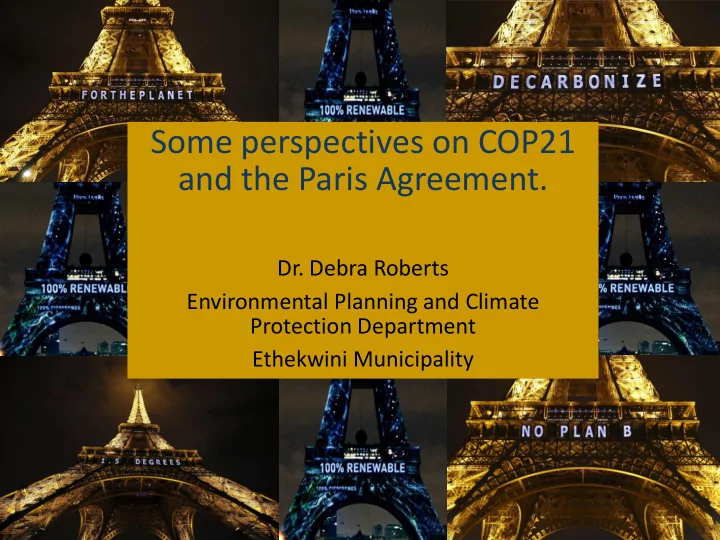
SLIDE 1 Some perspectives on COP21 and the Paris Agreement.
Environmental Planning and Climate Protection Department Ethekwini Municipality
SLIDE 2
One of the greatest threats of the 21st Century: Survey in 40 countries with more than 45 000 respondents (Pew Research Center, 2015) showed that the global population sees climate change as the greatest threat. Global economic instability (2nd) and ISIS (3rd). Countries in Latin America and Africa are particularly concerned about climate change.
SLIDE 3 The World Economic Forum (2016): “Global Risks 2015” report – after being in the top five risks for the past three years, the failure
- f climate change mitigation and
adaptation has risen to the top and is perceived as the most impactful risk for the years to come, ahead of weapons of mass destruction (2nd) and water crises (3rd).
SLIDE 4
Climate Vulnerability Monitor (2012) undertook a study commissioned by 20 of the world’s governments whose nations are most threatened by climate change. Found that climate change is already costing the global economy more $1.2 trillion a year - wiping 1.6% annually from global GDP while recent research (published in Nature in 2015) found that unmitigated global warming will leave global GDP per capita 23% lower in 2100.
SLIDE 5
According to the World Health Organisation (WHO) climate change is already causing 150 000 deaths a year and a new WHO report (2014) indicates climate change will lead to 250 000 extra deaths a year from 2030. 150 000 figure took into account deaths from malnutrition, malaria, and diarrhea caused by contaminated water. According to Climate Vulnerability Monitor (2012) the figure of 150 000 excluded the effects of heat waves, crop losses due to an increase in pests, and a range of other deadly diseases, which can be substantial. Estimated 400 000 annual deaths from climate change projected to grow to 700 000 by 2030.
SLIDE 6 A study of middle-class consumption in 215 cities (UBS, 2016) found that in high risk cities spent 0.6
- 0.8% more on housing compared to the national
average, and less on luxuries, entertainment and durable goods. "More fear, less fun”. Given the group’s size, spending power and dynamism, the erosion of middle-class wealth through climate change threatens both economic and sociopolitical stability.
SLIDE 7
What is climate change?
SLIDE 8 Earth is the “Goldilocks” planet: not too hot and not too cold.
SLIDE 9 IPCC AR5 Synthesis Report
Sources of Greenhouse Gas (GHG) emissions
Energy production remains the primary driver of GHG emissions
35% 24% 21% 14% 6.4% 2010 GHG emissions Energy Sector
Agriculture, forests and
Industry Transport
Building Sector
AR5 WGIII SPM
SLIDE 10 Who is the IPCC (Intergovernmental Panel on Climate Change) ?
to provide policy-makers
with an objective source of information about
- causes of climate change
- potential environmental
and socio-economic impacts
- possible response options
(adaptation and mitigation).
WMO= World Meteorological Organization UNEP= United Nations Environment Programme
Established by WMO and UNEP in 1988
Multiple studies published in peer-reviewed scientific journals show that 97% or more of actively publishing climate scientists agree that:
- Climate-warming trends
- ver the past century are
very likely due to human activities.
SLIDE 11 IPCC’s Fifth Assessment Report (AR5) released 2013/2014
EVERYONE
SLIDE 12 IPCC AR5 Synthesis Report
Key messages from AR5
- Human influence on the climate system is clear
- The more the climate is disrupted through Greenhouse
Gases (GHG) emissions, the more we increase the risk of severe, pervasive and irreversible impacts for people and ecosystems
- While climate change poses a threat to sustainable
development, there are opportunities to integrate mitigation, adaptation, and the pursuit of other societal
- bjectives when addressing climate change.
SLIDE 13 IPCC AR5 Synthesis Report
The window for action is rapidly closing if we are to achieve the 2oC goal
65% of the carbon budget compatible with a 2oC goal is already used. NB: this is with a probability greater than 66% of staying below 2oC
Amount Used 1870-2011:
1900 900
GtCO2 Amount Remaining:
1000 1000
GtCO2 Total Carbon Budget:
2900 2900
GtCO2
AR5 WGI SPM
NB: Emissions in 2011: 38 GtCO2/yr
"For a >66% chance of limiting warming below the internationally agreed temperature limit of 2 °C relative to pre-industrial levels, the most appropriate carbon budget estimate is 590–1,240 GtCO2 from 2015
- nwards…Current CO2 emissions are about 40 GtCO2
yr” (Rogelj et al., 2016). The carbon budget would be spent in 15 - 30 years for the 2 °C target and about a decade for a 1.5°C target.
SLIDE 14 Working Group III contribution to the IPCC Fifth Assessment Report
There will be substantial technological, economic and institutional challenges if we want to limit warming to 2°C relative to pre- industrial levels . Implies reducing global GHG emissions by 40 to 70% compared to 2010 by mid-century, and reaching zero or negative emissions by 2100.
SLIDE 15 Working Group III contribution to the IPCC Fifth Assessment Report
SLIDE 16
So how do we turn this science into policy?
SLIDE 17
SLIDE 18 UNFCCC
United Nations Framework Convention on Climate Change (UNFCCC) opened for signature at Rio Earth Summit in 1992
Objective of the Convention: to stabilize GHG concentrations in the atmosphere at a level that will prevent dangerous interference with the climate system.
SLIDE 19 Negotiations started in 1995. But COP17 in Durban (2011) was a critical turning point:
- Governments committed to a new universal legal climate
change agreement by 2015 (“a protocol, another legal instrument or an agreed outcome with legal force under the Convention applicable to all Parties”) that would apply from 2020.
- Led to the launch of the Ad Hoc Working Group on the
Durban Platform for Enhanced Action or ADP.
- The new negotiation platform also critically included finding
ways to raise the existing level of national and international ambition (i.e. pre 2020) to bring down GHG.
UNFCCC Timeline
SLIDE 20 President Zuma reminded everyone that Paris was about finishing the job we started in Durban “As Leaders, we are here today because of the historic and bold decisions we took in Durban to enhance the implementation of the Convention...For South Africa, the Durban decision to enhance the implementation of the Convention was of paramount importance, because the impacts of climate change are harshest on the poor. Climate change is a major global challenge that requires an urgent global response” .
Paris (COP21)
Lima (COP20-2014)
Warsaw (COP19 - 2013)
Doha (COP18 -2012)
Durban (COP17- 2011)
SLIDE 21 COP21-CMP11 – Paris, France: 30 November-12 December 2015 COP21 in numbers: 50+: pages in the final negotiating text for the conference. 150: the number of heads of state who attended the
- pening day - largest ever single-day gathering of heads
- f state.
2 800: police at the conference venue. 20 000: people accredited to attend the conference. 38 000: attended the conference and related side events 24: hours past the official deadline
SLIDE 22 Deciding our future
3 important climate milestones just before Paris:
- 1. Recognition that 2015 was set to be the hottest year on record.
- 2. The UK Meteorological Office announced that climate change was
set to pass the milestone of 1oC of warming since pre-industrial times (1750) by the end of 2015, representing “uncharted territory” – we are half way to 2oC already!
- 3. The World Meteorological Organization announced that 2016 would
be the first year in which the concentration of carbon dioxide in the atmosphere is over 400ppm on average, due to the continued burning of fossil fuels. This is up from about 278ppm in 1750.
- Note: while 400ppm is regarded as a “symbolic milestone” scientists say that
the ‘safe’ level of CO2 to avoid dangerous global warming is more like 350ppm.
SLIDE 23 Everyone knew we were going to make history…one way or another
this may not come again. We have never faced such a test. But neither have we encountered such great opportunity”.
here will reverberate down through the ages.”
UN Secretary General Ban Ki-moon
SLIDE 24 People also knew what was at stake…around the world 600 000 people demonstrated in favour of a strong agreement…while in Paris a ban on public gatherings in the wake of the 13th November terror attacks meant it was a case of “the shoes are marching for us.”
Place de la République
SLIDE 25
SLIDE 26 Central 3 elements to the Paris Outcome
The Paris Agreement: The text commonly called the “Paris Agreement” is actually two different documents. Firstly, the Agreement itself, which is a legally binding treaty on climate action and which contains emission reduction commitments from 187 countries starting in 2020. COP Decision: And secondly, the Paris Decision, which passes the agreement and sets out a number of less legally binding ways with immediate effect to accelerate climate action and to prepare for the implementation of the Paris Agreement once it enters into force. Lima Paris Action Agenda: Alongside the formal agreements a large number of commitments for additional action to reduce emissions and increase resilience were made by countries, regions, cities, investors, and companies e.g. Breakthrough Energy Coalition announced by Bill Gates and other billionaires. .
SLIDE 27
Landmark agreement charting a fundamentally new course The new treaty ends the strict differentiation between developed and developing countries that characterized earlier efforts (i.e. Annex 1 and Non- Annex 1 of Kyoto Protocol). Move from blame to collective will. Establishes bottom up common commitments while allowing flexibility to accommodate different national capacities and circumstances vs top down timetables and targets.
SLIDE 28 Article Subject
Article 2 Temperature Goal Article 3 Nationally Determined Contributions Article 4 Mitigation Article 5 Sinks/Forests Article 6 Establishment of a new market mechanism Article 7 Adaptation Article 8 Loss and Damage Article 9 Finance Article 10 Technology Article 11 Capacity Building Article 12 Public awareness and participation Article 13 Transparency Article 14 Global Stocktake Article 15 Implementation and Compliance
SLIDE 29 Article Subject
Article 2 Temperature Goal Article 3 Nationally Determined Contributions Article 4 Mitigation Article 5 Sinks/Forests Article 6 Establishment of a new market mechanism Article 7 Adaptation Article 8 Loss and Damage Article 9 Finance Article 10 Technology Article 11 Capacity Building Article 12 Public awareness and participation Article 13 Transparency Article 14 Global Stocktake Article 15 Implementation and Compliance
SLIDE 30
Key Outcomes: Temperature Goal (Article 2)
Reaffirms the goal of limiting global temperature increase to well below 2oC, while pursuing efforts to limit the increase to 1.5o C. The COP decision also invites the IPCC to produce a Special Report by 2018 on the impacts of 1.5oC and related global GHG emission pathways. BUT to keep warming below 1.5oC by 2100, have to stop GHG emissions to the atmosphere by 2060 (according to a study published in Nature Climate Change in 2015) and then start pulling carbon out of the atmosphere – not easy!
SLIDE 31 Article Subject
Article 2 Temperature Goal Article 3 Nationally Determined Contributions Article 4 Mitigation Article 5 Sinks/Forests Article 6 Establishment of a new market mechanism Article 7 Adaptation Article 8 Loss and Damage Article 9 Finance Article 10 Technology Article 11 Capacity Building Article 12 Public awareness and participation Article 13 Transparency Article 14 Global Stocktake Article 15 Implementation and Compliance
SLIDE 32
Key Outcomes: Mitigation (Article 4) Article 4 establishes binding commitments by all parties to make “nationally determined contributions” (NDCs), and to pursue domestic measures aimed at achieving them. Implementation is not a binding obligation. All countries have to submit new NDCs every five years, with the clear expectation that they will “represent a progression” beyond previous ones (specified in Article 3) and reflect a party’s “highest possible ambition.”
SLIDE 33 Article Subject
Article 2 Temperature Goal Article 3 Nationally Determined Contributions Article 4 Mitigation Article 5 Sinks/Forests Article 6 Establishment of a new market mechanism Article 7 Adaptation Article 8 Loss and Damage Article 9 Finance Article 10 Technology Article 11 Capacity Building Article 12 Public awareness and participation Article 13 Transparency Article 14 Global Stocktake Article 15 Implementation and Compliance
SLIDE 34
Key Outcomes: Adaptation (Article 7) In his opening day address President Zuma said: “A Global Goal for Adaptation must … be part of the Paris agreement. This Goal must express adaptation as a global responsibility that requires a global response…”.
SLIDE 35 Key Outcomes: Adaptation (Article 7) The agreement establishes a “global goal” on adaptation of “enhancing adaptive capacity, strengthening resilience and reducing vulnerability to climate change”. Links amount
- f adaptation and its cost to the level of
mitigation action. First agreement of its kind to put the need for adaptation on equal footing with the need for mitigation - remarkable as an adaptation goal was unthinkable even two years ago.
SLIDE 36 Article Subject
Article 2 Temperature Goal Article 3 Nationally Determined Contributions Article 4 Mitigation Article 5 Sinks/Forests Article 6 Establishment of a new market mechanism Article 7 Adaptation Article 8 Loss and Damage Article 9 Finance Article 10 Technology Article 11 Capacity Building Article 12 Public awareness and participation Article 13 Transparency Article 14 Global Stocktake Article 15 Implementation and Compliance
SLIDE 37 Key Outcomes: Loss and Damage (Article 8)
Loss and Damage has its own Article extends and makes permanent the Warsaw International Mechanism for Loss and Damage (established as an interim body at COP 19 in 2013) — an important political statement as L&D is now seen on a par with mitigation and adaptation. At the insistence of developed countries, led by the USA, the accompanying Paris Decision (51) specifies that the loss and damage provision “does not involve
- r provide a basis for any liability or compensation.”
.
SLIDE 38 Article Subject
Article 2 Temperature Goal Article 3 Nationally Determined Contributions Article 4 Mitigation Article 5 Sinks/Forests Article 6 Establishment of a new market mechanism Article 7 Adaptation Article 8 Loss and Damage Article 9 Finance Article 10 Technology Article 11 Capacity Building Article 12 Public awareness and participation Article 13 Transparency Article 14 Global Stocktake Article 15 Implementation and Compliance
SLIDE 39 Key Outcomes: Finance (Article 9) Surprise, surprise finance was a contentious issue, with poorer developing countries seeking stronger assurances that support will be scaled up, and developed countries pushing for wealthier developing countries to contribute as well. The agreement places a legal obligation on developed countries to continue to provide climate finance for mitigation and adaptation to developing countries (“in continuation of their existing
- bligations under the Convention”).
SLIDE 40 Key Outcomes: Finance (Article 9) Article 9 also for the first time encourages
- ther countries to provide support voluntarily.
Many of the details have been moved out of the legally binding agreement and into the more flexible decisions. This includes the provision that, prior to 2025, countries should agree a “new collective quantified goal” from the floor of $100billion per year, which is the current aspiration.
SLIDE 41 Article Subject
Article 2 Temperature Goal Article 3 Nationally Determined Contributions Article 4 Mitigation Article 5 Sinks/Forests Article 6 Establishment of a new market mechanism Article 7 Adaptation Article 8 Loss and Damage Article 9 Finance Article 10 Technology Article 11 Capacity Building Article 12 Public awareness and participation Article 13 Transparency Article 14 Global Stocktake Article 15 Implementation and Compliance
SLIDE 42
Key Outcomes: Transparency (Article 13) The Paris Agreement rests heavily on transparency as a means of holding countries accountable. Article 13 commits all countries to report regularly on their emissions and “progress made in implementing and achieving” their NDCs, and to undergo international technical expert review. Intended to be “facilitative, non-intrusive, non-punitive”. The rules on transparency were a top priority for the USA and EU, which were keen to ensure China faces equivalent scrutiny of its efforts.
SLIDE 43
SLIDE 44 Article Subject
Article 2 Temperature Goal Article 3 Nationally Determined Contributions Article 4 Mitigation Article 5 Sinks/Forests Article 6 Establishment of a new market mechanism Article 7 Adaptation Article 8 Loss and Damage Article 9 Finance Article 10 Technology Article 11 Capacity Building Article 12 Public awareness and participation Article 13 Transparency Article 14 Global Stocktake Article 15 Implementation and Compliance
SLIDE 45 Key Outcomes: Global Stocktake (Article 14)
Given that the current provisions are not going to be enough to reach the long-term 2oC temperature limit there is a two- stage process to increase ambition over time. In 2018 there will be a facilitative dialogue (Paris Decision 20) to take stock of the collective efforts of countries, which should help countries update and enhance individual plans. Countries which have submitted targets for 2025 are then urged to come back in 2020 with a new target, while those with 2030 targets are invited to “communicate or update” them ( Paris Decision 23&24). This process will be repeated every five years, with the first post-2020 stocktake occurring in 2023 and then every five years.
SLIDE 46
Role of non-state actors
The Paris Decision welcomes the efforts of all non- Party stakeholders to address and respond to climate change, including those of civil society, the private sector, financial institutions, cities and other subnational authorities and is thus less inward looking than previous agreements. Gives a greater role to non-Party stakeholders and invites them to scale up their efforts and support actions to reduce emissions and/or to build resilience and decrease vulnerability to the adverse effects of climate change and demonstrate these efforts via the Non-State Actor Zone for Climate Action.
SLIDE 47
Over 1 000 city and regional officials gathered at the “Climate Summit for Local Leaders” and through the “Paris City Hall Declaration” pledged support for 100% renewable energy and 80% reduction in emissions by 2050 and to produce and implement participatory resilience strategies and action plans to adapt to climate change hazards by 2020.
SLIDE 48
The potential urban emissions reductions of the Compact of Mayors by 2030 are equivalent to nearly 25% of the “gap” between national pledges made before COP21 and the what is required to keep global warming below 2°C.
SLIDE 49 How good really is the Paris outcome?
As many pointed out during the COP closing plenary, the Paris Agreement, as a compromise, “is good, but not perfect.” So what is good about it? It will shape climate action for decades into the future. The ambitious goals of the Agreement, the universal nature of the agreement and near-universal coverage
- f NDCs, five year review cycles, and the
transparency framework are much-needed signals to markets to redirect investments to low-carbon and climate-resilient development.
SLIDE 50 How good is the Paris outcome?
It signals the end of business as usual for the energy
- industries. Future investment will need to be compatible
with a zero carbon world. This will mean that governments and investors will need to manage an orderly transition away from a fossil fuel dominated economy in a way that avoids stranded assets and negative impacts on workers. The G20 has established a taskforce on the implications of climate policy on financial stability which will report in 2016. The Paris Agreement has broken new ground and placed adaptation, resilience and response to climate impacts at the heart of the new regime.
SLIDE 51 Next steps
The Paris Agreement will enter into force once 55 countries accounting for at least 55% of global emissions have acceded to it. In 2012 China, the US, India, Brazil, Russia and Japan topped this minimum
- alone. Such parties will need to sign the agreement in
New York between 22 April 2016 and 21 April 2017, and also adopt it within their own legal systems (through ratification, acceptance, approval, or accession). If states ratify quickly, these conditions could be satisfied pre-2020, allowing the COP to begin meeting as the “meeting of the Parties” to the Paris Agreement, to be known by the acronym CMA.
SLIDE 52 “In Paris, there have been many revolutions over the
- centuries. Today it is the
most beautiful and the most peaceful revolution that has just been accomplished – a revolution for climate change.”
French President Francois Hollande
Thank You
debra.roberts@durban.gov.za