Soil pH pH = log [H + ] Paulo Pagliari pH decreases as [H + ] - - PDF document

soil ph
SMART_READER_LITE
LIVE PREVIEW

Soil pH pH = log [H + ] Paulo Pagliari pH decreases as [H + ] - - PDF document

Soil pH pH = log [H + ] Paulo Pagliari pH decreases as [H + ] increases: 0.0001 g H + kg -1 soil will have pH of 4; Department of Soil, Water, and Climate change [H + ] to 0.001 g H + kg -1 soil pH will go to 3 ACIDIC University


slide-1
SLIDE 1

1

Soil pH

Paulo Pagliari Department of Soil, Water, and Climate University of Minnesota

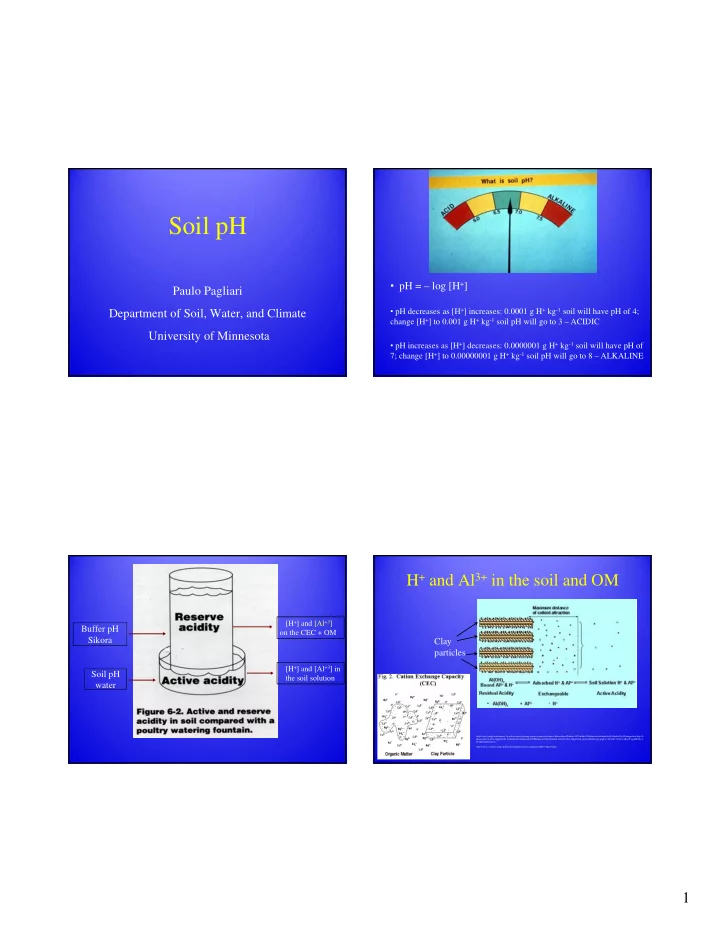
  • pH = – log [H+]
  • pH decreases as [H+] increases: 0.0001 g H+ kg-1 soil will have pH of 4;

change [H+] to 0.001 g H+ kg-1 soil pH will go to 3 – ACIDIC

  • pH increases as [H+] decreases: 0.0000001 g H+ kg-1 soil will have pH of

7; change [H+] to 0.00000001 g H+ kg-1 soil pH will go to 8 – ALKALINE

Buffer pH Sikora

[H+] and [Al+3]

  • n the CEC + OM

Soil pH water

[H+] and [Al+3] in the soil solution

H+ and Al3+ in the soil and OM

Clay particles

  • http://www.google.com/imgres?q=soil+cation+exchange+capacity+minerals&um=1&hl=en&sa=N&biw=1323&bih=958&tbm=isch&tbnid=8a0hUihaSm2zyM:&imgrefurl=http://h
ubcap.clemson.edu/~blpprt/acid1.html&docid=oOfnbaas8skS7M&imgurl=http://hubcap.clemson.edu/~blpprt/acid_photos/Buffering2.jpg&w=467&h=321&ei=zRqwTsqgLMGLsA LT4qDjAQ&zoom=1
  • http://www.extension.umn.edu/distribution/horticulture/components/M1193fig02.html
slide-2
SLIDE 2

2

Soil pH Effects on Soil Properties

  • Availability of most essential and non-

essential elements

  • Activity of microorganisms

Soil pH Effects on Soil Properties

  • Activity of microorganisms

– pH 5.5 - 6.5 best nitrification and OM decomposition rates

slide-3
SLIDE 3

3

Soil pH Effects on Soil Properties

  • Ability of soil to hold cations

– As pH decreases, soil exchange sites get saturated with H+ and Al+3

  • cations (K+, Ca+2, and Mg+2) come off exchange sites and may leach
  • ut of soil

Soil pH Effects on Soil Properties How Does the Soil Become Acid? Causes of Soil Acidification

  • Acidic parent material
  • Leaching of basic cations +

Crop removal of cations

  • Use of Nitrogen fertilizers
  • Other- Acid rain, industrial

emissions, internal combustion engines, etc

slide-4
SLIDE 4

4

Acid Forming Fertilizers

  • 2NH4 + 4O2

2NO3 + 2H2O + 4H+

  • Nitrification
  • NH4

+ immobilization

  • NH4 + R-OH

R-NH2 + H2O + H+ Nitrogen Applied each year for 5 years Soil pH* Aglime needed to return soil pH to 6.1 (lbs/a) (ton/a) 6.11 0.00

Effect of Nitrogen Fertilizer on Soil pH

40 6.10 0.31 80 6.02 0.65 120 5.98 0.96 160 5.81 2.03 200 5.68 2.72

Nitrogen applied as ammonium nitrate, Walsh, L.M. 1965; * Soil was a Plano silt loam cropped to corn

Aglime Required to Neutralize Acid Forming N Fertilizers

Nitrogen source Pounds of aglime needed per pound of Nitrogen1

A i lf 7 5 Ammonium sulfate 7.5 Diammonium phosphate 7.5 Anhydrous ammonia 5 Urea 5 Solutions (28% - 41% N) 4 Ammonium nitrate 4

1Approximation

Why do I Need Lime?

One year old stand

slide-5
SLIDE 5

5

One year old stand

Lime No lime

Effect of Soil pH on Crop Yield Response Liming Reaction in Soil

CaCO3 + 2H+ Ca+2 + CO2 + H2O

  • Calcium does not change soil pH, rather changes %BS
  • The oxide, hydroxide, and carbonate present in the lime

are the compounds responsible for changes in soil pH

CaCO3 + 2H Ca + CO2 + H2O

[H+] decreased pH increased

slide-6
SLIDE 6

6

Al3+ Reaction Against pH Increase

CaCO3 + 2H+ Ca+2 + CO2 + H2O H2O + 1/3Al3+ 1/3Al(OH)3 + H+

What Factors Determine the Lime Needs of a Soil

  • Soil pH (Active acidity) – determined by soil

test (pH in water) test (pH in water)

  • Buffer pH (Residual acidity) – determined by

soil test (pH in Sikora)

  • Target pH – determined by crop and crop

rotation

Target pH

  • Alfalfa – 6.8
  • Red Clover – 6.3
  • Soybean

6 3

  • Soybean – 6.3
  • Corn – 6.0
  • Pasture – 6.0
  • Oats – 5.8

Target pH

  • Rotation of Soybean, Corn, and Alfalfa

– Soybean – 6.3 – Corn – 6.0 – Alfalfa – 6.8

  • Alfalfa is the most sensitive so the target pH

for the rotation is 6.8

slide-7
SLIDE 7

7

Is all Lime the Same? What Determines the Quality

  • f a Liming Material
  • Purity

– measure of CaCO3 equivalency

The Purity Factor (CaCO3) Equivalent

What Determines the Quality

  • f a Liming Material
  • Fineness – a dry sieving process is used
slide-8
SLIDE 8

8

Particle Size Distribution Particle Size Distribution Effect on Soil pH Limestone Behavior in Soil

Mixing is critical

slide-9
SLIDE 9

9

Calculating the Neutralizing Index (NI) of a Liming Material

LR for pH of 6.8 = 195 – 28.4(BpH) + 0.144(WpH) LR6.8 = 3.0 ton/a

Calculating Lime Rate

Soil pH in water (WpH) = 5.90 Soil pH in Buffer Sikora (BpH) = 6.79

When Should I Apply Lime? Any time you can

slide-10
SLIDE 10

10

Choosing Between Liming Materials

  • Example

– 5 tons of 50-59 NI material at $ 13/ton results in a cost per acre of $ 65 p – 2 tons of 80-89 NI material at $ 16/ton results in a cost per acre of $ 32 – The cheaper product may not always be the best buy

Can the Soil pH be Lowered ?

  • Some crops may have lower optimum pH range
  • Soil pH can be lowered by addition of acid-forming fertilizers

Elemental Sulfur (S) 2S 3O 2H O 2SO

2

4H+ 2S + 3O2 + 2H2O 2SO4

  • 2 + 4H+

Aluminum Sulfate [Al2(SO4)3] Al2(SO4)3 + 6H2O 2Al(OH)3 + 3SO4

  • 2 + 6H+

Ammonium Nitrate (NH4)NO3 NH4NO3 + 2O2 2NO3

  • + H2O + 2H+

Thank you for attending!

Question?