
SLIDE 1
Social Implications
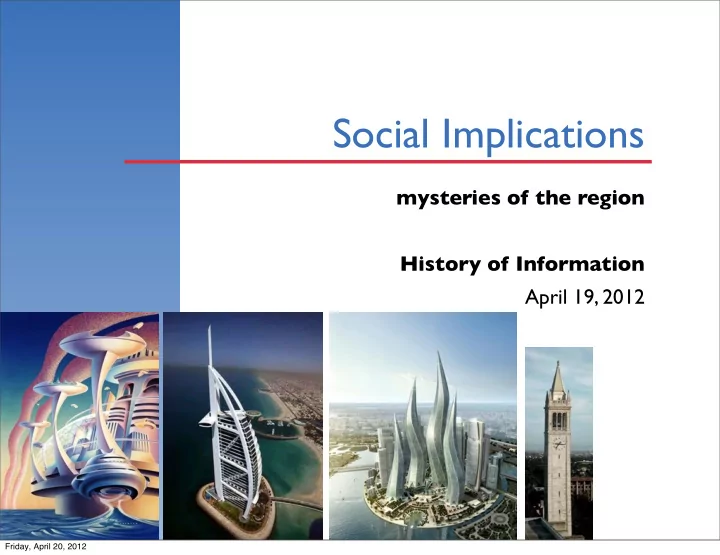
mysteries of the region History of Information April 19, 2012
Friday, April 20, 2012
Social Implications mysteries of the region History of Information - - PowerPoint PPT Presentation
Social Implications mysteries of the region History of Information April 19, 2012 Friday, April 20, 2012 exam May 9 11:30 - 2:30 155 Kroeber study sessions Tuesday May 1 -Thursday May 3 9:30-11:00 27-HofI12-SocImp-PD 2 Friday, April
Friday, April 20, 2012
27-HofI12-SocImp-PD
2
Friday, April 20, 2012
27-HofI12-SocImp-PD
3
Friday, April 20, 2012
27-HofI12-SocImp-PD
5
Friday, April 20, 2012
27-HofI12-SocImp-PD
6
Friday, April 20, 2012
27-HofI12-SocImp-PD
8
Friday, April 20, 2012
27-HofI12-SocImp-PD
9
Friday, April 20, 2012
footer
10
Friday, April 20, 2012
27-HofI12-SocImp-PD
"Ye Gods, annihilate but space and time, And make two lovers happy." 1728
11
Friday, April 20, 2012
27-HofI12-SocImp-PD
"The establishment of the telegraph is ... the best response to the publicists who think that France is too large to form a
and, in a way, brings an immense population together at a single point."
12 Claude Chappe (1763-1805)
Friday, April 20, 2012
27-HofI12-SocImp-PD
13
"Parvenu à la suite de travaux longs et pénibles à trouver, enfin, un art nouveau regardé comme impossible par beaucoup des Savans, une route nouvelle va fournir devant les efforts de l'homme, les distances vont disparaître et les extremités du Monde se rapprocher."
Friday, April 20, 2012
27-HofI12-SocImp-PD
"It is not visionary to suppose that it would not be long ere the whole surface
those nerves which are to diffuse, with the speed of thought, a knowledge of all that is occurring throughout the land; making one neighborhood of the while country." Morse to Congress, 1838
14
Friday, April 20, 2012
27-HofI12-SocImp-PD
"the almost complete annihilation of time and space between the distant antipodal points of the American continent ... produced by the construction of the Pacific Railroad"
Echoes from the Rocky Mountains, 1888
15
Friday, April 20, 2012
27-HofI12-SocImp-PD
"A line of telegraph ... from London to Kurrachee, and from thence to every part of India, ... intelligence and commands be daily and hourly communicated with the speed of lightening ... in this virtual annihilation of time and space in the communications between England and her distant possessions will be more than realised"
16
Friday, April 20, 2012
27-HofI12-SocImp-PD
17
Friday, April 20, 2012
27-HofI12-SocImp-PD
"It is impossible that old prejudices and hostilities should longer exist, while such an instrument has been created for the exchange of thought between all the nations of the earth."
The Story of the Telegraph, 1858 "Steam was the first olive branch offered to us by science. Then came the still more effective olive branch--this wonderful electric telegraph, which enables any man who happens to be within reach of a wire to communicate instantaneously with his fellow men all over the world."
18
Friday, April 20, 2012
27-HofI12-SocImp-PD
"Someday we will build up a world telephone system, making necessary to all peoples the use of a common language or common understanding of languages, which will join all the people of the earth into one
the earth a great voice coming out of the ether which will proclaim, 'Peace on earth, good will towards men.'"
19
Friday, April 20, 2012
27-HofI12-SocImp-PD
"Electric circuitry has overthrown the regime of 'time' and 'space' and pours upon us instantly and continuously concerns of all other men. It has reconstituted dialogue on a global scale. Its message is Total Change, ending psychic, social, economic, and political parochialism... Ours is a brand-new world of allatonceness. 'Time' has ceased, 'space' has vanished. We now live in a global village ... a simultaneous happening."
20
Friday, April 20, 2012
27-HofI12-SocImp-PD
21
"This has been predicted before; the difference now is that it is actually starting to happen"
Friday, April 20, 2012
27-HofI12-SocImp-PD
"Every cheapening of the means of communication, every new facility for the free interchange of ideas ... alters the action of the forces which tend to localize industries."
Principles of Economics, 1920
22 Alfred Marshall 1842-1924
Friday, April 20, 2012
27-HofI12-SocImp-PD
23
Friday, April 20, 2012
27-HofI12-SocImp-PD
24
Friday, April 20, 2012
27-HofI12-SocImp-PD
25
"He will go to the nearest shop for a trifling purpose, but for a more important purchase he will take the trouble
part of the town where he knows that there are specially good shops for his purpose."
Marshall, Principles of Economics, 1920
Friday, April 20, 2012
27-HofI12-SocImp-PD
26
Friday, April 20, 2012
27-HofI12-SocImp-PD
27 Ronald Coase 1910
Friday, April 20, 2012
27-HofI12-SocImp-PD
staying close to the customer
28
Friday, April 20, 2012
27-HofI12-SocImp-PD
staying close to the customer
28
Friday, April 20, 2012
27-HofI12-SocImp-PD
staying close to the customer
28
Friday, April 20, 2012
27-HofI12-SocImp-PD
staying close to the customer
28
Friday, April 20, 2012
27-HofI12-SocImp-PD
staying close to the customer
28
Friday, April 20, 2012
27-HofI12-SocImp-PD
if distance is dead ...
29
Friday, April 20, 2012
27-HofI12-SocImp-PD
30
"Every cheapening of the means of communication, every new facility for the free interchange
alters the action of the forces which tend to localize industries."
Marshall, Principles of Economics, 1920
Friday, April 20, 2012
27-HofI12-SocImp-PD
31
These difficulties ... Are however being diminished by the railway, the printing press and the telegraph."
Marshall, Principles of Economics, 1920
Friday, April 20, 2012
27-HofI12-SocImp-PD
32
Friday, April 20, 2012
27-HofI12-SocImp-PD
percentage of home workers in population
33
1960 1970 1980 1990 1999 2005
Friday, April 20, 2012
27-HofI12-SocImp-PD
34
Friday, April 20, 2012
27-HofI12-SocImp-PD
35
New York Times 1938 "Ceci tuera ..."
Friday, April 20, 2012
27-HofI12-SocImp-PD 36
Friday, April 20, 2012
27-HofI12-SocImp-PD
"Perhaps someday the desk worker fed up with traffic jams in the city will do his job at a computer input-output station at home: If he wants to see documents from company files, he punches his keyboard and they appear on his display
secretary, at her office desk or at her terminal in her home. She’ll type it on her keyboard— and the text will emerge in the downtown office, to go into the files and into the mail. Or she’ll send electronic impulses directly to the company addressed—into their computer....
37
Friday, April 20, 2012
27-HofI12-SocImp-PD
38
Friday, April 20, 2012
27-HofI12-SocImp-PD
"The accumulation of many large manufacturing establishments in the same district has a tendency to bring together purchasers or their agents from great distances, and thus to cause the institution of a public mart or exchange. This contributes to diffuse information relative to the supply of raw materials, and the state of demand for their produce, with which it is necessary manufacturers should be well acquainted. The very circumstance of collecting periodically, at
those who require its produce, tends strongly to check the accidental fluctuations to which a small market is always subject, as well as to render the average of the prices much more uniform."
39
Friday, April 20, 2012
27-HofI12-SocImp-PD
When an industry has thus chosen a locality for itself, it is likely to stay there long: so great are the advantages which people following the same skilled trade get from near neighbourhood to one another. The mysteries of the trade become no mysteries; but are as it were in the air, and children learn many of them unconsciously. Good work is rightly appreciated, inventions and improvements in machinery, in processes and the general organization of the business have their merits promptly discussed: if one man starts a new idea, it is taken up by others and combined with suggestions of their own; and thus it becomes the source
neighbourhood, supplying it with implements and materials, organizing its traffic, and in many ways conducing to the economy of its material.
40
Friday, April 20, 2012
27-HofI12-SocImp-PD
41
Friday, April 20, 2012
27-HofI12-SocImp-PD
Every cheapening of the means of communication ... alters the action of the forces which tend to localize industries. Speaking generally we must say that a lowering of tariffs, or of freights for the transport of goods, tends to make each locality buy more largely from a distance what it requires; and thus tends to concentrate particular industries in special localities: but on the other hand everything that increases people's readiness to migrate from one place to another tends to bring skilled artisans to ply their crafts near to the consumers who will purchase their
recent history of the English people.
42
Friday, April 20, 2012
27-HofI12-SocImp-PD
43
Friday, April 20, 2012
27-HofI12-SocImp-PD
44
Friday, April 20, 2012
27-HofI12-SocImp-PD
45
Friday, April 20, 2012
27-HofI12-SocImp-PD
"Children in the public schools will be taught practically everything by moving
46
Friday, April 20, 2012
27-HofI12-SocImp-PD
"The people's University of the Air will have a greater student body than all of
1932
47
Friday, April 20, 2012
27-HofI12-SocImp-PD
48
Friday, April 20, 2012
27-HofI12-SocImp-PD
49
Friday, April 20, 2012
27-HofI12-SocImp-PD
(Programmed Logic for Automated Teaching Operations) "One can predict that in a few more years, millions of schoolchildren will have the personal services of a tutor as well- informed as Aristotle."
Scientific American, 1966.
50
Friday, April 20, 2012
27-HofI12-SocImp-PD
51
Friday, April 20, 2012
27-HofI12-SocImp-PD
52
Friday, April 20, 2012
27-HofI12-SocImp-PD
(John Daniels)
53 Allama Iqbal Open University * Anadolu University * Athabasca University * Bangladesh Open University * China Central Radio & TV University * City College of San Francisco * Fern University in Hagen * Indira Gandhi National Open University * Indonesian Open Learning University * Instituto Tecnológico Autónomo de México * Payame Noor University * Korea National Open University * Sukhothai Thammathirat Open University * The Open University, U.K. * Universidad Nacional de Educacion a Distancia * University of Maryland University College * University of South Africa * University of Phoenix * Universidad Nacional Autonoma de Mexico * Shanghai TV University
"The people's University of the Air will have a greater student body than all of our universities put together." --RCA, 1932
Friday, April 20, 2012
27-HofI12-SocImp-PD
* Arizona State University
* College of Eastern Utah * Dixie State College of Utah * Johns Hopkins Bloomberg School of Public Health * Kaplan Higher Education * Massachusetts Institute of Technology * Michigan State University * Open Institute of law, Int. * Tufts University * UC Berkeley * University of Alaska Fairbanks * University of California, Irvine * University of Massachusetts Boston * University of Michigan * University of Notre Dame * University of Utah * University of Wisconsin- Eau Claire * Utah State University * Utah Valley State College * Weber State University * Western Governors University * Wheelock College
54
"Institutions working together to advance education and empower people worldwide through
www.ocwconsortium.org
Friday, April 20, 2012
27-HofI12-SocImp-PD
55
Friday, April 20, 2012
27-HofI12-SocImp-PD
56
Friday, April 20, 2012
27-HofI12-SocImp-PD
a "stagnant" sector --William Baumol
57
Friday, April 20, 2012
27-HofI12-SocImp-PD
58
Friday, April 20, 2012
27-HofI12-SocImp-PD
"But though books are easily procured, yet, even in this age of information, there are thousands in the lower classes that cannot read. Besides, it is a well-known truth, that the same precepts inculcated by a living instructor, adorned by a proper oratory, enforced by a serious and authoritative manner, produce a powerful effect, not to be experienced in solitary retirement."
Essays Moral and Literary, 1778
59
Vicesimus Knox 1752-1821
Friday, April 20, 2012
27-HofI12-SocImp-PD
"Those who acquire [writing] will cease to exercise their memory and become forgetful; they will rely on writing to bring things to their remembrance by external signs instead of on their own internal resources. ...your pupils will have the reputation for [wisdom] without the reality; they will receive a quantity of information without proper instruction, and in consequence be thought very knowledgeable when they are for the most part quite ignorant."
60 Plato 427-347 bce
Friday, April 20, 2012
27-HofI12-SocImp-PD
61
Friday, April 20, 2012
27-HofI12-SocImp-PD
Among the authors’ findings: 32 per cent of the students whom they followed in an average semester did not take any courses that assigned more than 40 pages of reading per week. Half did not take any courses in which more than 20 pages of writing were assigned throughout the entire term. Furthermore, 35 per cent of the students sampled spent five hours or less a week studying alone. Typical students spent about 16 per cent of their time on academic pursuits, and were “academically engaged,” write the authors, less than 30 hours a week. After two years in college, 45 per cent
four years, 36 per cent showed little change. And the students who did show improvement only logged very modest gains. Students spent 50 per cent less time studying compared with students a few decades ago.
Limited Learning on College Campuses, 2010
62
Friday, April 20, 2012
27-HofI12-SocImp-PD
kinds of distance geographical social disciplines or discipline?
Stephen Cameron,"The nonequivalence of high school equivalents," 1993
signalling
63
Friday, April 20, 2012
27-HofI12-SocImp-PD
64
Friday, April 20, 2012
27-HofI12-SocImp-PD
Let us consider the matter in this way: If the wise man or any
how will he proceed? .... He will consider whether what [the physician] says is true, and whether what he does is right, in relation to health and disease? ... But can any one attain the knowledge of either unless he have a knowledge of medicine? ... No one at all, it would seem, except the physician can have this knowledge; and therefore not the wise man; he would have to be a physician as well as a wise man. --Plato, Charmides
65
Friday, April 20, 2012
27-HofI12-SocImp-PD
“New products are associated with old brand
consumer of the quality of the product. “Doctors, lawyers, and barbers, the high school diploma, the baccalaureate degree, the Ph.D., even the Nobel Prize, ... education and labor markets themselves have their own ‘brand names’”.
Quality, Uncertainty, and the Market Mechanism,” 1970
66
Friday, April 20, 2012
27-HofI12-SocImp-PD
67
Week 15 24 Apr: Social Implications of the Internet II Required reading:
Networked Publics? How Race and Class Shaped American Teen Engagement with MySpace and Facebook.” In Digital Race Anthology (Eds. Lisa Nakamura and Peter Chow-White). Routledge.
Network and You Are Not a Gadget, by Jason Lanier) The New York Review of Books, Nov. 25, 2010.
Extremes.” The Chronicle Review, Dec. 14. 26 Apr: Wrap
Friday, April 20, 2012
27-HofI12-SocImp-PD 68
In some senses, the division in the perception and use of MySpace and Facebook seems obvious given that we know that online environments are a reflection of everyday life. Yet, the fact that such statements are controversial highlights a widespread techno‐ utopian belief that the internet will once and for all eradicate inequality and social divisions.
Shouldn’t we struggle against Facebook? Everything in it is reduced to the size of its founder. Blue, because it turns out Zuckerberg is red-green color-blind. “Blue is the richest color for me—I can see all of blue.” Poking, because that’s what shy boys do to girls they are scared to talk to. Preoccupied with personal trivia, because Mark Zuckerberg thinks the exchange of personal trivia is what “friendship” is. A Mark Zuckerberg Production indeed! We were going to live online. It was going to be extraordinary. Yet what kind of living is this? Step back from your Facebook Wall for a moment: Doesn’t it, suddenly, look a little ridiculous? Your life in this format?
Friday, April 20, 2012