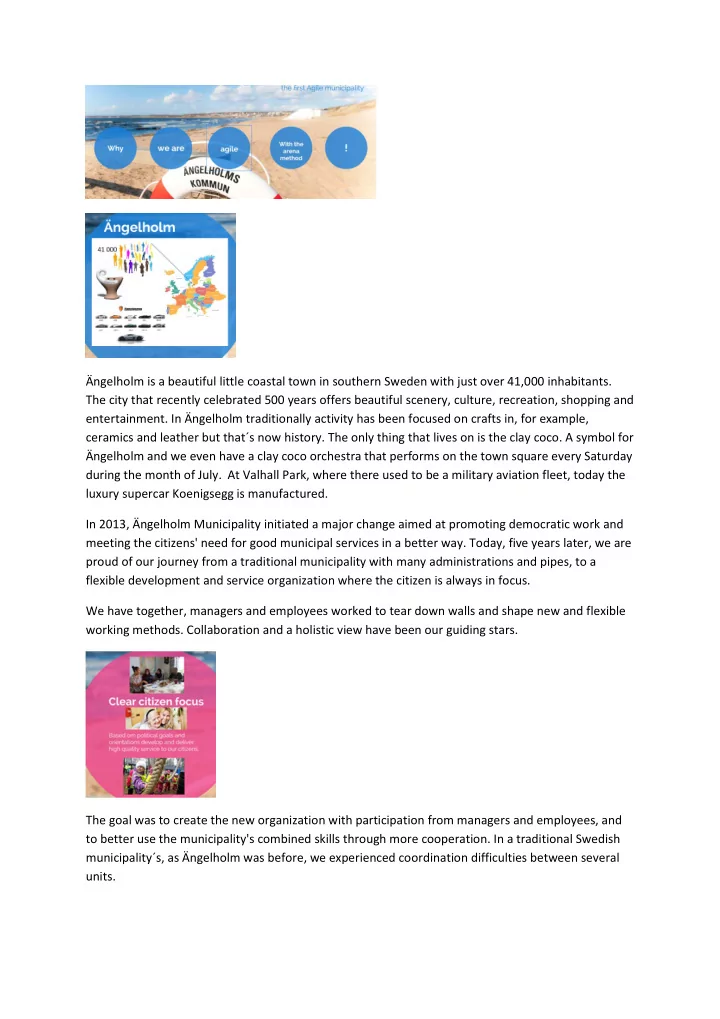
SLIDE 1 Ängelholm is a beautiful little coastal town in southern Sweden with just over 41,000 inhabitants. The city that recently celebrated 500 years offers beautiful scenery, culture, recreation, shopping and
- entertainment. In Ängelholm traditionally activity has been focused on crafts in, for example,
ceramics and leather but that´s now history. The only thing that lives on is the clay coco. A symbol for Ängelholm and we even have a clay coco orchestra that performs on the town square every Saturday during the month of July. At Valhall Park, where there used to be a military aviation fleet, today the luxury supercar Koenigsegg is manufactured. In 2013, Ängelholm Municipality initiated a major change aimed at promoting democratic work and meeting the citizens' need for good municipal services in a better way. Today, five years later, we are proud of our journey from a traditional municipality with many administrations and pipes, to a flexible development and service organization where the citizen is always in focus. We have together, managers and employees worked to tear down walls and shape new and flexible working methods. Collaboration and a holistic view have been our guiding stars. The goal was to create the new organization with participation from managers and employees, and to better use the municipality's combined skills through more cooperation. In a traditional Swedish municipality´s, as Ängelholm was before, we experienced coordination difficulties between several units.
SLIDE 2
So we created an agile municipality, an organization that is mobile, adaptable and flexible based on citizens' needs and changes in the outside world. The result is an agile municipal organization for development and service, with completely new demands on the managers and employees' ability to communicate and collaborate. Ängelholms has more than 3000 employees, the business spans over many areas of activity, but we all have a common basic assignment; to serve the citizen with the various features that you need throughout life. We work in Main missions and there is three of them. Learning and family respond to welfare areas such as childcare, school, adult education, support for people with disabilities and those who for some reason need our support. This is the biggest main mission with more than half of the municipality’s total of employees. Health provide our elderly with support and care. City environment is about ensuring that streets and roads are maintained and signs are posted correctly. That household waste is disposed of in an environmentally sustainable manner. They maintain central facilities such as sports facilities or exercise trails in the forest. And they allso provide Culture with libraries and recreation centers. Surrounding the main missions is Service support and they provide advice, support and service to the political organization, management staff and the three main missions. The dots are Public, non-profit and private partners and the municipality's companies. And this is our agile arenas and we will come back to them later. With Increased cooperation and collaboration we are taking better care of the skills and of the employees, which is a “win-win” and with this organization, it´s easier to collaborate across the main missions! We now would like to hear how you define agile: please take out your phones and enter the code and in one word tell us …… What is agile to you? Agility can be a lot and in our municipality we work with many different things in many different ways. Describe in plain words what agile means to you!
SLIDE 3 To create an agile organization hosting the name, requires in-depth knowledge of what agile work methods and approaches mean in everyday work. Ängelholm has received more than SEK 8 million in EU / ESF contributions to carry out training efforts for the leaders and employees. In 2016, 115 different workshops were conducted, resulting in a total of 4000 different improvement proposals. In 2017, all managers and employees have gained competence development in agile work practices and approaches, change skills and horizontal principles (gender equality, accessibility, non-discrimination and ecologically sustainable development) We want to be an organization that provides our professional staff with the opportunity to meet the citizen's needs. We need to have eyes for changes in the outside world and not only for our own
- rganization, We need to be curious about all the different parts of society. Our employees should be
given the opportunity to think new and try new things. And its also Important that old long experience meet up with new diversity. Ängelholm has identified the agile way of working like this: It's about putting the members of the municipality in the center, the people we are here for. In everything we do we must think; how does this benefit the citizen? When we say everyday innovations, we mean daring to try new things, do something different, to constantly learn and be in
- development. To make it happen is to go from word to action, to implement. To have a holistic view
- r comprehensive view, to relate your own part to a whole and to understand the context for
creating the best value for the citizen. Citizen Focus
SLIDE 4 Obviously, it is to always ask the question; How does the citizen benefit from what we are doing? But its also about having a dialogue with the people we are here for, with students, retirees, people with disabilities, etc. We do this through civil dialogues, where we as process leaders also have a role. It is the politicians that initiate the dialogue but we have the role of helping to plan and implement the dialogue. This is a great tool for creating participation and trust. It is always a big challenge to get people to participate and we are still learning and trying out new methods. Every day innovations It´s about trying new ways, work to increase the quality for the citizen and work with continuous
- improvements. There are a lot of ideas, knowledge and willingness among employees to change and
develop, but many times there is something in the leadership and in the system that prevents it from coming up to the surface. Most often we work with goals and performance management, with lots of documentation that might hamper innovations and limit the scope of action and inhibits the performance. We had the privilege of listening to Bjarte Bogsnes on a Swedish quality fair in november. Bogsnes is a popular international business speaker and he is the author of “Implementing Beyond Budgeting – Unlocking the Performance Potential”, He worked with Statoil that implemented innovative alternatives to traditional management, like abolishing traditional budgets and calendar-based management in favor of more decentralized, agile and human processes. He says: – ”Traditional performance management has run its course. It does not make us the agile and human
- rganizations we need to be. Can we learn something from traffic?”
He means that we expect a safe and good flow in order for us to be able to perform in traffic. And he shows this example:
SLIDE 5 The traffic light: Who is in control? The person who programmed the light. And what information is the programming based on? The historical traffic patterns, forecasts of how traffic will possibly develop, That is no fresh information for you who are waiting for the light to turn green. The person behind the programming is not there. But the intention is absolutely to create a safe and good flow. The alternative, the roundabout: the same purpose but a completely different solution. Who is in control here? I am, as a driver and based on what information? fresh realtime, here and now information. The roundabout is proven to be the more efficient and its allso the most difficult. We need to do whats best for preformens and that may the the more challeging, Who said that leadership should be easy He comperes the trafficlight with rulesbased management. The mindset; Me first, I dont care about the others and there is no trust from the authorities for us to make our own decisions. In the roundobout we need to help eachother. Make our intentions visable, interput other peoples
- intentions. We have the trust to make our own decisions and there is transperensy. Therefor this is a
more selfregulating way of management and Bogsnes argues that in today's organizations more of this is needed. The Swedish government has appointed an investigation on trust-based governance that Ängelholm follows closely. There are ongoing pilot projects and research studies. It is a question of governance in organizations to a greater extent based on the organization's confidence in the professions, to the ability of their own employees to perform their work. Going from review, control to show greater confidence in the willingness of individual employees and the ability to perform their work. Make it happen Implement and try the Innovations. Dare to make it happen and be effective. Holistic view /comprehensive view Avoid dive pipes, encourage different parts to interact, In order to do that we need common goals, show each other mutual respect, share important information, trust that everyone is doing their
- best. In Ängelholm We have chosen to work with a method we call Agila arenas.
An agile arena is a collaborative form aimed at gathering knowledge and abilities to deliver better service to the citizen. An agile arena is ordered when one main mission is not able to solve a
- problem. The purpose of the agila arena is to solve problems in the service of citizens by gathering
SLIDE 6 skills in collaboration, both within the municipality and the public, non-profit and private world. For every new need or challenge that the agile arena resolves, learning is progressed to the rest of the
There are three basic criteria for an agile arena to occur. Citizen needs: a problem and/or an improvement that directly increases the service to the citizen Cooperation/Collaboration; Where we need to work outside our own main mission to find solutions. Time; When the problem is expected to be solved in 3-5 arena meetings. If it needs more time it´s a development project. The problems or improvement proposals that does not meet the criteria become other activities. It may be something that the main mission is already working on or something that is more extensive and becomes a development project. Being a process leader in an agile arena is primarily about taking responsibility for the process and documentation in the agile arena. The process leader should facilitate the arena participants to generate the solution. To each agile arena, a process management team is appointed with two process leaders responsible for coordinating, staffing and leading this flexible team with internal and / or external skills. An agile arena arises when someone in the organization sends a signal about urgent citizenship
- needs. The signal is sent digitally. After the signal has been processed, an order on an agile arena can
be made by the municipality's main missions managers/ service support managers or commander group / municipal manager. When the order is approved, the process management team will start to work. The Arena assignments are then summarized in three stages, planning, implementation and evaluation.
SLIDE 7
One arena example was to jointly find solutions to address the traffic situation around schools at school start and school finish. The traffic situation in the morning when the students come to school was not optimal. Parents leave their children by car, schoolbuses leave the students and at the same time, students come walking and cycling. This occurs for a limited time while vehicles and unprotected children coexists in the same space, which means an increased risk of accidents. This signal came from main mission City environment. They felt that they could´nt soulve this problem. They needed to work with everybody involed. Students, parents, security department, the bus company and groundowners. The process leaders invited representatives from all those groups and from the two main missions City Environment and learning and family. The arena had four meetings in total. The students, parents and the staff in school had discussions about traffic behavior and practical solutions with the bus company, security people, and ground owners and finally they presented a united proposal. A solution that puts the children's safety at the heart of it and that does not take too much financial space. Another example was an idea about Increased access for citizens and companies to geographic information produced by the municipality. The purpose of this arena was to create a forum where a 3D model over the town of Ängelholm should be developed and financed by both the municipality and the business community. Working in this arena was business community, such as propertyowners, architects tec companies and schools, This arena turned in to a development project and a number of students was employed by a private architect for the purpose of continuing the work on building the city of Ängelholm in 3D. The Mark and Measure Manager, that participated in the arena became project manager for the continued project "Ängelholm Municipality in 3D Models". Whats next…?
SLIDE 8 At the moment we face big savings that affect central administration and non-statutory activities. This means that the quality-enhancing work will be affected and we need to screw further and get better at being effective. The political situation is instable. Right now, a minority government is leading with the oppositions budget. In September it's an election and nothing is given anything can happen. What we have seen is that the main mission Learning and Family, were we work is too big and a bit
- unreachable. Having social services and schooling under the same roof is a big challenge and it has
not yet reached the desired effect. Many believe that after the election, the activities will be devided again. Like we mentioned before we will closely follow The Trust Delegation - who will conduct research activities and eventually propose new governance models for the public sector. The aim is that management of the public administration should to a greater extent be based on trust. Employees' knowledge and experience should be better utilized so that welfare services generate greater benefit and quality for citizens. We will continue to develop the arena method. We simplify the signal process. It must be easy to signal a problem or an improvement. We have also seen that we must be better at giving feedback and especially those proposals that do not become an arena but get another action. We have also seen that Swedish Association of Local Authorities and Regions developed a similar method in the work of civilian dialogues of a complex nature. The biggest gain is that the arena method has well
- spread. The method is used in all contexts, within our municipality. So, even if the problem or
improvement proposal relates only to their own main mission, they use the same method.