
SLIDE 1
1 INSTITUT FOR MILJØVIDENSKAB
AARHUS UNIVERSITET
A U
SO SOMEDANISH PERSPEC ECTIVES ES
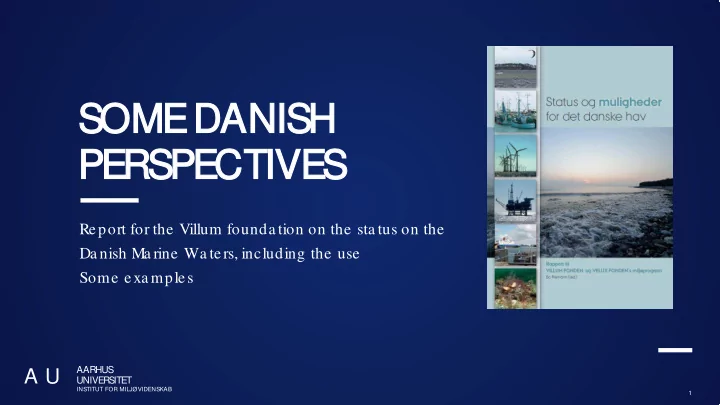
Report for the Villum founda tion on the sta tus on the Da nish Ma rine Wa ters, including the use Some exa mples
SO SOMEDANISH PERSPEC ECTIVES ES Report for the Villum founda - - PowerPoint PPT Presentation
SO SOMEDANISH PERSPEC ECTIVES ES Report for the Villum founda tion on the sta tus on the Da nish Ma rine Wa ters, including the use Some exa mples AARHUS A U UNIVERSITET INSTITUT FOR MILJVIDENSKAB 1 Fish landings, Denmark AARHUS A U
1 INSTITUT FOR MILJØVIDENSKAB
AARHUS UNIVERSITET
Report for the Villum founda tion on the sta tus on the Da nish Ma rine Wa ters, including the use Some exa mples
INSTITUT FOR MILJØVIDENSKAB
AARHUS UNIVERSITET
INSTITUT FOR MILJØVIDENSKAB
AARHUS UNIVERSITET
Direct consumer surplus (Bill. DKK.) Jobs (full time) Activities Coastal tourism 40,3 71.000 45 mill overnight stays Angling 2,5 2000 616.000 anglers (annual) Sailing/boating Uknown Unknown 250.000 active sailers 1 mill overnight stays in harbors Recreation,
5,4* NA 98 % of the population coastal recreation Note: *CS for access to costal recreational areas
INSTITUT FOR MILJØVIDENSKAB
AARHUS UNIVERSITET
Shipping, transport also important Windmills/ energy Aquaculture growing, but small sector Assessment of recreation and fisheriesindicate that recreation is of large economic importance
INSTITUT FOR MILJØVIDENSKAB
AARHUS UNIVERSITET
INSTITUT FOR MILJØVIDENSKAB
AARHUS UNIVERSITET
ecosystem condition can be used for Marine ESA
assessment can be used
ecosystem services from the literature.
6
INSTITUT FOR MILJØVIDENSKAB
AARHUS UNIVERSITET
retention (in CICES this belongs under regulating and maintenance service section, within division: mediation of waste, toxic, and other nuisances)
CICES division physical and intellectual interactions).
INSTITUT FOR MILJØVIDENSKAB
AARHUS UNIVERSITET
How do the ecological status of the water affect the ecosystem services, here fisheriesand recreation? Vice versa not included.
INSTITUT FOR MILJØVIDENSKAB
AARHUS UNIVERSITET
DESCRIPTORS AND I INDICATORS F FOR SERVICES THAT ARE INTERMEDIATE T TO RECREATION. THESE INDICATORS CAN T TO S SOME EXTENT BE USED TO M MEASURE THE S STATUS O OF T THE S SERVICE ‘RECREATION’ IN THE B BALTIC S SEA (MODIFIED F FROM SWAM, 2012) 2012).
EC ECOS YSTEM EM SER SERVICE DESC ESCRIPTORS IN INDIC ICATORS Eutrophic icatio ion mit itig igatio ion
5.1.1. Nutrients concentra tion in the wa ter column 5.2.4. Species shift in floristic composition such a s dia tom to fla gella te ra tio, benthic to pela gic shifts, a s well a s bloom events of nuisa nce/ toxic a lga l blooms (e.g. cya noba cteria ) ca used by huma n a ctivities Regula latio ion o
haz azar ardo dous s subs bstan ances
8.1.1. Concentra tion of the conta mina nts mentioned a bove, mea sured in the releva nt ma trix (such a s biota , sediment a nd wa ter) in a wa y tha t ensures compa ra bility with a ssessments under Directive 2000/ 60/ EC
in sea food) 9.1.1. Actua l levels of conta mina nts tha t ha ve been detected a nd number of conta mina nts which ha ve exceeded ma ximum regula tory levels Scen ener ery
itter) 10.1.1. T rends in the a mount of litter wa shed a shore a nd/ or deposited on coa stlines, including a na lysis of its composition, spa tia l distribution a nd, where possible, source
INSTITUT FOR MILJØVIDENSKAB
AARHUS UNIVERSITET
MSFD D5 D D5 indicators HELCOM in indic icators Impac pact Activity tha hat i is a adver ersel ely affec ected ed 5.1.1. NUTR TRIENT T CONC NCENT NTRATION N IN T N THE WATER ER C COLUMN Nutrient levels: winter (December- Februa ry) dissolved inorga nic nitrogen (DIN) a nd dissolved inorga nic phosphorus (DIP) concentra tions in the surfa ce la yer(0 - 10 m depth) (CORE) Ca using direct impa cts like phytopla nkton a nd fila mentous a lga l growth (ba sed on high nutrient levels), decrea sed tra nspa rency of wa ter a nd potentia l increa se in frequency of nuisa nce/ toxic blooms No direct effects:High nutrient concentra tions a re not problem a s such, if the regula tory service of Dilution is functioning. Seconda ry impa cts a ffect following a ctivities: Swimming, Diving, Fishing 5.2.1 C CHLO LOROPHYLL LL CONC NCENT NTRATION N IN T N THE WATER ER C COLUMN Direct effects: Summer (June-September) chlorophyll a concentra tion in the surfa ce la yer (0 - 10 m depth) (CORE) Direct effects: Increa sed phytopla nkton growth, decrea sed tra nspa rency of wa ter, potentia l increa se in frequency of nuisa nce/ toxic blooms a nd floa ting cya noba cteria stra nded on bea ches Swimming, Diving, Fishing Impa ired scenic experience in bea ch wa lking, picnicking 5.2.2 W WATER ER T TRANSP SPAREN ENCY Direct effects: Summer (June-September) Secchi depth (in meters) (CORE) Seconda ry impa cts: decrea sed depth of ma crophytes: Swimming, Diving, Fishing 5.3.1. ABUNDANCE O OF PER EREN ENNIAL SEA SEAWEED EEDS S AND SEA SEAGRASSES SSES (E. E.G. FUCOIDS, S, EEL EELGRASS SS AND NEP EPTUNE E GRASS) SS) ADVER ERSEL SELY IMPACTED ED BY D DEC ECREA EASE I SE IN W WATER ER TRANSP SPAREN ENCY Indirect effects: L
limit of ma crophyte species (m) (PRECORE) L ess ha bita ts for nursery function Impa ired scenic experience when diving Diving, Fishing 5.3.2 DISSO SSOLVED ED O OXYGEN EN Indirect effects: Annua l Oxygen debt below the ha locline (or in specific ca ses concentra tion) (CORE): L ess ha bita ts for fish feeding Declined regula tory service: Nutrient dilution, i.e. retention by sediments Fishing
INSTITUT FOR MILJØVIDENSKAB
AARHUS UNIVERSITET
Popula latio ions o
all ll commercia ially lly explo loit ited f fis ish and shellf llfis ish are w wit ithin in safe bio iolo logic ical lim l limit its, e exhib ibit itin ing a a po popu pulat ation age age an and d size di distribu bution that at is indi dicat ative of a a heal althy stock. Cri riteri ria Indica tors 3. 3.1 L 1 Level el of p pres essure e
ishin ing activ ivit ity 3.1.1 Fishing morta lity 3.1.2 Ra tio between ca tch a nd bioma ss index 3. 3.2 R 2 Rep eproductive e capac apacity o
the st stock 3.2.1 Spa wning Stock Bioma ss 3.2.2 Bioma ss indices 3.3 P Pop
ulation
and siz ize dis istrib ibutio ion 3.3.1 Proportion of fish la rger tha n the mea n size of first sexua l ma tura tion 3.3.2 Mea n ma ximum length a cross a ll species found in resea rch vessel surveys 3.3.3 95% percentile of the fish length distribution observed in resea rch vessel surveys 3.3.4 Size a t first sexua l ma tura tion, which ma y reflect the extent of undesira ble genetic effects of exploita tion
INSTITUT FOR MILJØVIDENSKAB
AARHUS UNIVERSITET
Studies conducted in the la st 5 yea rs :Almost a ll focused on cultura l or provisioning
inks to MSFD descriptors:
D1 Biodiversity (7 studies)
D3 Fish species (5)
D5 Eutrophica tion (6)
D8 Concentra tions of conta mina nts (2)
D10 Ma rine litter (1)
D11 Energy (including noise) (1)
BSAP stra tegic goa ls
Biodiversity (7)
Eutrophica tion (6)
Ha za rdous substa nces (3)
INSTITUT FOR MILJØVIDENSKAB
AARHUS UNIVERSITET
L
MARECOS reviewed recent va lua tion studies of ma rine ecosystem
Assessed the possibilities of benefit tra nsfer a nd a ggrega tion Discussed the va lua tion of three ecosystem services/ goods: recrea tion,
INSTITUT FOR MILJØVIDENSKAB
AARHUS UNIVERSITET
Va lua tion studies concentra ted on biodiversity, eutrophica tion a nd fish species, a nd links ca n be ma de for descriptors linking iphysica l models outcomes with va lua tion results
Most informa tion on the benefits of reduced eutrophica tion
Cha llenging to estima te the benefits of rea ching good environmenta l sta tus for other descriptors/ indica tors;
Ga ps in knowledge
Nea rly missing: D2 Non-ingidenous species, D9 Conta mina nts in sea food, D10 Ma rine litter
Spa tia l distribution of ecosystem services/ benefits
INSTITUT FOR MILJØVIDENSKAB
AARHUS UNIVERSITET
Possible to link to the rest of HOL AS –focusing on the effects on eutrophica tion a nd fish/ food webs
link between descriptors, pressure a nd impa ct index – thema tic pressure da ta set –e.g. inputs of nutrients linked to indica tors for eutrophica tion/ recrea tion a nd fish
Possible to link to existing Ba ltic models?
INSTITUT FOR MILJØVIDENSKAB
AARHUS UNIVERSITET
Tedesco et al 2016: Capabilities of Baltic Sea models to assess environmental status for marine biodiversity, Marine policy 2016 Nine Baltic Sea ecosystem models were analysed for their potential of addressing
” The general outcome is that the Baltic Sea models considered do not adequately cover all the requested needs of the MSFD, but can potentially do so to a certain extent, while for some descriptors/ criteria/ indicators/ pressures new indicators and/ or modelling techniques need to be developed in order to satisfactorily address the requirement of the MSFD and assess the environmental status of the Baltic Sea”.
INSTITUT FOR MILJØVIDENSKAB
AARHUS UNIVERSITET
The analysed Baltic models are capable of addressing biodiversity and food webs (D1 and D4) to some extent, while commercia ial l fish sh (D3) is addr addressed o d only by t the H he HTL m model els a nd huma n-induced eutrophica tion (D5), sea -floor integrity (D6) a nd hydrologica l a ltera tion (D7) only by the L
evel (L TL )