
SLIDE 1
Snap-back repellers in rational difference equations
Antonio Cascales, Francisco Balibrea
antoniocascales@yahoo.es balibrea@um.es Departamento de Matem´ aticas Universidad de Murcia (Spain)
18th ICDEA Barcelona. July 2012
Introduction Marotto chaos in RDE Numerical examples References
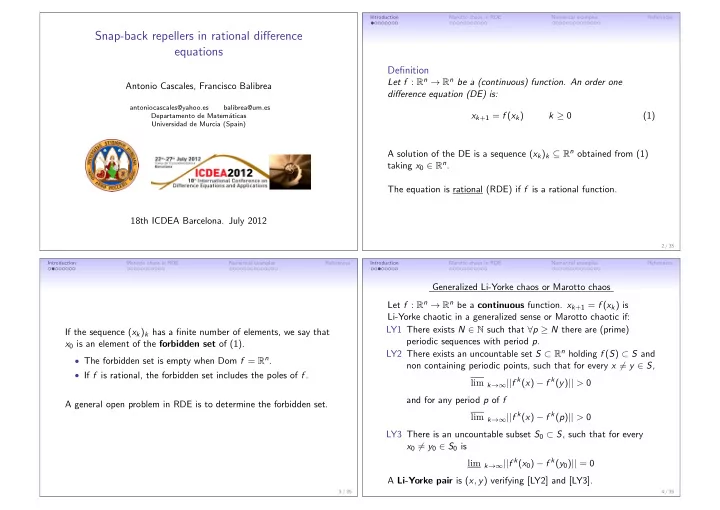
Definition
Let f : Rn → Rn be a (continuous) function. An order one difference equation (DE) is: xk+1 = f (xk) k ≥ 0 (1) A solution of the DE is a sequence (xk)k ⊆ Rn obtained from (1) taking x0 ∈ Rn. The equation is rational (RDE) if f is a rational function.
2 / 35 Introduction Marotto chaos in RDE Numerical examples References
If the sequence (xk)k has a finite number of elements, we say that x0 is an element of the forbidden set of (1).
- The forbidden set is empty when Dom f = Rn.
- If f is rational, the forbidden set includes the poles of f .
A general open problem in RDE is to determine the forbidden set.
3 / 35 Introduction Marotto chaos in RDE Numerical examples References
Generalized Li-Yorke chaos or Marotto chaos Let f : Rn → Rn be a continuous function. xk+1 = f (xk) is Li-Yorke chaotic in a generalized sense or Marotto chaotic if: LY1 There exists N ∈ N such that ∀p ≥ N there are (prime) periodic sequences with period p. LY2 There exists an uncountable set S ⊂ Rn holding f (S) ⊂ S and non containing periodic points, such that for every x = y ∈ S, lim k→∞||f k(x) − f k(y)|| > 0 and for any period p of f lim k→∞||f k(x) − f k(p)|| > 0 LY3 There is an uncountable subset S0 ⊂ S, such that for every x0 = y0 ∈ S0 is lim k→∞||f k(x0) − f k(y0)|| = 0 A Li-Yorke pair is (x, y) verifying [LY2] and [LY3].
4 / 35