Smart Robotic Quadruped Brittany Lamorie Duncan Prance Cody Otto - - PowerPoint PPT Presentation

smart robotic quadruped
SMART_READER_LITE
LIVE PREVIEW

Smart Robotic Quadruped Brittany Lamorie Duncan Prance Cody Otto - - PowerPoint PPT Presentation

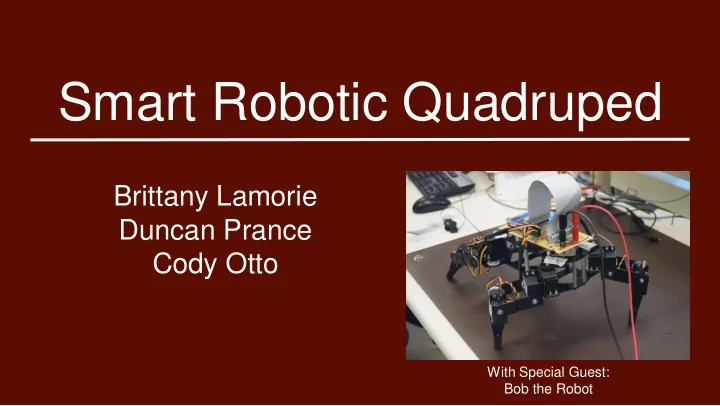
Smart Robotic Quadruped Brittany Lamorie Duncan Prance Cody Otto With Special Guest: Bob the Robot Motivation Goals Interest in robotics and machine Build working robot learning Create accurate simulation Walking is

slide-1
SLIDE 1

Smart Robotic Quadruped

Brittany Lamorie Duncan Prance Cody Otto

With Special Guest: Bob the Robot

slide-2
SLIDE 2

Motivation Goals

  • Interest in robotics and machine

learning

  • Walking is an interesting

challenge

  • ECE 449 Intelligent Systems
  • Build working robot
  • Create accurate simulation
  • f physical robot
  • Convert simulation output to

pulse width signals

  • Hard-code basic motions
  • Learned walking motion
  • On board adjustments
slide-3
SLIDE 3

Overview

Design Plan

  • Simulation is run; All learning done
  • n PC
  • Simulation outputs are converted

to pulse width signals

  • Pulse widths are saved in memory
  • On board program reads pulse

widths

slide-4
SLIDE 4

Overview

Current Functionality

  • Hardcoded Modes
  • Walk
  • Dance
  • Weight Shift
  • Simulation
  • Simulation output conversion
  • Battery powered tether
slide-5
SLIDE 5

Simulation

  • Simulation used a combination of

ODE and OpenGL for physics simulating, and PyBrain for the machine learning aspect

  • The machine learning uses a

reward based system, allowing for fine tuned control over learned motion

  • The simulation is taught through a

combination of neural networks and reinforcement learning

slide-6
SLIDE 6

Simulation

Trial 1 Trial 740 Trial 20000 Trial 10500

slide-7
SLIDE 7

Pulse Width Modulation

  • Square wave form
  • Defines the angle of the

servo motor

slide-8
SLIDE 8

Converting from Simulation to Real World

  • Slippage between gears
  • Varying pulse width ranges
  • Rotation around differing points
  • Degree conversion for ease of

use

slide-9
SLIDE 9

Robot motion versus simulation motion

slide-10
SLIDE 10

Learning to Walk Again…..

  • The stances shown allow for a

total weight shift from front to back legs and back again

  • 3 point balance allows for a

large safety margin for the torque of our servos

slide-11
SLIDE 11

Learning to Walk Again…..

  • Simulated and exaggerated

weight shifting was necessary to allow for balance during steps

slide-12
SLIDE 12

DEMO

slide-13
SLIDE 13

Challenges

  • Physical calibration
  • Math and precision
  • Simulation reward system to

achieve a proper forward motion

slide-14
SLIDE 14

Questions?