Smart Contracts: Navigating Legal, Regulatory and Consumer - - PowerPoint PPT Presentation

smart contracts navigating legal regulatory and consumer
SMART_READER_LITE
LIVE PREVIEW

Smart Contracts: Navigating Legal, Regulatory and Consumer - - PowerPoint PPT Presentation

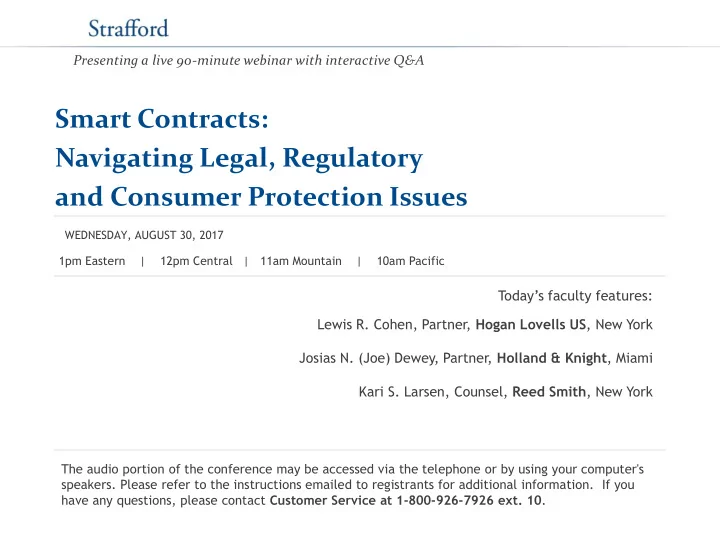
Presenting a live 90-minute webinar with interactive Q&A Smart Contracts: Navigating Legal, Regulatory and Consumer Protection Issues WEDNESDAY, AUGUST 30, 2017 1pm Eastern | 12pm Central | 11am Mountain | 10am Pacific


slide-1
SLIDE 1

The audio portion of the conference may be accessed via the telephone or by using your computer's

  • speakers. Please refer to the instructions emailed to registrants for additional information. If you

have any questions, please contact Customer Service at 1-800-926-7926 ext. 10.

Presenting a live 90-minute webinar with interactive Q&A

Smart Contracts: Navigating Legal, Regulatory and Consumer Protection Issues

Today’s faculty features:

1pm Eastern | 12pm Central | 11am Mountain | 10am Pacific WEDNESDAY, AUGUST 30, 2017

Lewis R. Cohen, Partner, Hogan Lovells US, New York Josias N. (Joe) Dewey, Partner, Holland & Knight, Miami Kari S. Larsen, Counsel, Reed Smith, New York

slide-2
SLIDE 2

Tips for Optimal Quality

Sound Quality If you are listening via your computer speakers, please note that the quality

  • f your sound will vary depending on the speed and quality of your internet

connection. If the sound quality is not satisfactory, you may listen via the phone: dial 1-866-961-8499 and enter your PIN when prompted. Otherwise, please send us a chat or e-mail sound@straffordpub.com immediately so we can address the problem. If you dialed in and have any difficulties during the call, press *0 for assistance. Viewing Quality To maximize your screen, press the F11 key on your keyboard. To exit full screen, press the F11 key again.

FOR LIVE EVENT ONLY

slide-3
SLIDE 3

Continuing Education Credits

In order for us to process your continuing education credit, you must confirm your participation in this webinar by completing and submitting the Attendance Affirmation/Evaluation after the webinar. A link to the Attendance Affirmation/Evaluation will be in the thank you email that you will receive immediately following the program. For additional information about continuing education, call us at 1-800-926-7926

  • ext. 35.

FOR LIVE EVENT ONLY

slide-4
SLIDE 4

Program Materials

If you have not printed the conference materials for this program, please complete the following steps:

  • Click on the ^ symbol next to “Conference Materials” in the middle of the left-

hand column on your screen.

  • Click on the tab labeled “Handouts” that appears, and there you will see a

PDF of the slides for today's program.

  • Double click on the PDF and a separate page will open.
  • Print the slides by clicking on the printer icon.

FOR LIVE EVENT ONLY

slide-5
SLIDE 5

Smart Contracts: Navigating Legal, Regulatory and Consumer Protection Issues How Smart Contracts Work

Josias N. Dewey, Partner Holland & Knight LLP joe.dewey@hklaw.com

slide-6
SLIDE 6

Definition

A smart contract is technically understood to include any piece of computer code capable of execution on a blockchain or distributed ledger network. It is not necessarily a legal contract. Some smart contracts do constitute legal agreements. So, while all coded legal agreements capable of execution on a blockchain or DLT system are smart contracts, not all smart contracts are legal agreements. Blockchain and DLT are used broadly to encompass most decentralized peer-to-peer networks with a mechanism for maintaining consensus across the network with respect to stored states.

6

slide-7
SLIDE 7

Examples – Not a legal agreement

  • Written in Solidity intended

for Ethereum public network

  • It is a smart contract
  • All it does is return “Hello

[X]”

  • Will execute on all nodes

connected to the network.

7

slide-8
SLIDE 8

Examples – legal agreement

  • Also written in Solidity

intended for Ethereum public network

  • It is a smart contract
  • It represents a token

and contains legal

  • bligations
  • Will execute on all

nodes connected to the network.

8

slide-9
SLIDE 9

Recap – What are they

  • Computational contracts that run on

blockchain and DLT.

  • Not all smart contracts are legally

binding.

  • We are mostly concerned with those

intended to constitute a traditional contract.

9

slide-10
SLIDE 10

How do they work?

  • In the beginning, there was only bitcoin, which had a limited scripting language.
  • Colored coins
  • Side chains
  • Then came the Ethereum protocol. Rather than limited scripting

language, Ethereum was powered by a Turing complete virtual machine, called the Ethereum Virtual Machine (EVM). Unlike Bitcoin, Ethereum can execute any code on the network.

  • Why do we execute code on the network?
  • Blockchains and DLTs are sometimes referred to as “state

machines”.

  • What do we mean when we talk about state in this context?

10

slide-11
SLIDE 11

Understanding State

All blockchains and DLTs have one primary function. They store values and provide functions to manipulate those values in a deterministic way.

11

slide-12
SLIDE 12

Distributed Execution

Now network is sharing not only ledger (storing state), but also sharing a single “runtime” where a smart contract’s code execute the same way on all machines, and updates ledger in same way across network.

12

slide-13
SLIDE 13

Other Protocols

  • There are now dozens of protocols.
  • Different approaches to consensus.
  • Private, permissioned vs. public.

13

slide-14
SLIDE 14

Concerns and Dangers

  • Security breaches due to key management.
  • Unintended consequences from bad code. For

example, The DAO and the Parity client application.

  • The more complex the operation, the more risk of

unintended consequences.

  • Denial of service attacks by overwhelming the

network.

14

slide-15
SLIDE 15

The Future of Smart Contracts

15

slide-16
SLIDE 16

FinTech

Smart Contracts

Stafford Webinar

Kari S. Larsen

August 30, 2017

slide-17
SLIDE 17

Application in Business Transactions and Industries

17 Reed Smith LLP

slide-18
SLIDE 18

Advantages of Smart Contracts

  • Because the terms of a smart contract are in code, they are less likely to be subjected to

linguistic ambiguity

  • Since smart contracts are programmed to automatically execute after their terms have

been fulfilled, they are less prone to breach

  • Bypass the many tedious steps a transaction must go through in the clearing and

settlement process

  • A higher volume of transactions are able to be efficiently completed at a faster rate
  • Paperless means reduced costs and environmental benefits
  • Record immutability on blockchains means more transparency and user accountability

18 Reed Smith LLP

slide-19
SLIDE 19

Where are Smart Contracts Used?

  • Commercial Initiatives:
  • Trade Finance
  • Supply chain management
  • Initial Coin Offerings (ICOs)
  • Energy
  • Shipping
  • Advertising
  • Financial institutions – trading and back office solutions
  • Government
  • Land registries
  • Corporate securities
  • Voting
  • Legal Industry ?

19 Reed Smith LLP

slide-20
SLIDE 20

Trade Finance

  • Blockchain technology may be used to track and distribute documents related to a trade

finance transaction

  • Such documents may contain smart contract provisions that execute automatically upon

satisfaction of certain conditions

  • This technology could facilitate faster settlement time and increased transparency
  • In early 2017, seven European global banks, including Deutsche Bank and HSBC,

joined to form the “Digital Trade Chain” (DTC) consortium, and are working with IBM to develop their blockchain-based trade financing platform aimed to provide more transparent, efficient, and secure, paperless trade financing services to small and medium-sized businesses conducting transnational transactions

20 Reed Smith LLP

slide-21
SLIDE 21

Supply Chain Management

  • Blockchain technology and smart contracts may be used to track transactions and

automate aspects of the supply chain

  • Often combined with the Internet of Things (IoT), a network of physical objects that

contain embedded technology to communicate and sense or interact with their internal states or the external environment, and provide data such as security, temperature, humidity levels, etc.

  • Microsoft, Walmart, IBM, Maersk, SAP Ariba and BHP Billiton are developing

blockchain-based supply networks that rely on smart contracts to automate the writing, shipping and receiving of transactions, and the transmission of documents between trading partners

  • A consortium of food suppliers, including Dole, Walmart, Kroger and Nestle, has

partnered with IBM to develop a blockchain solution for tracking dangerous foods

21 Reed Smith LLP

slide-22
SLIDE 22

Initial Coin Offerings (ICOs) and Token Sales

  • An ICO is the offering of all or a portion of the initial supply of a token to the public in

exchange for legal tender or other cryptocurrencies, such as bitcoin or ether

  • ICOs often are used as an alternative method for raising capital
  • The SEC recently asserted jurisdiction over ICOs that involve tokens that are

functionally equivalent to securities (i.e., pass the Howey test)

  • Tokens issued through an ICO may be connected to decentralized applications that

utilize smart contracts

  • “Utility” tokens are products issued for a particular purpose or use case – such as digital

poker chips issued by an online gambling website – and may be distinguished from currency and security tokens

22 Reed Smith LLP

slide-23
SLIDE 23

Energy and Shipping

  • Blockchain technology may allow persons to buy and sell electricity to the grid

using smart contracts that would automatically execute based on supply and demand

  • LO3 Energy developed a blockchain-based platform that allows persons to buy and sell locally-

generated solar energy in Brooklyn

  • Smart contracts may also be used in connection with renewable energy credits and other

environmental commodities

  • 23 European utility companies are working together to test blockchain-based trades in wholesale

power and natural gas markets using software called Enerchain

  • Blockchain-based technology may be used by shipping companies to track

their cargo, eliminating the amount of paperwork required to move goods

  • Samsung SDS, Maersk and IBM are all developing shipping logistics platforms

23 Reed Smith LLP

slide-24
SLIDE 24

Advertising

  • Smart contracts and digital ledger technology applications are currently being tested

for use in advertising and marketing

  • The regular use of blockchain in advertising and marketing is likely still a few years

away

  • One example currently being implemented: BitTeaser – Danish advertising network

that uses blockchain to collect ad revenue via bitcoin

  • Comcast is partnering with Disney, NBC, Cox and others to launch a blockchain

advertising platform that will enable marketers and networks to match their own customer data anonymously to determine which network program may have the best result for a product ad

  • Nasdaq is developing a platform for trading in securitized advertising contracts using

blockchain as the core ledger for transactions

24 Reed Smith LLP

slide-25
SLIDE 25

Financial Industry

  • Smart contracts and digital ledger technology applications are being tested in financial

transactions, such as swaps – Barclays, Citi, Credit Suisse, and JPMorgan carried out a successful test using the technology to manage affirmations and post-trade lifecycle processing for OTC equity swaps

  • DTCC is using blockchain technology to rebuild its credit default swaps trade

processing platform – the new Trade Information Warehouse is slated to go live in 2018

  • A group of 37 financial institutions and market infrastructure companies have formed

the Post-Trade Distributed Ledger Group to facilitate collaboration and information sharing

  • CME Group and the Royal Mint are working together to create a digital asset backed

by gold in the Royal Mint vaults called RMG

  • The Australian Securities Exchange is developing a post-trade solution that uses

blockchain technology

25 Reed Smith LLP

slide-26
SLIDE 26

Government

  • Georgia, Sweden, and the Ukraine, among other countries, are developing

blockchain-based land registries – such systems may simplify governance of land registration and reduce corruption

  • The State of Delaware allows corporations to use distributed ledgers to create

and maintain corporate data, including stock ledgers

  • FollowMyVote is using blockchain technology to facilitate online voting by

allowing users to cast votes as transactions that are recorded in a distributed ledger – it hopes to provide its technology to governments for use in elections

26 Reed Smith LLP

slide-27
SLIDE 27

Impacting the Legal Practice

27 Reed Smith LLP

slide-28
SLIDE 28

Automation of Contract Execution

  • The use of conditional logic may generate issues under contract law
  • Situs – issue of identifying the location of an asset or contract to determine the proper

jurisdiction

  • Some clauses may have more subjective elements
  • Some jurisdictions may not allow electronic signing of documents
  • Certain legal terms may not be capable of being represented in a non-ambiguous

way

28 Reed Smith LLP

slide-29
SLIDE 29

Digital Age Practice of Law

  • More lawyers may need to learn coding – at a minimum more lawyers will require a

deeper understanding of technology

  • Certain types of contracts may become more standardized – but complex transactions

will still require negotiated umbrella agreements or bespoke agreements

  • Humans being humans will still engage in disputes, but the cause of the disputes may

bring new challenges

  • Digital Ledger Technology may be used for client files
  • We may see an increase in artificial intelligence (AI) together with blockchain

technology use – but concern that AI will override the parties’ intent will be a barrier to adoption

  • Smart contracts are unlikely to be generally used in the legal practice until a common

coding language and standardized documentation becomes available

29 Reed Smith LLP

slide-30
SLIDE 30

Emerging Legal Issues

  • Data Privacy – Information access and control will be an important issue, including how

private client information is redacted, protected, and/or segregated if firms put client data on a blockchain while still allowing confidence in a ledger’s accuracy

  • Data Governance – Especially in highly-regulated industries, identifying data subject to

regulatory surveillance, litigation hold, or recordkeeping requirements will require both technical and legal expertise

  • Transparency – Transactions on a blockchain will be transparent to all those on the

blockchain, which may not always be appropriate

  • Permissioned blockchains can resolve the issue of the lack of confidentiality, but all parties to that

blockchain will still be able to inspect the register

  • Immutable record – While good for audit purposes, may make it difficult to correct errors

in data

  • Enforceability – New state laws (Arizona and Nevada) address contract enforcement

and taxes with respect to blockchain transactions

30 Reed Smith LLP

slide-31
SLIDE 31

Questions?

Kari S. Larsen

Counsel

New York, NY +1 212-549-4258 klarsen@reedsmith.com 31

San Francisco Los Angeles Century City Kazakhstan Silicon Valley Chicago Pittsburgh New York Princeton Philadelphia Wilmington Washington

  • N. Virginia

Richmond Abu Dhabi Dubai London Hong Kong Paris Munich Athens Beijing Shanghai Singapore Houston Frankfurt Miami

Reed Smith LLP

slide-32
SLIDE 32

August 30, 2017

  • Doc. #7965738

Lewis Rinaudo Cohen lewis.cohen@hoganlovells.com

Strafford Webinar: Blockchain

An introduction and key legal issues

slide-33
SLIDE 33

| 33

Key Legal Issues

Decentralised Nature

Centralised De-centralised

Traditional model of value transfer

Blockchain

33

slide-34
SLIDE 34

| 34

Key Legal Issues

No Central Party

Traditional model of value transfer

Blockchain Central party who is trusted and possibly regulated depending on the sector Regulatory requirements need to be complied with – may need to regulate decentralized parties

34

slide-35
SLIDE 35

| 35

Key Legal Issues

Who is Responsible?

Traditional model of value transfer

Blockchain Central party who is responsible and accountable for system May be unclear who is accountable if something goes wrong with the system

35

slide-36
SLIDE 36

| 36

Key Legal Issues

Data Security

Traditional model of value transfer

Blockchain Central party is responsible for data security through contract participation Who is responsible for data security of the overall system?

36

slide-37
SLIDE 37

| 37

Key Legal Issues

Governing Law

Traditional model of value transfer

Blockchain It will be clear where the central party should be regulated and the applicable law May be no clarity on how to regulate the blockchain or the applicable law which should apply

37

slide-38
SLIDE 38

| 38

Key Legal Issues

Governance

Traditional model of value transfer

Blockchain Governance is determined by central parties Need to create clear governance rules

38

slide-39
SLIDE 39

| 39

Key Legal Issues

Immutability

Traditional model of value transfer

Blockchain No immutability of transactions – depends on process and central party In-built immutability of transactions

39

slide-40
SLIDE 40

| 40

Key Legal Issues

Transparency

Traditional model of value transfer

Blockchain Transactions are closed to users of the

  • system. Central party decides who needs

to see what Blockchains can be public (open to anyone) or permissioned ie only permitted users are allowed to access. Transparency of the ledgers to other users of the system depends on the technology used – public blockchains records are open to all

40

slide-41
SLIDE 41

Regulatory Considerations

41

slide-42
SLIDE 42

| 42

Regulators' Perspective

No central party to regulate Reporting to regulators No specific blockchain regulation Due skill, care and diligence Use cases dependent Additional risk?

42

The Regulators' Perspective

slide-43
SLIDE 43

| 43

Reporting to regulators Use cases dependent Additional risk?

Example: Bitcoin transaction fees. What transactions are included in the block?

Reserved for priority content to be cleared without fee Chosen by miner based on mining efficiency

43

The Regulators' Perspective

slide-44
SLIDE 44

| 44

No central party to regulate Reporting to regulators Use cases dependent

Default fee

  • In the early Bitcoin days there was a default fee of

0.0001BTC/transaction.

  • As the Bitcoin network grew, a more reliable fee structure

for periods of congestion was needed.

Dynamic fees

  • Bitcoin wallets with dynamic fees; guarantee for fast and

reliable transaction confirmation regardless of how many people use the Bitcoin network. Fees increase of 1289% since March 2015.

Paid prioritisation in Blockchain

44

The Regulators' Perspective

slide-45
SLIDE 45

| 45

No central party to regulate Reporting to regulators Use cases dependent

"Time to pay"

45

The Regulators' Perspective

slide-46
SLIDE 46

| 46

No central party to regulate Reporting to regulators Use cases dependent

Dynamic fees

Regular bitcoin wallet – Fixed fees

  • Fixed fee
  • Potential delays in

transactions

Wallet automati-cally setting dynamic fees

  • Computerized fee;

fluctuation depending on transaction size and network congestion

  • Optimises clearance cost

and speed

  • Accelerate transactions

Bitcoin wallet allowing the user to set the fee

  • Fee set by the user; the

wallet warns the user in case the fee is too unnecessarily high or dangerously low

Transaction fee is set by the person sending the transaction, but the miner chooses which transactions he includes in the block. Thus, he has indirect influence on the fees…

46

The Regulators' Perspective

slide-47
SLIDE 47

| 47

No central party to regulate Reporting to regulators Use cases dependent

Effects on a blockchain network

Transactions with less satoshi’s/byte might remain unconfirmed The more satoshi’s/byte the user is willing to pay, the quicker will the transaction be executed Paying 300 satoshi’s/byte (or more) guarantees that the transaction will be included in the next block

47

The Regulators' Perspective

slide-48
SLIDE 48

| 48

No central party to regulate Reporting to regulators Use cases dependent

Biggest Bitcoin Mining Pools

48

The Regulators' Perspective

slide-49
SLIDE 49

| 49

No central party to regulate Reporting to regulators Use cases dependent

Where's the problem? Is there a problem?

49

The Regulators' Perspective

slide-50
SLIDE 50

| 50

No central party to regulate Reporting to regulators Use cases dependent

Where's the problem? Is there a problem?

Lower purchasing power High purchasing power

  • Consumers
  • SMEs
  • Businesses dealing with

small transactions

  • Large companies
  • Businesses dealing with a small

amount of big transactions

  • Manufacturers / Distributors selling
  • r buying in bulk

50

The Regulators' Perspective

slide-51
SLIDE 51

| 51

No central party to regulate Reporting to regulators

FCC Chairman Ajit Pai:

  • "Consumers benefit most from competition, not pre-

emptive regulation."

  • Internet Service Providers should voluntarily commit

to neutrality principles

  • Violations enforced by FTC as unfair business

practices ESMA Report: The DLT Applied to Securities Markets (Feb '17)

  • "ESMA anticipates a number of potential fair

competition issues with DLT, although some of these issues may not be unique to DLT.

  • Early participants might refuse or impose conditions
  • n new members that make it unduly difficult or costly

for them to join the DLT network. "

Additional risk?

A trans-Atlantic divide

51

The Regulators' Perspective

slide-52
SLIDE 52

| 52

The Regulators' Perspective

No central party to regulate Reporting to regulators

No concrete regulation on the horizon, but first indications for regulatory interest. Some blockchain applications more likely to attract regulation: Financial services, stock exchanges, consumer facing applications Lesson learned from net neutrality debate: Pre- emptive regulation vs. case-by-case antitrust assessment Trans-Atlantic divide affecting a global technology (unlike cable networks and ISP activities)

Conclusions

52

slide-53
SLIDE 53

Data privacy, localization and cross border transfer

slide-54
SLIDE 54

| 54

Identity of controllers and processors Data minimisation Right of erasure

Data Protection and Privacy

Data Security and Confidentiality Re-identification Risk

54

slide-55
SLIDE 55

| 55

Data Privacy, Localization and Cross Border Transfer

Data Security and Confidentiality Re-identification Risk

Data localisation Sector specific data localisation Exports to specific countries restricted Strong Data Export Controls Minimal / Voluntary Data Export Controls No Data Export Controls

55

slide-56
SLIDE 56

Smart contracts

56

slide-57
SLIDE 57

| 57

What is a blockchain (again)?

  • A blockchain is

– a data structure – created by a computer program

  • In most blockchains of interest,

– the stored data is transaction data – the computer program implements a transaction (e.g., Alice pays Bob $100)

57

slide-58
SLIDE 58

| 58

Why is a blockchain special?

  • In most blockchains of interest,

– the computer program runs on a network of computers

  • the data structure is stored on each computer

(a distributed ledger)

  • the network of computers must reach a consensus

to add data to the data structure

  • each computer adds data to its copy of the ledger

(blocks are added to the blockchain)

58

slide-59
SLIDE 59

| 59

What else can a blockchain store?

  • In some blockchains,

– the stored data is another computer program – the stored computer program implements a more complicated transaction (e.g., if today is June 15, then Alice pays Bob $100) – the network of computers run the stored computer program automatically and simultaneously based on data on/off the blockchain

59

slide-60
SLIDE 60

| 60

  • A smart contract is a computer program

(series of instructions for a computer to implement) – designed to implement (part or all of) an agreement – written in a computer programming language

60

Why use a smart contract?

slide-61
SLIDE 61

| 61

Why use a smart contract?

  • Automatic execution reduces contracting risks

– deliberate non-performance – third-party interference – force majeure

  • Less ambiguity – computer programs requires precision
  • Standardization – reliably repeatable performance
  • Fraud avoidance – contract stored “permanently”

61

slide-62
SLIDE 62

| 62

Our approach

  • Smart contracts lawyers (SCLs)

– Lawyers who understand DLT and blockchain – Lawyers who read/write computer programs

  • Bridge the gap between traditional lawyers and programmers

– Advise on design and implementation of smart contracts – Smart term sheets – “Due Diligence 2.0 “

62

slide-63
SLIDE 63

Closing remarks

63

slide-64
SLIDE 64

Blockchain: The buzz

What others are doing How much is being invested? Cost savings

80%

  • f banks are

predicted to initiate DLT projects by 2017

  • f North American and

European banks are exploring blockchain

  • f banks are

experimenting with permissioned blockchains

90%

69%

US£1.4bn+

2,500+

US$20bn

30%

The potential for reducing bank infrastructure costs Potential annual savings for banks

US$8- 12bn

US$15-20bn

Potential annual reduction in costs of banks’ infrastructure attributable to cross-border payments, securities trading and regulatory compliance, by 2022

64

slide-65
SLIDE 65

Blockchain: A hot topic

“[blockchain] could yield significant gains in the accuracy, efficiency and security of such processes, saving tens of billions of pounds

  • f bank capital and significantly improving

the resilience of the system.”

Mark Carney Governor of the Bank of England 65 65