SLIDE 1
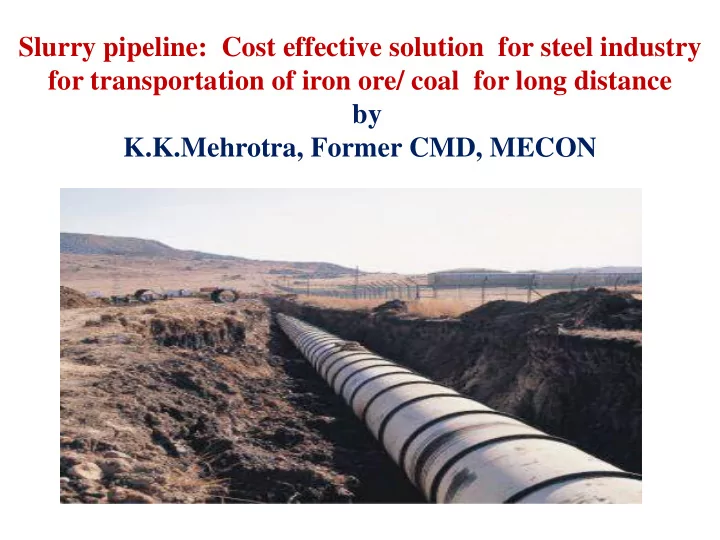
Slurry pipeline: Cost effective solution for steel industry for transportation of iron ore/ coal for long distance by K.K.Mehrotra, Former CMD, MECON
SLIDE 2 Background
- India’s steel production in 2016 : 95.6 Mt
- 3rd largest producer in the world
- Second largest producer of DRI in world in 2016
- National Steel Policy document : 300 Mt/yr steel
production by 2030-31
- Key assumption for such growth
SLIDE 3 Background
- Increase in per capita steel consumption : 63 kg to
130-140 kg
- Factor responsible for raising per capita steel
consumption are : ► Massive investment in infrastructure ► 10 % projected growth of manufacturing sector ► Development of 100 smart cities ► Emergence of rural market
SLIDE 4 Background
- Crude steel capacity by 2030-31 : 300 Mt
- Each 1 t steel requires 1.6 t prepared ore i.e.
2.0 – 2.1 t ROM
- ROM for domestic steel production incl. DRI by
2031 : 600 Mt
- Considering export of ore only 75 Mt
- Total ROM requirement by 2031 : 675 Mt
SLIDE 5 Iron ore scenario in India
- Total resources of ore : 28.5 billion t
- Hematite : 17.88 billion t
► Reserve category : 8.09 billion t ► Remaining resources : 9.79 billion t Magnetite : 10.62 billion t ► Reserve category : 0.02 billion t ► Remaining resources : 10.62 billion t ► Av. Fe content in magnetite : 35-40 %
SLIDE 6 Iron ore scenario in India
- Magnetite reserves are not being exploited , these
are mostly in eco fragile zone of Western Ghats
- These reserves remain locked for next decade, can
be considered for exploitation through sp. mining method to take care of environmental issues.
- Entire present steel production comes from
hematite ore. Over 85% hematite ore reserves are medium to high grade ( + 60 % ), used directly in BF & DRI plants
SLIDE 7 Iron ore scenario in India
- These reserves will last for only 45 years
- IBM has revised the cut off from 55% to 45 %
Fe for minable reserves.
- Total reserves with cut off of 45 % Fe will be much
higher than present estimate.
- Over 6 decades mining of +63 % Fe ore &
washing ore to get favourable alumina silica ratio resulted in piling of over 100 Mt rejected
SLIDE 8 Iron ore scenario in India
low grade fines & slimes with Fe of 45-55 % at various mine heads
- Slimes / lean ore mountains are not only occupying
precious land at mines but posing environmental problem
- Economical steel production by metallurgical
processes desires ore burden with + 62% Fe
SLIDE 9 Iron ore scenario in India
- For effective utilisation of lean ore & to conserve
precious natural resources for sustainable development , beneficiation is must in today’s context
- Mineralogical characteristic of lean ore revealed
removal of undesirable elements by grinding to minus 200 mesh for enriching Fe from 45 to 60 %
- In general beneficiation units are installed at mine
site for ease of handling of ROM & concentrate is transported to consuming centres
SLIDE 10 Hematite ore reserve
Recoverable Reserves of Hematite (Mt)
Jharkhand - Odisha Sector, 5617 Bailadila - Rowghat - Dalli - Rajhara Sector
- f Chattishgarh and
- ther deposits of
Maharashtra, 913 Bellary - Hospet belt and other deposits of Karnataka, 876 Goa Region, 469 Deposits of MP, AP, Rajasthan & UP , 216
SLIDE 11 Annual freight by Railways : Major material
Year Total, Mt Coal , Mt Ore , Mt Ore
Mt Finished Products, Mt 2011- 12 970 455 119 167 35.5 2012-13 1009 493 96 136 37.2 2013-14 1051 508 124 141 39.0 2014-15 1095 546 112 129 42.8 2015-16 1101 551 117 135 44.9
SLIDE 12 Need for slurry transportation
- Railways is most preferred mode of transportation
for bulk commodities e.g. coal, ore etc.
- Steel related traffic is about 27%
- Tremendous pressure on railway transportation
system by 2031 due to ► Increase demand of iron ore , other input materials & dispatch of associated finished products
SLIDE 13 Need for slurry transportation
► Increase demand of coal both for steel plant & power plants ► Existing railway transportation is not capable
- f handling fine ore concentrate
► Over saturated route ( 120% capacity utilisation in some sections ) ► Poor last mile connectivity
SLIDE 14
Need for slurry transportation
► No guaranteed transit time , freight train takes 6
to 8 days for 2000 km journey ► Common track for freight & passenger ► Logistic cost is 13-14% of GDP against 8-10% in developed world ► Pace of infrastructure development is not matching with industry’s requirement
SLIDE 15
Need for slurry transportation
► No movement of freight train in night in some sensitive areas ► Suffer from lack of adequate haulage capacity & has low heavy haul freight compared to global players 5400 t as compared to China 20,000 t , South Africa 22,000 t & Australia 32000 t ► Freight car turn around time is very low.
SLIDE 16 Gandhamardhan- Daitari- Maangtoli region in Orissa, Bababudhan of Karnataka, Ongole region
- f A.P are still not adequately supported by
Railway infrastructure
SLIDE 17 Advantage of slurry transportation
- Bulk transportation of iron ore concentrate in
slurry form is environment friendly.
- Eliminate the dependency on the railways and
reduce the cost on transportation of ore.
- Insensitive to surface condition such as storm,
inclement weather etc.
- 25 Mt/yr of material transportation reduces extra
load on railway to the tune of 50 rakes (25 inward & 25 outward) per day.
SLIDE 18 Advantage of slurry transportation
- Large distance transportation of ultra fine
concentrate will require special wagons, which can be avoided by slurry transportation.
- Don’t require return of empties to starting point ,
ideal for uni - directional traffic
- Up-gradation and utilization of the unused low
grade iron ore available at different mine sites across the country will enhance the resource base and support mineral conservation
SLIDE 19 Advantage of slurry transportation
- Fulfill the statutory requirements of IBM for
utililsation of +45% Fe iron ore by way of beneficiation
- Slurry transportation has minimum social impact,
shorter route, easier river crossings (without bridging) and minimum en-route losses
- Easier access for construction, operation and
maintenance
SLIDE 20 Global scenario of slurry pipeline –Iron ore
- Samarco : from Germano to Point Ubu Pellet
Plant in Brazil, 396 km , capacity : 15Mt/yr
- Da Hong Shan pipeline in China for Kunming
Iron & Steel Corp, 171 km , capacity 3.5 Mt/yr
- Anglo Ferrous Minas-Rio in Brazil , 522 km
capacity 23 Mt/yr
- Savage River , Tasmania , Australia, 85 km
SLIDE 21 Global scenario of slurry pipeline –Iron ore
- Minas Gerais to Iiheus Port, Brazil, 420 kms,
capacity : 25 Mt/yr
- Wellstead to Albany port, Australia, 100 km
- Chongin, North Korea, 98 km, capacity4.5My/yr
- Zanada Project : Mines to Pointe Noire Port,
Cango, 370 kms, capacity 12 Mt/yr ( 1st phase ) under engineering stage
SLIDE 22 Global scenario of slurry pipeline –Iron ore
- Mount Gibson Ranges to Geraldton, Asia Iron
Holding , Australia, 278 km, capacity 10 Mt/yr
- Balla Balla Mines to Port Hedland , Aurox
Resources, Australia 110 km ,capacity 10 Mt/yr
SLIDE 23 Slurry pipeline for other mineral
Black Mesa, USA : 439 km , Cap : 4.8 Mt/yr Belevo-Novosibink, CIS : 256 km , Cap : 3 Mt/yr
Irian Jaya, Indonesia : 112 km, Cap : 0.3 Mt/yr KBI, Turkey : 61 km, Cap : 1 Mt/yr Bougen Ville, Papua New Guinea : 27 km, Cap: 1 Mt/yr
SLIDE 24
Japan : 64 km, cap : 1.0 Mt/yr Ceba, Phillipines: 19 km, cap: 24 Mt/yr
Kensworth Beds, UK : 92 km, cap: 2.0 Mt/yr Calveras, USA : 28 km, cap: 1.5 Mt/yr
Velep, Brazil: 120 km, cap: 2.0 Mt/yr Golasfertil, Brazil : 14 km, cap: 1.0 Mt/yr
- Uranium bearing gold slime
Barldrosco, South Africa : 19 km, cap: 1 Mt/yr
SLIDE 25 Indian scenario- Existing Iron ore Slurry pipeline
Kudremukh to Mangalore , KIOCL, 68 km, capacity 8.0 Mt/yr
- Kirandul (Baildaila Sector) to Vishakhapatnam
Essar Steel , 267 km, capacity 8.0 Mt/yr
- Barbil to Kalinganagar, BRPL ,Orissa, 230 km ,
capacity 4.0 Mt/yr
- Joda( Dabuna )- Paradip, Orissa, Essar Steel,
253 km, capacity 8Mt/yr
SLIDE 26 Indian scenario- Proposed iron ore Slurry pipeline
Kirandul –Bacheli – Nagarnar - Vizag , NMDC 455 km , capacity 10 Mt/yr (Ongoing project )
- Mangalore to Tornagallu: 350 km by JSW (
Advance stage of implementation ) both for ore/ coal , investment Rs 2100 crores
- Barbil to Angul, Orissa, JSPL , capacity 12 Mt/yr
( Ongoing project )
SLIDE 27
SLIDE 28
Major System of slurry pipeline
► Storage tank & agitator ► Dispatch & Receiving terminals ► Slurry Pipeline ► Pumping stations ► Valves / Choke stations
SLIDE 29
System design of slurry pipeline
► Pressure monitoring stations ► Scraper Launcher / receiver ► Cathodic protection system ► SCADA System ► Return water pipeline ( Optional )
SLIDE 30 Cost benefit analysis
- Investment cost : Rs. 4.50- 5.0 / t/ km ( for min.
distance of 100 km & 10 Mt/yr capacity )
- Operating cost : Rs 0.60 / t/ km
- Railway freight charges for ore : Rs 1.60/ t/ km
- Road charges : Rs 3.50-5.0 / t/ km
SLIDE 31
For JSPL , Angul Plant Transporting iron ore from Barbil to Angul by road : Rs 2000/t Same distance by Train : Rs 820 /t Same by slurry pipeline : Rs 400 /t 80 % saving compared to road & 50 % saving compared to rail
SLIDE 32 Essar is saving Rs 1200/t from for transporting
- re slurry from Barbil , Keonjhar to Paradip
Pallet Plant. Report prepared for slurry pipeline from Mangalore to Vijaynagar for JSW shows only 15% of the cost of transport by slurry pipeline
- ver other means of transport.
SLIDE 33 Conclusion
- Railway is unable to cope up with ever increasing
demand of iron ore & other input materials by steel sector in next one decade
- To enhance ore reserve base , beneficiation of lean
- re is must, Railway is not in a position to
transport ultra fine ore/ concentrate as it needs special wagons.
- Iron ore slurry transportation is well established
mode of transportation in world as well as in India.
SLIDE 34 Conclusion
- Ore transportation by slurry pipeline is cost
effective , efficient & environmental friendly
- Common carrier slurry pipeline can be laid to
cater to many consumers in a zone / region
- Formation of Slurry Transportation Authority
under the Ministry of Steel (MoS) in line with NHAI for laying and operation of slurry pipeline in country.
SLIDE 35