Slides Context This all-day faculty workshop was offered in - - PDF document

slides
SMART_READER_LITE
LIVE PREVIEW

Slides Context This all-day faculty workshop was offered in - - PDF document

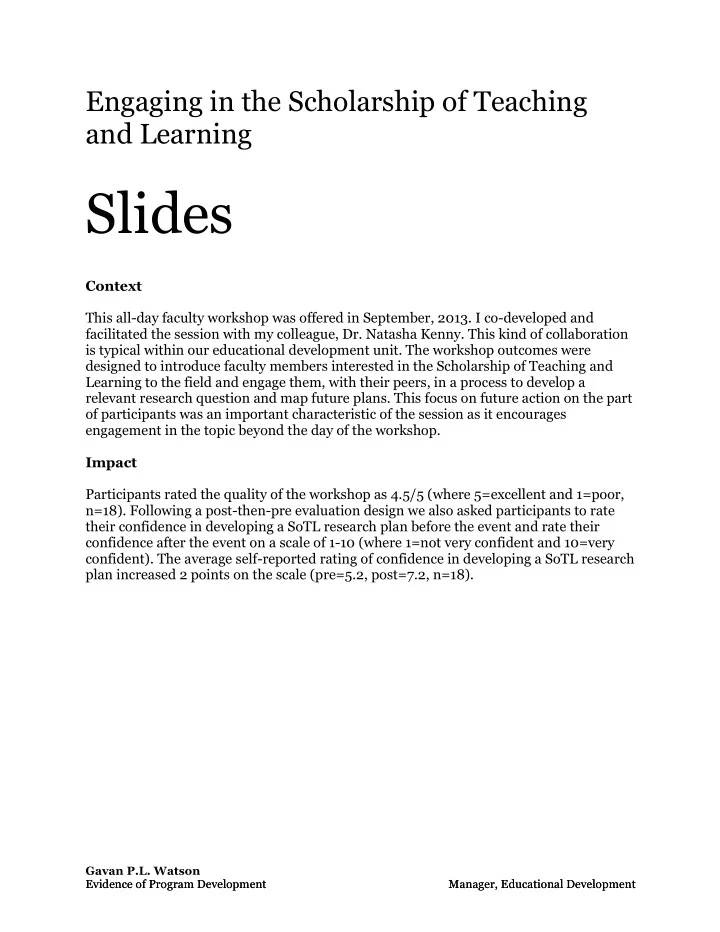
Engaging in the Scholarship of Teaching and Learning Slides Context This all-day faculty workshop was offered in September, 2013. I co-developed and facilitated the session with my colleague, Dr. Natasha Kenny. This kind of collaboration is


slide-1
SLIDE 1

Gavan P.L. Watson Evidence of Program Development Manager, Educational Development Evidence of Program Development Manager, Educational Development

Engaging in the Scholarship of Teaching and Learning

Slides

Context This all-day faculty workshop was offered in September, 2013. I co-developed and facilitated the session with my colleague, Dr. Natasha Kenny. This kind of collaboration is typical within our educational development unit. The workshop outcomes were designed to introduce faculty members interested in the Scholarship of Teaching and Learning to the field and engage them, with their peers, in a process to develop a relevant research question and map future plans. This focus on future action on the part

  • f participants was an important characteristic of the session as it encourages

engagement in the topic beyond the day of the workshop. Impact Participants rated the quality of the workshop as 4.5/5 (where 5=excellent and 1=poor, n=18). Following a post-then-pre evaluation design we also asked participants to rate their confidence in developing a SoTL research plan before the event and rate their confidence after the event on a scale of 1-10 (where 1=not very confident and 10=very confident). The average self-reported rating of confidence in developing a SoTL research plan increased 2 points on the scale (pre=5.2, post=7.2, n=18).

slide-2
SLIDE 2

2014%04%04& 1&

Engaging in the Scholarship of Teaching and Learning

Dr.$Natasha$Kenny. Dr.$Gavan$Watson.

Outcomes

  • Explore$the$scholarship$of$teaching$and$

learning$as$it$related$to$your$own$teaching$ practice.

  • Develop$an$awareness$of$the$ethical$

considerations$and$procedures$related$to$ the$SoTL.

  • Create$a$central$research$question$and$a$

plan$for$moving$forward.

Outline

10:00$11:00%Contextualizing$the$SoTL. 11:00$12:00%Developing$a$research$question. 12:00$1:00%Lunch$sponsored$by$PSEER. 1:00$%2:00%Ethical$considerations$related$to$ the$SoTL$. 2:00$2:15%Break. 2:15$%3:30%Developing$a$research$plan.

CONTEXTUALIZING%THE% SoTL8

Reflection

What$questions$related$to$student$learning$ that,$if$answered,$would$help$you$improve$ your$teaching$practice?. .

  • In$groups$of$four,$generate$list.
  • Record$on$flipchart$paper.

DEFINING%THE%SCHOLARSHIP% OF%TEACHING%&%LEARNING8

slide-3
SLIDE 3

2014%04%04& 2&

Scholarly$ teaching. Disciplinary$ research. Educational$ research.

SoTL

Dawson, 2006

SoTL

SelfNreflection$

  • n$disciplinary$

teaching$&$ learning. Engagement$ with$teaching$ &$learning$ knowledge. Public$sharing$

  • f$ideas$within$

discipline.

Martin et al., 1999

a

SoTL

Student$ Learning. Critical$ reflection$on$ practice. Systematic$ investigation. Dissemination. Killen, P , & Gallagher, E, 2013

Scopes of SoTL InterNdisciplinary. Discipline. Individual$Classroom. Subject$. expertise.

“For$me$the$main$point$of$engaging$in$the$ scholarship$of$teaching$and$learning$in$ higher$education$is$to$work$towards$ improving$our$students$learning.”.

(Prosser,$2008).

slide-4
SLIDE 4

2014%04%04& 3&

Excellent$teaching$=$SoTL$?.

necessarily.

≠. ?. But…. . Engagement$in$SoTL$can$ improve$teaching.

(Brew$and$Ginns,$2008).

In summary

SoTL$is:.

  • A$scholarly$practice$(see$Boyer,$1991).
  • (Often)$based$in$firstNhand$experience.
  • Sustained$critical$reflection$on$practice.
  • Grounded$in$literature.
  • Focused$on$improving$student$learning.
  • Has$cross$disciplinary$application.
  • Results$meaningfully$communicated$to$
  • thers.

MODELS%FOR%SoTL% ENGAGEMENT8

External. Department. Individual.

  • Dissemination$

beyond$discipline.

  • Discussions$with$

colleagues.

  • Developing$

knowledge.

  • Improving$practice.

Collecting$&$ communicating. Relating$to$ disciplinary$ literature$&$ knowledge$. Improving$student$learning$by$ investigating$own$teaching. Improving$teaching$by…. Knowing$literature$on$teaching. Focus$on$student$learning. Focus$on$. personal. practice.

Adapted from Trigwell et. al, 2000

Scale$of$Impact.

slide-5
SLIDE 5

2014%04%04& 4&

Where$are$you$comfortable$operating$within$ this$framework?.

EXPLORING%YOUR%INTERESTS% IN%RESEARCH%&%PEDAGOGY% % 8

Developing a research question

Framework

Using the framework: an example

1.$Theme$. Does$using$active$learning$improve$student$ learning$in$a$laboratory$seding?. . 2.$Three$moreNspecific$research$questions.

Using the framework: further context

3.$Further$context.

  • Human$anatomy$laboratory.
  • 3rd$year$course$.
  • Using$jigsaw$as$an$active$learning$

technique.

  • Class$topic$is$the$anatomy$of$hands$and$

feet.

Example Research Question

Does$the$implementation$of$the$“Jigsaw”$ active$learning$technique$in$a$3rd$year$ human$anatomy$laboratory$improve$ students’$ability$to$identify$the$anatomical$ features$of$human$hands$and$feet?.

slide-6
SLIDE 6

2014%04%04& 5&

Process

Step%1:%Work$on$steps$1N3$individually$(20$ min). Step%2:%In$groups$of$4,$at$your$tables:$.

– complete$step$“4”,$review$and$get$feedback$

  • n$questions$(4x10$min$=$40$min).

LUNCH8

Courtesy of the Physical Science and Engineering Education Research Centre

ETHICAL%CONSIDERATIONS% RELATED%TO%THE%SoTL%% % 8

BREAK8

15 min

DEVELOPING%A%RESEARCH% PLAN8

A SoTL Process

Identify$a$problem$

  • r$a$question$about$

student$learning$in$ a$course. Contextualize$it$in$ the$SoTL$literature. Propose$a$solution$

  • r$a$new$way$of$

understanding$the$ issue. Gather$relevant$ evidence. Discuss$the$ evidence$with$ peers. Make$findings$ public.

Killen, P & Gallagher, E., 2013

slide-7
SLIDE 7

2014%04%04& 6&

An overall question

How$will$students$be$involved$in$your$ research$process?. . (beyond$being$subjects).

As$partners$ in$action. As$partners$ in$ dissemination. As$partners$ in$inquiry. Students$as$

subjects.

Do$“to”$them. Do$“with”$them.

Process

Step%1:%Work$on$the$SoTL$plan$worksheet$ individually$(15N20$min). Step%2:%With$a$partner,$review$a$challenging$$ area$that$you$would$like$feedback$on$(2x15$ min$=$30$min). Step%3:$Based$on$this$conversation,$identify$ 2N3$concrete$actions$for$moving$forward$ using$the$action$plan$worksheet$(10$min).

WRAP$UP8

OpenEd Services Offered

  • Faculty$workshops.
  • Individual$consultations.
  • SoTL$community$of$practice.
  • Teaching$and$Learning$Innovations$

Conference$.

– April$30th,$2014:$Learning$Outcomes.

  • Course$ReNDesign$Institute.
  • University$Teaching:$Theory$&$Practice.

References

Boyer,$E.$L.$(1991).$Highlights$of$the$Carnegie$Report:$The$Scholarship$of$Teaching$from$lScholarship$ Reconsidered:$Priorities$of$the$Professoriatel.$College&Teaching,&39(1),$11N13.$. . Brew,$A.,$&$Ginns,$P.$(2008).$The$relationship$between$engagement$in$the$scholarship$of$teaching$and$learning$ and$studentsm$course$experiences.$Assessment&&&Evaluation&in&Higher&Education,$33(5),$535$N$545.$. . Dawson,$D.$(2006).$Enhancing$teaching:$Engaging$faculty$in$the$SoTL.$Reflections:&Newsle@er&of&the&Teaching& Support&Centre,&The&University&of&Western&Ontario,$54,$3.$Retrieved$hdp://www.uwo.ca/tsc/resources/ publications/newsleder/previous_issues/Reflections_54.pdf. . Killen,$P.$O.$C.,$&$Gallagher,$E.$V.$(2013).$Sketching$the$Contours$of$the$Scholarship$of$Teaching$and$Learning$ in$Theology$and$Religion.$Teaching&Theology&and&Religion,$16(2),$107N124.$. . Martin,$E.,$Benjamin,$J.,$Prosser,$M.,$&$Trigwell,$K.$(1999).$Scholarship$of$teaching:$a$study$of$the$approaches$
  • f$academic$staff.$In$C.$Rust$(Ed.),$Improving&Student&Learning:&Improving&Student&Learning&Outcomes.&(pp.$
326N331).$Oxford:$Oxford$Brookes$University.. . Prosser,$M.$(2008).$The$Scholarship$of$Teaching$and$Learning:$What$is$it?$A$Personal$View.$International&Journal& for&the&Scholarship&of&Teaching&and&Learning,&2(2),$1N4.$. . Trigwell,$K.,$Martin,$E.,$Benjamin,$J.,$&$Prosser,$M.$(2000).$Scholarship$of$Teaching:$A$model.$Higher&Education& Research&and&Development,$19(2),$155N168.$doi:$10.1080/072943600445628.
slide-8
SLIDE 8

Gavan P.L. Watson Evidence of Program Development Manager, Educational Development

Engaging in the Scholarship of Teaching and Learning

Handouts

slide-9
SLIDE 9

!

Model for SoTL engagement

Contact information

Natasha Kenny, PhD, nkenny@uoguelph.ca, x. 52963 Gavan Watson, PhD, watsong@uoguelph.ca, x. 56856

slide-10
SLIDE 10

!

Reflection

What questions related to student learning that, if answered, would help you improve your teaching practice?

slide-11
SLIDE 11

1

Scholarship of Teaching and Learning Workshop

September 20, 2013

Identifying Your General Research Interests

  • 1. Identify your research theme or the general area that you would

like to investigate related to teaching and learning in higher

  • education. Write this in the form of a question.
  • a. Why is answering this question important to improving

student learning?

  • b. How is your own personal teaching practice reflected in

this question?

  • c. How would the findings of answering this question be

applied to classrooms outside your discipline?

slide-12
SLIDE 12

2

Identifying your Specific SoTL Research Questions

  • 2. Based on your responses to question 1, identify 3 specific research questions

related to your research theme. Be sure to write your responses in the question- form.

  • 3. Next, re-write your 3 questions, getting even more specific by adding additional

detail based on your particular instructional context. Write each of your questions in terms as precisely as possible.

  • 4. Review your questions with colleagues, and together identify the question that: a)

resonates most with others and b) clearly states the problem or issue to be addressed.

The questions of the worksheet have been adapted from the following sources: Bishop-Clark, Cathy, & Dietz-Uhler, Beth. (2012). Engaging in the Scholarship of Teaching and Learning: A Guide to the Process, and how to Develop a Project from Start to Finish: Stylus. Felten, Peter. (2013). Principles of Good Practice in SoTL. Teaching and Learning Inquiry: The ISSOTL Journal, 1(1), 121-125. Killen, Patricia O’Connell, & Gallagher, Eugene V. (2013). Sketching the Contours of the Scholarship of Teaching and Learning in Theology and Religion. Teaching Theology and Religion, 16(2), 107-124.

slide-13
SLIDE 13

Creating a SoTL Plan Worksheet

Briefly respond to the questions, don’t be concerned if you don’t have a clear vision. Use the worksheet to brainstorm and begin to understand the scope and context of your SoTL project.

Scope: What methods would be appropriate to answering this

question? Where will you conduct the study? What groups do you want to study? How many people will you study? What kinds of outcomes do you expect?

Data Collection: What data will you collect? When will you

collect the data? Who will collect the data? Why are you collecting these data?

Data Analysis: How will you analyze the data? If your data

set needs to be coded, who will code it?

Reporting: How will you share results of this work? Where do

you plan to present and publish your findings?

Adapted from: Bishop-Clark, Cathy, & Dietz-Uhler, Beth. (2012). Engaging in the Scholarship of Teaching and Learning: A Guide to the Process, and how to Develop a Project from Start to Finish: Stylus.

slide-14
SLIDE 14

SoTL Action Plan Worksheet Goal for Moving Forward Concrete Next Step Timeline Additional Information

slide-15
SLIDE 15

Gavan P.L. Watson Evidence of Program Development Manager, Educational Development

Engaging in the Scholarship of Teaching and Learning

Evaluation

slide-16
SLIDE 16

Thank you for taking the time to complete this evaluation. We truly value your feedback!

Educational Development Workshop Evaluation

Fall SoTL Workshop Friday September 20th Kenny / Watson My constructive suggestion for improvement is: What was the most important thing that you learned at today’s session? What question(s) were you left with at the end of this session? Before this event, how confident did you feel in developing a SoTL research plan?

1 2 3 4 5 6 7 8 9 10 Not Very Somewhat Very

Now, how confident do you feel in developing a SoTL research plan?

1 2 3 4 5 6 7 8 9 10 Not Very Somewhat Very

Additional comments? Overall, I would rate the quality of this workshop as: 1 2 3 4 5 Poor Excellent