Slide 1 ___________________________________ - - PDF document

slide 1
SMART_READER_LITE
LIVE PREVIEW

Slide 1 ___________________________________ - - PDF document

Slide 1 ___________________________________ ___________________________________ Hot Lights and Cold Steel vs. Invisible Particle Therapy in Early Stage and High Risk Non-Small Cell Lung Cancer ___________________________________ David


slide-1
SLIDE 1

Slide 1

BAM 2004

David Jablons, M.D. Chief, Division of Thoracic Surgery Department of Surgery University of California, San Francisco

Hot Lights and Cold Steel vs. Invisible Particle Therapy in Early Stage and High Risk Non-Small Cell Lung Cancer

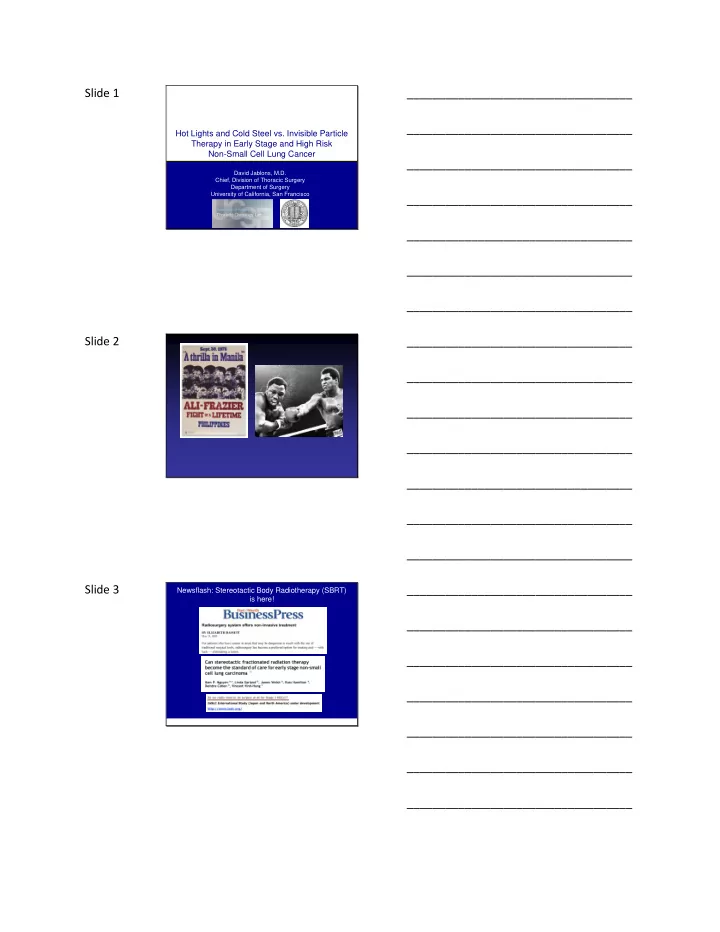
___________________________________ ___________________________________ ___________________________________ ___________________________________ ___________________________________ ___________________________________ ___________________________________ Slide 2 ___________________________________ ___________________________________ ___________________________________ ___________________________________ ___________________________________ ___________________________________ ___________________________________ Slide 3

BAM 2004

Newsflash: Stereotactic Body Radiotherapy (SBRT) is here!

Source:

___________________________________ ___________________________________ ___________________________________ ___________________________________ ___________________________________ ___________________________________ ___________________________________
slide-2
SLIDE 2

Slide 4

BAM 2004

Why all the excitement about Stereotactic Body Radiotherapy (SBRT)?

Source:

≥ ?

___________________________________ ___________________________________ ___________________________________ ___________________________________ ___________________________________ ___________________________________ ___________________________________ Slide 5

BAM 2004

Big Picture – What are we trying to accomplish?

Source:

Goals SBRT Surgery Cure cancer Minimize morbidity and mortality Treat all tumor locations Treat all early stage tumors Assess pathology and staging Perform prognostic and predictive profiling Use proven techniques Treat patients with poor lung function

___________________________________ ___________________________________ ___________________________________ ___________________________________ ___________________________________ ___________________________________ ___________________________________ Slide 6

BAM 2004

Curing Cancer

  • Many independent studies have been done on the

effectiveness of SBRT.

  • A common conclusion of SBRT trials for early stage lung

cancer is that it offers

  • 1. ―Comparable local control‖
  • 2. ―Comparable long-term survival‖

Source:

___________________________________ ___________________________________ ___________________________________ ___________________________________ ___________________________________ ___________________________________ ___________________________________

slide-3
SLIDE 3

Slide 7

BAM 2004

Curing Cancer

  • Many independent studies have been done on the

effectiveness of SBRT.

  • A common conclusion of SBRT trials for early stage lung

cancer is that it offers

  • 1. ―Comparable local control‖
  • 2. ―Comparable long-term survival‖
  • But don’t believe everything you read

Source:

___________________________________ ___________________________________ ___________________________________ ___________________________________ ___________________________________ ___________________________________ ___________________________________ Slide 8

BAM 2004

Curing Cancer

Source:

Source: Nguyen et al. Cancer Treatment Reviews 2008; 34: 719-727.

VATS Lobectomy SBRT < 100 Gy SBRT < 100 Gy:

  • 1. Small study populations
  • 2. Worse local control
  • 3. Worse survival (even at 3 years!)

___________________________________ ___________________________________ ___________________________________ ___________________________________ ___________________________________ ___________________________________ ___________________________________ Slide 9

BAM 2004

Curing Cancer

Source:

VATS Lobectomy SBRT > 100 Gy SBRT > 100 Gy is better than < 100 Gy, BUT:

  • 1. Small study populations
  • 2. Overall, worse local control
  • 3. Overall, worse survival

Source: Nguyen et al. Cancer Treatment Reviews 2008; 34: 719-727.

___________________________________ ___________________________________ ___________________________________ ___________________________________ ___________________________________ ___________________________________ ___________________________________

slide-4
SLIDE 4

Slide 10

BAM 2004

Curing Cancer

Source:

Source: Onishi et al. Journal of Thoracic Surgery 2007; 2: S94-100.

  • Frequently cited study: Onishi, 2007, Japan
  • Multi-institutional study with 257 pts
  • Local control – claimed overall response rate 86.8%
  • Complete response: Only 25.7% of patients!
  • Partial response (30% reduction in diameter): 61.1% of

patients

  • 5-year survival for medically operable patients ~70%
  • Survival decreases in pts with stage IB lung ca
  • Longer-term survival > 5 years worrisome due to lack of

compete response

___________________________________ ___________________________________ ___________________________________ ___________________________________ ___________________________________ ___________________________________ ___________________________________ Slide 11

BAM 2004

Minimizing Morbidity and Mortality

  • SBRT is not the only field evolving
  • Nowadays, VATS lobectomy and VATS wedge resection

have limited morbidity and mortality at experienced centers

  • At UCSF, morbidity < 1% and mortality (and

reimbursement) close to 0%

  • Comparative studies biased – compare VATS lobectomy

(not wedge resections) done at all centers vs. SBRT done at specialty centers

Source:

___________________________________ ___________________________________ ___________________________________ ___________________________________ ___________________________________ ___________________________________ ___________________________________ Slide 12

BAM 2004

Minimizing Morbidity and Mortality

  • But don’t worry, radiation is perfectly safe.

Source:

___________________________________ ___________________________________ ___________________________________ ___________________________________ ___________________________________ ___________________________________ ___________________________________

slide-5
SLIDE 5

Slide 13

BAM 2004

Minimizing Morbidity and Mortality

  • But don’t worry, radiation is perfectly safe.

Source:

___________________________________ ___________________________________ ___________________________________ ___________________________________ ___________________________________ ___________________________________ ___________________________________ Slide 14

BAM 2004

Minimizing Morbidity and Mortality

  • Many of our patients are elderly with already compromised

lung function; SBRT > 100 Gy is not benign in this setting

  • SBRT has measurable side-effects

Source:

Source: Nguyen et al. Cancer Treatment Reviews 2008; 34: 719-727.

___________________________________ ___________________________________ ___________________________________ ___________________________________ ___________________________________ ___________________________________ ___________________________________ Slide 15

BAM 2004

Treating All Tumor Locations

Source:

  • Surgery equally effective at treating both peripherally and

centrally located tumors, with minimal difference in morbidity and mortality

  • Study on SBRT by Timmerman, 2006, UT Southwestern
  • 11-fold increased risk of severe toxicity with centrally located tumors
  • 2-fold increased risk of death with centrally located tumors
  • No clear consensus on safety of SBRT with centrally located tumors

Source: Timmerman et al. J Clinical Oncology 2006; 24: 4833-9.

___________________________________ ___________________________________ ___________________________________ ___________________________________ ___________________________________ ___________________________________ ___________________________________

slide-6
SLIDE 6

Slide 16

BAM 2004

Treating All Early Stage Lung Cancer

Source:

  • Surgery proven effective in treating stage IA, IB, and IIA lung

cancer

  • Study on SBRT by Onishi, 2007, Japan
  • 41% increase in local recurrence and 24% increase in

regional nodal metastasis for Stage IB vs. IA

  • Be careful when recommending SBRT for Stage IB tumors!

Source: Onishi et al. Journal of Thoracic Surgery 2007; 2: S94-100.

___________________________________ ___________________________________ ___________________________________ ___________________________________ ___________________________________ ___________________________________ ___________________________________ Slide 17

BAM 2004

Assessing Pathology and Staging

Source:

+

  • 1. You have inspected the lung cavity
  • 2. Disease is in the bucket
  • 3. Disease can be verified by pathology
  • 4. You have adequately staged the patient

During and After Surgery

___________________________________ ___________________________________ ___________________________________ ___________________________________ ___________________________________ ___________________________________ ___________________________________ Slide 18

BAM 2004

Assessing Pathology and Staging

Source:

During and After Surgery During and After SBRT

+

  • 1. You have inspected the lung cavity
  • 2. Disease is in the bucket
  • 3. Disease can be verified by pathology
  • 4. You have adequately staged the patient
  • 1. You have produced a pretty

scar on a picture

  • 2. Disease ―supposed‖ to be gone
  • 3. You don’t know what you have

treated with your invisible particles

  • 4. Inadequate staging!

___________________________________ ___________________________________ ___________________________________ ___________________________________ ___________________________________ ___________________________________ ___________________________________

slide-7
SLIDE 7

Slide 19

BAM 2004

Performing Molecular Prognostic and Predictive Profiling

Source:

  • Newsflash: Molecular prognostic and predictive profiling is
  • n the horizon!
  • Unfortunately, technology to do this ―virtually‖ with CT

imaging has not yet been developed

  • Being able to do this with needle biopsy specimens is still

many, many years away

___________________________________ ___________________________________ ___________________________________ ___________________________________ ___________________________________ ___________________________________ ___________________________________ Slide 20

BAM 2004

Blinded Assay Validation

Kaiser Cohort (n=420) China Cohort (n=967)

___________________________________ ___________________________________ ___________________________________ ___________________________________ ___________________________________ ___________________________________ ___________________________________ Slide 21

BAM 2004

Using Proven Techniques

  • Surgery – Vast experience
  • VATS lobectomy and wedge resection are considered

standard of care

  • SBRT – Still not established
  • Trials are small
  • No proven large randomized trial comparing the two at

academic centers has been performed (STARS multicenter study for stage IA recruiting)

  • No consensus on optimal dosing yet (―expert‖

respondents to recent ASTRO survey recommended 6 different dose fractionation schedules)

  • Will community buy into further trials?

Source:

Source: Ball D. Current Opinion in Pulmonary Medicine 2008; 14: 297-302.

___________________________________ ___________________________________ ___________________________________ ___________________________________ ___________________________________ ___________________________________ ___________________________________

slide-8
SLIDE 8

Slide 22

BAM 2004

Treating Patients with Poor Lung Function

  • Standard guidelines for surgical resection of lung cancer
  • FEV1 >2L or >80% – Suitable for pneumonectomy
  • FEV1 >1.5L – Suitable for lobectomy
  • DLCO >40% – Suitable for surgery
  • If FEV1 <80% or DLCO <80%, then estimate predicted

postoperative (ppo) FEV1 through additional testing

  • ppo FEV1 <40% – High risk
  • ppo FEV1 <30% – Inoperable
  • Are there any surgical options for patients with lung

cancer deemed inoperable under the standard guidelines

Source: Colice et al. Chest 2007; 132(3): 161S-177S.

___________________________________ ___________________________________ ___________________________________ ___________________________________ ___________________________________ ___________________________________ ___________________________________ Slide 23

BAM 2004

Treating Patients with Poor Lung Function – Sublobar Resection

  • El-Sherif, 2006, Pittsburgh
  • Retrospective study of 784 patients with stage I NCSLC
  • Lobectomy was the standard of care (577), and

sublobar resection was reserved for patients with cardiopulmonary impairment (207)

  • Disease-free survival similar for stage IA but slightly

worse for stage IB

  • Overall survival worse (40% vs. 54% at 5yrs), but

associated with limited or no lymph node sampling

Source: El-Sherif et al. Ann Thorac Surg 2006; 82:408-16.

___________________________________ ___________________________________ ___________________________________ ___________________________________ ___________________________________ ___________________________________ ___________________________________ Slide 24

BAM 2004

Treating Patients with Poor Lung Function – Sublobar Resection

  • Kilic, 2009, Pittsburgh
  • Retrospective study comparing elderly patients >75yo

with stage I NSCLC undergoing segmentectomy (78) or lobectomy (106)

  • Larger tumors in the lobectomy group (3.5 vs. 2.5 cm),

and higher incidence of COPD and diabetes in segmentectomy group

  • Fewer complications in segmentectomy group (11.5%
  • vs. 25.5%)
  • Equivalent disease-free and overall survival
  • Current trial CALGB 140503— Randomized study

comparing lobectomy to sublobar resection for small ≤ 2cm peripheral NSCLC

Source: Kilic et al. Ann Thorac Surg 2009; 87: 1662-8.

___________________________________ ___________________________________ ___________________________________ ___________________________________ ___________________________________ ___________________________________ ___________________________________

slide-9
SLIDE 9

Slide 25

BAM 2004

Treating Patients with Poor Lung Function – VATS

  • Shennib, 2005, CALGB
  • Phase II prospective multicenter study of 58 high-risk

patients with cT1 tumors who underwent VATS wedge resection and radiation therapy

  • High-risk carefully defined as FEV1 <40%, DLCO <50%,
  • r VO2max <15mL/kg/min
  • 17% converted to thoracotomy, 3.5% aborted operation
  • 28% upgraded to pT2
  • Resection margins >=1cm for 44% of pT1 and 33% pT2
  • Low complication rate: Death 4%, air leak 10%,

pneumonia 6%, respiratory failure 4%

Source: Shennib et al. J Thorac Cardiovasc Surg 2005; 129: 813-8.

___________________________________ ___________________________________ ___________________________________ ___________________________________ ___________________________________ ___________________________________ ___________________________________ Slide 26

BAM 2004

Treating Patients with Poor Lung Function – Brachytherapy

  • Fernando, 2005, Pittsburgh
  • Retrospective study comparing sublobar resection alone

(64), sublobar resection with brachytherapy (60), and lobar resection (167) in patients with stage IA NSCLC

  • Patients who underwent sublobar resection had worse

preoperative pulmonary function

  • Brachytherapy associated with lower local recurrence

rate among patients undergoing sublobar resection (17.2% vs. 3.3%)

  • No difference in survival between sublobar and lobar

resection among patients with tumors <2cm

Source: Fernando et al. J Thorac Cardiovasc Surg 2005; 129: 261-7.

___________________________________ ___________________________________ ___________________________________ ___________________________________ ___________________________________ ___________________________________ ___________________________________ Slide 27

BAM 2004

Treating Patients with Poor Lung Function – Brachytherapy

  • Birdas, 2006, Pittsburgh
  • Retrospective study comparing sublobar resection with

brachytherapy (41) and lobar resection (126) in patients with stage IB NSCLC

  • Patients who underwent sublobar resection had worse

preoperative pulmonary function

  • Similar local recurrence rates, disease-free survival, and
  • verall survival

Source: Birdas et al. Ann Thorac Surg 2006; 81:434-9.

___________________________________ ___________________________________ ___________________________________ ___________________________________ ___________________________________ ___________________________________ ___________________________________

slide-10
SLIDE 10

Slide 28

BAM 2004

Treating Patients with Poor Lung Function – Brachytherapy

  • Current multicenter clinical trials with the American College
  • f Surgeons Oncology Group (ACOSOG)
  • Randomized study comparing sublobar resection alone

versus sublobar resection with brachytherapy for high- risk operable patients with stage I NSCLC tumors <= 3cm.

  • Randomized study comparing sublobar resection (with
  • r without brachytherapy) and SBRT in patients with

high-risk stage I NSCLC.

Source: http://www.clinicaltrials.gov

___________________________________ ___________________________________ ___________________________________ ___________________________________ ___________________________________ ___________________________________ ___________________________________ Slide 29

BAM 2004

Treating Patients with Poor Lung Function – LVRS

  • Lung Volume Reduction Surgery (LVRS) for emphysema
  • Better overall survival, exercise capacity, and symptoms

compared to medical therapy in a subgroup:

  • Patients with upper lobe predominant emphysema and

low exercise capacity

  • High mortality rate if FEV1 <20% and either

homogeneous emphysema or DLCO <20%

  • Predicted postoperative (ppo) FEV1 underestimated in

these patients

  • Patients who do not meet the standard criteria for surgery

may benefit from combined LVRS and lung cancer resection

Source: National Emphysema Treatment Trial Research Group. NEJM 2003; 348: 2059-73.

___________________________________ ___________________________________ ___________________________________ ___________________________________ ___________________________________ ___________________________________ ___________________________________ Slide 30

BAM 2004

Treating Patients with Poor Lung Function – LVRS

  • Many case series on combined operations for lung volume

reduction and lung cancer

  • McKenna, 1996, UCLA
  • 11 patients with severe emphysema and stage I NSCLC
  • Lobectomy performed if tumor in emphysematous area;

wedge resection performed if tumor in healthier lung

  • FEV1: Preop 0.65L (21.7%) >> Postop 1.1L (49%)

Source: McKenna et al. Chest 1996; 110: 885-888.

___________________________________ ___________________________________ ___________________________________ ___________________________________ ___________________________________ ___________________________________ ___________________________________

slide-11
SLIDE 11

Slide 31

BAM 2004

Treating Patients with Poor Lung Function – LVRS

  • Choong, 2004, Washington University
  • 21 patients with severe emphysema and lung cancer
  • In 9 patients, cancer located in emphysematous lobe; in

12 patients, cancer resection supplemented with LVRS

  • Preop

FEV1 0.7L (29%) DLCO 34%

  • Postop 1yr

FEV1 1.1L (43%) DLCO 36%

  • Postop 5yr

FEV1 0.8L (28%) DLCO 30%

  • Survival 100% at 1 year, 62.7% at 5 years

Source: Choong et al. J Thoracic Cardiovasc Surg 2004; 127(5): 1323-31.

___________________________________ ___________________________________ ___________________________________ ___________________________________ ___________________________________ ___________________________________ ___________________________________ Slide 32

BAM 2004

Treating Patients with Poor Lung Function – LVRS

  • What about survival?
  • Martin-Ucar, 2007, UK
  • Retrospective study of 118 patients who underwent

upper lobectomy for stage I NSCLC

  • Compared 27 patients with ppoFEV1 <40% to 91

patients with ppoFEV1 >40%

  • No significant difference in postoperative mortality
  • No significant difference in tumor recurrence rates
  • 5-year survival 35% vs. 65%
  • Survival may be affected by physiology, not oncology

Source: Martin-Ucar et al. Thorax 2007; 62: 577-580.

___________________________________ ___________________________________ ___________________________________ ___________________________________ ___________________________________ ___________________________________ ___________________________________ Slide 33

BAM 2004

Treating Patients with Poor Lung Function – LVRS

  • No standard criteria for combined operation
  • Consider if FEV1 >20% and DLCO >20%
  • Consider if tumor is located in emphysematous lobe that

contributes <10% of overall perfusion

  • Patients must be carefully selected

___________________________________ ___________________________________ ___________________________________ ___________________________________ ___________________________________ ___________________________________ ___________________________________

slide-12
SLIDE 12

Slide 34

BAM 2004

Treating Patients with Poor Lung Function – SBRT

  • Stereotactic body radiation therapy for inoperable lung

cancer

  • Timmerman, 2010, UT Southwestern
  • Radiation Therapy Oncology Group trial
  • Multicenter study of 55 patients with peripheral stage I

lung cancer and medical conditions precluding surgical treatment

  • SBRT 18 Gy x 3 fractions over 1.5-2 weeks
  • 3-year disease-free survival 48.3% and overall survival

55.8%

  • 3-year primary tumor control 97.6%, but disseminated

recurrence 22.1%

Source: Timmerman et al. JAMA 2010; 303(11): 1070-6.

___________________________________ ___________________________________ ___________________________________ ___________________________________ ___________________________________ ___________________________________ ___________________________________ Slide 35

BAM 2004

Big Picture – What are we trying to accomplish?

Source:

Goals SBRT Surgery Cure cancer ? ✓

___________________________________ ___________________________________ ___________________________________ ___________________________________ ___________________________________ ___________________________________ ___________________________________ Slide 36

BAM 2004

Big Picture – What are we trying to accomplish?

Source:

Goals SBRT Surgery Cure cancer ? ✓ Minimize morbidity and mortality ? ✓

___________________________________ ___________________________________ ___________________________________ ___________________________________ ___________________________________ ___________________________________ ___________________________________

slide-13
SLIDE 13

Slide 37

BAM 2004

Big Picture – What are we trying to accomplish?

Source:

Goals SBRT Surgery Cure cancer ? ✓ Minimize morbidity and mortality ? ✓ Treat all tumor locations X ✓

___________________________________ ___________________________________ ___________________________________ ___________________________________ ___________________________________ ___________________________________ ___________________________________ Slide 38

BAM 2004

Big Picture – What are we trying to accomplish?

Source:

Goals SBRT Surgery Cure cancer ? ✓ Minimize morbidity and mortality ? ✓ Treat all tumor locations X ✓ Treat all early stage tumors X ✓

___________________________________ ___________________________________ ___________________________________ ___________________________________ ___________________________________ ___________________________________ ___________________________________ Slide 39

BAM 2004

Big Picture – What are we trying to accomplish?

Source:

Goals SBRT Surgery Cure cancer ? ✓ Minimize morbidity and mortality ? ✓ Treat all tumor locations X ✓ Treat all early stage tumors X ✓ Assess pathology and staging X ✓

___________________________________ ___________________________________ ___________________________________ ___________________________________ ___________________________________ ___________________________________ ___________________________________

slide-14
SLIDE 14

Slide 40

BAM 2004

Big Picture – What are we trying to accomplish?

Source:

Goals SBRT Surgery Cure cancer ? ✓ Minimize morbidity and mortality ? ✓ Treat all tumor locations X ✓ Treat all early stage tumors X ✓ Assess pathology and staging X ✓ Perform molecular prognostic and predictive profiling X ✓

___________________________________ ___________________________________ ___________________________________ ___________________________________ ___________________________________ ___________________________________ ___________________________________ Slide 41

BAM 2004

Big Picture – What are we trying to accomplish?

Source:

Goals SBRT Surgery Cure cancer ? ✓ Minimize morbidity and mortality ? ✓ Treat all tumor locations X ✓ Treat all early stage tumors X ✓ Assess pathology and staging X ✓ Perform molecular prognostic and predictive profiling X ✓ Use proven techniques X ✓

___________________________________ ___________________________________ ___________________________________ ___________________________________ ___________________________________ ___________________________________ ___________________________________ Slide 42

BAM 2004

Big Picture – What are we trying to accomplish?

Source:

Goals SBRT Surgery Cure cancer ? ✓ Minimize morbidity and mortality ? ✓ Treat all tumor locations X ✓ Treat all early stage tumors X ✓ Assess pathology and staging X ✓ Perform molecular prognostic and predictive profiling X ✓ Use proven techniques X ✓ Treat patients with poor lung function ? ✓

___________________________________ ___________________________________ ___________________________________ ___________________________________ ___________________________________ ___________________________________ ___________________________________

slide-15
SLIDE 15

Slide 43

BAM 2004

Bottom Line – Who would you send your Grandmother to?

___________________________________ ___________________________________ ___________________________________ ___________________________________ ___________________________________ ___________________________________ ___________________________________ Slide 44

BAM 2004 Source:

OR

Bottom Line – Who would you send your Grandmother to?

___________________________________ ___________________________________ ___________________________________ ___________________________________ ___________________________________ ___________________________________ ___________________________________ Slide 45

BAM 2004

___________________________________ ___________________________________ ___________________________________ ___________________________________ ___________________________________ ___________________________________ ___________________________________

slide-16
SLIDE 16

Slide 46

BAM 2004

Thank You

___________________________________ ___________________________________ ___________________________________ ___________________________________ ___________________________________ ___________________________________ ___________________________________