SLIDE 1
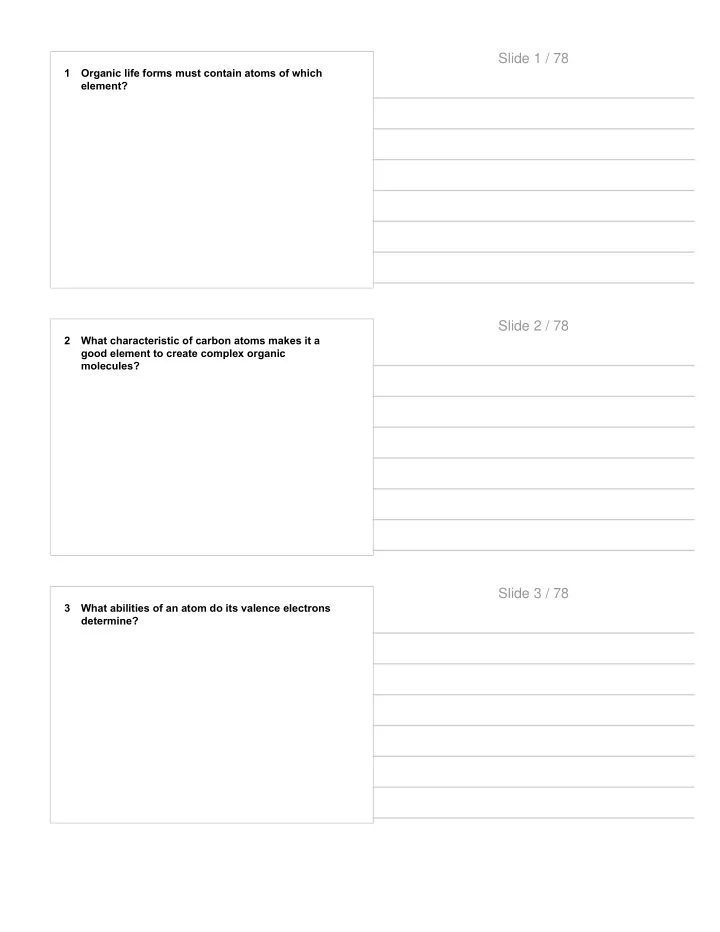
1 Organic life forms must contain atoms of which element?
Slide 1 / 78
2 What characteristic of carbon atoms makes it a good element to create complex organic molecules?
Slide 2 / 78
3 What abilities of an atom do its valence electrons determine?
Slide 3 / 78
SLIDE 2 4 Suppose carbon had 3 valence electrons instead
- f the 4. How would this change the bonding
characteristics of an atom of carbon?
Slide 4 / 78
5 Neon, atomic number 10, is considered an inert gas, because it will not react with atoms of other
- elements. Briefly compare and contrast neon and
carbon.
Slide 5 / 78
6 Compare the valence levels of the noble gases with that of carbon. What qualities of these elements are determined by the valence levels?
Slide 6 / 78
SLIDE 3
7 Why do double bonds not exist in a saturated hydrocarbon?
Slide 7 / 78
8 Suppose, theoretically, that the bonds that formed hydrocarbons were polar in nature. How would this affect the interaction between oil and water? Homework
Slide 8 / 78
9 Briefly explain the importance of the number of carbon’s valence electrons.
Slide 9 / 78
SLIDE 4
10 Knowing what you now know about the qualities and characteristics of carbon, briefly explain why, in science fiction movies, scientists search for “carbon based lifeforms” on other planets.
Slide 10 / 78
11 An atom of carbon readily bonds with hydrogen atoms, to form molecules called ‘hydrocarbons.’ Knowing what you know about chemical bonds, explain why and how carbon would bond with these hydrogen atoms.
Slide 11 / 78
12 What is the difference between a saturated and an unsaturated hydrocarbon?
Slide 12 / 78
SLIDE 5
13 What component of an unsaturated hydrocarbon creates the ‘bend’ in the compound?
Slide 13 / 78
14 Is it possible to add new atoms to an unsaturated hydrocarbon? Explain what would need to occur in order for this to take place.
Slide 14 / 78
15 Explain, in terms of polarity, why oil (a hydrocarbon) floats on water.
Slide 15 / 78
SLIDE 6
16 Imagine you are working in a lab to determine the nature of an unknown type of polymer. Through your experimentation, you denature (break down) the polymer into monomers, which happen to be amino acids. Under which group of organic polymers would you categorize your polymer? Why did you choose this group? Carbohydrates, Polysaccharides Classwork
Slide 16 / 78
17 Monosaccharides would be considered monomers of what more complex polymer group?
Slide 17 / 78
18 Explain how carbohydrates are structured in a 1:2:1 ratio. Which atom does each number in this ratio represent?
Slide 18 / 78
SLIDE 7
19 If a carbohydrate molecule contains 10 oxygen atoms, how many carbon atoms does it contain? How many hydrogen atoms does it contain?
Slide 19 / 78
20 Why are sugars soluble in water?
Slide 20 / 78
21 What are three roles for which monosaccharides are commonly used in biological function?
Slide 21 / 78
SLIDE 8
22 Label the components of the following reaction as either monosaccharides or disaccharides. Glucose + Fructose ( Sucrose + H2O
Slide 22 / 78
23 The basic chemical equation in question #22 is an example of what kind of a reaction?
Slide 23 / 78
24 Contrast the role of glycogen in humans to the role of cellulose in plants. Homework
Slide 24 / 78
SLIDE 9
25 Polysaccharides can be broken down into which specific monosaccharide?
Slide 25 / 78
26 If a carbohydrate molecule contains 32 hydrogen atoms, how many carbon atoms does it contain?
Slide 26 / 78
27 In the carbohydrate represented by the following formula, replace the question mark with a viable coefficient and variable: CxH?Ox
Slide 27 / 78
SLIDE 10
28 Compare the role of starch in plants to the role of glycogen in animals.
Slide 28 / 78
29 Starch and cellulose are both polysaccaharides found in plants. How is the function of each different?
Slide 29 / 78
30 Related to question #29, how is the function of the polysaccharides starch and cellulose related to their individual structures?
Slide 30 / 78
SLIDE 11
31 Why do humans not consume cellulose to obtain energy?
Slide 31 / 78
32 Why do athletes commonly “carbo-load” (consume a great deal of carbohydrates) prior to a physically strenuous activity? How is this related to the functionality of polysaccharides?
Slide 32 / 78
33 Would you rather consume a meal of celery or potatoes the night before a marathon? Defend your answer, being sure to include what you know about the different types of carbohydrates in your response. Nucleic Acids Classwork
Slide 33 / 78
SLIDE 12
34 Name the 3 parts of a nucleotide.
Slide 34 / 78
35 If a nucleotide is composed of a 5-carbon sugar, how many hydrogen atoms and oxygen atoms does this sugar also contain?
Slide 35 / 78
36 What role does the base sequence of a series of bonded nucleotides provide for an organism?
Slide 36 / 78
SLIDE 13
37 Explain how RNA and DNA work like a tag team in the cell in order to complete the task of storing and expressing genetic information.
Slide 37 / 78
38 Which quality of a nitrogen base would you investigate by determining the number of rings present in its structure? Homework
Slide 38 / 78
39 What characteristic possessed by RNA exists largely because it is a single stranded molecule, and makes it similar to proteins?
Slide 39 / 78
SLIDE 14
40 If adenine always pairs with thymine (or uracil) and cytosine always pairs with guanine, construct a general statement involving purines and pyrimidines to describe base pairing rules in DNA.
Slide 40 / 78
41 What is the appropriate scientific term for the shape of a DNA molecule?
Slide 41 / 78
42 Explain why DNA needs the presence of RNA for it to be a functional molecule.
Slide 42 / 78
SLIDE 15 43 Suppose you discover a new type of virus. Your research indicates that the molecular chemistry of the virus includes the nitrogen base uracil, but not
- thymine. Which nucleic acid does your research
support is utilized by this virus? Why did you come to this conclusion? Amino Acids, Proteins Classwork
Slide 43 / 78
44 Briefly explain why proteins, carbohydrates and nucleic acids are considered biomolecular polymers.
Slide 44 / 78
45 Which of the three components of an amino acid is most comparable in functionality to the nitrogen base of a nucleotide?
Slide 45 / 78
SLIDE 16 46 Amino acids each have an H atom on one and an OH group on the other end. What type of reaction do you think could be used to effectively join two amino acids together? What is the product of this reaction?
Slide 46 / 78
47 Of the three major components of each amino acid (Carboxyl Group, Amine, R Group Side Chain), which would you use to distinguish between two different amino acids? Why would you choose this particular component?
Slide 47 / 78
48 Suppose you took two amino acids, valine and tyrosine, and switched their R-group side chain
- components. Would this change the identity and
function of the amino acids? Why or why not?
Slide 48 / 78
SLIDE 17 49 What is the correct hierarchy of protein structure levels?
Slide 49 / 78
50 Briefly explain the importance of having the accurate primary structure for appropriate protein function.
Slide 50 / 78
51 The alpha helix shape and pleated sheet formation refer to which level of protein
Slide 51 / 78
SLIDE 18 52 What are two ways in which you could denature a protein?
Slide 52 / 78
53 Pick two classes of proteins and match them with their specific function. Homework
Slide 53 / 78
54 Amino acids are to Proteins as Bricks are to a
- Wall. Briefly explain why this analogy works.
Slide 54 / 78
SLIDE 19 55 Compare the role of glucose in polysaccharide formation to that of amino acids in the formation
Slide 55 / 78
56 Explain the role that dehydration synthesis plays in creating a peptide bond.
Slide 56 / 78
57 If you were to swap the carboxyl groups of proline and lysine (two amino acids), how would this impact the structure and function of each amino acid?
Slide 57 / 78
SLIDE 20 58 Explain how the R-Group side chain is like an identification card for each amino acid.
Slide 58 / 78
59 Explain how a mutation that affects the primary structure of a protein would change the polymer.
Slide 59 / 78
60 If you were a biomolecular biologist studying the tertiary structure of various proteins, which specific part of each amino acid would you focus
Slide 60 / 78
SLIDE 21
61 Explain how the change of shape of a protein can affect its ability to complete a task in the body.
Slide 61 / 78
62 Why would denaturing a protein affect its ability to function properly?
Slide 62 / 78
63 Which level of protein organization involves interaction between multiple polypeptide chains?
Slide 63 / 78
SLIDE 22
64 Which class of proteins would a fortifying shampoo most likely include? Lipids Classwork
Slide 64 / 78
65 Do amino acids, monosaccharides and nucleotides have a comparable counterpart in lipids? Why or why not?
Slide 65 / 78
66 Why is it significant that cell membranes are composed of amphiphilic molecules?
Slide 66 / 78
SLIDE 23
67 Explain the term ‘hydrogenated,’ using its relation to saturation as a guideline.
Slide 67 / 78
68 If a lipid is a liquid at room temperature, it is a good assumption that this lipid: does/does not contain double bonds. Explain your answer.
Slide 68 / 78
69 Explain, in scientific terms, why a waxy covering may be beneficial to a plant to prevent water loss. Homework
Slide 69 / 78
SLIDE 24
70 What happens when a hydrophobic molecule is exposed to water?
Slide 70 / 78
71 Explain why it is beneficial for a dish soap or detergent to be amphiphillic in nature.
Slide 71 / 78
72 Explain the role that phospholipids play in the creation of cell membranes.
Slide 72 / 78
SLIDE 25 73 Suppose you are analyzing an unidentified spread that has qualities of butter and margarine. How could determining whether or not the product was hydrogenated help you to identify the item?
Slide 73 / 78
74 Explain the change in appearance that would
- ccur if an unsaturated fat were to be
hydrogenated.
Slide 74 / 78
75 Why might it be a good idea to avoid trans fats in your diet if you are attempting your eating habits?
Slide 75 / 78
SLIDE 26 76 What type of lipid molecule includes testosterone and cholesterol?
Slide 76 / 78
This material is made freely available at www.njctl.org and is intended for the non-commercial use of students and teachers. These materials may not be used for any commercial purpose without the written permission of the owners. NJCTL maintains its website for the convenience of teachers who wish to make their work available to other teachers, participate in a virtual professional learning community, and/or provide access to course materials to parents, students and others.
Click to go to website: www.njctl.org New Jersey Center for Teaching and Learning Progressive Science Initiative
Slide 77 / 78
www.njctl.org
Large Biological Molecules Practice Questions
Slide 78 / 78