Slide 1 / 53 1 Two objects attract each other gravitationally. If - - PDF document

slide 1 53
SMART_READER_LITE
LIVE PREVIEW

Slide 1 / 53 1 Two objects attract each other gravitationally. If - - PDF document

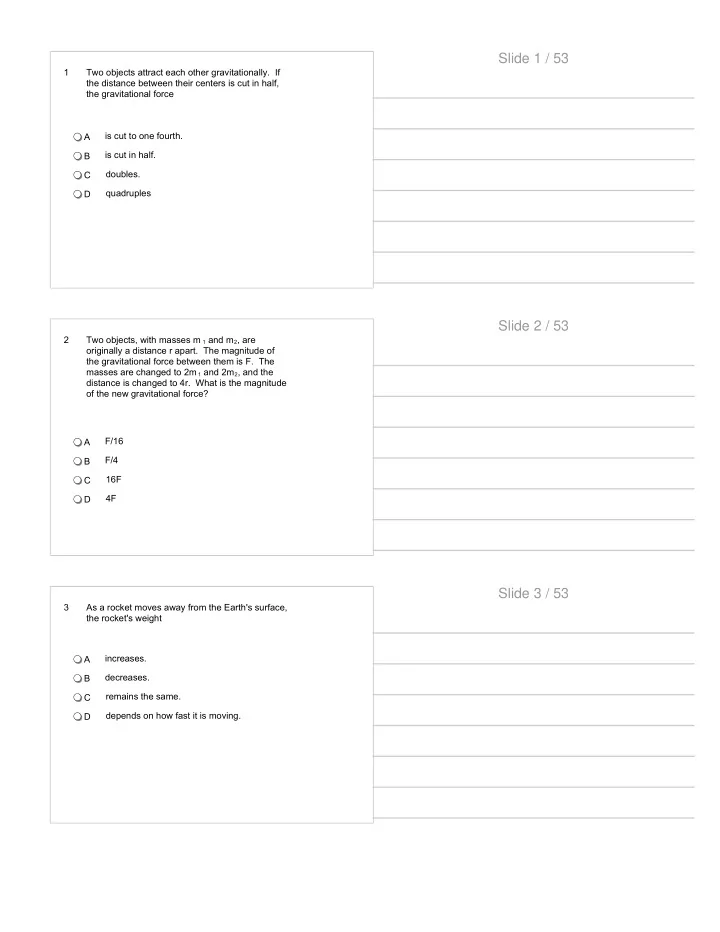
Slide 1 / 53 1 Two objects attract each other gravitationally. If the distance between their centers is cut in half, the gravitational force is cut to one fourth. A is cut in half. B doubles. C quadruples D Slide 2 / 53 2 Two objects,


slide-1
SLIDE 1

1 Two objects attract each other gravitationally. If the distance between their centers is cut in half, the gravitational force A is cut to one fourth. B is cut in half. C doubles. D quadruples

Slide 1 / 53

2 Two objects, with masses m 1 and m2, are

  • riginally a distance r apart. The magnitude of

the gravitational force between them is F. The masses are changed to 2m 1 and 2m2, and the distance is changed to 4r. What is the magnitude

  • f the new gravitational force?

A F/16 B F/4 C 16F D 4F

Slide 2 / 53

3 As a rocket moves away from the Earth's surface, the rocket's weight A increases. B decreases. C remains the same. D depends on how fast it is moving.

Slide 3 / 53

slide-2
SLIDE 2

4 A hypothetical planet has a mass of half that of the Earth and a radius of twice that of the Earth. What is the acceleration due to gravity on the planet in terms of g, the acceleration due to gravity at the Earth? A g B g/2 C g/4 D g/8

Slide 4 / 53

5 Two planets have the same surface gravity, but planet B has twice the mass of planet A. If planet A has radius r, what is the radius of planet B? A 0.707r B r C 1.41r D 4r

Slide 5 / 53

6 A planet is discovered to orbit around a star in the galaxy Andromeda, with the same orbital diameter as the Earth around our Sun. If that star has 4 times the mass of our Sun, what will the period of revolution of that new planet be, compared to the Earth's orbital period? A

  • ne-fourth as much

B

  • ne-half as much

C twice as much D four times as much

Slide 6 / 53

slide-3
SLIDE 3

7 The speed of Halley's Comet, while traveling in its elliptical orbit around the Sun, A is constant. B increases as it nears the Sun. C decreases as it nears the Sun. D is zero at two points in the orbit.

Slide 7 / 53

8 The gravitational attractive force between two masses is F. If the masses are moved to twice of their initial distance, what is the gravitational attractive force? A 4F B 2F C F/2 D F/4

Slide 8 / 53

9 A satellite encircles Mars at a distance above its surface equal to 3 times the radius of Mars. The acceleration of gravity of the satellite, as compared to the acceleration of gravity on the surface of Mars, is A zero. B the same. C

  • ne-third as much.

D

  • ne-sixteenth as much.

Slide 9 / 53

slide-4
SLIDE 4

10 Two moons orbit a planet in nearly circular orbits. Moon A has orbital radius r, and moon B has

  • rbital radius 4r. Moon A takes 20 days to

complete one orbit. How long does it take moon B to complete an orbit? A 20 days B 80 days C 160 days D 320 days

Slide 10 / 53

11 An astronaut goes out for a "space walk" at a distance above Earth's surface equal to the radius

  • f Earth. What is her acceleration due to gravity?

A zero B g C g/2 D g/4

Slide 11 / 53

12 The radius of Earth is R. At what distance above Earth's surface will the acceleration of gravity be 4.9 m/s2? A 0.41 R B 0.50 R C 1.0 R D 1.41 R

Slide 12 / 53

slide-5
SLIDE 5

13 An object weighs 432 N on the surface of Earth. At a height of 3REarth above Earth's surface, what is its weight? A 432 N B 48 N C 27 N D 0 N

Slide 13 / 53

14 The weight of a satellite on a planet's surface is

  • W. Which is closest to the weight of the satellite

when it's in orbit? A 0.05 W B 0.10 W C 0.95 W D

Slide 14 / 53

15 Two satellites, X with a mass of m and Y with a mass of 2m, orbit the same planet of mass M (m <<M) at the same height. The orbital velocity of X is v, what is the orbital velocity of Y? A v B 2v C v/2 D 4v

Slide 15 / 53

slide-6
SLIDE 6

16 Five different satellites orbit the same planet. The mass and orbital radius of each is given below. Which has the lowest speed? Mass Radius A 1/2 m 1/2R B m R C m 2R D 2m R

Slide 16 / 53

17 A student who weighs 500 N on Earth travels to a planet whose mass and radius are twice that of

  • Earth. His weight on that planet is about

A 1000 N B 500 / √2 N C 500 N D 250 N

Slide 17 / 53

18 Mars has 1/10 the mass of Earth and 1/2 its

  • diameter. What is the surface gravity on Mars?

A g B 1/2 g C 2 g D 2/5 g

Slide 18 / 53

slide-7
SLIDE 7

19 A planets mass can be determined if it is orbited by a small satellite by equating its gravitational and centripetal accelerations. Which of the below is not required to do this calculation? A The mass of the satellite B The radius of the satellite's orbit C The period of the satellite's orbit D The universal gravitational constant, G

Slide 19 / 53

20 An astronaut inside the space station appears

  • weightless. Which statement is true?

A The gravitational force on the astronaut is zero B The moon's gravitational pull cancels that of Earth C The astronaut is in free fall D The astronaut loses about 95% of her weight

Slide 20 / 53

21 A planet has four times the radius of Earth but the same density. What is the acceleration due to gravity on the planet compared to g on Earth? A 4g B 2g C g/2 D g/4

Slide 21 / 53

slide-8
SLIDE 8

22 A new planet is found with a density one third as much at Earth and a radius twice that of Earth. What is the acceleration due to gravity on this new planet? A 3.3 m/s2 B 6.5 m/s2 C 14.7 m/s2 D 19.6 m/s2

Slide 22 / 53

23 Two spheres, with radii of R, are in contact with each other and attract each other with a force of

  • F. If the radii of both of the spheres are cut to half

while the density remains the same, what is the new gravitational force between them? A 16F B 4F C F/2 D F/16

Slide 23 / 53

24 A satellite of mass M moves in a circular orbit of radius R with speed v. Which of these must be true for the satellite? A The net force on it is MR/v2 B Its acceleration is GM/R C Its orbital velocity is (GM/R)1/2 D Its orbital period is 2πR/v

Slide 24 / 53

slide-9
SLIDE 9

25 Spacecraft X has twice the mass of Spacecraft Y. They orbit Earth at the same radius. Which of these must be true? A X feels a greater gravitational force than Y B X travels twice as fast as Y C X takes twice as long to complete an orbit D The orbital period of X is the same as Y

Slide 25 / 53

  • 1. During a lunar eclipse, the Moon, Earth, and Sun all lie on the same

line, with the Earth between the Moon and the Sun. The Moon has a mass of 7.4 × 10²² kg; Earth has a mass of 6.0 × 1024 kg; and the Sun has a mass of 2.0 × 1030 kg. The separation between the Moon and the Earth is given by 3.8 × 10⁸ m; the separation between the Earth and the Sun is given by 1.5 × 10¹¹ m. (a) Calculate the force exerted on Earth by the Moon. (b) Calculate the force exerted on Earth by the Sun. (c) Calculate the net force exerted on Earth by the Moon and the Sun.

Slide 26 / 53

  • 1. During a lunar eclipse, the Moon, Earth, and Sun all lie on the same

line, with the Earth between the Moon and the Sun. The Moon has a mass of 7.4 × 10²² kg; Earth has a mass of 6.0 × 1024 kg; and the Sun has a mass of 2.0 × 1030 kg. The separation between the Moon and the Earth is given by 3.8 × 10⁸ m; the separation between the Earth and the Sun is given by 1.5 × 10¹¹ m. (a) Calculate the force exerted on Earth by the Moon.

Slide 27 / 53

slide-10
SLIDE 10
  • 1. During a lunar eclipse, the Moon, Earth, and Sun all lie on the same

line, with the Earth between the Moon and the Sun. The Moon has a mass of 7.4 × 10²² kg; Earth has a mass of 6.0 × 1024 kg; and the Sun has a mass of 2.0 × 1030 kg. The separation between the Moon and the Earth is given by 3.8 × 10⁸ m; the separation between the Earth and the Sun is given by 1.5 × 10¹¹ m. (b) Calculate the force exerted on Earth by the Sun.

Slide 28 / 53

  • 1. During a lunar eclipse, the Moon, Earth, and Sun all lie on the same

line, with the Earth between the Moon and the Sun. The Moon has a mass of 7.4 × 10²² kg; Earth has a mass of 6.0 × 1024 kg; and the Sun has a mass of 2.0 × 1030 kg. The separation between the Moon and the Earth is given by 3.8 × 10⁸ m; the separation between the Earth and the Sun is given by 1.5 × 10¹¹ m. (c) Calculate the net force exerted on Earth by the Moon and the Sun.

Slide 29 / 53

  • 2. A 2.10-kg brass ball is transported to the Moon. (The radius of the

Moon is 1.74 × 10⁶ m and its mass is 7.35 × 10²² kg.) (a) Calculate the acceleration due to gravity on the Moon. (b) Determine the mass of the brass ball on Earth and on the Moon. (c) Determine the weight of the brass ball on Earth. (d) Determine the weight of the brass ball on Moon.

Slide 30 / 53

slide-11
SLIDE 11
  • 2. A 2.10-kg brass ball is transported to the Moon. (The radius of the

Moon is 1.74 × 10⁶ m and its mass is 7.35 × 10²² kg.) (a) Calculate the acceleration due to gravity on the Moon.

Slide 31 / 53

  • 2. A 2.10-kg brass ball is transported to the Moon. (The radius of the

Moon is 1.74 × 10⁶ m and its mass is 7.35 × 10²² kg.) (b) Determine the mass of the brass ball on Earth and on the Moon.

Slide 32 / 53

  • 2. A 2.10-kg brass ball is transported to the Moon. (The radius of the

Moon is 1.74 × 10⁶ m and its mass is 7.35 × 10²² kg.) (c) Determine the weight of the brass ball on Earth.

Slide 33 / 53

slide-12
SLIDE 12
  • 2. A 2.10-kg brass ball is transported to the Moon. (The radius of the

Moon is 1.74 × 10⁶ m and its mass is 7.35 × 10²² kg.) (d) Determine the weight of the brass ball on Moon.

Slide 34 / 53

  • 3. A satellite of mass m is in a circular orbit around the Earth, which has

mass Me and radius Re. Express your answers in terms of a, m, Me, Re, and G. (a) Write the equation that can describe the gravitational force on the satellite. (b) Write an equation that can be used to find the acceleration of the satellite. (c) Find the acceleration of the satellite when it stays

  • n the same orbit with the radius a. Is this acceleration

greater, less than the acceleration g on the surface of Earth? (d) Determine the velocity of the satellite as it stays on the same orbit. (e) How much work is done the gravitational force to keep the satellite on the same orbit? (f) What is the orbital period of the satellite?

Slide 35 / 53

  • 3. A satellite of mass m is in a circular orbit around the Earth, which has

mass Me and radius Re. Express your answers in terms of a, m, Me, Re, and G. (a) Write the equation that can describe the gravitational force on the satellite.

Slide 36 / 53

slide-13
SLIDE 13
  • 3. A satellite of mass m is in a circular orbit around the Earth, which has

mass Me and radius Re. Express your answers in terms of a, m, Me, Re, and G. (b) Write an equation that can be used to find the acceleration of the satellite.

Slide 37 / 53

  • 3. A satellite of mass m is in a circular orbit around the Earth, which has

mass Me and radius Re. Express your answers in terms of a, m, Me, Re, and G. (c) Find the acceleration of the satellite when it stays

  • n the same orbit with the radius a. Is this acceleration

greater, less than the acceleration g on the surface of Earth?

Slide 38 / 53

  • 3. A satellite of mass m is in a circular orbit around the Earth, which has

mass Me and radius Re. Express your answers in terms of a, m, Me, Re, and G. (d) Determine the velocity of the satellite as it stays on the same orbit.

Slide 39 / 53

slide-14
SLIDE 14
  • 3. A satellite of mass m is in a circular orbit around the Earth, which has

mass Me and radius Re. Express your answers in terms of a, m, Me, Re, and G. (e) How much work is done the gravitational force to keep the satellite on the same orbit?

Slide 40 / 53

  • 3. A satellite of mass m is in a circular orbit around the Earth, which has

mass Me and radius Re. Express your answers in terms of a, m, Me, Re, and G. (f) What is the orbital period of the satellite?

Slide 41 / 53

  • 4. A satellite is placed into a circular orbit around the planet Jupiter,

which has mass MJ = 1.90 x 1027 kg and radius RJ = 7.14 x 10⁷ m. (a) If the radius of the orbit is R, use Newton's laws to derive an expression for the orbital velocity. (b) If the satellite increases its orbital radius, how it would change the orbital velocity? Explain. (c) If the radius of the orbit is R, use Newton’s laws to derive an expression for the orbital period. (d) The satellite rotation is synchronized with Jupiter’s rotation. This requires an equatorial orbit whose period equals Jupiter’s rotation period of 9 hr 51 min = 3.55*104 s. Find the required orbital radius.

Slide 42 / 53

slide-15
SLIDE 15
  • 4. A satellite is placed into a circular orbit around the planet Jupiter,

which has mass MJ = 1.90 x 1027 kg and radius RJ = 7.14 x 10⁷ m. (a) If the radius of the orbit is R, use Newton's laws to derive an expression for the orbital velocity.

Slide 43 / 53

  • 4. A satellite is placed into a circular orbit around the planet Jupiter,

which has mass MJ = 1.90 x 1027 kg and radius RJ = 7.14 x 10⁷ m. (b) If the satellite increases its orbital radius, how it would change the orbital velocity? Explain.

Slide 44 / 53

  • 4. A satellite is placed into a circular orbit around the planet Jupiter,

which has mass MJ = 1.90 x 1027 kg and radius RJ = 7.14 x 10⁷ m. (c) If the radius of the orbit is R, use Newton’s laws to derive an expression for the orbital period.

Slide 45 / 53

slide-16
SLIDE 16
  • 4. A satellite is placed into a circular orbit around the planet Jupiter,

which has mass MJ = 1.90 x 1027 kg and radius RJ = 7.14 x 10⁷ m. (d) The satellite rotation is synchronized with Jupiter’s rotation. This requires an equatorial orbit whose period equals Jupiter’s rotation period of 9 hr 51 min = 3.55*104 s. Find the required orbital radius.

Slide 46 / 53

  • 5. The Sojourner rover vehicle was used to explore the surface of Mars

as part of the Pathfinder mission in 1997. Use the data in the tables below to answer the questions that follow.

Mars Data Sojourner Data Radius: 0.53 x Earth's radius Mass of Sojourner vehicle:11.5 kg Mass: 0.11 x Earth's mass Wheel diameter: 0.13 m Stored energy available: 5.4 x 10⁵ J Power required for driving: 10 W Land speed: 6.7 x 10⁻³ m/s

(a) Determine the acceleration due to gravity at the surface of Mars in terms of g, the acceleration due to gravity at the surface of Earth. (b) Calculate Sojourner's weight on the surface of Mars. (c) Assume that when leaving the Pathfinder spacecraft Sojourner rolls down a ramp inclined at 20° to the horizontal. The ramp must be lightweight but strong enough to support Sojourner. Calculate the minimum normal force that must be supplied by the ramp. (d) What is the net force on Sojourner as it travels across the Martian surface at constant velocity? Justify your answer. (e) Determine the maximum distance that Sojourner can travel on a horizontal Martian surface using its stored energy. (f) Suppose that 0.010% of the power for driving is expended against atmospheric drag as Sojourner travels on the Martian surface. Calculate the magnitude of the drag force.

Slide 47 / 53

  • 5. The Sojourner rover vehicle was used to explore the surface of Mars

as part of the Pathfinder mission in 1997. Use the data in the tables below to answer the questions that follow.

Mars Data Sojourner Data Radius: 0.53 x Earth's radius Mass of Sojourner vehicle:11.5 kg Mass: 0.11 x Earth's mass Wheel diameter: 0.13 m Stored energy available: 5.4 x 10⁵ J Power required for driving: 10 W Land speed: 6.7 x 10⁻³ m/s

(a) Determine the acceleration due to gravity at the surface of Mars in terms of g, the acceleration due to gravity at the surface of Earth.

Slide 48 / 53
slide-17
SLIDE 17
  • 5. The Sojourner rover vehicle was used to explore the surface of Mars

as part of the Pathfinder mission in 1997. Use the data in the tables below to answer the questions that follow.

Mars Data Sojourner Data Radius: 0.53 x Earth's radius Mass of Sojourner vehicle:11.5 kg Mass: 0.11 x Earth's mass Wheel diameter: 0.13 m Stored energy available: 5.4 x 10⁵ J Power required for driving: 10 W Land speed: 6.7 x 10⁻³ m/s

(b) Calculate Sojourner's weight on the surface of Mars.

Slide 49 / 53

  • 5. The Sojourner rover vehicle was used to explore the surface of Mars

as part of the Pathfinder mission in 1997. Use the data in the tables below to answer the questions that follow.

Mars Data Sojourner Data Radius: 0.53 x Earth's radius Mass of Sojourner vehicle:11.5 kg Mass: 0.11 x Earth's mass Wheel diameter: 0.13 m Stored energy available: 5.4 x 10⁵ J Power required for driving: 10 W Land speed: 6.7 x 10⁻³ m/s

(c) Assume that when leaving the Pathfinder spacecraft Sojourner rolls down a ramp inclined at 20° to the horizontal. The ramp must be lightweight but strong enough to support Sojourner. Calculate the minimum normal force that must be supplied by the ramp.

Slide 50 / 53

  • 5. The Sojourner rover vehicle was used to explore the surface of Mars

as part of the Pathfinder mission in 1997. Use the data in the tables below to answer the questions that follow.

Mars Data Sojourner Data Radius: 0.53 x Earth's radius Mass of Sojourner vehicle:11.5 kg Mass: 0.11 x Earth's mass Wheel diameter: 0.13 m Stored energy available: 5.4 x 10⁵ J Power required for driving: 10 W Land speed: 6.7 x 10⁻³ m/s

(d) What is the net force on Sojourner as it travels across the Martian surface at constant velocity? Justify your answer.

Slide 51 / 53

slide-18
SLIDE 18
  • 5. The Sojourner rover vehicle was used to explore the surface of Mars

as part of the Pathfinder mission in 1997. Use the data in the tables below to answer the questions that follow.

Mars Data Sojourner Data Radius: 0.53 x Earth's radius Mass of Sojourner vehicle:11.5 kg Mass: 0.11 x Earth's mass Wheel diameter: 0.13 m Stored energy available: 5.4 x 10⁵ J Power required for driving: 10 W Land speed: 6.7 x 10⁻³ m/s

(e) Determine the maximum distance that Sojourner can travel on a horizontal Martian surface using its stored energy.

Slide 52 / 53

  • 5. The Sojourner rover vehicle was used to explore the surface of Mars

as part of the Pathfinder mission in 1997. Use the data in the tables below to answer the questions that follow.

Mars Data Sojourner Data Radius: 0.53 x Earth's radius Mass of Sojourner vehicle:11.5 kg Mass: 0.11 x Earth's mass Wheel diameter: 0.13 m Stored energy available: 5.4 x 10⁵ J Power required for driving: 10 W Land speed: 6.7 x 10⁻³ m/s

(f) Suppose that 0.010% of the power for driving is expended against atmospheric drag as Sojourner travels on the Martian surface. Calculate the magnitude of the drag force.

Slide 53 / 53