Slide 1 / 47 1 Two substances mercury with a density 13600 kg/m3 and - - PDF document

slide 1 47
SMART_READER_LITE
LIVE PREVIEW

Slide 1 / 47 1 Two substances mercury with a density 13600 kg/m3 and - - PDF document

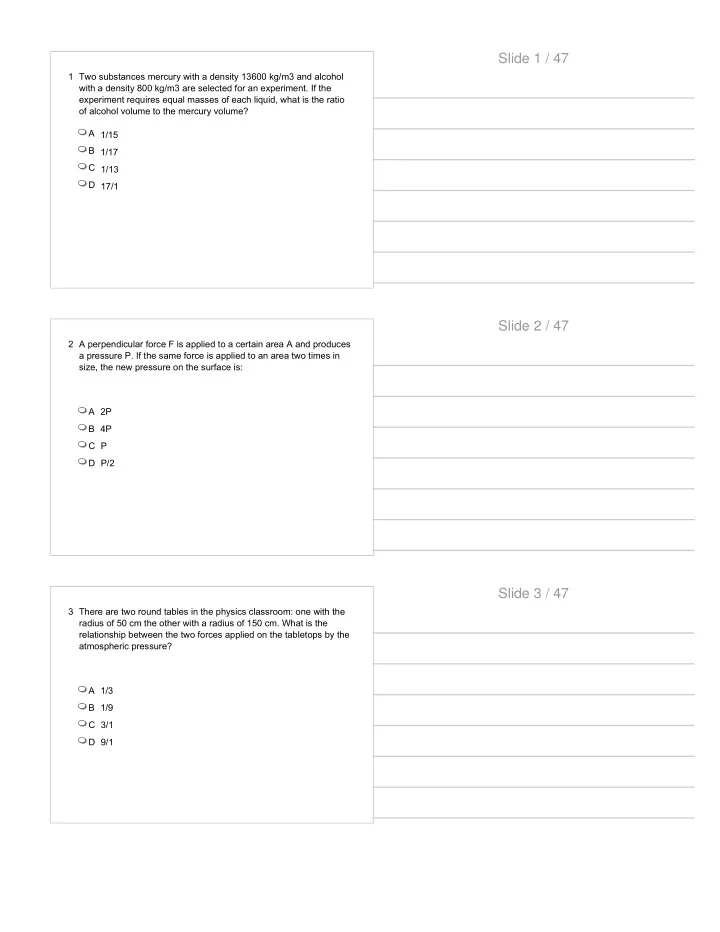
Slide 1 / 47 1 Two substances mercury with a density 13600 kg/m3 and alcohol with a density 800 kg/m3 are selected for an experiment. If the experiment requires equal masses of each liquid, what is the ratio of alcohol volume to the mercury


slide-1
SLIDE 1

1 Two substances mercury with a density 13600 kg/m3 and alcohol with a density 800 kg/m3 are selected for an experiment. If the experiment requires equal masses of each liquid, what is the ratio

  • f alcohol volume to the mercury volume?

A 1/15 B 1/17 C 1/13 D 17/1

Slide 1 / 47

2 A perpendicular force F is applied to a certain area A and produces a pressure P. If the same force is applied to an area two times in size, the new pressure on the surface is: A 2P B 4P C P D P/2

Slide 2 / 47

3 There are two round tables in the physics classroom: one with the radius of 50 cm the other with a radius of 150 cm. What is the relationship between the two forces applied on the tabletops by the atmospheric pressure? A 1/3 B 1/9 C 3/1 D 9/1

Slide 3 / 47

slide-2
SLIDE 2

4 Three containers are used in a chemistry lab. All containers have the same bottom area and the same height. A chemistry student fills each of the containers with the same liquid to the maximum

  • volume. Which of the following is true about the pressure on the

bottom in each container? A P1>P2>P3 B P1<P2<P3 C P1<P2>P3 D P1=P2=P3

Slide 4 / 47

5 What is the difference between the pressure on the bottom of a pool and the pressure on the water surface? A ρgh B ρg/h C ρ/gh D gh/ρ

Slide 5 / 47

6 A boy swims a lake and initially dives 0.5 m beneath the surface. When he dives 1 m beneath the surface, how does the absolute pressure change? A It doubles B It quadruples C It cut to a half D It slightly increases

Slide 6 / 47

slide-3
SLIDE 3

7 Which of the following scientists invented a mercury barometer? A Blaise Pascal B Evangelist Torricelli C Amedeo Avogadro D Robert Brown

Slide 7 / 47

8 A car driver measures a tire pressure of 220 kPa. What is the absolute pressure in the tire? A 321 kPa B 119 kPa C 0 kPa D 101 kPa

Slide 8 / 47

9 In a hydraulic lift the small piston has an area of 2 cm2 and large piston has an area of 80 cm2. What is the mechanical advantage of the hydraulic lift? A 40 B 4 C 2 D 1

Slide 9 / 47

slide-4
SLIDE 4

10 A hydraulic lift is used to lift a car. The small piston has a radius of 5 cm and the large piston has a radius of 50 cm. If a driver applies a force of 88 N to the small piston, what is the weight of the car the large piston can support? A 880 N B 88 N C 8800 N D 8.8 N

Slide 10 / 47

11 Three blocks of equal volume are completely submerged into

  • water. The blocks made of different materials: aluminum, iron and
  • lead. Which of the following is the correct statement about the

buoyant force on each block? (ρaluminum = 2700 kg/m3, ρiron = 7800 kg/m3, ρlead = 11300 kg/m3) A Faluminum > Firon > Flead B Faluminum < Firon < Flead C Faluminum < Firon > Flead D Faluminum = Firon = Flead

Slide 11 / 47

12 A piece of iron has a weight of 3.5 N when it is in air and 2.0 N when it is submerged into water. What is the buoyant force on the piece of iron? A 3.5 N B 2.0 N C 1.5 N D 1.0 N

Slide 12 / 47

slide-5
SLIDE 5

13 Physics students use a spring scale to measure the weight of a piece of lead. The experiment was performed two times: once in the air and once in water. If the volume of lead is 50 cm3, what is the difference between the two readings on the scale? A 0.5 N B 5.0 N C 50 N D 500 N

Slide 13 / 47

14 A solid cylinder of mass 5 kg is completely submerged into water. What is the tension force in the string supporting the piece of aluminum if the specific gravity of the cylinder’s material is 10? A 5 N B 0.5 N C 50 N D 45 N

Slide 14 / 47

15 An object has a weight of 9 N when it is in air and 7.2 N when it is submerged into water. What is the specific gravity of the object’s material? A 5 B 6 C 7 D 8

Slide 15 / 47

slide-6
SLIDE 6

16 A wooden block with a weight of 7.5 N is placed on water. When the block floats on the surface of water it is partially submerged in

  • water. What is the weight of the displaced water?

A 5.0 N B 5.5 N C 6.0 N D 7.5 N

Slide 16 / 47

17 A wooden block with a weight of 9 N is placed on water. When the block floats on the surface of water it is partially submerged in

  • water. What is the volume of the displaced water?

A 500 cm3 B 400 cm3 C 300 cm3 D 900 cm3

Slide 17 / 47

18 Water flows at a constant speed of 16 m/s through narrow section

  • f the pipe. What is the speed of water in the section of the pipe

where its radius is twice of the initial radius? A 16 m/s B 12 m/s C 8 m/s D 4 m/s

Slide 18 / 47

slide-7
SLIDE 7

19 Venturi tubes have three sections with different radii. Which of the following is true about manometer readings? A P1 > P2 > P3 B P1 < P2 < P3 C P2 >P1 > P3 D P3 = P2 = P1

Slide 19 / 47

20 An open bottle is filled with a liquid which is flowing out trough a spigot located at the distance h below the surface of the liquid. What is the velocity of the liquid leaving the bottle? A √2gh B 2gh C 4gh D ρgh

Slide 20 / 47

21 A table surface of area A is placed underwater in a tank at a depth H relative to the surface of the water. A toy submarine is placed into the water and it sinks onto the table. If the submarine has a mass that cannot be ignored, and the amount of water displaced from the tank is Mw, what is the pressure on the table surface? A B C D

Slide 21 / 47

slide-8
SLIDE 8

22 A student wishes to test which things will float on olive oil. Olive oil has a specific gravity of 0.70. The following are specific gravities

  • f various substances. Which will float on olive oil? Select two

answers. A Oak - 0.78 B Balsa wood - 0.16 C Beeswax – 0.95 D Charcoal – 0.40

Slide 22 / 47

23 Two boxes lie on a table top: a 2 N box with a volume of 5 x 6 x 4 cm3 and a 3 N box with a volume of 4 x 5 x 9 cm3. Which two arrangements will exert the same pressure? Select two answers. A The 2N box on the 6 cm x 5 cm side. B The 2N box on the 4 cm x 5 cm side. C The 3N box on the 4 cm x 5 cm side. D The 3N box on the 5 cm x 9 cm side.

Slide 23 / 47

24 A partially evacuated vertical cylindrical container is covered by a circular lid that makes an airtight seal. The pressure in the room is 1.01 x 10⁵ Pa and the pressure inside the container is 0.41 x 10⁵

  • Pa. What other two quantities would you need to know in order to

calculate the minimum upward applied force required to lift the lid? Select two answers. A The volume of the container. B The density of the air in the container. C The mass of the lid. D The radius of the lid.

Slide 24 / 47

slide-9
SLIDE 9

25 Four objects are thrown into water. Two objects, with volumes 0.02cm3 and 0.04cm3, float and two objects, also with volumes 0.02cm3 and 0.04cm3, sink. Which two objects could have the same buoyant force exerted on them? Select two answers. A The object with a volume of 0.02m3 that floats. B The object with a volume of 0.04m3 that floats. C The object with a volume of 0.02m3 that sinks. D The object with a volume of 0.04m3 that sinks.

Slide 25 / 47

1. A small sphere of mass m and density D is suspended from an elastic spring. The spring is stretched by a distance X1.

  • a. Determine the spring constant.

Slide 26 / 47

1. A small sphere of mass m and density D is suspended from an elastic spring. The spring is stretched by a distance X1. The sphere is submerged into liquid of unknown density ρ < D. The new displacement of the spring is X2.

  • b. On the diagram below show all the applied forces on the

sphere when it is submerged.

Slide 27 / 47

slide-10
SLIDE 10

1. A small sphere of mass m and density D is suspended from an elastic spring. The spring is stretched by a distance X1. The sphere is submerged into liquid of unknown density ρ < D. The new displacement of the spring is X2.

  • c. Determine the weight of the displaced liquid by the sphere.

Slide 28 / 47

1. A small sphere of mass m and density D is suspended from an elastic spring. The spring is stretched by a distance X1. The sphere is submerged into liquid of unknown density ρ < D. The new displacement of the spring is X2.

  • d. Determine the density of liquid. Express your result in terms of

D, X1, X2.

Slide 29 / 47

  • 2. A pool has an area A = 50 m

2 and depth h = 2.5 m. The pool is

filled with water to the maximum height. An electrical pump is used to empty the pool. There are two pipes coming out the pump: one is submerged into water and has a radius r1 = 4 cm while the other has a radius r2 = 2.5 cm. Answer the following questions ignoring friction, viscosity, and turbulence.

  • a. Calculate the net force on the bottom of the pool.

Slide 30 / 47

slide-11
SLIDE 11
  • 2. A pool has an area A = 50 m

2 and depth h = 2.5 m. The pool is

filled with water to the maximum height. An electrical pump is used to empty the pool. There are two pipes coming out the pump: one is submerged into water and has a radius r1 = 4 cm while the other has a radius r2 = 2.5 cm. Answer the following questions ignoring friction, viscosity, and turbulence.

  • b. Calculate work done by the pump required to empty the pool in 5 h.

Slide 31 / 47

  • 2. A pool has an area A = 50 m

2 and depth h = 2.5 m. The pool is

filled with water to the maximum height. An electrical pump is used to empty the pool. There are two pipes coming out the pump: one is submerged into water and has a radius r1 = 4 cm while the other has a radius r2 = 2.5 cm. Answer the following questions ignoring friction, viscosity, and turbulence.

  • c. Calculate the speed of the water flow in the submerged pipe.

Slide 32 / 47

  • 2. A pool has an area A = 50 m

2 and depth h = 2.5 m. The pool is

filled with water to the maximum height. An electrical pump is used to empty the pool. There are two pipes coming out the pump: one is submerged into water and has a radius r1 = 4 cm while the other has a radius r2 = 2.5 cm. Answer the following questions ignoring friction, viscosity, and turbulence.

  • d. Calculate speed of the water flow in the second section of the pipe

placed on the ground. The pump produces a pressure P1 = 9*105 Pa in the submerged pipe.

Slide 33 / 47

slide-12
SLIDE 12
  • 3. A submarine dives from rest a 100-m distance beneath the surface
  • f the Pacific Ocean. Initially the submarine accelerates down at a

constant rate 0.3 m/s2 until it reaches a speed of 4 m/s and then continues its journey down at a constant speed. The density of salt water is 1030 kg/m3. The submarine has a hatch with an area of 2 m2 located on the top of the submarine’s body.

  • a. How much time does it take for the submarine to move down

100 m?

Slide 34 / 47

  • 3. A submarine dives from rest a 100-m distance beneath the surface
  • f the Pacific Ocean. Initially the submarine accelerates down at a

constant rate 0.3 m/s2 until it reaches a speed of 4 m/s and then continues its journey down at a constant speed. The density of salt water is 1030 kg/m3. The submarine has a hatch with an area of 2 m2 located on the top of the submarine’s body.

  • b. Calculate the gauge pressure applied on the submarine at the

depth of 100 m.

Slide 35 / 47

  • 3. A submarine dives from rest a 100-m distance beneath the surface
  • f the Pacific Ocean. Initially the submarine accelerates down at a

constant rate 0.3 m/s2 until it reaches a speed of 4 m/s and then continues its journey down at a constant speed. The density of salt water is 1030 kg/m3. The submarine has a hatch with an area of 2 m2 located on the top of the submarine’s body.

  • c. Calculate the absolute pressure applied on the submarine at the

depth of 100.

Slide 36 / 47

slide-13
SLIDE 13
  • 3. A submarine dives from rest a 100-m distance beneath the surface
  • f the Pacific Ocean. Initially the submarine accelerates down at a

constant rate 0.3 m/s2 until it reaches a speed of 4 m/s and then continues its journey down at a constant speed. The density of salt water is 1030 kg/m3. The submarine has a hatch with an area of 2 m2 located on the top of the submarine’s body.

  • d. How much force is required in order to open the hatch from the

inside of submarine?

Slide 37 / 47

  • 4. A rectangular slab of ice floats on water with a large portion

submerged beneath the water surface. The volume of the slab is 20 m3 and the surface area of the top is 14 m2. The density of ice is 900 kg/m3 and sea water is 1030 kg/m3.

  • a. On the diagram below show all the applied forces on

the slab.

Slide 38 / 47

  • 4. A rectangular slab of ice floats on water with a large portion

submerged beneath the water surface. The volume of the slab is 20 m3 and the surface area of the top is 14 m2. The density of ice is 900 kg/m3 and sea water is 1030 kg/m3.

  • b. Calculate the buoyant force on the slab.

Slide 39 / 47

slide-14
SLIDE 14
  • 4. A rectangular slab of ice floats on water with a large portion

submerged beneath the water surface. The volume of the slab is 20 m3 and the surface area of the top is 14 m2. The density of ice is 900 kg/m3 and sea water is 1030 kg/m3.

  • c. Calculate the height h of the portion of the slab that is

above the water surface.

Slide 40 / 47

  • 4. A rectangular slab of ice floats on water with a large portion

submerged beneath the water surface. The volume of the slab is 20 m3 and the surface area of the top is 14 m2. The density of ice is 900 kg/m3 and sea water is 1030 kg/m3. A polar bear climbs to the top of the slab and sits on the slab for a long time.

  • d. On the diagram below show all the applied forces on

the slab.

Slide 41 / 47

  • 4. A rectangular slab of ice floats on water with a large portion

submerged beneath the water surface. The volume of the slab is 20 m3 and the surface area of the top is 14 m2. The density of ice is 900 kg/m3 and sea water is 1030 kg/m3. A polar bear climbs to the top of the slab and sits on the slab for a long time.

  • e. If the average mass of a polar bear is 500 kg, calculate

the maximum number of bears that can sit on the slab without sinking.

Slide 42 / 47

slide-15
SLIDE 15
  • 5. A sphere with a radius of 5 cm is completely submerged in a tank
  • f water and it is attached to the bottom of the tank by a string as

shown in the picture above. The tension in the string is 0.75 times the weight of the sphere. The density of water is 1000 kg/m3.

  • a. The circle below represents the sphere. Draw and label each of

the applied forces that act on the sphere.

Slide 43 / 47

  • 5. A sphere with a radius of 5 cm is completely submerged in a tank
  • f water and it is attached to the bottom of the tank by a string as

shown in the picture above. The tension in the string is 0.75 times the weight of the sphere. The density of water is 1000 kg/m3.

  • b. Calculate the density of the sphere.

Slide 44 / 47

  • 5. A sphere with a radius of 5 cm is completely submerged in a tank
  • f water and it is attached to the bottom of the tank by a string as

shown in the picture above. The tension in the string is 0.75 times the weight of the sphere. The density of water is 1000 kg/m3.

  • c. The string is cut and the sphere begins to move. Calculate the

initial acceleration of the sphere immediately after the string is cut.

Slide 45 / 47

slide-16
SLIDE 16
  • 5. A sphere with a radius of 5 cm is completely submerged in a tank
  • f water and it is attached to the bottom of the tank by a string as

shown in the picture above. The tension in the string is 0.75 times the weight of the sphere. The density of water is 1000 kg/m3.

  • d. Does the buoyant force change as the sphere rises to the

surface? Justify your answer.

Slide 46 / 47

  • 5. A sphere with a radius of 5 cm is completely submerged in a tank
  • f water and it is attached to the bottom of the tank by a string as

shown in the picture above. The tension in the string is 0.75 times the weight of the sphere. The density of water is 1000 kg/m3.

  • e. Does the buoyant force change as the sphere reaches the

surface and rises out of the water? Justify your answer.

Slide 47 / 47