Single-use Systems Jerold Martin Sr. VP, Global Scientific Affairs - - PowerPoint PPT Presentation

single use systems
SMART_READER_LITE
LIVE PREVIEW

Single-use Systems Jerold Martin Sr. VP, Global Scientific Affairs - - PowerPoint PPT Presentation

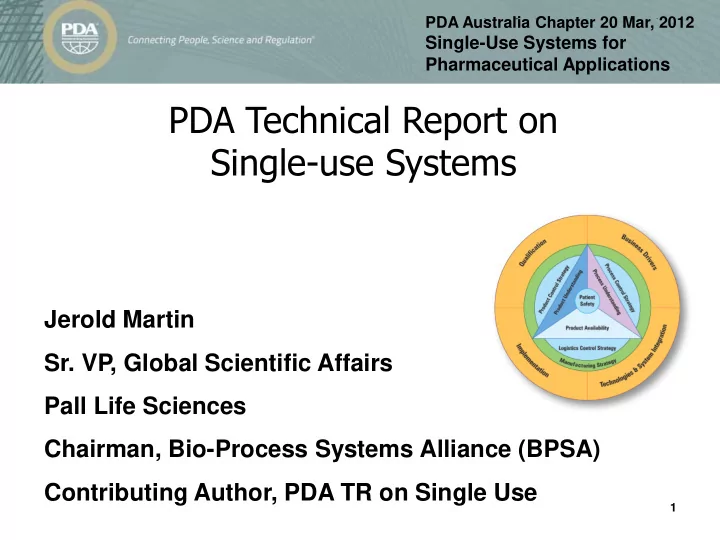
PDA Australia Chapter 20 Mar, 2012 Single-Use Systems for Pharmaceutical Applications PDA Technical Report on Single-use Systems Jerold Martin Sr. VP, Global Scientific Affairs Pall Life Sciences Chairman, Bio-Process Systems Alliance (BPSA)


slide-1
SLIDE 1

1

PDA Technical Report on Single-use Systems

April, 2011 | PDA Annual Meeting, San Antonio, Texas

Jerold Martin

  • Sr. VP, Global Scientific Affairs

Pall Life Sciences Chairman, Bio-Process Systems Alliance (BPSA) Contributing Author, PDA TR on Single Use

PDA Australia Chapter 20 Mar, 2012

Single-Use Systems for Pharmaceutical Applications

slide-2
SLIDE 2

2

Technical Report (TR) on Single Use System (SUS)

  • Support implementation of SUS
  • A guide, listing the areas to consider
  • Easy and fast to read
  • Build on the current best practice
  • Address regulatory aspects
  • Address technical aspects
  • Written by suppliers, users and regulatory

bodies

2

slide-3
SLIDE 3

3

PDA Goals for Technical Reports

  • PDA TR’s should reflect a global perspective and are

educational documents that are based in sound science and discuss meaningful studies and practical applications

  • f the science
  • Include not just the “How’s,” but also the “Why’s”
  • “Points to Consider” documents;

– current and applicable references used wherever possible to give further detail and/or support concepts presented

  • PDA Technical Reports are not intended to set standards
slide-4
SLIDE 4

4

Approach to the PDA Technical Document

  • Who are our Customers?

– Industry End Users – Regulators – Suppliers – PDA Scientific Approval Board

  • What do they want from this report?

– An understanding of Key Principles and Concepts for selection, use and qualification/validation of Single Use Systems – Breath of knowledge to enable people at various levels in an

  • rganization to make effective decisions relating to Single Use

Systems

4

slide-5
SLIDE 5

5

PDA Single Use Systems Task Force

Representatives from

  • US and Europe
  • Regulatory, US and Europe
  • Biopharmaceuticals
  • Vaccines
  • Gene Therapy
  • Small Molecules
  • Industry Suppliers
  • BPSA (Bio-Process Systems Alliance)

US 71% Europe 29% Supplier 32% End Users 63% Enabler 11% Regulator 5%

slide-6
SLIDE 6

6

Bill Hartzel Catalent (formerly with Arkema) Chris Smalley Merck Christian Julien Meissner Filtration Duncan Low Amgen Eberhard Bill, Ph.D. Boehringer Ingelheim GmbH & Co. Eric Isberg Computype (formerly w Thermo Fisher) Ingrid Markovic FDA James Robinson Lachman Consultant Services, Inc. Jeff Carter, Ph.D GE Healthcare Jerold Martin Pall Life Sciences Michael Kraich, Ph.D. Boehringer Ingelheim GmbH & Co. Morten Munk Co-Chair CMC Biologics Niels Guldager NNE Pharmaplan Paul Priebe Sartorius-Stedim Biotech Rich Levy PDA Robert Repetto Chair Pfizer Robert Shaw Ark Therapeutics Robin Alonso Genentech Russell Wong Bayer Healthcare Stephen Brown Vivalis

PDA Single Use Systems Task Force

slide-7
SLIDE 7

The Pyramid represents the desired state results of any well executed SUS implementation A through understanding of product and process risks are required in order to have a robust process with demonstrated patient safety, and product availability

slide-8
SLIDE 8

8

A well designed Manufacturing Strategy including Process Control, and Logistic Controls to support the desired state, patient safety, and product availability

slide-9
SLIDE 9

9

The outer circle identifies individual strategies required to successfully met the desired state

slide-10
SLIDE 10

10

Organization of the Document

slide-11
SLIDE 11

11

Introduction

  • Introduce QRM and QbD

– Philosophical basis of document

  • Flexible guidance providing concepts and key

considerations so the reader can ask the right questions, and make the best decision for their individual situation

  • Present guidance so organizations can make

the road map that suits them best.

  • Partnership between Supplier and End User
slide-12
SLIDE 12

12

Document Themes

slide-13
SLIDE 13

13

Asking the right questions depends on your situation….

  • What are your core functions?
  • What are your goals?
  • What stage is your product?
  • What is your core business?
  • Will SUS solve a problem you have, or reduce

cost?

  • Is there a better way?
slide-14
SLIDE 14
  • Voice of the PDA Community
  • 10 topic blocks

–Quality –Regulatory –Implementation –Business –Supplier Relation –Risk Assessment

14

slide-15
SLIDE 15

15

Time line for the SUS TR

slide-16
SLIDE 16

16

Section 3 – Manufacturing Strategy Decision Process

  • Designed to be able to stand alone, if only a
  • verview is required
  • Introduction and guide to find more detailed

information in the rest of the document

  • First section to be drafted and will be the last

section to find its final version, to ensure it meets its purpose

slide-17
SLIDE 17

17

SUS Advantages (some)

  • Reduced risk for (cross) contamination
  • Higher degree of closed operation
  • Reduced risk for need for re-scheduling due to

equipment operation issues

  • Higher flexibility
  • Lower capital investment
  • Flexibility for changes in market demand
  • Less down time (multi use facility)
  • Facility set-up time
slide-18
SLIDE 18

Asking the right questions depends on your situation

  • New facility
  • Single product
  • Development
  • Biological product
  • CMO
  • Few kg per year
  • Established facility
  • Multi product
  • Commercial production
  • Chemical product
  • Innovators' Facilities
  • Ton of product per year
slide-19
SLIDE 19

19

No · S i z e , P r e s s u r e , T e m p e r a t u r e L i m i t a t i

  • n

s · C

  • m

p l e x i t y

  • f

t h e s y s t e m · C

  • m

p a t i b i l i t y · F l e x i b i l i t y · F a c i l i t y u t i l i z a t i

  • n

· B a l a n c e

  • f

c a p i t a l a n d

  • p

e r a t i n g c

  • s

t s · C r

  • s

s c

  • n

t a m i n a t i

  • n

· A d s

  • r

p t i

  • n

· E x t r a c t a b l e s / L e a c h a b l e s · Regulatory acceptance · System reliability · Internal change acceptance Is SUS Technically Feasible? Implementation Strategy Acceptable? Process Control Strategy Acceptable? Logistic Control Strategy Acceptable? Product Risk Acceptable? Process Risk Acceptable?

SUS is feasible

· S y s t e m I n t e g r i t y L

  • s

s · P r

  • c

e s s a d j u s t m e n t s · O p e r a t

  • r

S a f e t y · Supply · Qualification · Transportation · Process validation · Measurement quality · Process interaction and and

SUS may not be applicable

Business Case Acceptable? and and and and and

Guided Decision Process
slide-20
SLIDE 20

Guided Decision Process - 1

slide-21
SLIDE 21

Guided Decision Process - 2

slide-22
SLIDE 22

Guided Decision Process - 3

slide-23
SLIDE 23

Guided Decision Process - 4

If the answer is YES to all question, then implementation of SUS can only be too SLOW

slide-24
SLIDE 24

24

No · S i z e , P r e s s u r e , T e m p e r a t u r e L i m i t a t i

  • n

s · C

  • m

p l e x i t y

  • f

t h e s y s t e m · C

  • m

p a t i b i l i t y · F l e x i b i l i t y · F a c i l i t y u t i l i z a t i

  • n

· B a l a n c e

  • f

c a p i t a l a n d

  • p

e r a t i n g c

  • s

t s · C r

  • s

s c

  • n

t a m i n a t i

  • n

· A d s

  • r

p t i

  • n

· E x t r a c t a b l e s / L e a c h a b l e s · Regulatory acceptance · System reliability · Internal change acceptance Is SUS Technically Feasible? Implementation Strategy Acceptable? Process Control Strategy Acceptable? Logistic Control Strategy Acceptable? Product Risk Acceptable? Process Risk Acceptable?

SUS is feasible

· S y s t e m I n t e g r i t y L

  • s

s · P r

  • c

e s s a d j u s t m e n t s · O p e r a t

  • r

S a f e t y · Supply · Qualification · Transportation · Process validation · Measurement quality · Process interaction and and

SUS may not be applicable

Business Case Acceptable? and and and and and

Guided Decision Process

slide-25
SLIDE 25
slide-26
SLIDE 26
slide-27
SLIDE 27

27

Is a SUS solution technically feasible? – a moving target

  • Structured evaluation of the available technical

solutions

  • Comparing MUS and SUS solutions
  • Moving to more integrated / complex systems
  • Technical risk evaluation
  • Integration between:
  • MUS and SUS
  • SUS and SUS
  • Different suppliers
slide-28
SLIDE 28
slide-29
SLIDE 29

29

Is SUS good business? – move from gut feelings to facts

  • Balance on fixed and operating costs
  • Time to market
  • Number of products / batches per year
  • “Green” manufacturing - waste handling
  • Risk factors – productions failures, contaminations,

supplier delivery issues, cleaning validation, etc.

  • Facility utilization / flexibility
  • Different products / Different locations
  • Time to establish manufacturing facility
slide-30
SLIDE 30

30

Project Survival %

Research Development Market

Clinical Trials I,II,III & Registration

50% 100% 8% 10%

40 Mont nth Projec

  • ject: 50%

% chan ance of being ing neede eeded 24 Mont nth Projec

  • ject: 90%

% chan ance of being ing neede eeded

Reducing project duration by 16 months reduces chance of the wrong investment being made by a factor of 5!

Effect of Postponing Decision to Build

slide-31
SLIDE 31
slide-32
SLIDE 32

32

Patient safety can never be compromised -

  • Extractables and Leachables issues
  • Risk evaluation – balancing pro and cons for

MUS and SUS systems

  • Sanitation and sterilization
  • Integrity (leak) testing
  • Quality of components / data from SUS sensors
  • Supplier Audits / Qualification
  • Validation issues
  • Acceptance test – installation qualification
slide-33
SLIDE 33

A directional risk profile of various SUS applications

System complexity

Low Medium High

Complexity

  • f

application

High Freeze thaw Fill and finish Cell culture Product storage Medium Transport shipping Mixing Purification Low Buffer storage Concentration Clarification Recovery

33

The addition of valves, sensors and manifolds increases complexity and risk

slide-34
SLIDE 34
slide-35
SLIDE 35

35

All the other things that make a project successful or not

  • Risk Assessment – logistic issues and

combining risk assessments - full picture

  • Implementation plan
  • Stakeholder management
  • Supplier agreements
  • Training
  • Safety for operators
  • Material management – receiving, storage,

transport and waste

  • Facility layout
slide-36
SLIDE 36

SUS Impact on Plant Design

Conventional design New design

slide-37
SLIDE 37

Materials Control

37

slide-38
SLIDE 38

38

Components of material risk

Supplier risk Material risk Process impact

Business continuity

  • Capacity
  • Sole sourcing
  • Disaster recovery
  • Business fit

Material safety

  • Toxicity, carcinogenicity
  • Immunogenicity
  • Viral safety
  • Residual solvents, metals

Quality

  • Purity
  • Contaminant profile
  • Product variants
  • Point of use

Supplier Quality

  • Audit
  • Change control
  • Supply chain transparency

Material complexity

  • Compendial chemicals
  • Complex nutrients
  • Integrated systems

Process performance

  • Titer
  • Yield
  • Throughput

Technical capability

  • Process/product understanding
  • Applications development
  • Service and support

Handling

  • Lot-to-lot consistency
  • Clumping, particles
  • Cleaning, disposal

Facility fit

  • Available equipment
  • Tankage
  • Local regulations
slide-39
SLIDE 39

39

A science- and risk-based approach consistent with ICH Q8

Define Target Product Profile

  • Efficacy
  • Safety
  • Manufacturability

Establish CQA’s

  • Science based, prior experience
  • Linked to TPP
  • Susceptible to variability

Conduct Risk Assessment Verify Design Space

  • Critical process parameters
  • Process execution requirements
  • Process performance attributes

Implement Control Strategy

  • In-process and end of process controls
  • Use of online and offline controls
  • Real time release

Practice Continuous Improvement

  • Continuous Quality Verification
  • Change within/outside design space
  • Risk-appropriate regulatory approach
  • Link RM attributes and CPP to CQA’s
  • Impact on safety and efficacy
  • Rank order by criticality
slide-40
SLIDE 40

40

Repeat at multiple points as more information becomes available

Materials selection Materials qualification From A-Mab: a Case Study in Bioprocess Development. Available from CASSS and ISPE

Initial assessments prioritize and focus studies Additional assessments confirm and lead to control and mitigation

slide-41
SLIDE 41

Identify the risk associated with SUS

  • Product contact vs. non-product contact
  • Upstream vs. downstream
  • Short term vs. long term
  • Leachable components

– Product and process interactions

  • Impact of sterilization

41

slide-42
SLIDE 42

Risk Identification – Organize Information

  • Brainstroming, What If?, Mind mapping
  • Flowcharting, process mapping, fishbone/Ishikawa
slide-43
SLIDE 43

Risk analysis – choose the right tool

Simple - Risk ranking, pareto, control charts Complex - Fault tree analysis, PHA, HACCP, FMEA, FMECA

Attributes What If? PHA FMEA HAZOP Description

Brainstorming technique used to analyze design hazards Broad qualitative tool used in the early stages of system design Used to identify system failure points Systematic technique used to simulate the ways a process can fail

Complexity

Complex, but easily understood Simple More complex to facilitate and understand Most complex to facilitate and understand

Applicability

Preliminary or detailed design and operations Early stages of project Detailed design

  • f process

Detailed design of process and

  • perations
slide-44
SLIDE 44

Limitations of FMEA

  • Not good at prioritizing very low frequency

catastrophic events (shutdown, recall)

  • Doesn’t differentiate between products, processes

and sites

  • Differentiation between random negative events and

deliberately targeted criminal activity

  • There are simple precautions we should take even if

the risks are very low

44

slide-45
SLIDE 45

Analyse risk in terms of point of use and potential consequence

Category Material risk Consequence

DP Components Product containers Terminal filters Viral filters Bioreactor bags Resins In-process filters Media bags Generic filters Buffer bags Adulteration Viral contamination Discontinuation/shortage Material quality failure Material process modification Material variability Extraneous matter Price increase Product recall Manufacturing shutdown Release test failure In process failure Process performance Nuisance

45

slide-46
SLIDE 46

A directional risk profile of various SUS applications

System complexity

Low Medium High

Complexity

  • f

application

High Freeze thaw Fill and finish Cell culture Product storage Medium Transport shipping Mixing Purification Low Buffer storage Concentration Clarification Recovery

46

The addition of valves, sensors and manifolds increases complexity and risk

slide-47
SLIDE 47

Comprehensive characterization is a pre-requisite to understanding variability

  • Surface Morphology

– Optical microscopy (polarized and stereo-microscope) – Scanning Electron Microscopy (SEM)

  • Surface Chemistry

– X-Ray Photoelectron Spectroscopy (XPS) – FTIR-microscope and Raman-microscope – Energy-dispersive X-ray spectroscopy (EDS)

  • Surface Hydrophobicity

– Tensiometry (contact angle)

  • Leachable/Extractable
  • NMR, FTIR, HPLC/MS, GC/MS, ICP-MS.
slide-48
SLIDE 48

Impact goes beyond physicochemical testing

  • USP <88> for Class VI Plastics is NOT representative of

cell culture requirements

– See USP <87> “Cytotoxicity”

  • Consider impact of E/L on media and SUB

performance as well as buffer and drug product

– Impact on cholesterol dependent cells – Impact of multiple passages

  • Impact on other process steps

– Residual silicone from tubing can significantly depress bubble points of filters

48

slide-49
SLIDE 49

Follow a defined path to qualification and control

49

slide-50
SLIDE 50

Use of supplier documentation

  • Definitive for film design/manufacturing
  • Starting point for extractables and leachables

– Assess for relevance

  • Sufficient for low risk/impact applications

– Short term exposure – No drug product contact – Upstream step

  • Critical review is required when comparing suppliers

50

slide-51
SLIDE 51

User Quality Systems

  • Receive, quarantine, inspect and release
  • Testing will depend on the application

– Mostly confirmation to drawings, supplier data

  • Off the shelf vs. custom
  • Acceptable particulates

– On bag – In film (cosmetic vs. compromises integrity) – In bag (where’s the filter?)

51

slide-52
SLIDE 52

Validating an SUS

  • Process validation remains the responsibility of the

pharmaceutical manufacturer

  • Leveraging supplier data requires an understanding of how it

was developed

– Materials of construction – Testing procedures (e.g. pyrogens, heavy metals, solvents , E/L)

  • System design may require features to facilitate validation

– Alternate receiving vessels to accommodate testing

  • Integrity testing

– Desirable, but not necessarily realistic or achievable

  • Campaigning

– Surge vessels, columns

52

slide-53
SLIDE 53

SUS in the real world

  • What if there’s a leak?

– Before or after use? – Buffers and media filtered prior to use – SUB’s – positive pressure prevents ingress? – maybe – Product container integrity is compromised

  • Training, inspection and handling procedures
  • Failure rates of 1 in 500 or better

– 1 failed run in 4 years for 3 bags in a seed train and 40 batches – Compare to probability of failing a questionable integrity test

53

Share information on process capability to be able to provide regulators with data on the level of risk

slide-54
SLIDE 54

Materials management - no pain, limited gain

  • Low impact mtls are relatively easy to alternate source

– Decreases exposure at a single supplier – Gain experience of alternative suppliers’ quality system – Financial benefits a consideration

  • High impact materials require more work to qualify

– Addresses higher risks (supply interruptions, recalls) – Lower frequency of use – The back-up may fail before the primary

  • Maintain high levels of support and service from

suppliers

54

slide-55
SLIDE 55

Conclusions

  • Suppliers are an integral part of the quality system
  • Unprecedented levels of transparency and data

sharing and management are required

  • Those who fully embrace true partnerships will be

the most successful

55

slide-56
SLIDE 56

Quality Attributes – Sterilization and Particulates

slide-57
SLIDE 57

Quality Attributes that need to be qualified

  • Extractables and Leachables (E&L)
  • Primary difference between qualification requirements of

SUS and classic Multiple-use Systems

  • Sterilization and Particulates
  • Need a full understanding of supplier data and

recommendations that support the validation effort

  • Determination of sterilization methods
  • Assembly environment impacts bioburden and

particulate levels

  • Any process steps such as rinsing
slide-58
SLIDE 58
  • Sterilization
  • Irradiation is the leading means of providing

a sterilized SUS by a supplier

  • Ionizing radiation readily penetrates plastics
  • Dosing is well characterized
  • Representative Master Product SUS for
  • Bioburden
  • Low ‘Verification’ Dose (VDmax) sterility
  • Calculation of a suitable dose for 10p6 SAL

(per ISO 11137)

  • Typical dose is >25 kGy
slide-59
SLIDE 59
  • Irradiation needs to be

performed prior to almost all other qualification tests

  • n irradiated components
  • Will affect E&L and

physicochemical tests, among others

  • Caution - double dose

sterilization prior to qualification tests may not be appropriate

59

slide-60
SLIDE 60
  • Sterilization may not be necessary
  • Intrinsic bioburden is Low
  • Applications similar to plastic bottles for oral

products

  • Bioburden reduction may be sufficient
  • 25 kGy or lower dose exposure

(8 – 10 kGy)

slide-61
SLIDE 61

Sterilization: (cont’d)

  • Irradiation causes formation of free radicals

– Increases E&L – Can degrade some polymers

  • Re-sterilization should not be done
slide-62
SLIDE 62

Sterilization: (cont’d)

  • Moist Heat (Steam) - alternate means of providing

a sterilized SUS

  • Difficulty in assuring steam penetration &

equilibration to all fluid contact surfaces

– Vent filters may need to be added – Positioning to prevent condensate build-up – Systems may not be able to be sterilized fully assembled

  • Subsequent aseptic/sterile connections
slide-63
SLIDE 63

Sterilization: (cont’d)

  • Moist Heat (Steam)

– Can Increase E&L – Can degrade some polymers

  • If qualification is performed on 2x sterilized SUS

units, re-sterilization on package failure or other issues could be possible(?)

– Otherwise, re-sterilization should not be done

slide-64
SLIDE 64

Sterilization: (cont’d)

  • Except for Interfaces, SIP is not commonly used
  • Most SUS cannot withstand pressure in situ
  • Gas Sterilization (EtO) is not commonly used,

nor is VHP

– Gas and reaction products may remain within the plastic material and become leachables

slide-65
SLIDE 65

Incorporating Single Use Systems into manufacturing processes has enormous potential to simplify and optimize

  • perations

Industries challenge is to escape our past practices and develop an actionable roadmap for implementing these concepts Incorporating Single Use Systems into manufacturing processes has enormous potential to simplify and optimize

  • perations

Industries challenge is to escape our past practices and develop an actionable roadmap for implementing these concepts

Particulates:

  • Limits for particulates should be based on applic’n
  • Particles embedded in the plastic film or molded part

do not need to be addressed

  • Methodology should follow USP <788> “Particulate

Matter in Injections”

  • Acceptance criteria are not applicable to upstream

processes

  • Particulate specification for upstream process

components/SUS can be based on process requirements

65

slide-66
SLIDE 66

Particulates: (cont’d)

  • Some SUS suppliers can perform particulate

shedding/release testing to investigate the robustness of their manufacturing process

  • Typically Class 100,000/Grade C Clean Rooms
  • Users can qualify SUS by testing fluid path rinses
  • Initially lot samples, then periodic audits
  • Consider peristaltic pump effects on tubing

66

slide-67
SLIDE 67

Acknowledgments

  • Bob Repetto,

Pfizer

  • Morton Monk,

CMC Bio

  • Duncan Low,

Amgen

slide-68
SLIDE 68

Questions