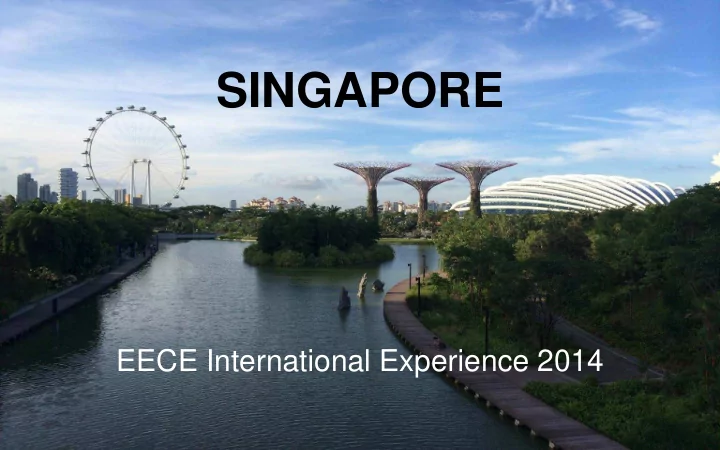
SINGAPORE EECE International Experience 2014 Rett, Ian, Z, Grace, - - PowerPoint PPT Presentation

singapore
SMART_READER_LITE
LIVE PREVIEW

SINGAPORE EECE International Experience 2014 Rett, Ian, Z, Grace, - - PowerPoint PPT Presentation

SINGAPORE EECE International Experience 2014 Rett, Ian, Z, Grace, and Shane NUS Overview Vision: A leading global university centered in Asia Divided into 14 schools and faculties, gives 55 bachelor's degree Student population


slide-1
SLIDE 1

SINGAPORE

EECE International Experience 2014

slide-2
SLIDE 2

Rett, Ian, Z, Grace, and Shane

slide-3
SLIDE 3

NUS Overview

  • Vision: A leading global university

centered in Asia

  • Divided into 14 schools and faculties,

gives 55 bachelor's degree

  • Student population in the 12’-13’

school year is 27,216 UG and 10,210 graduate students.

  • School of engineering, with ~7000 UG

students and ~350 faculties, has comprehensive programs that encompass many major fields in engineering.

Elements of the NUS logo: Open book - portal to knowledge 3 rings - creating, imparting and applying knowledge, and they reinforce each other Lion - symbol of the nation of Singapore

slide-4
SLIDE 4

NUS ChBE Department

slide-5
SLIDE 5

Chemical Engineering Labs

Fume hoods and workbenches seen in NUS ChBE research labs.

slide-6
SLIDE 6

Clathrate Hydrates

  • Dr. Praveen Linga’s research

interests include:

  • storage of carbon dioxide with

Hydrate Based Gas Separation technique;

  • development of method to recover

methane from hydrates

  • development of inhibitors to

prevent undesired hydrate formation in pipelines

slide-7
SLIDE 7

Methane Hydrates

  • Clathrates - gas molecules trapped in

water-based solid that resembles ice.

  • Water cages are made by hydrogen

bonds, and can form different crystal structures (as seen in the figure on the right)

  • A large amount of methane is trapped in

clathrate form on the deep ocean floor, a vast potential clean energy source.

  • Sudden release of methane from clathrate

form is a major cause of greenhouse effect.

slide-8
SLIDE 8

Hydrogen Storage

Why store hydrogen in hydrates form?

  • A small volume of hydrate can

store hydrogen that are >100x larger in standard state.

  • It requires only moderate

temperature and pressure to accomplish.

  • It is safe to store, and is

environmentally benign.

  • Using of THF can reduce

pressure need, but THF also reduced storage capacity.

slide-9
SLIDE 9

The Merlion

  • Mascot and personification
  • f Singapore.
  • Fish tail represents

Singapore’s origin as a fishing village.

  • Lion head symbolizes

Singapore’s original name in Malay: Singapura - “Lion City”

  • Now located in the most

prosperous area by the bay.

slide-10
SLIDE 10

Multi-Objective Optimization

Real-life problems have multiple

  • bjectives, decision variables, and

constraints. Dr G. P. Rangaiah investigates solutions to these problems in Chemical Engineering.

slide-11
SLIDE 11

Using Excel: EMOO

Excel-based Multi-Objective Optimization (EMOO) is a program written by Dr Rangaiah and Shivom Sharma to solve MOO. It is in beta and currently used in academic settings.

slide-12
SLIDE 12

Modeling of Particles

Research in particle modeling is in the application to practical systems.

  • Dr. Eldin Lim researches the application
  • f CFD-DEM theory to fluidized beds,

granular materials, and evacuation.

slide-13
SLIDE 13

Nanyang Technological U.

NTU is another major university in Singapore. A $849M grant in 2008 helped build the Nanyang Environmental and Water Research Institute (NEWRI).

slide-14
SLIDE 14

Transportation in Singapore

It costs $80K to purchase a “driving permit” in Singapore, intended to reduce congestion. Most people get around using the robust public transit network of subways, light rail, and busses.

slide-15
SLIDE 15

Self-Assembly of Amphiphiles

The interaction of the hydrophilic and hydrophobic sections allow these molecules to have emerging material science applications, usefulness as

  • Dr. Shing Bor

Chen

diagram of micelle

drug delivery systems, and possibilities as innovative medical diagnostic tools.

slide-16
SLIDE 16

Methodology

  • Rheometry
  • Calorimetry
  • Fluorescence

Microscope

  • UV-vis

spectrometry

  • Computer

simulation Dynamic Light Scattering (DLS)

slide-17
SLIDE 17

Clean Energy

Jim Yang Lee, Department Head

  • Energy consumption scales with

global economic growth.

  • Clean energy=clean energy

source + efficient use of the energy

  • Sustainability involves

environmental, economic, and social impact.

slide-18
SLIDE 18

CO2 Emissions vs. GDP

“Energy system transformation is not only a technical issue, but also a high level management, financial, and political issue. We need a program of planned activities from all governments and market-based actions for a solution in the short time we have.” -Dr. Lee

slide-19
SLIDE 19

Cleaner Fuels?

Biofuels: The main value

  • f biofuels is not in reducing

global warming, but in increasing energy security.

  • 1st generation- from food crops -
  • > food vs. energy debate
  • 2nd generation- cellulosic --

>positive net energy gains?

  • 3rd generation- photosynthetic

algae or cyanobacteria -- >carbon negative?

  • 4th generation- genetically

engineered photosynthetic cells

  • -> carbon negative?

Source: Jim Yang Lee’s presentation

Greener Fossil Fuels: Thermodynamics favors the use of

high-energy, low oxidation state carbon starting materials as it will release the most heat when burned. Lowering of the carbon oxidation state requires energy input (e.g. photosynthesis).

slide-20
SLIDE 20

Singapore International Water Week

  • Innovative Technology

in the water treatment sector and beyond

  • Encouraging

Professionals from around the globe

  • Introduction to specific

aspects of industry

Pictured with sand filtration display

slide-21
SLIDE 21

Gardens by the Bay

Above: Super Trees lit up at night Right: Waterfall inside Cloud Forest Conservatory

slide-22
SLIDE 22

Process Systems Engineering

Challenges in Oil & Gas Supply Chains Professor Karimi Department of Chemical & Biomolecular Engineering

  • Broad, qualitative overview:

modeling, simulation, and

  • ptimization (EMOO)
  • The lecture as it applies to my

major: ○ Methods of systems eng. applied within the domain of chemical eng. ○ Signals & Systems: input-

  • utput, state-space models

○ Operations Research: linear programming

slide-23
SLIDE 23

Jurong Island

slide-24
SLIDE 24

Not the Earthquake’s Fault

Geophysical Hazards and Post-Colonial Ecology in Haiti Brian McAdoo Professor of Environmental Studies and Geophysics

  • Defining engineering

○ Practical application of pure sciences ○ Scientists point out problems. Engineers fix them. ○ “Science with accountability”

  • Risk = hazard x vulnerability - mitigation

resilience

slide-25
SLIDE 25

Case Study: 2010 Haiti Earthquake

Just outside Port-au-Prince

slide-26
SLIDE 26

The Coastline Problem

150 m

slide-27
SLIDE 27

Large-Scale Sedimentation

The positive feedback loop of deforestation and poverty

slide-28
SLIDE 28

NEWater

The Process

  • 1. Membrane filtration
  • 2. Reverse osmosis
  • 3. UV treatment

The Need High population density on a small plot of land The Future NEWater currently meets 30 percent of the nation’s water

  • demands. It hopes to bring

that number to 55 percent by 2060.

slide-29
SLIDE 29

Food

Diverse, Communal and Cheap

  • Sentosa
  • Boat Quay
  • Market food

3 proteins, rice and veggie: $4 SG = $3.20 US

slide-30
SLIDE 30

Waste Biomass to Fuels

Ning Yan

Assistant Professor, Dept. of ChBE PhD (Chemistry) Peking University, 2009

slide-31
SLIDE 31

From Nature to Product

  • Lignin transformation: aromatic polymer with many C-O bonds, cut them by Hydrogenolysis
  • Glucose to HMF: dehydration reaction using chromium chloride in synthesis
  • Oxidize HMF to get FDCA, make bottles from it
slide-32
SLIDE 32

Chitin to Chemicals

  • Chitin has amine group on carbon 2, otherwise same as cellulose
  • Synthesize chitin into oil, natural gas, or coal
  • New source for nitrogen-containing products, good alternative to using N2
  • Reduce waste and utilize by low-energy means all at once
slide-33
SLIDE 33

Impacts of Biomass Burning

Rajasekhar Bala

Associate Professor, Dept. of CEE Ph.D. (Atmospheric Chem.), University of Miami, 1991 Regional air pollution caused by airborne particulate matter > In Southeast Asia, particularly in Sumatra, Indonesia, peat fires affect the soil, the rainfall, the stratosphere, biodiversity, air, solar radiation, etc.

slide-34
SLIDE 34

Global Issue for Humans

  • Burning of fossil fuels

results in ozone destruction, loss of biodiversity, release of aerosols, effects on soil, etc.

  • Forest fires do occur

naturally, but many of the fires that affect entire ecosystems are caused by humans

  • From the haze in Beijing to

the peat fires in Sumatra, we all have to help stop environmental destruction

slide-35
SLIDE 35

Biopolis

  • Multi-discipline research

complex

  • Publically funded
  • Buildings organized by research

topics

slide-36
SLIDE 36

The Nanos

Institute of bioengineering and nanotechnology

“Delivery of a Granzyme B Inhibitor Gene Using Carbamate-Mannos Modified PEI Protects Against Cytotoxis Lymphocyte Killing”

“From Biomass to Bio-Chemicals” Biomass surgars to HMF to FDCA to make nylon and polymer

slide-37
SLIDE 37

Night Safari