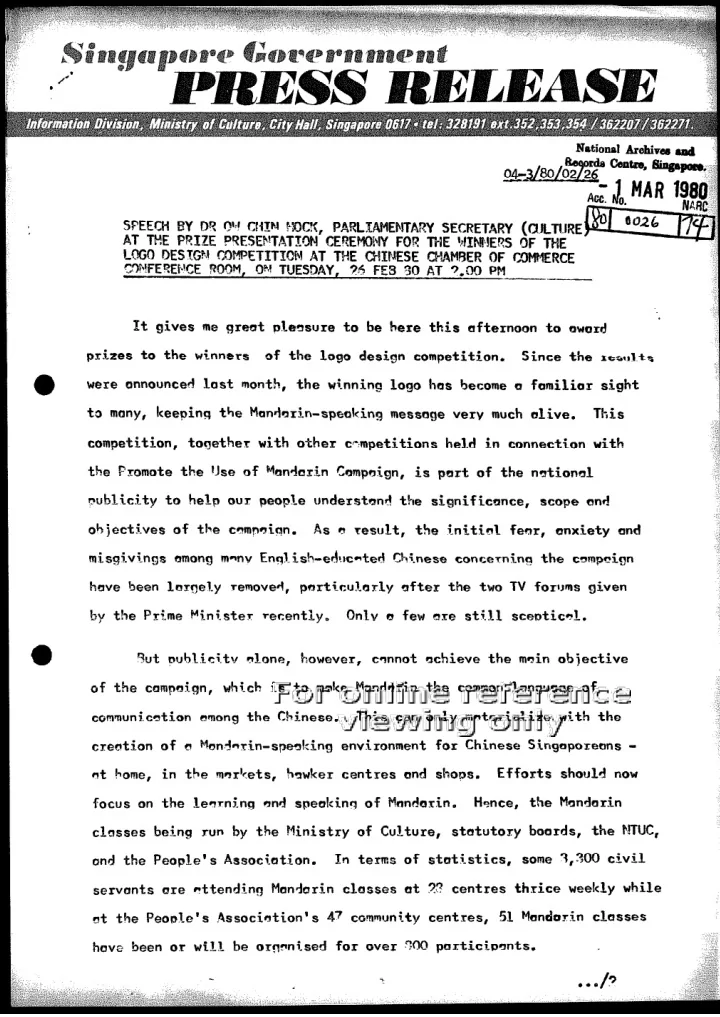
Since the results of the logo design competition. prizes to the - - PDF document

since the results of the logo design competition
SMART_READER_LITE
LIVE PREVIEW

Since the results of the logo design competition. prizes to the - - PDF document

gives me great pleasure to be here It this afternoon to award Since the results of the logo design competition. prizes to the winners were announced lost month, the winning logo has become a familiar sight many, keeping the


slide-1
SLIDE 1

It

gives me great pleasure to be here

this afternoon to award prizes to the winners

  • f the logo design competition.

Since the results

were announced lost month, the winning logo has become a familiar sight to many, keeping the Mandarin-speaking message very much alive. This competition,

together with other

competitions held in connection with the Promote the Use of Mandarin Campaign, is part

  • f

the national publicity to help

  • ur

people understand the significance, scope and

  • bjectives
  • f

the

campaign.

As a result, the initial fear, anxiety

and

misgivings among many English-educated Chinese concerning the

campaign

have been largely

removed, particularly

after the two TV forums given by the Prime Minister recently, Only a few are still

sceptical

But publicity alone, however, cannot achieve the main objective

  • f

the campaign,

which is to make Manderin the

common language

  • f

communication among

the Chinese. This con only

moterialize with the creation of a Mondarin-speaking environment for Chinese Singaporeans

  • at

home, in the markets, hawker centres and shops. Efforts should now focus

  • n the

learning and speaking of Mandarin. Hence, the Mandarin

classes being run by the Ministry

  • f Culture,

statutory

boards, the NTUC,

and the People’s Assocation.

In terms of statistics, some 3,300 Civil

servants are attending

Mandarin classes at

at

23 centres thrice weekly while

at the People’s

Association's 47 community

centres, 51 Mandarin classes

have been or will be organised for over 800 participants. *

slide-2
SLIDE 2

3

As far as the Mandarin course for civil servants is concerned, the results have been more than satisfactory. A recent survey shows that the majority of the participants were highly motivated, adopting Q positive attitude towards the course. A questionnaire survey on attitudes end expectations conducted

  • n 1,703 particpants in

62 Mandarin classes (Ok 56%

  • f th e

total participants) reveals that 85%

were pleased to attend the course while about 75% felt that the course Was useful to them. In fact, the response to such courses has been very encouraging; even to dote, the Ministry of Culture still receives requests from the various a ministries for the enrolment of their officers. In view of this, my Ministry will approach

the Ministry of Finance to consider increasing

the number

  • f these classes.

In planning Mandarin courses in the future, we will take into consider&ion some

  • f the observations we made
  • n the

present course

participants A pre-course evoluation

  • f the Mandarin

proficiency of a random sample

  • f

457 officers,

shows that many of

them hod no difficulty

in listening and understanding Mandarin. In fact, some

  • f then had had

a few years of Chinese education. The emphasis should therefore be on encouraging the participants to speak and practise the language as often

as possible in order to attain

confidence and fluency

and correct

usage

  • f words phrases and expressions.

The enthusiesm shown by these officers

towards the learning of

Mandarin and the good response to the Mandarin classes at

community

centres show that many English-educated have been convinced of the usefulness and importance of the language. Another target group of Chinese Singaporeans yet to be won

  • ver

are the less-educated ones Such as hawkers,

stallholders

and

shop

assistants. Despite their support for the compaign, they still tend to use .-.. /3

slide-3
SLIDE 3

NO national. compaign,

especially

  • ne involving

so sensitive an a issue OS language,

can

he launched without some misconception and

apprehension in Some guarters.

You will recall

the strong

reaction among

some sections

  • f

the Chinese population against the decision

  • f

the then RTS to dub popular Contonese TV serials into Mandarin. Many reasons flavour were expounded, such as lack

  • f

fervour,

excitement, authenticity, etc. But all proved to be unfounded.

There

are indications

that

more people

now are enjoying the serial., "Heaven

Sword and Dragon Sabre", which OS the first Cantonese serial to be dubbed

had

caused the controversy. According to the latest SRS

survey, conducted over a six-week period, the Mandarin version

  • f

this serial is now enjoyed by 322,000

viewers,

as compared with 826,000

viewers for the

last. two episodes

  • f

the Cantonese serial. “The Romantic Swordsman” and the first four episodes

  • f the Mandarin

version

  • f

"Heaven Sword and Dragon Sabre" over a

previous six-wee'.: period.

This is proof that viewers value the quality

  • f

a production, not the language used. After some initial

resistance,

Chinese Singaporeans are now enjoying the dubbed programmes. Another controversial

issue associated

with the Mandarin

campaign

Was the use of Hanyu Pinyin for the naming of the new-horns

in birth-

certificates.

Since we are now making

great

efforts towards the day

when ..,../4.

use dialects

in the hawker centres and shops. The reason is not innorance

  • f

Mondarin

but

a

deeply ingrained speech habit.

More efforts

must

therefore be channeled towards this

direction.

In fact

in

a speech earlier

this month,

I urged the hawkers

to organize Mandarin

classes

with the help

  • f

perhaps, the Environment Ministry and the Housing Board. Towards this common objective,

the Singapore Chinese

Chamber

  • f

Commerce and Industry,

which is one of

the

  • rganizers
  • f

the campaign,

can also play a big role in

urging

the the

and clan

associations to

run Mandarin closseS for their members.

slide-4
SLIDE 4

when Mandarin will

be widely used among the Chinese Singaporeans

in our

society, it is only logical to

standardize

the spelling of Chinese

names and business names in the long-run.

However, as Hanyu Pinyin is a

completely new way of spelling Chinese names, standordization

is to be

implemented only

when people are more familiar

with the system. In the

meantime,' however,

parents who choose to use Hanyu Pinyin for their

children's names may do so at the Registry of Births

and Deaths where

there is a guide on surnames in

Hanyu Pinyin for reference. Efforts

hove been made to popularise the use of Hanyu Pinyin. The SBC will soon

broadcast and telecast a

13-week

course on Hanyu Pinyin for

those

who

are interested in learning

the system. But due to the legal and social

complications

involved in the Hanyu Pinyin,

  • f Chinese surnames, it

may be

better, es a first step, for

the

business sector and clan associations to adopt the use of Hanyu Pinyin.

The Singapore Chinese

Chamber

  • f

Commerce and Industry

could

play a role in

this

respect.

Finally, I would like to

commend

the Singapore Chinese

Chamber

  • f

Commerce

and Industry for

having contributed

so much towards the promotion

  • f

the Speak Mandarin Campaign.

The Logo

Design

Competition is just one

  • f the

many examples of its

support and efforts.

However, as the compaign’s

  • bjective

involves a long-term process, success can only be ensured through

sustained

effort,

and I hove no doubt that

it will

continue to join in the national

effort to work towards the emergence

  • f

a

Mandarin-speaking environment

for Chinese

Singaporeans.

My congrotulations, too, to the winners of the logo Design Competition.