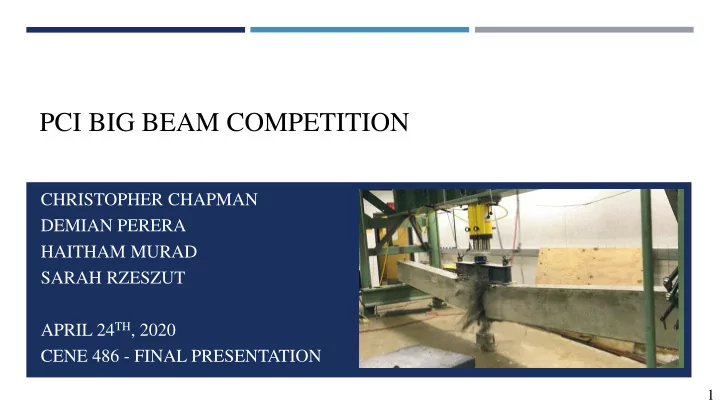
PCI BIG BEAM COMPETITION CHRISTOPHER CHAPMAN DEMIAN PERERA HAITHAM - - PowerPoint PPT Presentation
PCI BIG BEAM COMPETITION CHRISTOPHER CHAPMAN DEMIAN PERERA HAITHAM MURAD SARAH RZESZUT APRIL 24 TH , 2020 CENE 486 - FINAL PRESENTATION 1 STAKEHOLDERS Figure 1. NAU Logo Figure 2. PCI Logo Figure 3. TPAC Logo 2 PROJECT INTRODUCTION
STAKEHOLDERS
2
Figure 1. NAU Logo Figure 2. PCI Logo Figure 3. TPAC Logo
PROJECT INTRODUCTION
Purpose:
- Analyze, design, and test a
prestressed concrete beam Technical Aspects and Considerations:
- Rules for the competition
- 20-foot long beam
- Crack after 20 kips
- Break between 32-40 kips
3
Figure 4. Load Distribution
MILESTONES
4
- Task 1: Preliminary
Research
- Task 2: Preliminary
Beam Design
- Task 3: Final Design
and Analysis
- Task 4: Predictions
- Task 5: Shop Drawings
- Task 6: Casting of
Beam
- Task 7: Testing of Beam
- Task 8: Project
Management
- Task 9: Project Impacts
TASK 1: PRELIMINARY RESEARCH
5
1.1 Three Stages of Design Prestressed Concrete Beam
- Release
- Cracking load
- Ultimate strength
1.2 Preliminary Cross-Section Designs
- I-beam
- T-beam
- Box
- Hollow Box
1.3 Preliminary Decision Matrix
- Determine decision
matrix criteria based off PCI scoring
TASK 1.1: THREE STAGES OF DESIGN PRESTRESSED CONCRETE BEAM
- Release (1)
- Cracking load (2)
- Ultimate strength (3)
6 P = Vertical Load A = Area MPS = Moment prestress c = Distance from fiber to neutral axis I = Moment of Inertia fc28 = 28 compressive stress MD = Moment dead load MLL = Moment live load Ap = Area Prestressing fp = Stress due to prestress 𝞒1 = Depth factor
TASK 1.1: THREE STAGES OF DESIGN PRESTRESSED CONCRETE BEAM
7
Figure 5. Release Process
TASK 1.2: PRELIMINARY DESIGNS
8
I-Beam T-Beam Box
Figure 6. I-Beam Figure 7. T-Beam Figure 8. Hollow Box
TASK 1.3: PRELIMINARY DECISION MATRIX
- Determine decision matrix criteria based off PCI scoring
- Lowest cost
- Lowest weight
- Largest deflection
9
Figure 9. PCI Logo
TASK 2: PRELIMINARY BEAM DESIGN
2.1 Initial Beam Designs
- Design 6 beam options with
different depths and cross sections 2.2 Final Decision Matrix
- Mix selection
- Beam selection
10
Figure 10. MathCAD Logo
TASK 2.1: INITIAL BEAM DESIGN
- Design 6 beam options with different depths and cross sections
11
I-Beam T-Beam Box
Figure 12. I-Beam Figure 11. Box Figure 13. T-Beam
TASK 2.2: DECISION MATRIX
12
Table 1. Beam Decision Matrix
TASK 3: PRELIMINARY RESEARCH
13
3.1 Shear Design 3.2 Reinforcement Design 3.3 Cracking Load 3.4 Max Load at Midspan
Figure 14. Bending Beam
TASK 3.1: SHEAR DESIGN
14
Figure 15. Equations for Shear
Vcia = Flexure Shear Capacity ⋋ = factor for density of concrete fc = Compressive stress of concrete bw = base width dp = distance from compression steel to prestressing vd = shear force due to dead load vi = shear force due to max moment Mcre = Moment of cracking die to applied load Mmax = Maximum moment Vcib = Flexure Shear Capacity Vcw = Web Shear Capacity fpc = Compressive stress of concrete resisting external loads vp = Vertical effective prestress force
TASK 3.1: SHEAR DESIGN
15
- Shear design is based off the smaller value of the Flexure Shear
Capacity (Vci) and Web Shear Capacity (Vcw)
- Calculated at the support that has maximum shear and the load
point which has the maximum shear
- No.3 stirrups at 18” spacing were used on beam
Figure 16. Live Load Diagrams
16
Figure 17. Self Weight Diagram
17
Figure 18. Combined Diagram
18
TASK 3.2: REINFORCEMENT DESIGN
19
Compression Steel (top of beam)
- 3 No. 4 bars
Prestressing Strand (bottom of beam)
- 2 of .5” Diameter Low Relax Strands
Figure 19. Big Beam Theory Logo
TASK 3.3: CRACKING LOAD
20
21.083 kip
Figure 20. MathCAD Sheet for Cracking Load
TASK 3.4: MAX LOAD AT MIDSPAN
21
37.062 kip
Figure 21. MathCAD Sheet for Max Load
TASK 4: PREDICTIONS
22
4.1 Response 2000
- Moment curvature and Internal
moment and axial force 4.2 Prediction Calculations
- Deflection
- Camber
Figure 22. Response 2000 Logo
23
Figure 23. Response 2000 Input
24
Figure 24. Response 2000 Output
TASK 4.1: RESPONSE 2000
25
Figure 25. Response 2000 Output Cracking Depth Cracking Moment Maximum Moment Cracking Moment
TASK 4.1: RESPONSE 2000
26
Figure 26. Response 2000 Output
TASK 4.2: PREDICTION CALCULATIONS
- Deflection - .477 inches
- Camber - .042 inches
Figure 27. Beam Bending
27
TASK 4.2: PREDICTION CALCULATIONS
Losses
- Elastic Shortening = 3.38 ksi
- Beam length gets shorter
- Creep of Concrete = 4.28 ksi
- Pressure causes deformation in
the concrete
28
Figure 28. Last year’s formwork
TASK 4.2: PREDICTION CALCULATIONS
Losses
- Shrinkage of Concrete = 10.29 ksi
- Drying of concrete affects stretch of
the strands
- Average annual humidity percentage
- Relaxation of Tendons = 4.28 ksi
- Strands relaxation over time
29
Figure 29. Last year’s Screeding of Concrete
TASK 5: SHOP DRAWINGS
30
5.1 AutoCAD
- 5.1.1 Side Elevation
- 5.1.2 Cross Section
- 5.1.3 Profile View
Figure 30. AutoCAD Logo
31
Figure 31. Shop Drawings
TASK 5.1.1: SIDE ELEVATION
32
Figure 32. Side Elevation
TASK 5.1.2: CROSS SECTION
33
Figure 33. Cross Section
TASK 5.1.3: PROFILE VIEW
34
Figure 34. Profile View
TASK 6: CASTING OF BEAM
35
Casting Info:
- Poured on 3/23 at 9am
in Phoenix
- The Beam should be
approaching 8,000 psi
Figure 35. Beam at TPAC facility
TASK 7: TESTING OF BEAM
36
Figure 36. Last Year's Beam at NAU Lab
Current Status of Beam:
- The beam is still at
TPAC facility because
- f COVID-19
- The beam will be
tested early May if the “stay at home” order is lifted
TASK 8: PROJECT MANAGEMENT
Reports Website Meetings
- Team
- Grading Instructor
- Technical Advisor
37
Figure 37. Team Website
TASK 9: PROJECT IMPACTS
- Regulatory: Competition rules
- Environmental: Mining of cement is the 3rd largest CO2 emissions in the
world.
- Social: Winning can bring NAU more students by showing potential
students that NAU can beat top ranked schools in competitions
- Economic: Increases the demand of jobs for getting the materials for the
concrete and casting the beam
38
WHAT WE WOULD DO DIFFERENT
- Build more float into schedule
- Weekly calendar updates
- More TA meetings
- Better communication with TPAC
- Start design earlier
- Stay on top of design work
39
ANY QUESTIONS? THANK YOU FOR LISTENING
40
Figure 38. The Big Beam Theory Logo
REFERENCES
- [1] R. Tuchscherer, Lecture Slides, Flagstaff: NAU, 2019.
- [2] "2019-2020 PCI Competition".
- [3] ACI 318-19 Code
- [4] PCI Design Handbook 7th Edition