Silver nanoparticles biokinetics study by mathematical modelling of - - PowerPoint PPT Presentation

silver nanoparticles biokinetics study
SMART_READER_LITE
LIVE PREVIEW

Silver nanoparticles biokinetics study by mathematical modelling of - - PowerPoint PPT Presentation

NATIONAL RESEARCH CENTER KURCHATOV INSTITUTE Silver nanoparticles biokinetics study by mathematical modelling of the their transport in living organism Viacheslav A. Demin 1,2 , I.V. Gmoshinsky 3 , V.F. Demin 1 , A.A. Antsiferova 1 ,


slide-1
SLIDE 1

NATIONAL RESEARCH CENTER “KURCHATOV INSTITUTE”

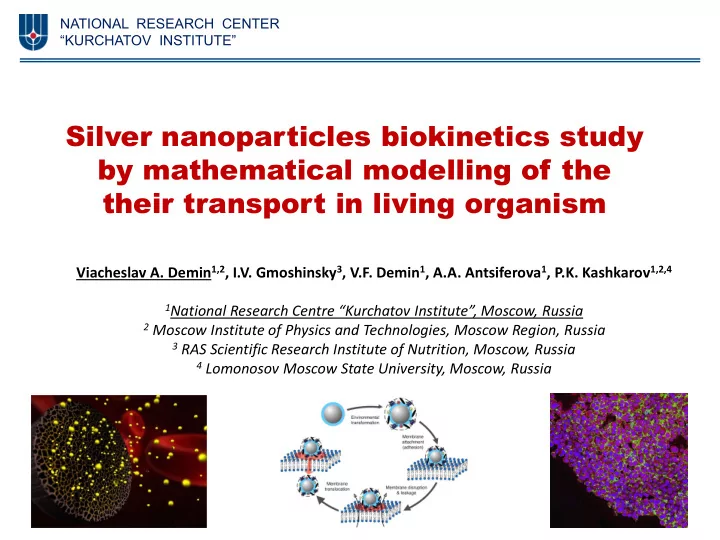
Silver nanoparticles biokinetics study by mathematical modelling of the their transport in living organism

Viacheslav A. Demin1,2, I.V. Gmoshinsky3, V.F. Demin1, A.A. Antsiferova1, P.K. Kashkarov1,2,4

1National Research Centre “Kurchatov Institute”, Moscow, Russia 2 Moscow Institute of Physics and Technologies, Moscow Region, Russia 3 RAS Scientific Research Institute of Nutrition, Moscow, Russia 4 Lomonosov Moscow State University, Moscow, Russia

slide-2
SLIDE 2

NATIONAL RESEARCH CENTER “KURCHATOV INSTITUTE”

  • Nanomaterials

(NMs) and, more specifically, Nanoparticles (NPs) potentially have new, emergent properties and unknown impact on living organisms. Nanotoxicity and Nanopharmaceutics Research: Aims and Problems

Alternative: to investigate the Adsorbtion, Distribution, Metabolism and Excretion (ADME) of NPs by mathematical modelling of their transport in living

  • rganisms due to building of NPs impact prognostic scenarios based on limited

experimental data.

  • Most of nanotoxicity research is implemented
  • n

cells cultures in vitro.

  • The experimental investigation of NPs impact on

living beings is expensive and limited in literature.

slide-3
SLIDE 3

NATIONAL RESEARCH CENTER “KURCHATOV INSTITUTE”

The purpose of current study

  • The development

and application of mathematical “chamber” model for adsorption, distribution and excretion of non-metabolizable NMs in the laboratory rat’s organism on the example of silver NPs. Number of NP, % Size, nm

Silver NPs: ARGOVIT-S (Biologically active food supplement; Russian production) – Ag NPs in PVP stabilizing shell with Average Diameter of 3515 nm DLS measurements

slide-4
SLIDE 4

NATIONAL RESEARCH CENTER “KURCHATOV INSTITUTE”

Experiment on rats with Ag NP acute insertion through the gastrointestinal tract

Ag NPs colloids Activation by neutrons in nuclear reactor IR-8 (Kurchatov Institute): Ag  110mAg Insertion of radioactively labelled Ag NPs through a stomach pump into the rats’ GIT Organs and bioliquids removal at 24, 48 and 72 hours after NPs insertion -radiation measurements of radioactively labelled Ag NPs in organs and bioliquids  Ag NPs content determination

slide-5
SLIDE 5

NATIONAL RESEARCH CENTER “KURCHATOV INSTITUTE”

Experimental results and specifications to the model

Organ / tissue / bioliquid* Time after NP insertion, hours 24 48 72

GIT+feces (in total)

>98 >98 >99

GIT (calculated value [Pinna K. et al, J.Nutr., 2001])

65 6,2 0,2

Bone-muscular carcass

0,36±0,17 <0,6 0,23±0,09

Liver

0,60±0,18 0,8±0,3 0,18±0,10

Kidneys

0,014±0,002 0,029±0,008 0,007±0,003

Blood

0,13±0,05 0,20±0,05 0,05±0,02

Lungs

0,009±0,003 0,016±0,003 0,006±0,003

Heart

0,0042±0,0016 0,0060±0,0015 0,0032±0,0007

Pancreas

0,0079±0,0015 0,012±0,005 0,0039±0,0013

Spleen

0,05±0,02 0,06±0,03 0,010±0,004

Gonads

0,016±0,003 0,033±0,007 0,010±0,004

Brain

0,0029±0,0010 0,0123±0,0023 0,0053±0,0017

Urine (increasing total)

0,012±0,002 0,032±0,009 0,05±0,04

*Values are in % of inserted dose of Ag NPs

Specifications (simplifications) to the model: Only those organs should be accounted for, the content of Ag NPs in which is not less than 20% of blood NPs content during the whole experiment. Chambers for the model:

  • Gastrointestinal tract
  • Blood
  • Bone-muscular carcass
  • Liver
  • Spleen
slide-6
SLIDE 6

NATIONAL RESEARCH CENTER “KURCHATOV INSTITUTE”

Chamber Model Scheme kt,b kb,t kb,m km,b kb,l kl,b kb,s ks,b kb,r kr,b kt,ex

slide-7
SLIDE 7

NATIONAL RESEARCH CENTER “KURCHATOV INSTITUTE”

Chamber Model System of Differential Equations

, , , , , , , , , , , , , , , , , , , , ,

, , , , ) , ,

t t b t b t b t ex t m m b m b m b l l b l b l b s s b s b s b b t b t m b m l b l s b s b t b m b l b s b r b r b r b r r b r b r b

dM k M k M k M dt dM k M k M dt dM k M k M dt dM k M k M dt dM k M k M k M k M dt k k k k M k M k M dM k M k M dt                                                 , , , , ,

t m l s b r

M M M M M M

where are the NPs mass or percentage contents in the GIT, bone- muscular carcass, liver, spleen, blood and rest organs. According to the assumptions made above about the chambers that should be accounted for, we can suppose that kb,r  0. Consequently, Mr  0, and we can neglect by the 2 terms of the last but one of equation and by the last equation as a whole.

This system of 5 ODE cannot be solved analytically, so the numerical methods should be used, along with a fitting of the biokinetics parameters set such that solutions would approximate the experimental data minimizing some optimization (e.g. the error least square) functional.
slide-8
SLIDE 8

NATIONAL RESEARCH CENTER “KURCHATOV INSTITUTE”

Chamber Model Solutions

, , , , 1 , , , , ,

1/ 200 1/ 4.5 1/ 60 1/ 45 1/ 90 1/ 45 1/ 90 1/ 27 1/15

t b b t m b b m l b b l s b b s t ex

k k k k k k hour k k k

                                

Results of biokinetics parameters fit:

0 50 100 150 hours

The model does not satisfactorily approximate the GIT biokinetcs  The physiological timing

  • f

NPs excretion from GIT shall be accounted for in the case of acute NPs insertion: digestion process lasts from 18 to 25 hours, so

( ) , ( ) , ,

( ) ( ) . 20 1 exp 5

t ex t ex t ex

k k t k t t 

 

          

slide-9
SLIDE 9

NATIONAL RESEARCH CENTER “KURCHATOV INSTITUTE”

Chamber Model Solutions

, , , , 1 , , , , ( ) ,

1/ 300 1/ 4 1/ 50 1/ 55 ( ) 1/ 50 1/ 30 1/ 20 1/ 200 1/10

t b b t m b b m l b b l s b b s t ex

k k k k k k hour k k k

 

                                

New results of biokinetics parameters fit:

0 50 100 150 hours

The corrected model does satisfactorily approximate the GIT and other organs biokinetcs.

( ) , ( ) , ,

( ) ( ) . 20 1 exp 5

t ex t ex t ex

k k t k t t 

 

          

slide-10
SLIDE 10

NATIONAL RESEARCH CENTER “KURCHATOV INSTITUTE”

Chamber Model Prediction Capabilities

  • 1. Stationary values of Ag NPs content in organs of rats reached under a sub-

chronic nutrition can be evaluated. where m is an everyday NPs dose in nanogramms.

, , , , , , , , , , ,

/ 417 / 5 / [ / ]* 9 ( ) 0.4 / 5 1

b t t b t b m m b m t b l b l l b t ex b t s b s s b b

k k M k k M k m M k k m ng day ng k k M k k M                                                   100 10 0.1

0.01 10-3

0 50 100 150 200

Percent of everyday NPs dose

hours

  • 2. Maximum (peak) dose evaluation of

Ag NPs content in organ (indexed “o”)

  • f

rat, reached under the acute nutrition can be done.

, , , ,max ,max ,max , , ,

( ) 0,011 ,

b o b o b o

  • b
  • b
  • b
  • b
  • b

k k k M M t M M k k k   

slide-11
SLIDE 11

NATIONAL RESEARCH CENTER “KURCHATOV INSTITUTE”

Chamber Model Prediction Capabilities

0.01 0.1 1 10 100 1E-3 0.01 0.1 1 10 100 Stationary Ag NPs Content, g/g of organ Daily dose, g/g of body

Liver Spleen 3 g/g

0.01 0.1 1 10 100 1E-3 0.01 0.1 1 10 100

Liver Spleen 3 g/g

Peak Ag NPs Content, g/g of organ Single dose, g/g of body

Sub-chronic nutrition of Ag NPs Acute nutrition of Ag NPs

According to the most of literature sources [Hussain S.M., et al., Toxicol. In vitro. 2005; Arora S., et al., Toxicol. Appl. Pharmacol. 2009; Haase A., et al., Toxicol. Sci. 2012; etc.] any effects on cells cultures were observed at the Ag NPs concentration  3 g/g. Possible toxicity-emerging daily dose (for liver): 10.6 g/g of body Possible toxicity-emerging daily dose (for liver): 5.3 g/g of body

[Kim Y.S., et al., Part. Fibre Toxicol. 2010; Shumakova A.A., et al., Voprosy pitaniia 2011]

These results qualitatively correspond to the experiments on rats and mices with Ag NPs:

slide-12
SLIDE 12

NATIONAL RESEARCH CENTER “KURCHATOV INSTITUTE”

Chamber model of silver NPs transport in the organism of rat can be used to predict the possible time dependent mass content and the concentration of NM in different organs and tissues of animal, using for that only the limited experimental ADME data for acute intake of NPs. Chamber model can establish the probabilistic connection between NPs exposition dose and toxic effects on tissues and organs under acute and sub-chronic insertion of NM, using for that all known in vitro and in vivo experimental data for hazardous effects. It is even possible to evaluate the NM impact on human health making a correction on different metabolism by methods of pre-clinical trial. The development of the model should account for the minor (“rest”) organs, in which the NPs content is negligible at the sub- chronic scale but can become determinative at chronic exposures and following excretion of NPs. Some of the such organs (like brain, heart, gonades) have the significant meaning for the whole organism and the possible NPs impact on them shall be analyzed. Conclusions and the nearest perspectives

slide-13
SLIDE 13

NATIONAL RESEARCH CENTER “KURCHATOV INSTITUTE”

Thank you for attention!