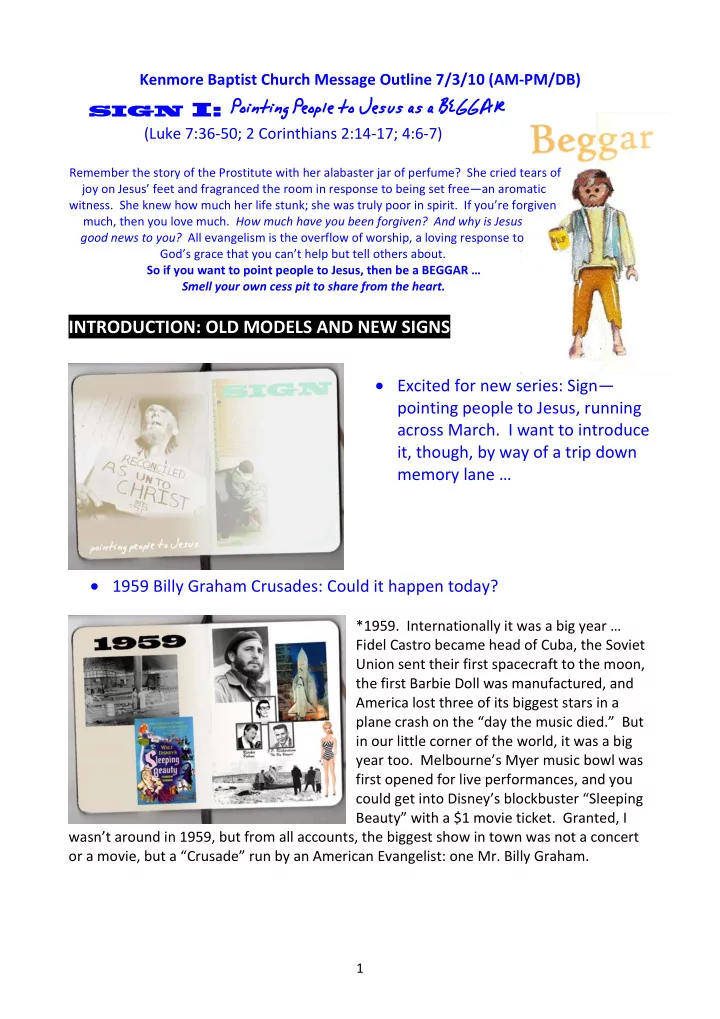
SIGN I: Pointing People to Jesus as a BEGGAR (Luke 7:36-50; 2 - - PDF document

sign i pointing people to jesus as a beggar
SMART_READER_LITE
LIVE PREVIEW

SIGN I: Pointing People to Jesus as a BEGGAR (Luke 7:36-50; 2 - - PDF document

Kenmore Baptist Church Message Outline 7/3/10 (AM-PM/DB) SIGN I: Pointing People to Jesus as a BEGGAR (Luke 7:36-50; 2 Corinthians 2:14-17; 4:6-7) Remember the story of the Prostitute with her alabaster jar of perfume? She cried tears of joy on


slide-1
SLIDE 1

1

Kenmore Baptist Church Message Outline 7/3/10 (AM-PM/DB)

SIGN I: Pointing People to Jesus as a BEGGAR

(Luke 7:36-50; 2 Corinthians 2:14-17; 4:6-7)

Remember the story of the Prostitute with her alabaster jar of perfume? She cried tears of joy on Jesus’ feet and fragranced the room in response to being set free—an aromatic

  • witness. She knew how much her life stunk; she was truly poor in spirit. If you’re forgiven

much, then you love much. How much have you been forgiven? And why is Jesus good news to you? All evangelism is the overflow of worship, a loving response to God’s grace that you can’t help but tell others about. So if you want to point people to Jesus, then be a BEGGAR … Smell your own cess pit to share from the heart.

INTRODUCTION: OLD MODELS AND NEW SIGNS

  • Excited for new series: Sign—

pointing people to Jesus, running across March. I want to introduce it, though, by way of a trip down memory lane …

  • 1959 Billy Graham Crusades: Could it happen today?

*1959. Internationally it was a big year … Fidel Castro became head of Cuba, the Soviet Union sent their first spacecraft to the moon, the first Barbie Doll was manufactured, and America lost three of its biggest stars in a plane crash on the “day the music died.” But in our little corner of the world, it was a big year too. Melbourne’s Myer music bowl was first opened for live performances, and you could get into Disney’s blockbuster “Sleeping Beauty” with a $1 movie ticket. Granted, I wasn’t around in 1959, but from all accounts, the biggest show in town was not a concert

  • r a movie, but a “Crusade” run by an American Evangelist: one Mr. Billy Graham.
slide-2
SLIDE 2

2

*Now, we need a comparison point, given this was back in 1959. If you’re into music, then you’ve probably heard of Big Day Out. In 2009 it covered 6 major music festivals across New Zealand and Australia, with a total attendance of 260,000 people. Back in 1959 the population of Australia was half what it is now—take this into account. Okay, so Billy Graham toured New Zealand and Australia in his Southern Cross Crusade. Over the same time period as Big Day Out, he had 3,360,000 people attend. In the final engagement, 150,000 people attended the Sydney Showground and Cricket Ground to hear him preach. Over this Crusade, more than 130,000 people (almost 2% of the Australian population at that time) made a commitment to Christ. The Australian Bureau

  • f Statistics reported a significant reverse

trend during this period and the following year, with a drop in alcohol consumption, extra-marital births, and crime statistics. One secular reporter said that “the effect of the Billy Graham tour of Australia still lingers today as its ripples are being felt across every sphere of Australian life.” *Amazing. BUT. Back to present, dinner Mr. And Mrs. A, recalling the power as this good looking, charismatic, and well-spoken American stood up to the microphone, opened the Word of God, and began, “The Bible says …” Could it happen today? Honestly, can you see more people than Big Day Out turning up to hear an American Evangelist talk about Jesus?

  • Changing Times and Plausibility Problems:

pluralism, postmodernism, consumerism

*perhaps it could happen again—God’s big and can do anything he wants. But as I read the Signs of the Times, I can see that the Sky has changed. Our culture is different to 1959. (1) Pluralism … mostly Christians and lapsed Christians … cultural understanding … now immigration, take your pick of religions—neighbours just as likely to be staunch atheists as Buddhists, Hindus, Muslims, or New Age Spiritual Seekers.

1 1 1 1

slide-3
SLIDE 3

3

(2) Postmodernism … “The Bible says” likely to be scoffed at … hasn’t science disproved it? But more so, “Who are you to say?” All “truth” is just a mask for power … you have your perspective and truth, and I have mine. And I can see all your historical failings and hypocrisy, with one tele-evangelist after another condemning greed and sex but then hoarding and hoaring. Your attempts to convert me are just as coercive as the crusades and inquisitions, so back off. When you say “Jesus is the

  • nly way to God,” you may as well declare religious war … we’re a multicultural,

tolerant society with no room for your exclusivity. (3) Consumerism … Besides which, the Gospel is old news. We’ve moved on. You Christians don’t have a corner on the religious market anymore. You’ve got to compete with multiple religions, not to mention multi-billion dollar marketing

  • budgets. Why settle for “heaven when I die” when I can find paradise with my next
  • purchase. I’m permanently open to new possibilities, and always waiting for the

better offer that appeals to me as the sovereign consumer … so good luck with all these calls to count the cost and lay down my life to follow some old dead dude.

  • Post-Christian Attitude, Pre-Christian Understanding:

arrogant, irrelevant, insular, bland

*Get the picture? In short, our culture is best understood as post-Christian in attitude (been there and done that, not interested, thanks), and pre-Christian in understanding (isn’t Christianity just about being good enough to get a ticket to heaven when you die?). *The idea of evangelizing, or proselytizing, is in bad taste in a culture like ours: we’re seen as arrogant (sure, only your religion is right and the rest go to hell!), irrelevant (heaven is a dream, but what about our struggling world now), insular (I get it, you want more people in your religious club, so you leave the fortress to drag us into the Church), and bland (I’d have more fun watching the grass grow than listening to you prattle on about religious stuff—why don’t you just go and have some fun—get a life!)

  • Any surprise only 1 in 10 Christians share about Christ?

*latest research in Australia reports that on average, only 1/10 share faith. Don’t want to impose, don’t identify with the stereotypes so avoid evangelism altogether, don’t feel confident enough or slick enough to be an evangelist, worried what friends think and don’t want to be responsible for saying something wrong and turning friends off God. *Besides which, Christians are now on the outer, and in a world where we always look for friends, who wants to stand up when we may be ridiculed? FRANK > like me, bonus if Jesus.

slide-4
SLIDE 4

4

*In spite of it all … to be a disciple is to be a messenger.

“God brought us back to himself through Christ. And God has given us this task of reconciling people to him.” (2 Corinthians 5:18-19)

*When Christ saved us, he simultaneously sent us to reconcile the world to Him. And the Bible makes it clear this can’t happen unless our lives display good deeds and good words. We’ve been commissioned as “agents of reconciliation.” … So, how’s this mission going? When’s the last time you pointed someone to Jesus?

  • Time for new SIGNS: Beggar; Story-Teller; Life-Guard; Cook.

*Arrogant, irrelevant, insular, and bland … we need new images for evangelism. A slick evangelist on a stage, working the microphone won’t cut it. And nor will some angry guy

  • n a soap box in the city yelling at disinterested and offended bypassers to “turn or burn.”

*We need new images. We need new signs. *SIGNS – like candles on your birthday cake, passing on the Olympic torch, dirt thrown on a coffin … these physical elements are significant in themselves, but they point deeper to something more meaningful and true. And that’s what we’re called to be: a SIGN pointing people to Christ and His Kingdom. *Over the next month: SIGN: 3 small group sessions, 15 devotions, and 4 messages on Sunday culminating with “Church in the Park.” In these messages I want to rework our understanding of evangelism from the Bible up: If you want to point people to Jesus, then you must adopt the Sign of the Beggar, the Storyteller, the Lifeguard, and the Cook. Will you be a Sign pointing people to Jesus? Then stick with us for this series and connect into a small group. And perhaps, in a different way, we may yet see millions respond to Jesus. *First, let’s explore the SIGN of the BEGGAR: arrogance is out, and humility is in … smell your own cess pit to share from the heart.

<<READING/DRAMA: LUKE 7:36-50 >> different powerpoint for this>> 1 1 1 1

slide-5
SLIDE 5

5

THE BEGGAR: SOME BACKGROUND TO LUKE 7:36-50

  • Simon the Pharisee and Charissa the Forgiven: a study in contrasts

*7 scenes in this short space:

  • 1. Introduction of key characters
  • 2. The Outpouring of the Woman’s Love (action)
  • 3. A Dialogue (Simon judges wrongly)
  • 4. A Parable
  • 5. A Dialogue (Simon judges rightly)
  • 6. The Outpouring of the Woman’s Love (retrospect)
  • 7. Conclusion with key characters

*massive contrast between the man and the woman—for a Pharisee and male dominated culture, very subversive that it champions the powerless woman—Jesus’ habit … very Australian! On the side of the underdog. In a society where she was considered a nobody, Jesus gave her an identity and treated her as a person of worth. So though her name isn’t provided >> Charissa, from Charis in the Greek, meaning “grace and forgiveness” … for Jesus essentially identified her by her new status in God’s Kingdom … not a sinner, but forgiven.

>> N. T. Wright, “The balance of the scene is superb, with Jesus keeping his poise between the outrageous adoration of the woman and the equally outrageous rudeness of his host—and yet coming up with something fresh, something which, to the onlookers, was just as outrageous as the behaviour of the other two.”

*Why invite Jesus? Likely scenario: visiting rabbi preaching in the synagogue > get status by having them over for lunch (Pastor for lunch!) … but hidden agenda to test him out … Simon invited Jesus over to judge Him: was he really the Messiah? >> know this is his attitude, as hospitality crucial in their society … whole series of formalities should go through … kiss on hand as sign of respect, servants to wash his feet,

  • ptional to anoint his head with oil. Scandal … tension … like not taking jacket or shaking

hand … obvious social snub to Jesus: “how will he respond?” >> seems Jesus doesn’t just care for the outcast, but is willing to dine with anyone who will offer an invite … His grace always includes. Simon excludes himself by his lack of

  • hospitality. But even here, Jesus just absorbs the offense.

*So, why is Charissa gate-crashing? >> public events, open doors, but not interfere with the party. ENACT … reclining > tells us it was a formal dinner, a banquet … so she hears Jesus is there, and apparently comes planning to show her love. It’s obvious they had met before, and she found forgiveness and freedom from Jesus, so this is in response. >> Jesus reclines, feet away from the table—disgusting part of body in oriental cultures … humble, doesn’t want to interrupt, and doesn’t feel worthy to anoint his head, so she anoints his feet. More on that later, but gives insight into her heart attitude.

1 1 2 2

slide-6
SLIDE 6

6

*so, a study in contrasts: Simon the judge, Charissa the humble; Simon is the host, but only Charissa shows him hospitality; Simon has social standing, but Charissa walks away justified.

  • Parables: Less about explanation, more about subverting Kingdom

blockages

*at the centre of this story’s seven scenes is the parable: the interpretive hinge >> pretty obvious that the bigger debtor is Charissa, Simon the lesser, and Jesus on behalf of God the Father is the money-lender.

*Robert Farrar Capon, Kingdom, Grace, Judgment, p5. “A Word about Parables” > “the device of parabolic utterance is used not to explain things to people’s satisfaction but to call attention to the unsatisfactoriness of all their previous explanations and understandings. … [p7] In resorting so

  • ften to parables, his main point was that any understanding of the kingdom his hearers could

come up with would be a misunderstanding. Mention ‘messiah’ to them, and they would picture a king on horseback, not a carpenter on a cross; mention ‘forgiveness’ and they would start setting up rules about when it ran out. From Jesus’ point of view, the sooner their misguided minds had the props knocked from under them, the better. After all their yammer about how God should or shouldn’t run his own operation, getting them just to stand there with their eyes popped and their mouths shut would be a giant step forward.”

  • Poverty makes us uncomfortable—it stinks … but then, so do we

*Charissa stands as the Sign of the Beggar. She’s a beggar in more ways than one. She had some money, as the alabaster jar and perfume wasn’t cheap. But besides this, she was incredibly poor. Socially—an outcast. Materially—when it says that she was a “sinner in the city,” it’s a subtle way of identifying her as a prostitute, an adultress. They got used and abused, so chances are she was poor in this way too. Emotionally—she would have been mistreated by men for many years. And Spiritually—her moral failures would have weighed her down with tremendous guilt, separated from God. *Poverty makes us uncomfortable. Even choosing the covers for SIGN, using two homeless people—it’s confronting … kinda’ ugly. I’d rather identify with the shining ones, the one’s behind the microphone or in front of the screen, the upwardly mobile. But a beggar? >> VANCOUVER … in our church, and on the streets … smelly, awkward, uncomfortable … easy to look the other direction and walk on by. After all, if you give a break to the beggar, won’t they just go and spend your grace on more wild living? Buy another bear, secure another hit of crystal meth? >> but in our poverty, we rarely notice where they are rich, and where we stink. >> SUBWAY RUN … not all, but most beggars freely share (cardboard boxes, sandwiches … tell others when they’re onto a good deal, unashamed, not afraid to be honest about their brokenness … they’re the antithesis of arrogance.)

1 1 2 2

slide-7
SLIDE 7

7

*BIG ISSUE … purchase in city, way to make some $$ selling rather than sponging. Always read Vendor Profile. Take Claudette from last month: > Adelaide, loves getting to know customers and talking about life > left school in grade 8, put in a foster home > stroke when 1 > paralysed left side > made it hard to work > pregnant with first son at 18, father walked

  • ut after 2nd kid

> doing her best to make it by … dependence—recognize brokenness and need, and not too proud to get help: “I have my caseworker to help cut my food, help me shower and all that. And I can come into the city on my bike—it takes one-and-a-half hours, but I’ll have to get a taxi home today. With my back the way it is, I can’t sit up that long. I need insulin because of my diabetes.” Other beggars are Claudette’s family. She needs love. And she gives it the best she can. She may not have much, but she’s rarely selfish. *but have you noticed that these are exactly the kind of people Jesus chooses to identify with?

>> “Nowhere in the New Testament is the privileged position of turkeys, nobodies, and marginal people on the fringes of society disclosed more dramatically than in Jesus’ ministry of meal sharing.” (Manning, The Ragamuffin Gospel, p56) >> in their culture, to share a meal meant acceptance … Simon invited Jesus for prestige and to set him up as a test … but Jesus freely shared meals with all the shady characters. Just two verses earlier he was accused of being a drunkard and a glutton with all the meals. “A social climber Jesus was not.”

  • The story invites us in: Am I Simon (arrogant and judging), or Charissa

(poor but forgiven)?

*So, why start a series on evangelism with this story? Matthew, Mark, and John share a similar story of a woman with an alabaster jar, but their main concern is over the cost of the perfume apparently wasted. The majority

  • f commentators think Luke’s account is a

different occasion—apparently women were in the habit of anointing and kissing Jesus’

  • feet. But the similarities make it fair to apply

what Jesus said in Mark 14:9 “I tell you solemnly, wherever throughout the world the Good News is proclaimed, what she has done will be told also, in remembrance

  • f her.”

1 1 1 1 1 1 2 2

slide-8
SLIDE 8

8

In a series focused on the Good News, the Gospel, we’d better start here. WHY? Recognition of brokenness, overwhelmed and authentic response in costly sacrifice, with a fragrant witness to an onlooking world … this is the heart of evangelism.

  • The story asks of us: What did my forgiveness cost? How much do I love?

What’s my witness?

>> That’s enough background … let’s get into the parable itself, and try and make sense of how Jesus saw the situation. >> three observations at the heart of the parable …

OBSERVATION ONE: … a money-lender with two debtors (v. 41)

WE’RE ALL IN GOD’S DEBT … sniff deep: our lives stink

  • Different debts, but the same condition

*50 denarii vs. 500 denarii. Denarius roughly a day’s wage, so Simon has perhaps two month’s debt, and Charissa is nearly two years in trouble. Now, the difference may be greater, as Simon would have earned more than Charissa, who was probably hard up. *obvious to see Charissa’s debt … she’d broken every social convention—she was a prostitute, and it was obvious to Simon that she was in trouble with God. … But why was Simon in God’s debt? *the Pharisees had hundreds, even thousands of rules to keep, and they were strict. In Simon’s mind, he could tick every box. He was so good in his own eyes, He didn’t even need God … He was doing God a favour with the way He lived. Or so he thought.

  • Sin (hamartōlos); Debt (opheiletēs) … to miss the mark and transgress,
  • wing God

*sin is missing the mark … we shoot our lives like an arrow and they don’t just veer from the bulls-eye … they don’t even reach the target at all. A similar word is used for debt, that they’ve not only crossed the line, but they’ve stomped all over it. In this picture, they owe God big time. >> but again, why do we owe God?

1 1 2 2 1 1 2 2 3 3 1 1

slide-9
SLIDE 9

9

  • Our tendency to judge: comparisons with others, the in and out,

righteous and unrighteous. Even the Church can become a house for Pharisees.

*we all think we’re good in our own eyes … and we all tend to judge: >> MATT JOHNS example, one of many parties to a date-rape. Now, I’m not excusing what he did, or making light of it. But for a self-confessed tolerant society, the reporters were ruthless. He was dumped from the coaching staff, fired from the footy show, given the tenth degree by Tracey Grimshaw on A Current Affair … “You had to know that what you were doing was wrong.” Everyone acted surprised and shocked, as though none of us would ever do anything wrong, like lust, or use power to manipulate. >> even on lesser issues, political correctness has become a lynching mob … you smoke—NO! You don’t recycle, and you drive a Hummer—NO! Evil.

*Robert Farrar Capon, Kingdom, Grace, Judgment, p 203, re: Pharisees judging and excluding

  • thers as better than them, arrogant: “It is a rerun of the old, disgraceful human story: all of us,

even the rankest outsiders, feel better about ourselves if we can keep someone else further

  • utside than we are.”

*Even so, you can make a case that the Church still has the corner on judging, just like Simon the Pharisee. Granted, Jesus told us not to judge—but many Christians didn’t get the memo! Sinners were attracted to Jesus, but most wouldn’t be found dead in a church … >> Philip Yancey, “The Midnight Church” … attended Alcoholics Anonymous meetings, and noticed how much like the early church it was … no prestige, no positions, just “Hi, I’m Tom and I’m an alcoholic and a drug addict.” “Hi, Tom!” … In the twelve steps they feely acknowledge the wrong they’ve done without justifications, ask for forgiveness, and admit their need for help from a Higher Power. Rationalizations and excuses are

  • forbidden. They never say “I was an alcoholic”—the battle is ongoing. They met in a

church basement, and Yancey asked Tom if he ever went along to the Church service

  • upstairs. “Never!” he replied. The church seems irrelevant, vapid, and gutless to him—all

the stories of rejection, judgement, and “guilt trips.” The church is the last place he would stand up and declare, “Hi, I’m Tom. I’m an alcoholic and a drug addict.” What’s the one ingredient missing from the church, asked Yancey. Tom replied not with love or

  • acceptance. Instead, he said softly this one word: dependency. “None of us can make it
  • n our own—isn’t that why Jesus came?” he explained. “Yet most church people give off a

self-satisfied air of piety or superiority. I don’t sense them consciously leaning on God or each other. Their lives appear to be in order. An alcoholic who goes to church feels inferior and incomplete.” *We’ve got a lot to learn from alcoholics and beggars like Tom. *But back to the debt. How is it that we’re in debt to God? Why do we all owe him?

2 2

slide-10
SLIDE 10

10

  • Created to love God (look up), love others (look out), and cultivate the

earth (look around)

*picture from a newly released version of John Milton’s classic, Paradise Lost. It draws us into the bigger story. The human story plays out against a cosmic backdrop with angels on the margins observing the unfolding drama. God has given Adam and Eve everything, but it’s on loan. They were created to love God, love others, and cultivate the earth— stewards, tenants, not the owners. They were to look up, out, and around.

  • Instead we’ve despised and ignored God, abused others, and vandalized

the world: “Homo curvatus en se es” (humanity is self-obsessed, curved in on ourselves: looking only inwards) … because of us, this world is not the way it’s supposed to be

*instead, Adam and Eve have eaten the fruit—they’ve acted as though their lives and the world is their own, and they’ve sought power, knowledge, and beauty apart from God the life-giver. They have turned away not only from God but also from each other. *As Luther explained sin, “homo curvatur en se es” (humanity is curved in on itself) … we’ve despised and ignored God, abused others, vandalized the world—this is sin… and we

  • nly look in … what are my needs, my wants … it’s all about me, right?

*In rejecting God’s right order, we’ve damaged this world, each other, and even ourselves. And it’s all on loan. We’ve borrowed God’s pristine planet and returned it to Him in ruins.

  • Our sin accrues a significant debt, and we each owe God (Psalm 14:1-3;

Romans 3:23; 6:23) … you pay for what you break, and the world’s blood is on all our hands

*Store: touch it nice, but you break, you pay! Or artist, deface art-work … Now, with Black Saturday bushfires, when a careless kid discarded a cigarette butt and burned down houses and lives, how much does he owe? Flick on the news: environmental destruction, genocide, wars, rape, greed, killing—it’s not a good score card. A newspaper once asked prominent thinkers to answer the question: “What’s Wrong with the World.” G. K. Chesterton succinctly replied: “Dear Sirs, I am.” … we all know the world is broken, but God has placed us as gardeners of this planet … and when we went astray, the whole planet groaned. The blood of the world is on all

  • ur hands. How much do we owe God? Everything.

3 3 1 1

slide-11
SLIDE 11

11

  • God goes beyond appearances to judge the heart (Matthew 5:17-48,

especially verses 25-26): hate = kill; lust = adultery; unforgiveness = unforgiven; love your enemy and be perfect. Break one law and you’ve broken them all (James 2:10)

*We like the blame game—it’s not my fault. And after all, no body’s perfect. And I’ve only done itty bitty sins. But we miss the point. *In Matthew 5:17-48, Jesus gets to the heart of the human problem. And it’s the problem

  • f the human heart. Why do we hate, and abuse, and swear? Because contrary to pop-

psychology, our hearts aren’t so pure after all. *hate = kill; lust = adultery; unforgiveness = unforgiven *like flouro light getting ready for work in the morning—once on, I look bad! Compared to each other we might look alright … Simon’s life looks pretty clean … only 50 days debt. But compared to God’s holiness, we’re in deep trouble. And God is loving, but He’s also just … if He were to fix the world and remove the evil, that would be our end too.

  • Sniff deep: our heart’s stink (Jeremiah 17:9; Matthew 15:18-20)

*“The heart is deceitful above all things and beyond cure. Who can understand it?” *The problem is not that we’re misunderstood and are led into wrong. The problem is that God knows us fully, and we’re fallen—we’ve missed the mark, and our heart’s stink.

  • We dress up the exterior, but we each have a cess-pit: can you smell

yours?

*RENOVATING: art of beautiful exterior while rework the insides. Slow going, poor excuse for a man, impractical … frustrated, working away … to top it off, there was a terrible stench in the house, and only a day later I found out why. My initial response was anger at my dad … he’d left the cap off the cess pit … the stench wafted through the whole house >> then I was humbled. It was like a metaphor for my life. After all, what was the cess pit but the sum total of all my contributions? Under even a little pressure, my own crap rose to the surface—anger, frustration, selfishness … but my first response was to blame rather than own my problems. *So, even for all Simon’s rule keeping, He still owed God a huge debt. What about you? How’s your sin debt? What do you owe God. Sniff deep … it ain’t pretty. Every one of us stinks, and we owe God big time.

1 1

slide-12
SLIDE 12

12

OBSERVATION TWO: … neither of them could pay (v. 42a)

WE’RE ALL DEAD BROKE BEGGARS … look deep: our pockets are empty

  • Simon and Charissa were both dead broke beggars

*I can picture Simon thinking, Okay, debt is a problem for Charissa—she owes more, and she’s got no way to pay. But I’m fine. I’m

  • rich. My pockets are deep.

*And then Jesus drops the bomb: Simon, you’re broke. Fifty days pay might not look to bad, but you’re chronically unemployed and have no money at all. Your pockets are

  • empty. Simon, you’re a beggar.
  • Poverty is unattractive, and it stinks … but look in the mirror. We are
  • poor. We are broken. Our false perception that we are rich blocks God’s

grace (Luke 6:25)

*I’m the beggar? As I look at the magazine cover for SIGN, that’s me … unkempt, toothy grin … a ragamuffin? But I’ve got a job, friends and family, a good wardrobe … don’t worry God, I can repay … My bank account’s full of good deeds, with more to come. I’m rich! >> “Woe to you who are well fed now, for you will go hungry. Woe to you who laugh now, for you will mourn and weep.”(Luke 6:25) Jesus apparently saw this one coming … it’s our false perception that we’re rich that blocks God’s grace.

  • Christ came in poverty to make us rich (2 Corinthians 8:9; 13:4;

Philippians 2:5-11; Hebrews 4:15). He came for the least, the last, the lost, the little, and the dead (Luke 5:29-32; 7:34; 14:21; 18:16-17; John 11:25-26): Which am I?

*If we are rich, then why did Jesus need to come to save us? “For you know the grace of our Lord Jesus Christ, that though he was rich, yet for your sake he became poor, so that you through his poverty might become rich.” (2 Corinthians 8:9) *If we are successful and upwardly mobile without God, then we don’t need Jesus.

1 1 1 1 2 2

slide-13
SLIDE 13

13

*Jesus came to save the least, the last, the lost, the little, and the dead. Which am I? And if I don’t think I fit any of these categories, then in what sense have I been saved?

*Robert Farrar Capon, Kingdom, Grace, Judgment, pp. 203-204, re: admitting poverty: “Jesus came to save a lost and losing world by his own lostness and defeat; but in this wide world of losers, everyone except Jesus remains firmly, if hopelessly, committed to salvation by winning. … We will do anything rather than face either the bankruptcy of our wealth or the richness of our

  • poverty. … It would be funny if it were not fatal; but fatal it is, because grace works only in those

who accept their lostness. Jesus came to call sinners, not the pseudo-righteous; he came to raise the dead, not to buy drinks for the marginally alive.” *Capon, pp. 183-84 “In spite of all our fakery, though, Jesus’ program remains firm. He saves losers and only losers. He raises the dead and only the dead. And he rejoices more over the last, the least, and the little than over all the winners in the world. That alone is what this losing race

  • f ours needs to hear, even though it can’t stand the thought of it. That alone is the salt that can

take our perishing insipidity and give it life and flavour forever. That alone.”

  • Why can’t we repay?

*Now hold on … we’ve got bearer bonds stamped with good works … maybe you’ve been doing Bill-Gates-like-Philanthropy, and you figure that if there is a God out there, He probably owes you, right? Why can’t we pay. Two reasons.

*Robert Farrar Capon, Kingdom, Grace, Judgment, pp. 255. “The Gospel truth is that neither we nor the world can be saved by efforts at living well. If the human race could have straightened up its act by the simple pursuit of goodness, it would have done so long ago. We are not stupid; and our Lord knows, from Confucius to Socrates to Moses to Joyce Brothers, we’ve had plenty of advice. But we haven’t followed it. The world has taken a five-thousand-year bath in wisdom and is just as grimy as

  • ever. And our own lives now, for all our efforts to clean them up, just get grimier and grimier.

We think pure thoughts and eat wheat germ bread, but we will die as our fathers did, not noticeably better.”

(a) All our works are tainted, and the wages of our work are death (Proverbs 16:2; 20:6; Isaiah 64:6; Romans 3:23; 6:23)

*God doesn’t just judge our actions—He judges our motives. Have you ever noticed how many of our good works are done with selfish motives—not in love of God and neighbour. Just look at all those ads from companies quick to blow the trumpet that they care for the environment, or help little kids with cancer. *doctrine of “total depravity” not popular today … doesn’t mean that we’re as bad as we could be … just means nothing is as good as it should be … like putting salmonella in a glass

  • f water, the whole glass is tainted and not fit for drinking. Even the good we do is tainted

by our obsession with ourselves … so every extra work we do accrues an even greater debt.

2 2 1 1

slide-14
SLIDE 14

14

Most of the worst damage done to the world is not by overtly evil people, but humans who are blind to their own agenda and think they’re helping out. When the world crumbles under nuclear holocaust, it will have been a well intentioned bureaucrat flicking the switch in a pre-emptive attack, necessary of course to save the world. * “All of us have become like one who is unclean, and all our righteous acts are like filthy rags; we all shrivel up like a leaf, and like the wind our sins sweep us away” (Isaiah 64:6). >> we offer up our good works to the pure and perfect God, and it’s like offering greasy rags to clean the windows of Heaven. It doesn’t work. Thanks, but no thanks.

(b) Even when we do good, we further borrow from God’s grace (Ephesians 2:8-10; Philippians 1:6; Hebrews 13:21) …. Beware of the “debtor’s ethic”

*Christians confuse this one too … we’re saved by grace, right, but once saved, we think we can repay God. We do good, we say grace, we serve as best we can. And then we expect God to say, “Thanks, you know I couldn’t have done that without you—guess I owe you.” No? Then why are we angry with God when He doesn’t answer our prayers or give us what we want. We figure we deserve it—we’ve earned it! >> in John Piper’s words, “Beware the debtor’s ethic.” If it wasn’t for God’s grace, we wouldn’t desire to do any of these works. It’s like owing this huge debt, then borrowing more of the lender’s money to repay. Every good work we do is a further withdrawal on God’s grace … so we can never repay him.

  • Thus, blessed are the poor, for they shall inherit the Kingdom (Matthew

5:3-10). Christ’s Kingdom is full or reversals: the last are first and Prostitutes enter before Pharisees (Matthew 20:16; 21:28-32)

*So, not only are we in debt with a stinky life, but we are dead-broke beggars with no way to repay. This goes whether you’re a Charissa

  • r a Simon.

>> The difference is that Charissa is a Beggar … she recognizes that she is broken and broke, with no way to repay … so she’s ready to accept any break she can. Simon on the other hand is arrogant … he’s happy to tell others about how to follow God as well as He does … how to jump through the hoops and make the grade. His hands are closed to God’s grace. * “Blessed are the poor in spirit, for theirs is the kingdom of heaven.” (Matthew 5:3) * “So the last will be first, and the first will be last.” (Matthew 20:16) * “Truly I tell you, the tax collectors and the prostitutes are entering the kingdom of God ahead of you.” (Matthew 21:31) … OUCH. Ease up Jesus. Still, Blessed are the Beggars.

1 1

slide-15
SLIDE 15

15 *Brennan Manning, The Ragamuffin Gospel, p102 “Every parable of mercy in the gospel was addressed by Jesus to his opponents: murmuring scribes, grumbling Pharisees, critical theologians, members of the Sanhedrin. They are the enemies of the gospel of grace, indignant because Jesus asserts that God cares about sinners, incensed that he should eat with people they despised. What does he tell them? These sinners, these people you despise are nearer to God than you. It is not the hookers and thieves who find it most difficult to repent: it is you who are so secure in your piety and pretence that you have no need of conversion. They may have disobeyed God’s call, their professions have debased them, but they have shown sorrow and repentance. But more than any of that, these are the people who appreciate his goodness: they are parading into the kingdom before you: for they have what you lack—a deep gratitude for God’s love and deep wonder at his mercy.”

OBSERVATION THREE: … he let them both off, so which loved him more? (vv. 42b-43)

WE ALL NEED A SAVIOUR … drink deep: the forgiven freely share

  • Charissa’s awkward display of emotion was unreflective, unplanned, and

totally authentic. This kind of raw love shocked everyone around her, a reflection of the shocking grace of a God who freely forgives and lavishes grace on sinners.

*Now, cut Simon some slack, here. You’ve put on this special party, you’ve got an agenda, and then this gatecrasher comes in, makes a scene, and gets all emo on the guest. I’d be asking a few questions, too. And when it says she cried, and she kissed Jesus’ feet, the Greek indicates that the crying and kissing were full on, and began a while back and continued the whole way through the story. It’s not like one tear and one kiss … she’s still going while Jesus is telling the parable, and pointing to her as he makes the point to Simon. This is an embarrassing scene. *It gets worse. Perhaps she planned on the anointing part … but not the crying and kissing. How do I know? She would have come with a towel. She just wanted to give Jesus the respect he deserved when Simon failed. But overcome with emotion she floods his feet with tears. What to dry with?—totally unreflectively she lets down her hair. >> Big mistake. This is not G rated anymore. Find in Talmud that they were to stone to death any woman who exposed her breasts or let down her hair while in public. Peasant women could only let down their hair with their husband—it was the most intimate gesture—she could be divorced for this one action. She might as well have done a strip tease on the banquet table while she was at it. >> Simon is confirmed in his judgment—she is an immorally loose woman … and

  • bviously Jesus couldn’t be the Saviour, as no Messiah would accept this kind of woman

1 1 2 2 3 3

slide-16
SLIDE 16

16

>> it never crosses this arrogant man’s mind that Jesus knows exactly who she is, and yet loves her. When Simon is forced to connect the dots, that the one forgiven more loves more, he only gives a grudging admission: I suppose she would love more, perhaps,

  • maybe. But of course! In judging, he ends up being judged.
  • Those forgiven much love much … how much have you been forgiven?

*Those forgiven much love much … it makes you wonder the circumstance in which Charissa first encountered Jesus, and he forgave her sins, trading her brokenness for love. *We need to remember, too, that God is no ordinary money lender. He’s no shylock, demanding His pound of flesh. Honestly, if you owed the bank two years’ wages, do you think they’d just write it off? They’d charge interest and force you into bankruptcy! Yet God freely forgives. God doesn’t have to forgive. Get that and you’re positioned for grace. *When you think of how much God has forgiven you, does it make you want to sing and dance, even if you get shamed in the process? Or does it only motivate you to say, “yeah, thanks God for that … I guess you’re alright with me.”

*Brennan Manning, The Ragamuffin Gospel, p136 “At Sunday worship, as in every dimension of

  • ur existence, many of us pretend to believe we are sinners. Consequently, all we can do is

pretend to believe we have been forgiven. As a result, our whole spiritual life is pseudo- repentance and pseudo-bliss. … Biblically, there is nothing more detestable than a self-righteous disciple.” ... in contrast … People like Charissa honour the Lord more than all the Simons of the world put together, as she “is so persuaded of the infinite mercy of God that all her sins appear to her as but an atom in the presence of this mercy.”

*M. Lloyd Jones … paid debt while out … need to know how much, my resources, and how paid … if video fine, great … if business went bankrupt and home loan lapsed, and a friend covered this to keep you from going to gaol, you’d fall down and kiss his feet too. …

“The gospel is like a banker walking up to us when we cannot pay our mortgage; rather than foreclosing he writes a cheque that pays off the debt. If you met a banker like that, you would always be grateful to him and tell your friends about him. God is that spiritual banker, who has paid our debt of sin through Jesus.”

  • What did forgiveness cost? God’s justice and love meet at the cross,

seen in Christ’s sacrifice (Romans 5:8; 1 John 3:16; 4:7-21) … he took me at my worst.

*so, Jesus covered our debt. But how? And what permitted Jesus to announce forgiveness for this woman. >> in Luke 7:49, the guests rightly wonder how Jesus can forgive Charissa’s sins … did she sin against Jesus … probably not. So what is Jesus claiming? >> here’s the kicker … they all knew that only God could forgive sins … any debts we have are ultimately to God, so only God can write it off and pick up the tab. In essence, Jesus is claiming to be God. That’s why at other times when Jesus forgave sins, they accused Him of blasphemy … making Himself equal with God (Luke 5:21).

1 1 2 2

slide-17
SLIDE 17

17

*The question still remains—how can God forgive sin? Just like if a kid smashes up your car, you might forgive them, but the car doesn’t fix itself. Someone’s got to pay. We’ve smashed up God’s planet, so who pays? >> it’s on the cross that God’s justice and His love meet, with Jesus’ sacrifice. We’ll never fully understand this, but without the shedding of blood, there is no dealing with

  • ur sin. When we despise the giver of life

and destroy each other and His world, the penalty is death. Yet on the cross, the true God of true God, taken on flesh—Jesus the Christ—gave His riches in place of our poverty, paying for our debt so we could be forgiven and free. *There is no greater love than someone laying down their life for another. We love because God first loved us. And when did He love us? >> When we were rich, well-dressed, and morally clean-cut? No! He sees us at our worst—He drew deep from the stench in our cess pit, and took us when we had no hope: “But God demonstrates his own love for us in this: While we were still sinners, Christ died for us.” (Romans 5:8) “Love covers a multitude of sins” (1 Peter 4:8).

  • Faith (trust) in Christ’s forgiveness restores those who’ve missed the

mark, bringing God’s shalom, reconciling us to God, each other, and the planet in right relationships of peace

*We can’t earn this forgiveness. Remember, we owe God, and we’re dead broke. His grace is a gift. We’ve missed the mark—loving God, loving others, and cultivating the

  • earth. In Jewish terms, this was shalom … fully orbed right relationships of peace and
  • flourishing. She is reconciled. Now she can be an agent of reconciliation for others.

>> the only way to God’s peace is when we trust in what Christ did on the cross and accept His forgiveness. Then the process of restoration begins. We never paid for it, but peace can be ours. In Jesus, the Charissas of this world become whole and rescued: they always depart into peace.

>> N. T. Wright, “True faith is what happens when someone looks at Jesus and discovers God’s forgiveness; and the sign and proof of this faith is love.”

3 3 1 1 1 1

slide-18
SLIDE 18

18

  • Forgiveness flows into worship, and worship naturally leads to witness—

the aroma of Christ poured out for all to smell (2 Corinthians 2:14-17)

*But it doesn’t end there. Once we recognize we’re beggars, and we accept God’s grace, then we naturally want to worship Him. As Charissa took her costly perfume, she poured it out in worship of Jesus. And in so doing > powerful and potent witness … the aroma of Christ for all to smell. >> in the same way, it’s only when we’re humble and broken before God that the fragrance of God in us will flow out and draw people to Christ: “But thanks be to God, who always leads us as captives in Christ's triumphal procession and uses us to spread the aroma of the knowledge of him everywhere. For we are to God the pleasing aroma of Christ among those who are being saved and those who are perishing.” (2 Corinthians 2:14-15)

*“Why does Jesus associate with sinners? Because in forgiving sinners for a large debt of sin, God is able to transform them into people who display great love. Jesus understands this transformation, and it is at the heart of his mission.”

  • God’s power is made perfect in weakness, and our poverty is a Gospel

Sign that my transformation can happen to you, too … so wear your scars with pride (2 Corinthians 4:1-18; 12:7-10; Colossians 1:27). It’s through the cracks in our lives that Christ’s light shines (2 Cor. 4:6-7)

*Can you see the implications … God’s power is made perfect in weakness … our poverty is a Sign that the Gospel transforms, and this transformation can happen to you, too. *conversation with KBC young adult, embarrassed from the scars of self-harm … do I need to cover up, I don’t want the shame, and the questions … >> Christ would say “Never!” When did following Jesus ever require triumphant stories and shiny lives all together? God took us at our worst, and He journeys with those who still walk with a limp. So wear your scars with pride. >> “God made his light shine in our hearts to give us the light of the knowledge of God's glory displayed in the face of Christ. But we have this treasure in jars of clay to show that this all-surpassing power is from God and not from us.” (2 Corinthians 4:6b-7) … our lives are fragile, but it’s through the cracks and scars that the glory of God shines. The last thing God wants you to do is cover up your brokenness. This is a community of grace, wounded pilgrims traveling together as a Sign of God’s grace and love.

1 1

slide-19
SLIDE 19

19 *Michael Pucci, “The Gospel and Human Poverty,” pp. 222-224: “If it is true that the medium is the message, God is certainly saying something very profound about the nature of His Gospel

  • message. For He has chosen to send us. He is not sending a detached word (or worse, an

attached word document). . . . We incarnate the Gospel because that is God’s medium of choice. One good thing about the human medium is that it tends to preserve the holistic nature of the

  • Gospel. We are whole people, not walking sandwich boards. . . . For the Gospel is not a law or a

disembodied message that God wants to convey, but the living, breathing word of the Kingdom exampled in its messengers. If the Gospel is good news to the poor, it is also [good news] through the poor. . . . We are the best expressions of both the poverty of the human condition and its redemption and ongoing transformation in Christ. We are signs of poverty for the

  • Gospel. . . . Therefore, the fact of our imperfection as vessels of the Gospel is something we

need to embrace, not hide. . . . It is precisely our sharing in poverty that makes us effective

  • priests. Furthermore, walking in a posture that acknowledges this fact of our own poverty is

itself alignment with and a testimony to the power of the Gospel. . . . Our brokenness and continuing transformation is a key part of what we testify to. The authenticity of transparency is a powerful vehicle of the Gospel. … Our Gospel is actually Christ’s Gospel, and so it should not surprise us that it is in weakness and poverty, in vulnerability and solidarity with the poor that we

  • witness. And yet we tend to hide the very poverty God not only wants to heal, but wants to be

the sign He uses to communicate the power of the Gospel to others. There is always new material for our testimonies.”

  • Thus, arrogance gives way to humility in our witness: evangelism is one

beggar telling another beggar where to find bread … “Come and see!”

*It takes humility to see one’s need for forgiveness, and God honours the humble. Just like back in Vancouver on a Subway run, as a full beggar was quick to gather their hungry friends, evangelism is simply one beggar telling another where to find bread. Come, see! *In preparation, read magnificent book called The Ragamuffin Gospel. >> Ragamuffin = “a dirty, shabbily-clothed child—an urchin, a sorry creature in rags” in short, a beggar. >> what qualifies him to write? For one, Brennan is a Priest who has journeyed with Jesus for decades, noting that Jesus spent a disproportionate amount of time with all the down and outs of the world. For two, Brennan is an alcoholic. When he speaks of God’s grace for ragamuffins, he writes in the first person. When Brennan points people to Jesus, there can be no arrogance, for he has been humbled and broken through and through. Permit me to read an extended quotation from his book. *Brennan Manning, The Ragamuffin Gospel, pp28-29, “Often I have been asked, ‘Brennan, how is it possible that you became an alcoholic after you got saved?’ It is possible because I got battered and bruised by loneliness and failure, because I got discouraged, uncertain, guilt-ridden, and took my eyes off Jesus. Because the Christ-encounter did not transfigure me into an angel. Because justification by grace through faith means I have been set in right relationship with God, not made the equivalent of a patient etherized on a table. …

1 1

slide-20
SLIDE 20

20

Because salvation is by grace through faith, I believe that among the countless number of people standing in front of the throne and in front of the Lamb, dressed in white robes and holding palms in their hands (Revelation 7:9), I shall see the prostitute from the Kit-Kat Ranch in Carson City, Nevada, who tearfully told me she could find no

  • ther employment to support her two-year-old son. I shall see the woman who had an

abortion and is haunted by guilt and remorse but did the best she could faced with gruelling alternatives; the businessman besieged with debt who sold his integrity in a series of desperate transactions; the insecure clergyman addicted to being liked, who never challenged his people from the pulpit and longed for unconditional love; the sexually-abused teen molested by his father and now selling his body on the street, who, as he falls asleep each night after his last ‘trick’, whispers the name of the unknown God he learned about in Sunday school; the death-bed convert who for decades had his cake and ate it, broke every law of God and man, wallowed in lust and raped the earth. ‘But how?’ we ask. Then the voice says, ‘They have washed their robes and made them white in the blood of the Lamb.’ There they are. There we are—the multitude who so wanted to be faithful, who at times got defeated, soiled by life, and bested by trials, wearing the bloodied garments of life’s tribulations, but through it all clung to the faith. My friends, if this is not good news to you, you have never understood the gospel of grace.” >> My friends, if the good news doesn’t motivate you to humbly share it with

  • thers, then you have never understood the gospel of grace. Perhaps Wayne’s story

makes this clear?

  • Wayne’s Story: Captive; Free; Witness.

<<Play 5 minute DVD of Wayne’s Story >>

slide-21
SLIDE 21

21

CHALLENGE: Recognize your poverty; Receive grace; Relate Christ’s love

  • Which are you: Simon the self-righteous, or Charissa the forgiven? Is

your identity wrapped up in judgment, or poured out in response to God’s extravagant grace?

*Simon’s identity was wrapped up in arrogance and judgment … Pharisees make for a terrible witness. They always act superior, and look down on outsiders. >> When you share with others, are you a Simon? *So, what was Charissa’s identity wrapped up in? Back to the perfume. Ladies love their

  • perfume. But back in Jesus’ day, Jewish ladies

commonly wore their perfume flask suspended from a cord round their neck, and it was so much a part of them that they were allowed to wear it on the Sabbath. Added to this, if Charissa was a prostitute, I’m sure the perfume served to sweeten the deal. It represented over a year’s wages for her … probably 500 denarii, just like in the parable. >> But that was before she met Jesus. Simon sees her by a former identity: sinner. But in Jesus she’s been renamed: forgiven. And in response, as she breaks this alabaster jar and pours out her perfume, she symbolically breaks her identity and pours out her life as a fragrant offering to God. Her identity is wrapped up in God. >> And this is the way it’s supposed to be. Sin is taking anything other than God and making it an ultimate thing, the centre of your identity. Simon built his identity on

  • judgment. Charissa built her identity on perfume. But in Christ, she was transformed, and

God became the centre. And when everything else in her life was smashed, she stood

  • firm. How could she respond in any way but worship?

>> WHICH ARE YOU … SIMON, OR CHARISSA? What’s your identity built on?

*Brennan Manning, The Ragamuffin Gospel, pp168-69 “We need to ask ourselves: Do I really believe the Good News of Jesus Christ? Do I hear his word spoken to my heart: ‘Shalom, be at peace, I understand’? And what is my response to this call, whispering to me, ‘You have my love. You don’t have to pay for it. You didn’t earn it and can’t deserve it. You only have to open to it and receive it. You only have to say yes to my love—a love beyond anything you can intellectualize or imagine.”

1 1 2 2 3 3

slide-22
SLIDE 22

22

  • As in Isaiah 6:1-8, we must first recognize our poverty and receive God’s

grace before we can powerfully relate Christ’s love to a poor world

*Have you smelt your cess pit? Have you studied your reflection and seen the beggar? Only then are you rightly positioned to relate Christ’s love to a broken and poor world.

*Brennan Manning, The Ragamuffin Gospel, p122 “The ministry of evangelization is an extraordinary opportunity of showing gratitude to Jesus by passing on his gospel of grace to

  • thers. However, the ‘conversion by concussion’ method with one sledge hammer blow of the

Bible after another [arrogance] betrays a basic disrespect for the dignity of the other and is utterly alien to the gospel imperative to bear witness. To evangelize a person is to say to him or her: you, too, are loved by God in the Lord Jesus. And not only to say it but to really think it and relate it to the man or woman so they can sense it. This is what it means to announce the Good News. But that becomes possible only by offering the person your friendship; a friendship that is real, unselfish, without condescension, full of confidence, and profound esteem.”

  • We are called to declare the praises of Him who brought us from

darkness to light (1 Peter 2:9), and tell the world of the freedom we’ve found (Psalm 107:1-2; John 8:32; 10:10). When we’ve experience God’s love and forgiveness, we’ll naturally desire to love others and share the good news as the overflow of worship (1 John 4:19-21). But, this only happens if we’ve tasted God’s grace (Psalm 34:8)

*“But you are a chosen people, a royal priesthood, a holy nation, God's special possession, that you may declare the praises of him who called you out of darkness into his wonderful light.” (1 Peter 2:9) * “Oh, thank God—he's so good! His love never runs out. All of you set free by God, tell the world! Tell how he freed you from oppression” (Psalm 107:1-2, MSG) *We have a mission … but it’s not until you’ve tasted God’s love for yourself that you’re ready to be a Sign pointing people to Jesus. True witness always begins in worship. >> have you tasted God’s grace? Honestly? Perhaps today is the time to start.

*Lesslie Newbigin, Foolishness to the Greeks: The Gospel and Western Culture, pp. 149-50: “Mission is the spontaneous overflow of a community of praise . . . [as we experience] the superabundant riches of the being of the Triune God, in whom love is forever given and forever enjoyed in an ever-new exchange. . . . The church’s witness among the nations is at heart the

  • verflow of a gift. Boldness and expectancy are the marks of those who have been surprised by

joy and know that there are still surprises to come, because God is great.” *Darrell Guder, Missional Church, p107: “Announcing the reign of God comes as a spontaneous expression of gratitude, humility, and joy when it occurs in the context of being the forgiven community . . . .” *Darrell Johnson, “mission is the overflow of delight and communion.” … “People alive for affection toward the living God, cannot help but be engaged in mission with the living God.” … We only evangelize to the extent of the overflow of God’s grace in our life.

1 1 2 2

slide-23
SLIDE 23

23

  • Revelation 3:17-20: Repentance starts at home … what kind of host will

you be to Jesus? Let go of your false wealth, admit your poverty, and receive His riches.

*“You say, 'I am rich; I have acquired wealth and do not need a thing.' But you do not realize that you are wretched, pitiful, poor, blind and naked. I counsel you to buy from me gold refined in the fire, so you can become rich; and white clothes to wear, so you can cover your shameful nakedness; and salve to put on your eyes, so you can see. Those whom I love I rebuke and discipline. So be earnest, and repent. Here I am! I stand at the door and knock. If anyone hears my voice and opens the door, I will come in and eat with them, and they with me.” (Revelation 3:17-20) >> Whether you are an arrogant Simon, or a broken Charissa, Jesus wants to eat at your place. He’s stands at the door of your life and knocks. What kind of host will you be? Will you keep Him at a distance, and judge His ability to save? Or will you release your false wealth, admit your poverty, and receive His forgiveness? Only beggars get grace.

*Brennan Manning, The Ragamuffin Gospel, p61 “If Jesus appeared at your dining room table tonight with knowledge of everything you are and are not, total comprehension of your life story and every skeleton hidden in your closet; if he laid out the real state of your present discipleship with the hidden agenda, the mixed motives, and the dark desires buried in your psyche, you would feel his acceptance and forgiveness.” … So what kind of host are you: a pre-emptive judge, or the forgiven one amazed at his grace that He would dine with someone like you? He stands at the door and knocks … will you let Him in and dine together?

  • Charissa, a prostitute’s previous encounter with Jesus? See yourself in

John 8:1-11.

*Charissa had encountered Jesus before … on this night, Jesus reminded her that she was no longer a sinner, but instead forgiven. So when did this prostitute previously encounter Jesus? What kind of radical encounter would elicit such radical worship and witness? *suggestive: John 8:1-11 … picture self in this … darkest secrets > forgiven & embraced

*Brennan Manning, The Ragamuffin Gospel, p69 “The ragamuffin gospel reveals that Jesus forgives sins—including sins of the flesh—that he is comfortable with sinners who remember how to show compassion, but that he cannot and will not have a relationship with pretenders in the Spirit. … Although truth is not always humility, humility is always truth: the blunt acknowledgement that I

  • we my life, being, and salvation to Another. This fundamental act lies at the core of our response

to grace.”

So if you want to point people to Jesus, then be a BEGGAR … Smell your own cess pit to share from the heart. 3 3

slide-24
SLIDE 24

24

*OPPORTUNITY TO RESPOND … DURING SONG, AND SONGS AFTERWARDS, DON’T LET THE CHANCE PASS TO CONFESS YOUR SINS AND RECEIVE GOD’S GRACE … DO BUSINESS WITH HIM > AFTER THIS, HANDS UP IF FIRST TIME WANT TO RECEIVE CHRIST, AND ALIGN THEIR LIFE WITH HIM > COME TO THE FRONT & PRAY WITH YOU, TO GET YOU STARTED ON THIS NEW JOURNEY OF FREEDOM AND LIFE. >> NEW BELIEVER’S PACKS. >> CHALLENGE CHRISTIANS FIRST, PRAY FORGIVENESS FOR ARROGANCE AND JUDGMENT, TO RECEIVE GOD’S GRACE … From

Kenneth Bailey, Through Peasant Eyes, p. 21: “I am a great sinner, just like Charissa. This I have not realized. I have not repented, nor have I heard the offer of the grace of God as this woman

  • has. I have been forgiven little and thus I have loved God’s agent, Jesus, little. If Jesus really wants

to avoid sinners He should avoid me, not the people I judge and have despised. [Forgive me Lord for my arrogance. Humble me. I need your grace. I’m a beggar before you. Give me a heart to respond to your love. And as I worship, may my life point many people toward you, the God of amazing grace.]”

>> NON-CHRISTIANS NEXT, TO RECEIVE GOD’S GRACE.

Luke 7:36-50 (Today's New International Version)

36 When one of the Pharisees invited Jesus to have dinner with him, he went to the Pharisee's

house and reclined at the table.

37 A woman in that town who lived a sinful life learned that Jesus

was eating at the Pharisee's house, so she came there with an alabaster jar of perfume.

38 As she

stood behind him at his feet weeping, she began to wet his feet with her tears. Then she wiped them with her hair, kissed them and poured perfume on them.

39 When the Pharisee who had invited him saw this, he said to himself, "If this man were a

prophet, he would know who is touching him and what kind of woman she is—that she is a sinner."

40 Jesus answered him, "Simon, I have something to tell you."

"Tell me, teacher," he said.

41 "Two people owed money to a certain moneylender. One owed him five hundred

denarii, [a] and the other fifty.

42 Neither of them had the money to pay him back, so he forgave the

debts of both. Now which of them will love him more?" [A denarius is about a day’s wage, cf. Matthew

20:2]

43 Simon replied, "I suppose the one who had the bigger debt forgiven."

"You have judged correctly," Jesus said.

44 Then he turned toward the woman and said to Simon, "Do you see this woman? I came into

your house. You did not give me any water for my feet, but she wet my feet with her tears and wiped them with her hair.

45 You did not give me a kiss, but this woman, from the time I entered,

has not stopped kissing my feet.

46 You did not put oil on my head, but she has poured perfume on

my feet.

47Therefore, I tell you, her many sins have been forgiven—as her great love has shown.

But whoever has been forgiven little loves little."

48 Then Jesus said to her, "Your sins are forgiven." 49 The other guests began to say among themselves, "Who is this who even forgives sins?" 50 Jesus said to the woman, "Your faith has saved you; go in peace."

slide-25
SLIDE 25

25

DISCUSSION QUESTIONS:

  • 1. When you hear the word “evangelism” and “evangelist,” what kind of images come

to mind? How are these images helpful or unhelpful in motivating you to share?

  • 2. “Our culture is post-Christian in attitude, but pre-Christian in understanding.” Is this

your sense? Why, or why not?

  • 3. A Beggar, a Story-Teller, a Life-Guard, and a Cook: how do these Signs change the

caricature of evangelistic Christians as arrogant, irrelevant, insular, and bland?

  • 4. As you read the story of the woman with her alabaster jar, what stands out most?

What is the greatest contrast between her and Simon? Who do you most look like?

  • 5. As you sniff deep from your own cess pit, can you smell your brokenness and debt?
  • 6. “You are a dead-broke beggar with no way to repay God.” Why is that? How does

this make you feel? What would it mean to embrace the Sign of the Beggar?

  • 7. Have you recognized your need for a Saviour? Share how you came to faith.
  • 8. “Evangelism is one beggar telling another beggar where to find bread.” With whom

would you like to share? Lift this person up to God, and out of the recognition of your own brokenness and the overflow of worship, share from the heart.