
SLIDE 1
SIFT
16-385 Computer Vision (Kris Kitani)
Carnegie Mellon University
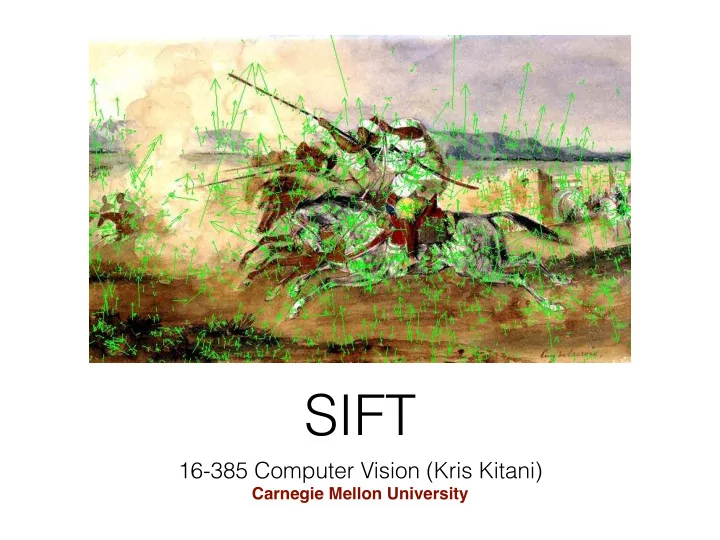
SIFT 16-385 Computer Vision (Kris Kitani) Carnegie Mellon - - PowerPoint PPT Presentation
SIFT 16-385 Computer Vision (Kris Kitani) Carnegie Mellon University SIFT (Scale Invariant Feature Transform) SIFT describes both a detector and descriptor 1. Multi-scale extrema detection 2. Keypoint localization 3. Orientation assignment
16-385 Computer Vision (Kris Kitani)
Carnegie Mellon University
(Scale Invariant Feature Transform) SIFT describes both a detector and descriptor
First octave Second octave
Gaussian Difference of Gaussian (DoG)
Gaussian Laplacian
Selected if larger than all 26 neighbors Difference of Gaussian (DoG) Scale of Gaussian variance
2nd order Taylor series approximation of DoG scale-space Take the derivative and solve for extrema Additional tests to retain only strong features
For a keypoint, L is the Gaussian-smoothed image with the closest scale, Detection process returns
location scale
x-derivative y-derivative
Image Gradients
(4 x 4 pixel per cell, 4 x 4 cells)
SIFT descriptor
(16 cells x 8 directions = 128 dims)
Gaussian weighting
(sigma = half width)
Locally orderless Global histogram