Short historical notes Dislocations: V. Volterra (1905) K. Kondo - - PowerPoint PPT Presentation

short historical notes
SMART_READER_LITE
LIVE PREVIEW

Short historical notes Dislocations: V. Volterra (1905) K. Kondo - - PowerPoint PPT Presentation

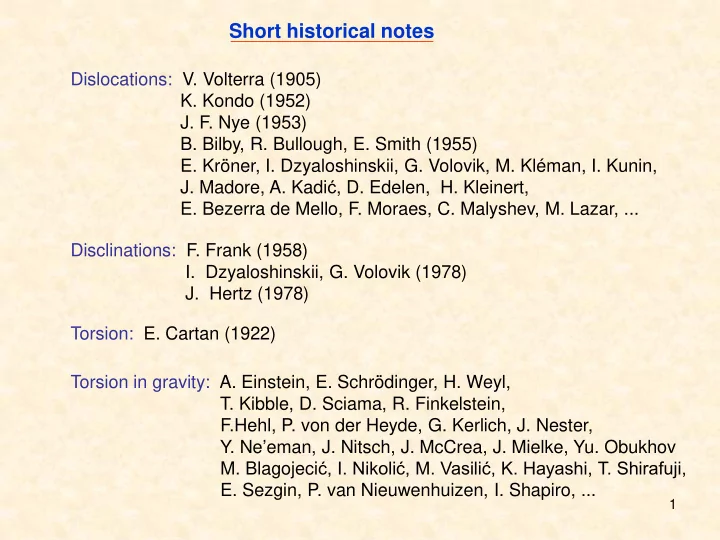
Short historical notes Dislocations: V. Volterra (1905) K. Kondo (1952) J. F. Nye (1953) B. Bilby, R. Bullough, E. Smith (1955) E. Krner, I. Dzyaloshinskii, G. Volovik, M. Klman, I. Kunin, J. Madore, A. Kadi , D. Edelen, H. Kleinert,


slide-1
SLIDE 1

1

Short historical notes

Dislocations: V. Volterra (1905)

  • K. Kondo (1952)
  • J. F. Nye (1953)
  • B. Bilby, R. Bullough, E. Smith (1955)
  • E. Kröner, I. Dzyaloshinskii, G. Volovik, M. Kléman, I. Kunin,
  • J. Madore, A. Kadić, D. Edelen, H. Kleinert,
  • E. Bezerra de Mello, F. Moraes, C. Malyshev, M. Lazar, ...

Disclinations: F. Frank (1958)

  • I. Dzyaloshinskii, G. Volovik (1978)
  • J. Hertz (1978)

Torsion: E. Cartan (1922) Torsion in gravity: A. Einstein, E. Schrödinger, H. Weyl,

  • T. Kibble, D. Sciama, R. Finkelstein,

F.Hehl, P. von der Heyde, G. Kerlich, J. Nester,

  • Y. Ne’eman, J. Nitsch, J. McCrea, J. Mielke, Yu. Obukhov
  • M. Blagojecić, I. Nikolić, M. Vasilić, K. Hayashi, T. Shirafuji,
  • E. Sezgin, P. van Nieuwenhuizen, I. Shapiro, ...
slide-2
SLIDE 2

2

  • M. O. Katanaev, Steklov Mathematical Institute, Moscow
  • J. Zanelli, Centro de Estudios Cienificos, Valdivia, Chile

Chern-Simons term in the Geometric Theory of Defects

Katanaev, Volovich Ann. Phys. 216(1992)1; ibid. 271(1999)203 Katanaev Theor.Math.Phys.135(2003)733; ibid. 138(2004)163 Phisics – Uspekhi 48(2005)675. Notation Elasticity theory of small deformations

2

ij j i ij ij k ij k

f σ σ λδ ε µε ∂ + = = +

  • Newton’s law
  • Hooke’s law
  • continuous elastic media = Euclidean three-dimensional space
  • Cartesian coordinates
  • Euclidean metric
  • displacement vector field
  • strain tensor
  • stress tensor

( ) ,

i

f x λ µ

  • density of nonelastic forces
  • Lame coefficients

( 0)

i

f =

3 1 2

, 1,2,3 ( ) ( )

i i ij i ij i j j i ij

x y i u x u u δ ε σ = = ∂ + ∂ 

slide-3
SLIDE 3

3

Differential geometry of elastic deformations

( )

i i

y x y → ( ) 2

k l ij kl ij i j j i ij ij i j

y y g x u u x x δ δ δ ε ∂ ∂ = ≈ − ∂ − ∂ = − ∂ ∂

1 2 (

)

ijk i jk j ik k ij

g g g Γ = ∂ + ∂ − ∂ ≠  ( )

l l m l ijk i jk ik jm

R i j = ∂ Γ − Γ Γ − ↔ =    

i i j k jk

x x x = −Γ    

l ijk

R =

k k k ij ij ji

T = Γ − Γ =   x ( )

i i i

x y u x = +

  • diffeomorphism:

3 3

→  

  • induced metric

(*) (*)

  • Christoffel’s symbols
  • curvature tensor
  • extremals (geodesics)
  • Saint-Venant integrability conditions of
  • torsion tensor

i

y

i

x

ij

δ

ij

g y 

slide-4
SLIDE 4

4

Dislocations

Edge dislocation Screw dislocation

b b

1

x

2

x

b

1

x

2

x

3

x

3

x

  • Burgers vector

Vacancy Linear defects:

( )

i

u x   

is continuous = elastic deformations is not continuous = dislocations Point defects:

slide-5
SLIDE 5

5

Edge dislocation

C

b

1

x

2

x

i i i C C

dx u dx y b

µ µ µ µ

∂ = − ∂ = −

∫ ∫  

, 1,2,3 xµ µ = ( )

i

y x ( )

i i i i C S

b dx e dx dx e e

µ µ ν µ µ ν ν µ

= = ∧ ∂ − ∂

∫ ∫∫ 

( ) ( )

i i ij j ij ij ik j k

T e e R

µν µ ν µ ν µν µ ν µ ν

ω µ ν ω ω ω µ ν = ∂ − − ↔ = ∂ − − ↔

i i

b dx dx T

µ ν µν

= ∧

∫∫

  • arbitrary curvilinear coordinates
  • is not continuous !
  • Burgers vector in elasticity
  • torsion
  • curvature

ij ji µ µ

ω ω = −

  • definition of the Burgers vector

in the geometric theory

ij

Rµν =

ij µ

ω →

then Back to elasticity: if

( ) lim

i i i

y e x y

µ µ µ

∂  =  ∂  

  • triad field

(continuous on the cut) SO(3)-connection

(*)

(*) ⇒

  • outside the cut
  • on the cut
slide-6
SLIDE 6

6

Disclinations

( )

i

n x

i

n ( )

i j i j

n n S ω = (3)

j i

S ∈ (3)

ij ji

ω ω = − ∈ so 1 2

jk i ijk

ω ε ω =

ijk

ε

123

( 1) ε =

  • unit vector field
  • fixed unit vector
  • orthogonal matrix
  • Lie algebra element (spin structure)
  • rotational angle
  • totally antisymmetric tensor

Examples

C

1

x

2

x

C

1

x

2

x

ij ij C

dxµ

µω

Ω = ∂

∫ 

jk i ijk

ε Θ = Ω

i i

Θ = Θ Θ 2π Θ = 4π Θ =

  • Frank vector

(total angle of rotation) Ferromagnets

slide-7
SLIDE 7

7

More examples Nematic liquid crystals

C

1

x

2

x

C

1

x

2

x Model for a spin structure:

1

( )

j k j i i k

l S S

µ µ −

= ∂

  • trivial SO(3)-connection (pure gauge)

π Θ = 3π Θ =

2

cos sin (1 cos ) (3),

k j j j j i ki i i i i

S ω ε ω ω δ ω ω ω ω ω ω ω ω = + + − ∈ = 

  • principal chiral SO(3)-model

ij

l

µ µ

∂ =

i i

n n −  ( ) (3)

i x

ω ∈ so

  • basic variable
slide-8
SLIDE 8

8

( )

ij x

ω ( ) lim

ij ij ij

x

µ µ µ

ω ω ω ∂  =  ∂  

  • is not continuous !
  • SO(3)-connection

(continuous on the cut)

( )

ij ij ij ij

dx dx dx

µ µ ν µ µ ν ν µ

ω ω ω Ω = = ∧ ∂ − ∂

∫ ∫∫ 

( )

ij ij ik j k

Rµν

µ ν µ ν

ω ω ω µ ν = ∂ − − ↔

ij ij

dx dx R

µ ν µν

Ω = ∧

∫∫

  • curvature
  • definition of the Frank vector

in the geometric theory Back to the spin structure: if

2

n∈

then

(3) (2) →  

  • outside the cut
  • on the cut
  • the Frank vector

Frank vector

slide-9
SLIDE 9

9

Summary of the geometric approach (physical interpretation)

3

with a given Riemann-Cartan geometry Independent variables

i ij

µ

ω     

  • triad field
  • SO(3)-connection

( ) ( )

i i ij j ij ij ik j k

T e e R

µν µ ν µ ν µν µ ν µ ν

ω µ ν ω ω ω µ ν = ∂ − − ↔ = ∂ − − ↔

  • torsion (surface density of

the Burgers vector)

  • curvature (surface density of

the Frank vector)

0, 0, 0, 0,

ij i ij i ij i ij i

R T R T R T R T

µν µν µν µν µν µν µν µν

= = = ≠ ≠ = ≠ ≠

Elastic deformations: Dislocations: Disclinations: Dislocations and disclinations: Media with dislocations and disclinations =

=

slide-10
SLIDE 10

10

The free energy

[ ] [ ]

HE CS

S S e S ω = +

( )

i i

g e

µν µν µ µ

δ δ = =

( )

3

1 1 CS 2 3 j i i k i i ijk i

S d J ω ω ε ω ω ω ω

∧ ∧ ∧ ∧

= + −

 1 2

, : ,

ij kij ij k k ijk µ µ µ µ

ω ω ε ω ω ε = = , ,... 1,2,3; , ,... 1,2,3 i j µ ν = =

( )

( ): 2

ij i j k ijk k k ijk

R R

µν µν µ ν ν µ µ ν

ω ε ω ω ω ω ε = = ∂ − ∂ +

No dislocations:

  • SO(3) connection

(1-form, the only variable)

  • free energy for disclinations
  • the source term (2-form)
  • equations of equilibrium
  • the total free energy
  • Euclidean metric

HE

S →

  • indices

i

J

k k

R J

µν µν

=

  • curvature

Three dimensions:

slide-11
SLIDE 11

11

One linear disclination

( )

2 int 3 i i

S q J q

µ µ

δ δ δω = −   x q

( ) ( )

int 3 3 3 2 3 i i i i i i i i

S dq J dtq J q dtd xq J x q d x J q

µ µ µ µ µ µ µ µ

ω ω ω δ ω δ = = = = − = −

∫ ∫ ∫ ∫

    x q

  • the core of disclination
  • the interaction term

Notation:

3 3

,

x y

ω ω

  • the only nontrivial components

3

x

  • the curvature tensor

1 3 3 3 2 2 i z x y

ω ω ω = −

  • one complex component

One disclination along axis

( )

3,

q t t

µ

∈ ∈  

1 2

, , : x x x y z x iy = = = +

( )

3 3 3

2

zz z z z z

R ω ω = ∂ − ∂

  • the source term

1 2

( , ) x x = x C

1

x

2

x

slide-12
SLIDE 12

12

One straight linear disclination

3 z

iA z ω = −

( )

1

z

z z πδ ∂ =

xy yx

ω ω ∂ = ∂ 2 arctan x A C y ω = − +

( )

3

4 ,

zz

R iA z A π δ = ∈

Fixing the source term:

  • new kind of defect

The solution:

3 3 2 2 2 2

2 2 ,

x y

Ay Ax x y x y ω ω = − = + +

  • real components

Rotational angle field The integrability conditions are fulflled

  • a general solution

( )

ω x

  • important formula

2 2 2 2

2 2 ,

x y

Ay Ax x y x y ω ω ∂ = − ∂ = + + tan = , : 2 x C A y A ω π ϕ ϕ = ⇒ =

  • polar angle
slide-13
SLIDE 13

13

One straight linear disclination

( )

, x y ω

To make the rotational angle field well defined, we must impose the quantization condition:

, 2 n A n n ω ϕ = ∈ ⇒ =  ฀

12 2 2 12 2 2

sin , cos .

x y

ny n x y nx n x y ω ϕ ω ϕ = − = − + = = +

SO(3)-connection:

x y C

slide-14
SLIDE 14

14

Conclusion

1) The first example of disclination is described within the geometric theory of defects. 2) The Chern-Simons term is well suited for disclinations in the geometric theory of defects. 3) Linear disclinations correspond to a new type of defects of the SO(3) connection (the spin structure).