Sharing Intelligence is our Best Defense: Incentives That Work - - PDF document

sharing intelligence is our best defense
SMART_READER_LITE
LIVE PREVIEW

Sharing Intelligence is our Best Defense: Incentives That Work - - PDF document

Sharing Intelligence is our Best Defense: Incentives That Work versus Disincentives That Can Be Solved William Yurcik* Adam Slagell Jun Wang NCSA Security Research National Center for Supercomputing Applications (NCSA) University of Illinois


slide-1
SLIDE 1

1

National Center for Supercomputing Applications

William Yurcik* Adam Slagell Jun Wang

NCSA Security Research National Center for Supercomputing Applications (NCSA) University of Illinois at Urbana-Champaign

Sharing Intelligence is our Best Defense:

Incentives That Work versus Disincentives That Can Be Solved

Data Sharing Panel FloCon 2004

National Center for Supercomputing Applications

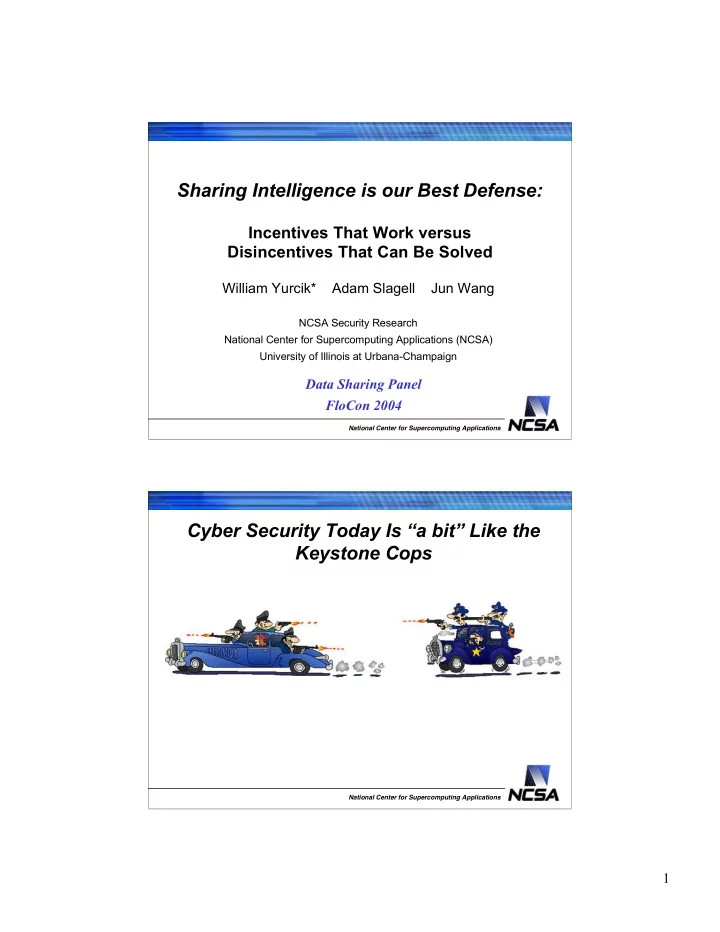
Cyber Security Today Is “a bit” Like the Keystone Cops

slide-2
SLIDE 2

2

National Center for Supercomputing Applications

Cyber Security Today Is “a bit” Like the Keystone Cops They do something really bad!

National Center for Supercomputing Applications

Cyber Security Today Is “a bit” Like the Keystone Cops They do something really bad! Then we chase them to the border.

slide-3
SLIDE 3

3

National Center for Supercomputing Applications

Security Information Sharing

  • Need to share information on attacks.

– Fingerprints and attack profiles – Individual events

  • Identify individuals
  • We cannot continue to stop at the border, we need to

cooperate with law enforcement and each other.

– Security event repository – Event correlation across administrative domains

  • “unfortunately, this country takes body bags and

requires body bags sometimes to make really tough decisions about money and about governmental arrangements” - Richard Clarke 9/11 Testimony

National Center for Supercomputing Applications

Greater Dependency on Collaborations and Technology The World is Rapidly Changing

slide-4
SLIDE 4

4

National Center for Supercomputing Applications

Cooperation is Voluntary The vast majority of incidents are never reported

National Center for Supercomputing Applications

Cooperation is Voluntary Caveat - except in California!

Only state mandatory disclosure law currently on the books at state level. Effective as of July 2003

slide-5
SLIDE 5

5

National Center for Supercomputing Applications

Cooperation is Voluntary Caveat - except in California!

Only state mandatory disclosure law currently on the books at state level. Effective as of July 2003 California Law has national effects: California is home to many of the biggest technology companies in the country. Law applies to all who “conduct business” in the state. Of course many companies route their information through servers housed in California. Potential for litigation in California - many times companies will have no way of knowing whether a person is resident of California or not.

National Center for Supercomputing Applications

Computer Emergency Response Teams CERTs

http://www.first.org/team-info/

slide-6
SLIDE 6

6

National Center for Supercomputing Applications

Information Sharing and Analysis (ISACs)

  • Gathering, analysis

and sharing of information related to actual or unsuccessful attempts at computer security breeches.

  • Presidential Decision

Directive (PDD)-63

  • Fee base

membership

  • Operational ISACs

– Electric power – Telecommunications – Information technology – Financial services – Water supply – Surface transportation – Oil & gas – Emergency fire services – Food – Chemicals industry – Emergency law enforcement

National Center for Supercomputing Applications

Question: Question: Can we share? Can we share?

slide-7
SLIDE 7

7

National Center for Supercomputing Applications

(1) SANS

National Center for Supercomputing Applications

(2) DShield.org Distributed Intrusion Detection System

Services registered for this port …. Vulnerabilities for this port …

slide-8
SLIDE 8

8

National Center for Supercomputing Applications

(3) Forum of Incident Response and Security Teams

<http://www.first.org/>

(4) CIC-SWG

Committee on Institutional Cooperation

  • IT Security Working Group

(Big Ten Universities plus the University of Chicago) <http://www.cic.uiuc.edu/groups/ITSecurityWorkingGroup/>

National Center for Supercomputing Applications

Incentives Incentives / / Disincentives Disincentives

slide-9
SLIDE 9

9

National Center for Supercomputing Applications

Framing the Data Sharing Issues

  • Both an Internal / External Issue (within before between)
  • Who should share externally?

– at what organizational levels (more/less bureaucracy) – flat or hierarchical (scalability)

  • What should be shared?

– raw data, processed data, known answers

  • How should it be shared?

– phone calls/Emails, reports, automation

Significant time and effort to share

– payback? none/long-term real-time

Does technology exist to share securely

– Will information I share come back to bite me?

National Center for Supercomputing Applications

Commonly Available Logs

1) NetFlows Logs 2) Packet Traces - tcpdump 3) Network IDS- BRO,Snort, etc. 4) Host IDS – Tripwire, etc. 5) Syslogs (general) 6) Authentication Logs 7) DHCP Server Logs 8) Firewall logs 9) Mail Server Logs 10) Backup Logs 11) AntiVirus Logs 12) Vulnerability Scan Logs 13) Nameserver DNS Cache 14) SNMP Logs 15) BGP Tables 16) Dial-Up Server Logs 17) ARP Cache 18) Workstation Logs 19) Process Accounting Logs 20) Trace Route Logs 21) “Homegrown” Logs …..
slide-10
SLIDE 10

10

National Center for Supercomputing Applications

Attributes Across Logs

National Center for Supercomputing Applications

Log Anonymization

Log Anonymizing Engine Requirements Algorithms Multiple Levels of Anonymized Logs

(e.g., different internal/external requirements)

slide-11
SLIDE 11

11

National Center for Supercomputing Applications

Statistical Inference Known Plain-Text Attacks

Anonymized Prefix-Preserving IDS Log Anonymized Prefix-Preserving Syslog Log

unique scan of IP X at time T1 unique ssh attempt on IP X at time T1 IP X unique syslog messages at time T2 IP X with port activity at Time T2 National Center for Supercomputing Applications

slide-12
SLIDE 12

12

National Center for Supercomputing Applications

NCSA SIFT Project NCSA SIFT Project http://www.ncassr.org/projects/sift/ http://www.ncassr.org/projects/sift/ VizSEC

VizSEC Workshop Oct 29, 2004 Workshop Oct 29, 2004 ACM Computer and Communications ACM Computer and Communications Security Washington DC Security Washington DC http://www. http://www.cs cs.fit. .fit.edu edu/~ /~pkc pkc/vizdmsec04/ /vizdmsec04/

National Center for Supercomputing Applications

Discussion

  • No one-size-fits-all solution exists for log sharing
  • Solutions depend on the application

– three major problems

1) huge distributed data volumes

  • visualization is part of the solution here – next workshop

2) security must be considered

  • CIA
  • may require re-design/re-architecture (I hope not!)

3) Incentives

  • Operational incentives may be the key

– We have a counter-intuitive example that actually works:

  • sharing between very selfish sysadmins with very sensitive security

information (go figure)

– “only cooperation will make us less vulnerable”