Shale Gas and fracking An Introduction Markus Hnchen ETH Zrich 1 - - PowerPoint PPT Presentation

shale gas
SMART_READER_LITE
LIVE PREVIEW

Shale Gas and fracking An Introduction Markus Hnchen ETH Zrich 1 - - PowerPoint PPT Presentation

Shale Gas and fracking An Introduction Markus Hnchen ETH Zrich 1 April 2014 Ewen et al., 2012 U.S. Shale Gas Production 39% of total natural gas production in 2013 U.S. EIA, 2012 Formation of Fossil Fuels Burial of organic


slide-1
SLIDE 1

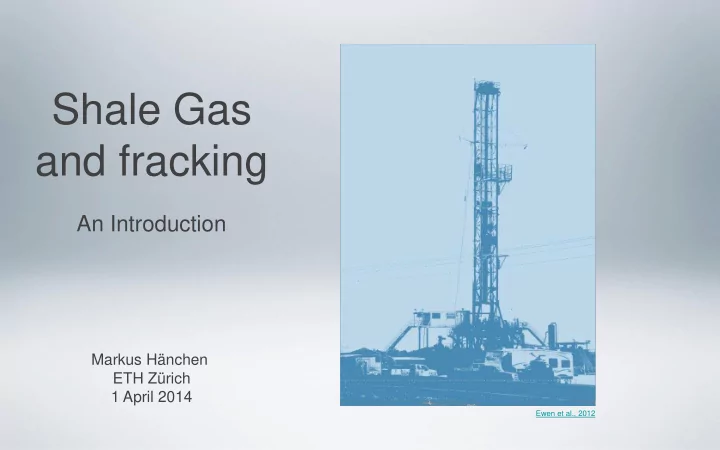
Shale Gas and fracking

Markus Hänchen ETH Zürich 1 April 2014

An Introduction

Ewen et al., 2012
slide-2
SLIDE 2

U.S. Shale Gas Production

39% of total natural gas production in 2013

U.S. EIA, 2012

slide-3
SLIDE 3
  • Burial of organic material
  • First: biogenic methane production
  • Thermogenic oil and gas production
  • Oil and gas window

Formation of Fossil Fuels

Seewald, 2003

slide-4
SLIDE 4

Unconventional Natural Gas

  • Upward migration

from source rock

  • Conventional gas:

Accumulation under structural traps

  • Tight gas: Trapped

in low permeability rock

  • Shale gas:

Remains trapped in source rock

U.S. EIA, 2010

slide-5
SLIDE 5

Why We Need Fracking

Permeability in millidarcy Thin section photograph of shales -- small, unconnected pores

King, 2012 Pierce (USGS), 2012

slide-6
SLIDE 6

Hydraulic Fracturing

  • Pumping large volumes of

water with sand and additives

  • 10 m3/min, 500 bar,

10’000 m3/well

  • Sand prevents closure of

fractures after pressure reduction

  • 5 to 80% returns mixed

with highly saline formation water (incl. heavy metals, NORM)

Marathon Oil, 2012

slide-7
SLIDE 7

Well Construction

  • Multiple concentric

steel casings encased with cement

  • Typically four

casings with three casings in the freshwater layer

  • Depths of 1000 to

4000 m, lateral length of 1 to 3 km

Ewen et al., 2012 BP, 2012

slide-8
SLIDE 8

Well Layout

  • Multiple wells (up to

30+) drilled from

  • ne well pad
  • One pad can cover

an area of 3x3 km

  • r larger

Ewen et al., 2012

slide-9
SLIDE 9

Frac Fluids

(1) Modify fluid properties

  • (2) Prevent undesirable reactions
  • (3) pH adjustment

fracfocus.org, August 2012

slide-10
SLIDE 10

Frac Fluids

(1) Modify fluid properties

  • Friction reducer
  • Gellant
  • Crosslinker
  • Breaker
  • Surfactant

(2) Prevent undesirable reactions

  • Biocide
  • Corrosion inhibitor
  • Anti-scaling agent
  • Clay stabiliser
  • Iron control

(3) pH adjustment

  • Strong acids, bases, buffers

Frac Fluids rarely contain components from all additive groups

slide-11
SLIDE 11

Examples of common additives

(1) Modify fluid properties

  • Friction reducer > Polyacrylamide
  • Gellant > Guar Gum
  • Crosslinker > Sodium Perborate
  • Breaker > Sodium Peroxidisulphate, Cellulase
  • Surfactant > Nonyl Phenol Ethoxylate

(2) Prevent undesirable reactions

  • Biocide > Glutaraldehyde
  • Corrosion inhibitor > Isopropanol
  • Anti-scaling agent > Ammonium Chloride
  • Clay stabiliser > Potassium Chloride
  • Iron control > Citric Acid

(3) pH adjustment

  • Strong acids, bases, buffers > Hydrochloric Acid, Acetic acid
slide-12
SLIDE 12

Frac Fluid Developments

  • The most toxic additives have been

phased out (benzene, diesel, fluorocarbons)

  • One operator: shortlist of nine chemicals
  • nly
  • Biocides replaced with UV, ozone,

chlorine dioxide (drinking water purification)

  • Possible: Only using food additives
  • Water-free fracs: Propane, N2, CO2
  • (Full) disclosure > fracfocus.org (since 2011)

since 2011

fracfocus.org, April 2014

slide-13
SLIDE 13

Fracturing Monitoring

  • Pressure-flow rate

response

  • Microseismic
  • Tiltmeter

Zoback, 2010

slide-14
SLIDE 14

What Can Be Problematic

  • Methane in groundwater (more sampling)
  • Surface or near surface spills of frac fluid or backflow (reduce

toxicity of additives, stricter procedures)

  • Migration from deep underground (very unlikely)
  • Disposal of backflow (mostly re-injected, increased recycling)
  • Methane emissions during well completion (technically solvable:

Green Completions, required in the US now)

  • Freshwater needs (only in arid areas)
  • Induced seismicity (mainly from backflow re-injection)
  • Land use, noise, light (mainly in undisturbed nature)