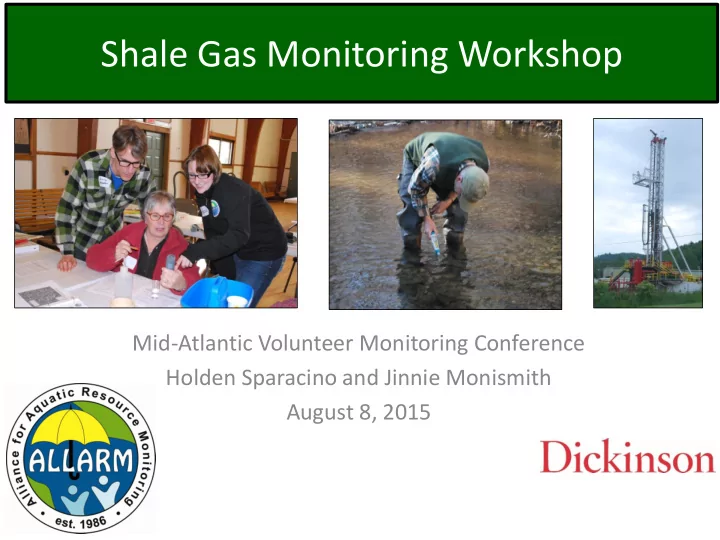
Shale Gas Monitoring Workshop Mid-Atlantic Volunteer Monitoring - - PowerPoint PPT Presentation

shale gas monitoring workshop
SMART_READER_LITE
LIVE PREVIEW

Shale Gas Monitoring Workshop Mid-Atlantic Volunteer Monitoring - - PowerPoint PPT Presentation

Shale Gas Monitoring Workshop Mid-Atlantic Volunteer Monitoring Conference Holden Sparacino and Jinnie Monismith August 8, 2015 Game Plan Introduction to ALLARM Science of Shale Gas Monitor Protocol Quality Assurance / Quality


slide-1
SLIDE 1

Shale Gas Monitoring Workshop

Mid-Atlantic Volunteer Monitoring Conference Holden Sparacino and Jinnie Monismith August 8, 2015

slide-2
SLIDE 2

Game Plan

  • Introduction to ALLARM
  • Science of Shale Gas
  • Monitor Protocol
  • Quality Assurance /

Quality Control

  • Findings
  • Questions
  • Hands-on Meter Testing
slide-3
SLIDE 3

About ALLARM

  • Director: Julie Vastine
  • Assistant Directors: Jinnie Monismith & Holden Sparacino
  • Science Advisor/Founder: Candie Wilderman
  • 13 Dickinson College Students
  • Program of Dickinson College
  • 40% supported by the college, 60% funded by federal, state, family

foundation grants

slide-4
SLIDE 4

1986 1987 1988 1989 1990 1991 1992 1993 1994 1995 1996 1997 1998 1999 2000 2001 2002 2003 2004 2005 2006 2007 2008 2009 2010 2011 2012 2013

Acid Rain Monitoring Traditional Technical Assistance

Shale Gas

Monitoring Program Region Volunteers Model of C Science Acid Rain Statewide Individuals Contributory WatershedTA Southcentral PA Groups Co-created Shale Gas Marcellus & Utica Groups & Individuals Collaborative

2014 2015

ALLARM History

Empower communities to use scientific tools to monitor, protect, and restore waterways.

slide-5
SLIDE 5

ALLARM Areas of Assistance

Scientific

  • Study design creation
  • Chemical monitoring
  • Quality Assurance/ Quality

Control

  • Biological Monitoring
  • Visual assessment
  • Data interpretation and

communication

  • Shale-gas monitoring
  • Coming soon: Chesapeake Bay

Monitoring

Programmatic

  • Strategic planning
  • Volunteer recruitment and

retention

slide-6
SLIDE 6
slide-7
SLIDE 7

Shale Gas Plays

slide-8
SLIDE 8

Depth to Marcellus Shale

slide-9
SLIDE 9

Depth to Utica Shale

slide-10
SLIDE 10

Shale Gas Wells in Region

slide-11
SLIDE 11

Unconventional vs. Conventional

http://seekingalpha.com/article/131641-unconventional-natural-gas-just-a-frac-away

slide-12
SLIDE 12

Hydraulic Fracturing (Fracking)

This protocol documents flowback pollution and visual

  • bservations in small streams.
slide-13
SLIDE 13

Differences in Drilling

Traditional Hydrofracking

  • Typically 20,000 to 80,000

gallons of fluid were used each time a well was hydrofractured.

  • Traditional hydrofracking

used 700 to 2,800 lbs. of chemical additives

  • 1940s

High Volume Hydrofracking (HVHF)

  • HVHF uses between 2 and 10

million gallons of fluid (on average 5.6 million), the exact amount depends upon the length of the well bore and the number of fractures created along the lateral extent.

  • HVHF uses between 205,000 and

935,000 lbs. of chemical additives, per well many of which are toxic to humans and wildlife.

  • Late 1990s

www.TCgasmap.org Marcellus Accountability Project-Tompkins

slide-14
SLIDE 14

Flowback water

  • Quantity: 10-15% of frack water flows back
  • Quality:

– Brine (salty water) including high concentrations of chlorides, sodium, sulfates: very high TDS – Metals, e.g. barium iron, manganese, arsenic, strontium, lead, cadmium, chromium, aluminum – Naturally occurring radioactive materials such as uranium, radium, and radon – Bacteria – Methane

  • Pathway to environment: spills, incomplete

treatment, well casing leaks, migration through bedrock, illegal dumping

Water that returns to surface - it consists of frack water plus chemicals released from underground rock formations.

slide-15
SLIDE 15

What Do Monitors Test For?

  • 1. Flowback Monitoring:

Chemical Parameters Indicator chemicals

Conductivity & TDS Signature Chemicals Barium Strontium

Stage Monitoring

Relationship to conductivity

  • 2. Physical Impacts

Visual Observations:

  • Land disturbances
  • Spills and discharges
  • Gas migration/leakages
  • Pipeline impacts
slide-16
SLIDE 16

Goal: Red flag monitoring

  • Document violations
  • Report to agencies

to respond

slide-17
SLIDE 17
  • Frack water mixes

with natural brine, found in the shale

  • Flowback water

contains high concentrations of salts and metals

Picture by Amy Bergdale, US EPA

Why Conductivity and TDS?

slide-18
SLIDE 18

Barium and Strontium

  • Naturally-
  • ccurring

metals found deep underground

  • Indicate

contamination from Marcellus Shale activities (signature chemicals)

https://www.msu.edu/~zeluffjo/periodic_table.gif

slide-19
SLIDE 19

Stage Monitoring

slide-20
SLIDE 20

Visual Assessment

  • Earth Disturbances
  • Spills and Discharges
  • Gas Migration/Leakages
  • Pipelines

Marcellus Shale Well Sites in Dimock, PA; 2010

slide-21
SLIDE 21

Photo courtesy of PA Council of Trout Unlimited Photo courtesy of PA Council of Trout Unlimited

Earth Disturbances

http://www.postcarbon.org/reports/shale-gas-well.jpg

slide-22
SLIDE 22

Drilling fluid spill at Cabot site Dimock, PA September 2009

Photo courtesy of Delaware Riverkeeper Network Photo courtesy of Delaware Riverkeeper Network Photo courtesy of Delaware Riverkeeper Network Photo courtesy of Delaware Riverkeeper Network

Spills and Discharges

slide-23
SLIDE 23

Gas Migration or Leakages

ALLARM ALLARM

ALLARM

slide-24
SLIDE 24

Pipeline Erosion & Sedimentation

ALLARM ALLARM

slide-25
SLIDE 25

Online Monitoring Toolkit

http://blogs.dickinson.edu/marcellusmonitoring/

slide-26
SLIDE 26

Meter Trials

Dickinson students, faculty, and staff helped test conductivity/TDS meters to determine which meter is most accurate, precise, and easy to use.

slide-27
SLIDE 27

Tailoring the ALLARM Protocol

Establish where wells are located and where they will be located. Find an entity who is willing to perform QA/QC checks (conductivity & TDS) and barium & strontium analysis (signature chemicals). Determine which agency you to report violations (multiple) & understand how they will respond.

Well Location Information Laboratory Testing Agency Reporting

slide-28
SLIDE 28

Well Location Information

  • State agency
  • Non-profit entity

Develop a protocol for monitors to find/track well locations and status.

slide-29
SLIDE 29

Laboratory Testing

  • State agencies
  • State-certified labs
  • Colleges/universities

Develop an agreement and create a protocol for monitors to follow.

slide-30
SLIDE 30

Agency Reporting

  • Local, state & federal

agencies

  • Interested parties

Develop a decision tree and a contact list for monitors to use if they witness a violation.

slide-31
SLIDE 31

Data Use: Decision Trees

Report monitoring information when values exceed criteria in decision trees Chemical Monitoring * Visual Assessment * Pipelines

slide-32
SLIDE 32

ALLARM’s QA/QC Program has led to:

  • 1. Agreement with PA DEP to prioritize calls from volunteers with

information about a suspected pollution event

  • 2. EPA approved Quality Assurance Project Plan (QAPP)

Quality Assurance/Quality Control

  • Training provided:
  • Care for equipment
  • Calibrate equipment
  • Collect and test a water sample
  • Documented procedures
  • Replicates
  • Split sample analysis (twice/year)
slide-33
SLIDE 33
  • Monitors send samples to

ALLARM twice a year.

  • Samples are analyzed by

ALLARM for conductivity and total dissolved solids.

  • Monitor’s results are

compared to ALLARM’s results for precision.

Split Sample Analysis

slide-34
SLIDE 34

ALLARM Data Analysis

Data collected 2010 – 2013 Dataset was reduced

  • Monitoring frequency
  • QA/QC

Conductivity values compared to watershed characteristics

  • Watershed size
  • Geology
  • Land cover
  • Number/density of wells

in watershed

slide-35
SLIDE 35

Watershed Size

Most of the monitoring sites were in small, headwater streams.

  • 58% of the watersheds were less than 10 square miles.
  • 88% of the watersheds had a drainage area of less than 50 square miles.

Watershed size did not influence conductivity values.

slide-36
SLIDE 36

Geology

For the purpose of the analysis, the geology was categorized as: There was a strong relationship between conductivity and the percent limestone in the watershed.

slide-37
SLIDE 37

Land Cover

Most of the watersheds were predominately in forested areas (101 of 116). Sites with the highest average conductivity values (1245 – 1647 µS/cm) were generally found in developed areas. The eight urban sites also had a large amount of limestone in the watershed.

slide-38
SLIDE 38

Drilled Wells

Only 23 (of 116) sites were downstream from a shale gas well. The number of wells drilled in each watershed ranged from 1 – 475, although only two watersheds had more than 12 shale gas wells. Conductivity was not influenced by the number

  • f wells or the density of

wells in the watershed.

slide-39
SLIDE 39

Conclusions

Average conductivity values in streams were related to the amount of land development (urban area) and limestone (geology) in the watershed. It is not significantly related to the size

  • f the watershed or the

number/density of drilled wells (although only 23/116 watersheds had wells drilled at the time of sampling). The ALLARM Shale Gas Volunteer Monitoring Program has demonstrated the value of a large volunteer-collected dataset in detecting patterns related to watershed characteristics. The dataset shows similar patterns to data reported in the scientific literature.

slide-40
SLIDE 40

Questions?

Alliance for Aquatic Resource Monitoring (ALLARM) Phone: 717.245.1565 Email: allarm@dickinson.edu Website: dickinson.edu/allarm Toolkit: blogs.dickinson.edu/marcellusmonitoring/ Social Media: @allarmwater facebook.com/allarmwater

slide-41
SLIDE 41

Hands-on Activity

Monitor Equipment: 1. LaMotte Tracer PockeTester and calibration solution vial 2. 84 µS/cm & 1413 µS/cm standard calibration solution 3. Distilled water wash bottle 4. Stream testing bottle 5. 3 sample bottles

– Two sample bottles for QA/QC – One bottle for pollution event Ba and Sr analysis

6. Gage Stick