Severe Multi-System Presentation of COVID-19 in a Four-Month- Old - - PDF document

severe multi system presentation of covid 19 in a four
SMART_READER_LITE
LIVE PREVIEW

Severe Multi-System Presentation of COVID-19 in a Four-Month- Old - - PDF document

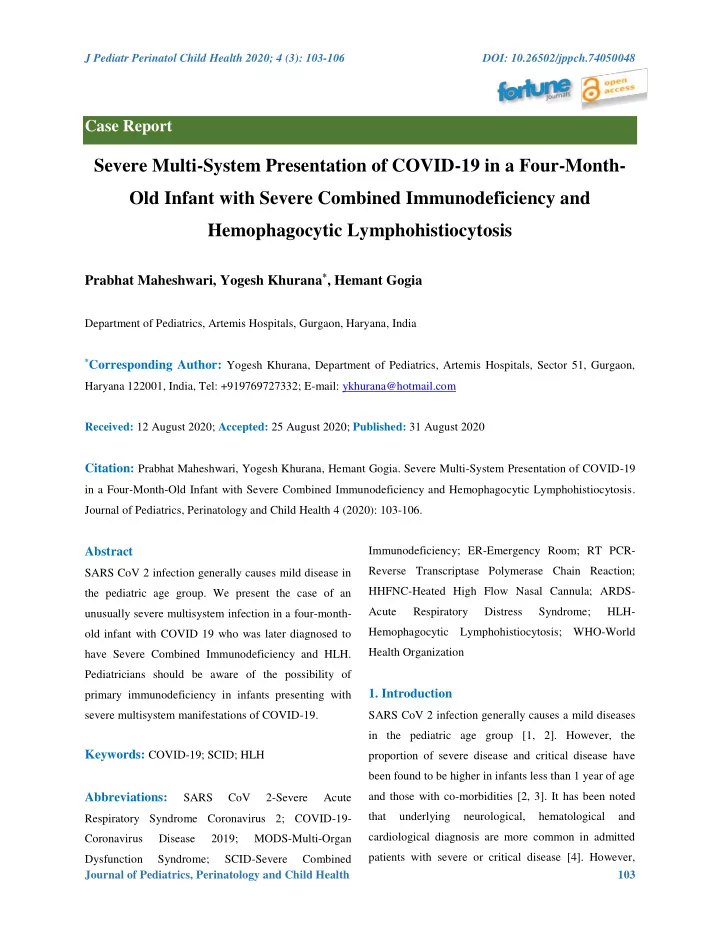
DOI: 10.26502/jppch.74050048 J Pediatr Perinatol Child Health 2020; 4 (3): 103-106 Case Report Severe Multi-System Presentation of COVID-19 in a Four-Month- Old Infant with Severe Combined Immunodeficiency and Hemophagocytic Lymphohistiocytosis


slide-1
SLIDE 1

J Pediatr Perinatol Child Health 2020; 4 (3): 103-106 DOI: 10.26502/jppch.74050048 Journal of Pediatrics, Perinatology and Child Health 103

Case Report

Severe Multi-System Presentation of COVID-19 in a Four-Month- Old Infant with Severe Combined Immunodeficiency and Hemophagocytic Lymphohistiocytosis

Prabhat Maheshwari, Yogesh Khurana*, Hemant Gogia

Department of Pediatrics, Artemis Hospitals, Gurgaon, Haryana, India

*Corresponding Author: Yogesh Khurana, Department of Pediatrics, Artemis Hospitals, Sector 51, Gurgaon,

Haryana 122001, India, Tel: +919769727332; E-mail: ykhurana@hotmail.com Received: 12 August 2020; Accepted: 25 August 2020; Published: 31 August 2020

Citation: Prabhat Maheshwari, Yogesh Khurana, Hemant Gogia. Severe Multi-System Presentation of COVID-19

in a Four-Month-Old Infant with Severe Combined Immunodeficiency and Hemophagocytic Lymphohistiocytosis. Journal of Pediatrics, Perinatology and Child Health 4 (2020): 103-106.

Abstract

SARS CoV 2 infection generally causes mild disease in the pediatric age group. We present the case of an unusually severe multisystem infection in a four-month-

  • ld infant with COVID 19 who was later diagnosed to

have Severe Combined Immunodeficiency and HLH. Pediatricians should be aware of the possibility of primary immunodeficiency in infants presenting with severe multisystem manifestations of COVID-19.

Keywords: COVID-19; SCID; HLH Abbreviations:

SARS CoV 2-Severe Acute Respiratory Syndrome Coronavirus 2; COVID-19- Coronavirus Disease 2019; MODS-Multi-Organ Dysfunction Syndrome; SCID-Severe Combined Immunodeficiency; ER-Emergency Room; RT PCR- Reverse Transcriptase Polymerase Chain Reaction; HHFNC-Heated High Flow Nasal Cannula; ARDS- Acute Respiratory Distress Syndrome; HLH- Hemophagocytic Lymphohistiocytosis; WHO-World Health Organization

  • 1. Introduction

SARS CoV 2 infection generally causes a mild diseases in the pediatric age group [1, 2]. However, the proportion of severe disease and critical disease have been found to be higher in infants less than 1 year of age and those with co-morbidities [2, 3]. It has been noted that underlying neurological, hematological and cardiological diagnosis are more common in admitted patients with severe or critical disease [4]. However,

slide-2
SLIDE 2

J Pediatr Perinatol Child Health 2020; 4 (3): 103-106 DOI: 10.26502/jppch.74050048 Journal of Pediatrics, Perinatology and Child Health 104 there is considerable disagreement regarding the clinical

  • utcomes COVID-19 in immunosuppressed children.

Studies suggest both a milder disease outcome [5] or a more severe disease outcome [6]. SCID is a rare congenital disorder [7] with heterogenous clinical and genetic basis characterized by absent T lymphocyte functioning with profound defects in cellular and humoral immunity [8]. We present a unique case of an infant with fatal SARS CoV 2 infection in a yet unknown case of SCID to emphasise the need to explore for underlying immunodeficiencies in neonates and infants with severe manifestations of COVID-19.

  • 2. Case Presentation

A four-month-old neonate presented to the ER with history of fever since the last ten days associated with cough since the last six days and gradually increasing respiratory distress. On examination the child appeared sick, was febrile and had respiratory distress in the form

  • f tachypnea with subcostal retractions and tachycardia.

On systemic examination, there was significant

  • hepatosplenomegaly. Initial reports were suggestive of

deranged liver function tests, elevated ferritin, C reactive protein, d-dimer and Lactate dehydrogenase. The hemogram showed anemia with leukopenia and

  • lymphopenia. RT PCR for SARS CoV 2 was positive.

There were bilateral perihilar and left lower lobe

  • pacities on chest x-ray. The infant was started on broad

spectrum antibiotics, steroids and enoxaparin. He was started on HHFNC in view of respiratory distress and given packed cell transfusion for the anemia. Despite therapy, there was worsening in clinical and lab

  • parameters. As there was gradually progressive

respiratory distress and the child was progressing towards respiratory failure, he was intubated and mechanically ventilated as per the unit ARDS protocol. Simultaneously, he had persistent fever and the lab investigations revealed increasing hyperferritinemia along with pancytopenia and worsening liver functions. A diagnosis of HLH was considered and Intravenous Immunoglobulin was given in addition to steroids. However, there was a worsening of lab parameters in the form

  • f

progressive pancytopenia with hyperferritinemia and deranged liver functions, thus a bone marrow biopsy was done which was confirmatory

  • f HLH. After discussion with pediatric hemato-
  • ncologist and family members a trial of Etoposide was

started as per HLH 2004 protocol. Blood Cultures showed growth of Candida Parapsilosis, Endotracheal aspirates stained positive for Norcardia and blood CMV PCR was positive. Antimicrobials were optimized as per culture and organisms. In view of the infections with unusual organisms along with persistent lymphopenia and severe disease course a suspicion of primary immunodeficiency was considered and genetic workup was sent on clinical suspicion of SCID. The child remained clinically stable on antimicrobial therapy and repeat cultures were negative. However, despite optimal therapy and prone ventilation, the lung functions kept worsening and the ventilatory requirement kept on

  • increasing. While on mechanical ventilation the child

developed hemodynamic instability, which progressed into irreversible shock and despite our best efforts the child died after 27 days of admission. (Serial reports in appendix A).

  • 3. Discussion

The SARS CoV 2 virus is the seventh subtype of coronavirus to have caused clinical disease in human, and has taken on overwhelming economic and healthcare significance. As it is a new disease information regarding the disease is still emerging, however, there are significant gaps in our knowledge regarding epidemiology, clinical course, co-morbidities and treatment options. To our knowledge this is the first case of a SARS CoV 2 infection presenting in a yet unknown case of SCID, although there is a case report

  • f a HCoV HKU1 coronavirus infection in SCID which
slide-3
SLIDE 3

J Pediatr Perinatol Child Health 2020; 4 (3): 103-106 DOI: 10.26502/jppch.74050048 Journal of Pediatrics, Perinatology and Child Health 105 was also fatal [8]. SCID represents a heterogenous group of disorders affecting T lymphocyte function leading to additional dysfunction of B and NK cells. They represent the most severe form of primary immunodeficiencies, with average life expectancies of 1-2 years. SCID is a rare disease with approximately 1 in 588000 cases, however, it may be curative with HSCT only if detected before onset of overwhelming infections, therefore the current emphasis is on early diagnosis by newborn screening [9]. Furthermore, as seen in our case primary immunodeficiencies are commonly associated with HLH, due to abnormalities in T cell structure and function Moreover, co-association

  • f primary immunodeficiencies with HLH is associated

with a poorer prognosis [10]. COVID-19 is generally considered to cause mild disease in the pediatric age group, however the proportion of severe or critical disease is higher in infants. The prevalence of severe and critical disease was 10.6% in children aged <1 at diagnosis, 1-5 years (7.3%), 6-10 years (4.2%), 11-15 years (4.1%) and 16-17 years (3.0%) [2]. Despite the higher incidence of severe/ critical disease in infancy, physicians should also actively look for any co- morbidities especially primary immunodeficiencies in infants presenting with critical multisystem manifestation of COVID -19.

  • 4. Conclusion

We present the case of a four-month-old infant presenting with severe multisystem manifestations requiring mechanical ventilation with associated HLH. On evaluation found to have persistent lymphopenia and multiple infections with unusual organisms which were not responding to conventional therapy. The profile of the child raised a suspicion

  • f

primary immunodeficiency for which genetic workup was sent. The genetic workup was received post mortem confirming a JAK-3 Mutation causing SCID. We would like to emphasis the need for early diagnosis of Primary immunodeficiencies, especially early screening for SCID so that curative therapy maybe undertaken prior to the onset of overwhelming infection. Furthermore, we would re-emphasise the need for evaluation of comorbidities, especially primary immunodeficiencies, in infants presenting with unusually severe multisystem manifestations of SARS CoV 2 infection.

Conflicts of Interest

None.

Appendix

http://www.fortunejournals.com/appendix.pdf

References

  • 1. Patel NA. Pediatric COVID-19: Systematic

review of the literature. Am J Otolaryngol 41 (2020): 102573.

  • 2. Ludvigsson JF. Systematic review of COVID-

19 in children shows milder cases and a better prognosis than adults. Acta Paediatrica 109 (2020): 1088-1095.

  • 3. Yonker LM, Shen K, Kinane TB. Lessons

unfolding from pediatric cases of COVID-19 disease caused by SARS-CoV-2 infection. Pediatric Pulmonology 55 (2020): 1085-1086.

  • 4. DeBiasi RL, Song X, Delaney M, et al. Severe

COVID-19 in Children and Young Adults in the Washington, DC Metropolitan Region. J Pediatr 223 (2020): 199-203.

  • 5. Minotti C, Tirelli F, Barbieri E, et al. How is

immunosuppressive status affecting children and adults in SARS-CoV-2 infection? A systematic review. J Infect 81 (2020): 61-66.

  • 6. Gao Y, Chen Y, Liu M, et al. Impacts of

immunosuppression and immunodeficiency on COVID-19: A systematic review and meta-

  • analysis. J Infect 81 (2020): 93-95.
slide-4
SLIDE 4

J Pediatr Perinatol Child Health 2020; 4 (3): 103-106 DOI: 10.26502/jppch.74050048 Journal of Pediatrics, Perinatology and Child Health 106

  • 7. Cirillo E, Giardino G, Gallo V, et al. Severe

combined immunodeficiency-an update. Ann N Y Acad Sci 1356 (2015): 90-106.

  • 8. Szczawinska-Poplonyk A, Jonczyk-Potoczna

K, Breborowicz A, et al. Fatal respiratory distress syndrome due to coronavirus infection in a child with severe combined

  • immunodeficiency. Influenza Other Respi

Viruses 7 (2013): 634-636.

  • 9. Michniacki TF, Seth D, Secord E. Severe

Combined Immunode fi ciency : A Review for Neonatal Clinicians. Neo Reviews 20 (2019): 326-335.

  • 10. Faitelson Y, Grunebaum E. Hemophagocytic

lymphohistiocytosis and primary immune deficiency disorders. Clin Immunol 155 (2014): 118-125. This article is an open access article distributed under the terms and conditions of the

Creative Commons Attribution (CC-BY) license 4.0